
THIRTEEN FOR HALLOWEEN: Gynoug/Wings of Wor
28/10/2016
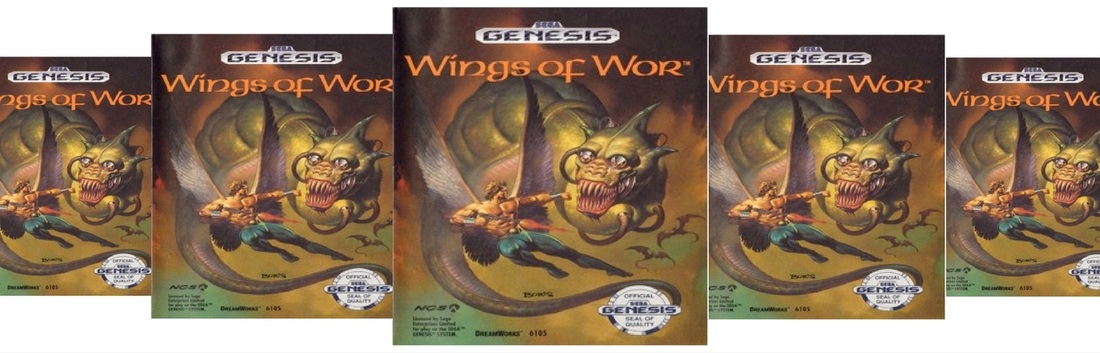 Side-scrolling shooters were ten a penny during the days of the 16-bit era; both the Sega Megadrive and Super Nintendo (the dominant systems of the era) were replete with such titles, most of them not terribly good; pale emulations of those that stood at the very height of the genre such as R-Type, Gradius et al. The bafflingly titled Gynoug (Wings of Wor in the U.S.A) distinguishes itself amongst the dross not by dint of its mechanics (which are hardly revolutionary) or game design (again, hardly different from any other random side-scrolling shooter you might pluck from the shelves), but in terms of its subject matter, aesthetics and atmosphere. Whereas most in its genre boasted some form of science fiction backdrop (space-ace dog-fighting with marauding alien invaders, for the most part), Gynoug is more mythological; the player character not a space ship, but a winged angel, the enemies not various forms of alien craft or swarms of semi-robotic machines, but demons, devils and spirits, all of which are derived from genuine occult and religious symbolism. This, more than anything, lends the game a layer of weight and disturbance that it might otherwise have lacked: from the tortured souls of the cathedral level to the flayed, Hellraiser-esque demons of the Hell-scapes that come later, each of the enemies is bizarrely distressing and often outright horrific; highly unusual for the genre and for games of the era in general.  As for the levels themselves, their sheer variety and invention is startling: from the rumbling caverns in which the game begins to under-water explorations, from Satanic cathedrals to great, warped and distorted factories of Hellish industry, the levels are superbly designed, various in tone and flavour, each disturbing in their own, unique ways. Easily the stand out in this regard is the game's final realm; the bowels of some immense demon, walls of flesh and flayed muscle, systems of veins trailing across the foreground, enemies resembling hideous parasites: human faced worms, skinless souls, clutching at the player from the fleshy depths...the atmosphere is palpable, enhancing the overall feeling and weight of the game, and making it a cut above the more usual parade of tired and derivative space-shooters. In terms of gameplay, anyone who has ever played any flavour of side-scrolling shooter will know the mechanics instantly. In more recent parlance, the game is an example of “Bullet Hell” titles, in which the screen fills so fast and furiously with enemy fire, swarms of monsters and traps and missiles, it becomes an exercise in survival. To aid him in his quest, the angel can pick up various scrolls that appear on screen and combine them into spells whose effects vary from making him temporarily invincible to enhancing his fire power with enemy-seeking fire balls, blasts of lightning etc.  The game is also fiendishly difficult, particularly in its latter stages, requiring the player to familiarise themselves with the environments, the patterns of enemies and projectiles, if they are to stand a ghost of a chance of survival. This can actually be rather difficult when the environments are so compelling and distracting, especially since many of them are also animated (the later flesh-stage, for example, is constantly rippling and distorting, making it difficult to discern enemies and bullets from background details). But the very, very best element of the entire work is undoubtedly the bosses. In terms of presentation, they are fantastic: an ominous chord sounds, the music slows, the background flickers and grows dark...then, immense grotesqueries emerge on-screen, from the first level's fusion of demon and locomotive to the eviscerated, mutilated Orpus, guardian of the fourth industrial level, every boss is luridly graphic in its design, strangely threatening and fantastically atmospheric.  The stand out example, once again, occurs at the end of the final level; a Giger-esque monstrosity that resembles an immense, phallic worm, pock-marked with disease, swellings, tumours...its torso that of a hunched and sickly man, its eyes swollen shut with what look to be seeping cancers...a truly vile creation, redolent of designs that might be found in Silent Hill's bestiary. Whilst extremely simplistic and repetitive by present day standards, the game certainly stands out in its genre. Given the overtly occult and religious symbolism in the game, not to mention its gore and horror stylings, it's a wonder that the game was released at all into the market of the late 1980s/early '90s, and that it didn't court an enormous amount of controversy.  As it stands, the game went mostly unnoticed and unremarked upon, even in terms of its unusual design and subject. It has recently garnered something of a minor cult status as a game that people vaguely remember playing at friends of friend's houses, but not knowing the name of; only that its imagery freaked them out as children, and perhaps inspired one or two nightmares in more sensitive souls.  Comments are closed.
|

George Lea is an entity that seems to simultaneously exist and not exist at various points and states in time and reality, mostly where there are vast quantities of cake to be had. He has a lot of books. And a cat named Rufus. What she makes of all this is anyone's guess. CAMP SUNSHINE
|
 RSS Feed


|

|