• HOME
  • CONTACT / FEATURE
  • FEATURES
  • FICTION REVIEWS
  • FILM REVIEWS
  • INTERVIEWS
  • YOUNG BLOOD
  • MY LIFE IN HORROR
  • FILM GUTTER
  • ARCHIVES
    • SPLASHES OF DARKNESS
    • THE MASTERS OF HORROR
    • THE DEVL'S MUSIC
    • HORROR BOOK REVIEWS
    • Challenge Kayleigh
    • ALICE IN SUMMERLAND
    • 13 FOR HALLOWEEN
    • FILMS THAT MATTER
    • BOOKS THAT MATTER
    • THE SCARLET GOSPELS
GINGER NUTS OF HORROR
  • HOME
  • CONTACT / FEATURE
  • FEATURES
  • FICTION REVIEWS
  • FILM REVIEWS
  • INTERVIEWS
  • YOUNG BLOOD
  • MY LIFE IN HORROR
  • FILM GUTTER
  • ARCHIVES
    • SPLASHES OF DARKNESS
    • THE MASTERS OF HORROR
    • THE DEVL'S MUSIC
    • HORROR BOOK REVIEWS
    • Challenge Kayleigh
    • ALICE IN SUMMERLAND
    • 13 FOR HALLOWEEN
    • FILMS THAT MATTER
    • BOOKS THAT MATTER
    • THE SCARLET GOSPELS
GINGER NUTS OF HORROR

BOOKS THAT MATTER - MARK ALL ON STOKER'S DRACULA

16/3/2015
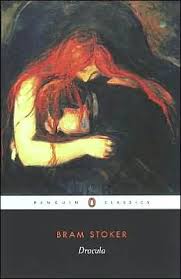
BRAM STOKER'S DRACULA BOOK COVER BRAM STOKER'S DRACULA
Bram Stoker’s Dracula is the book that made me. The classic film version with Bela Lugosi lured me toward arguably the greatest horror novel ever written and the blueprint for all that followed in the genre.

When I was ten years old, my mother allowed me to stay up late Friday nights to watch the eleven-thirty horror movie with the cheesy local television ghoul host. The black-and-white Universal horror classics from the thirties and science fiction movies from the fifties profoundly warped and influenced me. Struggling through a rough childhood, I found these movies cathartic because they externalized my internal terrors and ended with intrepid heroes defeating the monsters.

Science fiction movies like The Thing From Another World were also thrilling, but I was most drawn to supernatural horror. Many science fiction movies and shows like The Outer Limits conveyed a sense of otherworldliness with the music and sound effects, effectively rendering the pseudo-scientific creatures as supernatural beings.

But the Universal horror films drew the viewer into a gloomy, cobwebbed atmosphere of age and decay, evocative of the grave, that frightened more viscerally than a giant carrot or ant ever could. They conjured directly the essence of horror, the fear of the unknown, and as Stephen King has asserted, the fascination for and dread of the body under the sheet, and that body is us.

No movie did so more effectively than Dracula. The mere thought of the dead returning to life terrified the not-yet-jaded audience of the time. Dracula possessed the ability to take the form of a bat or mist and appear in the unsuspecting, vulnerable maiden’s bedroom by night. The deep disquiet produced by these aspects of the vampire foreshadows the effect on Lovecraft’s characters of encountering cosmic horrors, which drove men mad because the human mind cannot bear to comprehend them.

By the time I was fourteen I’d become a voracious reader. I could argue that Robinson Crusoe is the book that made me because it was the first piece of substantial literature I read and began my reading addiction. But a more personal and profound revelation came to me when I saw a new paperback edition of Dracula on the shelves at the drug store—the primary book-buying site in the southern United States in the early sixties. I realized that horror was not only the stuff of dated, campy movies most people disdained, but had been serious literature for ages. I discovered a new and potentially infinite universe of horror.

More significantly, despite lacking the visual impact of film, horror fiction possessed far more depth and breadth than film ever could. Anything could happen in a novel, unlimited by production budget or the technical limitations of special effects. However awe-inspiring I found the transformation of Lawrence Talbot into the Wolfman, a book could create in my mind a realistic and personal experience that transcended a visual medium. And the additional length of a book allowed for more events than could be crammed into five films, in detail that illuminated the very minds of the characters and the depths of Hell.

Dracula provided the template and exemplary model for all horror to come, in tone, concept, tropes, imagery, and structure. The book was a veritable Wikipedia entry of arcane vampire lore, setting the rules of the Undead. It provided me the insider’s air of superiority and exclusivity because I was among the few who knew that so many movies were “factually” incorrect! Sunlight could not kill Dracula! They did not realize that the vampire could not cross running water. And films omitted so many astonishing abilities of the vampire, to command the weather, to transform not only into a bat, but a wolf or mist, to travel on moonbeams. And not only would a wooden stake through the heart destroy the Undead, but a knife could as well.

Stoker’s novel was also epic in scale, and I was stunned to realize that the classic film ended halfway through the book! I couldn’t understand how the filmmakers could omit the heart-pounding pursuit of Dracula back to his Carpathian castle and the final dramatic showdown in the snow as they fought the gypsies to kill the vampire before the sun set, when he would reach his full power. I didn’t realize until later that the Bela Lugosi film was based on a stage play, but I did suppose that a horror film in the thirties would not have been allotted the length and special effects of a movie like The Ten Commandments.

The book possessed an epistolary structure, nineteenth century writing style, and sheer length, weight, and scope that bestowed on it the status of serious literature.

Dracula is not only one of the best books I’ve ever read, a sheer joy for a monster movie aficionado, but revealed to me a new world of horror and adventure to explore, an intellectual and emotional experience surpassing the beloved but dated Universal movies—with as much impact as the land of Oz appearing in color after a prelude of black-and-white.

BY MARK ALL 

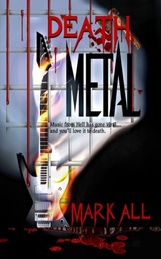
MARK ALL DEATH METAL DEATH METAL
Music from Hell has gone viral…and you’ll love it to death. 

After the car crash that destroyed his band, David Fairburn has given up on life—until his song-writing partner returns from the dead to complete their final album. David signs a record deal with Jessica, a beautiful label rep, but those who stand in the way of the album's release die one by one, and listeners become homicidal maniacs. When the concert to debut the album erupts in bloody violence, David and Jessica must prevent it from going viral and unleashing slaughter on a global scale.

Ian Jarvis link
20/3/2015 12:29:49

Hi Mark. That's a great piece about Dracula. I don't know if you ever visit the UK, but if you do, be sure to get yourself to Whitby. Little has changed there since Stoker's time and the little fishing town is pretty much as he described it through Mina's eyes up at the church. Lucy's bench is still there and you can retrace Mina's journey through the narrow streets to where she saw "something" bending over the seated Lucy there in the moonlight. You can also see the house on the Crescent where the two girls stayed and where Mina spotted the large bat on the window sill. It's just along from the house where Stoker used to stay and which bears a blue wall plaque commemorating this. A marvellous, atmospheric place. All the best with your writing.

Mark All link
31/5/2015 09:34:02

Thanks so much, Ian! I'd be ecstatic to visit those sites, I had no idea they existed. Sorry I didn't see your comment sooner!

Regards,
Mark


Comments are closed.
    Picture

    RSS Feed

https://l.facebook.com/l.php?u=https%3A%2F%2Fmybook.to%2Fdarkandlonelywater%3Ffbclid%3DIwAR1f9y1sr9kcIJyMhYqcFxqB6Cli4rZgfK51zja2Jaj6t62LFlKq-KzWKM8&h=AT0xU_MRoj0eOPAHuX5qasqYqb7vOj4TCfqarfJ7LCaFMS2AhU5E4FVfbtBAIg_dd5L96daFa00eim8KbVHfZe9KXoh-Y7wUeoWNYAEyzzSQ7gY32KxxcOkQdfU2xtPirmNbE33ocPAvPSJJcKcTrQ7j-hg
Picture