
 SCARY STORIES TO TELL IN THE DARK The Books That Matter : Scary Stories to Tell in the Dark In the back of my second-grade classroom, tucked in between books about dinosaurs and dragons, I found the little black book that would influence my writing twenty-five years later. It’s hard to describe how I felt about Scary Stories to Tell in the Dark. Alvin Schwartz’s book seemed benign while sitting on the shelf, but as soon as I picked it up, I knew that this book was different. Stephen Gammell’s illustrations set a tone darker than any I had seen in my short life. People talk about the freedom of learning to ride a bicycle. For me, learning to read by myself was a taste of intellectual freedom. My reading was solitary and private in a way that few things are for a child of that age. Scary Stories to Tell in the Dark was the first of my forbidden fruit. I truly believed that if my parents knew what that little black book contained, they would never approve. I grew up in a rural, protestant town. Anything that seemed to have a touch of evil terrified me. I remember having an Ozzy Osbourne CD years later that part of me believed would be my ticket to Hell. I read Scary Stories to Tell in the Dark in quick gulps, hidden from the authority figures that I was sure had made some mistake. They couldn’t have known it was there, I thought. They wouldn’t allow unassuming, good kids like me to come in to contact with such things. I will always remember the first story of the book, “The Big Toe.” A little boy, whom I imagined to be my age, finds a toe in the garden, digs it up, and takes it home to his mother. She, of course, prepares it for dinner. Much to the boy’s dismay, the owner of the toe comes by to reclaim their mean. The illustration has stuck with me for my entire life. A hoe-wielding ghoul of a boy with razor sharp fingernails squats above a plump toe sticking out of the dirt like a cabbage. The illustrations are wonderful and horrifying, touching at some of the basest emotion. The horror genre predates writing, reaching back to the dawn of oral storytelling. Early humans, having developed verbal communication, sat around a fire and told stories that were not much different than these. The stories are simple and timeless. Schwartz says that he collected them from folklore, and retold them in the book. The amazing thing is that they still hold up. They still scare us, as if they connect to some scarred part of our collective unconscious that knew fear intimately. These same stories could just as easily scare my son, a quarter century later. The stories, songs, and poems in Scary Stories to Tell in the Dark are storytelling artifacts. The traditional love of a well-told horror tale inspired the very beginnings of the genre. It led to books like The Turn of the Screw, which starts with people telling ghost stories around the fire. It is the predecessor to The Heart of Darkness, which reminds us that “This also, has been one of the dark places of the Earth.” Some scientists believe that the creation of synapses within the brain at a young age dictate the way a person thinks for the rest of their life. Looking back at my experience with Scary Stories to Tell in the Dark, I can almost hear the cracking of synapses buzzing with dark electricity. I have no doubt that the little black book I found in the back of the classroom, with all of its tiny, disturbing tales, is the reason that I write horror. From that moment on, the horror genre felt like home. A good ghost story was as comforting as finding an old security blanket Stories of ghouls were as familiar as the Talking Bear, the stuffed animal that kept me company as a toddler. It was a part of me, entwined with my personal history. Its influence continues to guide me as an adult. Scary Stories to Tell in the Dark is an academic work of horror disguised as a children’s book. It contains numerous appendices full of notes and sources. It holds a complete bibliography of Schwartz’s research. When I decided to major in Literary Criticism in graduate school, I focused my research upon Gothic literature, particularly its social origins. I wrote my thesis on Bram Stoker’s Dracula. I became enamored with the scholarly research of the dark genres. I didn’t realize until after I had received my degree and set it up near my copy of Scary Stories to Tell in the Dark that my repeated cover to cover study of that book as a child was the gateway to an entire lifetime of horror storytelling and research. It’s the gateway drug of horror. I would almost bet that if you dissect the psyche of most horror writers of my age, you will find Alvin Schwartz sitting in the shadows with a grin on his face that only Stephen Gammell could create. You will find that book, even if they haven’t thought about it for years. I found the first two volumes at a used book store a few years ago and snatched them up. I hadn’t seen the book in decades, but I recognized it immediately from the other side of the aisle. Later, I received a hardbound copy of The Scary Stories Treasury as a Christmas present. It sits in a place of honor on a shelf with the rare, collector’s edition books that I hold dear. I finally understood the impact it had upon my life. A few years ago, I learned that the book was being reprinted without Stephen Gammell’s horrifying illustrations. Some publisher had decided that the art wasn’t suitable for children. I was horrified by the most powerful book of my childhood had been neutered for an entire generation. Then, I sat down to write this blog at my parents’ house on Easter weekend. As I wrote, my nephew and my niece both passed by. They noticed my worn paperback copy of Scary Stories to Tell in the Dark. “I used to read that all the time,” my niece said. My nephew added “I love that book” before running off to do whatever fifteen year-old’s do. I felt reassured. Maybe the magic of fear isn’t dead. Maybe we haven’t been destroyed by political correctness and over-protection. Maybe we are going to be okay after all. Author Biography: When he's not stepping on his son's Lego creations, Jack Campbell Jr. writes horror and dark literary fiction in Lawrence, KS. His writing has appeared in a variety of venues both online and in print. He possesses both a real Master's degree from Fort Hays State University and a fake Bachelor's degree from Miskatonic University. He is a member of the Horror Writer's Association and a lifetime member of the H. P. Lovecraft Historical Society. You can follow Jack and his writing at www.jackcampbelljr.com. His collection, All Manner of Dark Things: Collected Bits and Pieces is now available from Bottle Cap Publishing. 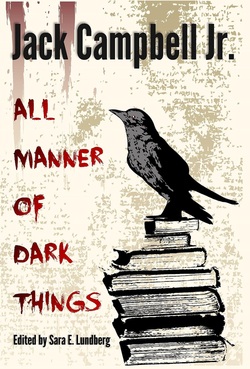 A small town hangs a murderer. An ancient civilization is threatened by a cannibal horde. A psychopath pursues his most insidious desires. In the first collection from Jack Campbell Jr., you will find tales of obsession, paranoia, lust, greed, vengeance, and insanity. You will find both the supernatural and the psychological. Inside, you will find all manner of dark things. "Just a great fable" - A. W. Gifford, editor of Bete Noir, on "The Flute of the Dead" "A brutal, very moving story" - N. K. Wagner, editor of Page and Spine, on "A Burial" "An unusual, beautiful love story" - Cindy Rosmus, editor of Yellow Mama, on "Mercury Beach" Click here for an interview with Jack
Comments are closed.
|

 RSS Feed

|

|