
SIMON KEARNS ON ROALD DAHL'S KISS KISS
3/12/2014
 ROALD DAHL'S KISS KISS ROALD DAHL'S KISS KISS I spent some time considering the book that made me the writer I am – so many to choose from, how could I narrow it down to one in particular? Should I choose a film instead, as film has been so hugely influential on my creative development? Then again, so has music. Perhaps I should go for an album? After a few days reflecting on these questions, I realised the answer to all of them was staring me in the face. The work that made the writer I am today is the book Kiss Kiss by Roald Dahl. As a reader, I grew up on Roald Dahl. I raced through all of his children’s books, relishing their dark humour and unsentimental straight-talking style. There can be no doubt that Dahl played a major role in developing my taste in reading matter. But not only in books, in all forms of art I lean toward the weird, the wonderful, and the honest. Dahl’s books for children are refreshingly honest about the world, deriving their dread from inhumane behaviour and very real dangers, in a similar way to the real-world horror we find underpinning Grimm’s fairy tales, (the original Grimm’s fairy tales, that is, not the neutered, safe versions that have proliferated in recent decades). I consider it a kind of avuncular cynicism. Having read all of Dahl’s children’s books, my reading veered off, by way of Narnia, into fantasy. Some years later, I’m not sure when, aged around thirteen or fourteen, I found an odd collection of stories with Dahl’s name on it. Looking through it, I very quickly realised that these were not stories for children, but for adults. The book was Kiss Kiss, and I gobbled it up. Here again was that uncle figure I had come to trust, only now he was introducing me to a whole new world of unpleasantries and horror: the world of grown-ups. In the children’s books, adults are generally the enemy of the young protagonist, and Dahl, taking the side of the child, criticises and ridicules the inconsistencies and cruelty of adult behaviour. They invariably reinforce a moral stance, one which, by the end of the story, has been properly established, resulting in the punishment of the wicked elders, and reward of the virtuous child. In Kiss Kiss, I found a world where Dahl had tossed out morality. People did bad things to one another, and, for the most part, they got away with it. In direct opposition to the stories for children, the adult stories did not end happily. Here we come to the twist in the tail. Dahl was a master of the surprise ending. Often within the last few lines, he was able to recast the entire story in an unexpected way, a darker, crueller sense that would linger in the mind. Perhaps this was the dynamic that fed him as a writer: children’s stories that have everything coming right at the end, and adult stories which have everything going wrong at the end. It is a fine illustration of the contrast between the hope of the child, and the wearied pessimism of adulthood. Early in my writing life I tried to emulate this trick. My stories worked toward surprise denouements, but it is a difficult thing to do well. Occasionally, I still attempt it and sometimes it works, sometimes it doesn’t. Most of the stories in Kiss Kiss (there are eleven in all) have remained fresh in my mind since that first read. In William and Mary, a dying husband agrees to let himself become the subject of a medical experiment that aims to keep his brain alive. It is an exploration of the philosophical idea that a brain in a vat, when subjected to convincing sensory inputs, would be incapable of knowing it is a brain in a vat. In Dahl’s story, however, the implication is that the unfortunate William, having become nothing more than a brain wired up to an eyeball, knows very well his circumstance; as does his vengeful wife, Mary, who takes the vat home with her. Royal Jelly plays on primal fears surrounding parents caring for an infant. Georgy Porgy explores sexual inhibition and ends in a wonderfully surreal predicament, with the clever and subtle suggestion that the protagonist has been sectioned. Vegetarianism and the repercussions of an isolated childhood are tackled in Pig, with a deliciously horrific final scene on the killing floor of an abattoir. These are among the most macabre works of Dahl’s long career. The brilliance of them, though, is that in each case, the horror is not explicitly spelt out. Dahl provides just enough to suggest where the story is going. By implying the horror, the reader is guided toward picturing the consequences in their own imagination, and, as any horror writer worth their salt knows, if a reader is allowed to imagine something scary or unpleasant, the result will be so much more effective than simply having it written down for them. The perfect illustration of Dahl’s ability to let the reader supply the horror is found in the shortest piece in the book, Genesis and Catastrophe: A True Story. We are at the bedside of a mother who has just given birth to a baby boy. She is fearful, her three previous children all died soon after childbirth. I remember reading the story and thinking, where will the malice come from, where, in this heart-breaking situation, will Dahl lay his rotten concept? Would he even wish to pollute such a tender moment? The story progresses, the doctor assures the mother that the newborn is healthy, he will survive — the mother hardly dares believe him. This is a scene of hope, of life triumphant. Ah, I thought, he has given us something positive to counteract the tone of the rest of the book. And yet, as one reads on and puts the clues together, realisation dawns. What was seemingly a heart-warming piece becomes a sickening slap in the face. With an impressive economy of words, Dahl pulls off his greatest twist, laying bare in the process an inescapable moral conundrum. Each of the stories in Kiss Kiss play havoc with the reader’s expectations. Even when you know you are being set up for a surprise, he still manages to wrong-foot you. The prose throughout is sober and straightforward, it does not draw attention to itself, but rather lulls you into a false sense of security, all the better to shock you at the end. From childhood, through adolescence, and beyond, the work of Roald Dahl has shaped my writing. And, above all others, it was his collection, Kiss Kiss, that had the greatest influence on me. If you haven’t read the book yourself, get a copy as soon as possible; you’re in for an unpleasant treat. 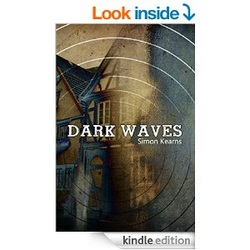 DARK WAVES DARK WAVES Simon Kearns grew up in the North of Ireland and now lives in the South of France. His debut novel, Virtual Assassin (Revenge Ink, 2010), explores personal responsibility in a corrupt society. Dark Waves, about a powerful haunting and the rationalist determined to debunk it, is out now. DARK WAVES There are those who believe that science can explain everything. John Stedman is such a man. As a sound engineer, he uses his expertise in subsonic resonance to debunk hauntings, and pursues the task with a missionary zeal. In the lead up to the launch of his book on the subject, he accepts a challenge from a journalist to investigate a particularly powerful haunting at The Dawlish Inn, a 15th Century tavern situated on the south coast of England. John is all set for a pleasant weekend in the country, good food, local ale, and interesting company. But beneath the cosy bar and gourmet restaurant, down in the ancient cellar of the inn, something is waiting for him, something his science can not easily explain, an encounter that will change his world forever. GINGER NUTS OF HORROR THE HEART AND SOUL OF HORROR WEBSITES5/12/2014 07:33:38
great article, that re,indeed me of how much I loved and admired Dahl as a kid. Comments are closed.
|


 RSS Feed

|

|