
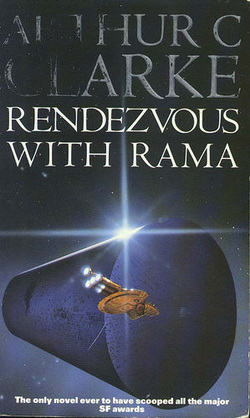
 In the year 2130, a very large object happens through the solar system. It is so large that at first astronomers take it for an asteroid, and even give a it name, Rama, as they would for any newly discovered astronomical body. Closer investigation of Rama reveals a startling fact. The object is a cylinder, 50 kilometers long and 20 kilometers in diameter. It is a made thing, not a natural object. Furthermore, the creatures who built it clearly had advanced technologically far beyond humankind. Wonders increase when the survey ship visits Rama. The survey crew easily passes through the air-locks—the doors are not locked—and find an inhabitable, self-contained world in the hollow interior. But there are no signs of the intelligent life that built Rama. The crew explores the vast interior for days, but Rama remains virtually the same enigma as when first discovered. Because Rama will pass dangerously close to the sun, the survey crew must abandon the vehicle. But before leaving, they prevent the Hermians (the human colonists on Mercury) from destroying Rama. The Hermians fear that Rama is preparing to take up a strategic orbit from which the Ramans—finally out of hiding—could control the solar system. But Rama behaves in no way expected by humans. After rounding the sun, from which it draws energy, Rama continues on its way out of the solar system, its destination and purpose unknown to man. In paying critical attention to Rendezvous with Rama, I should first note that it is an extraordinary example of hard SF in the Vernian tradition. The giant vehicle is neither fantasy nor literary prop. It is very real, from the triple air-locks outside to the cylindrical sea inside. Further, its structure and movements are, until the last chapters, consistent with known scientific principles. Very late in the novel, Rama shows propulsion capabilities that defy Newtonian physics ("There goes Newton’s Third Law," one character says in disbelief). Until then, though, Rama is big, but not bigger than the potential of human understanding. At another level, the Wellsian one, Rama is about the human reaction to an alien encounter. With considerable skill, Clarke develops in the narrative the two most elemental responses to aliens: first, that they could only want to conquer us, or, second, they will come to save us from ourselves. The first attitude we see in the Hermians, who consider Rama a threat. The second attitude we see in Boris Rodrigo, who, as a member of the Fifth Church of Christ, Cosmonaut, sees Rama as a giant ark, come to save the faithful. As we have seen, though, Rama is neither (or reveals itself as neither). It has no apparent concern for earth, and has traveled this way entirely for its own purposes. Humans must face the possibility that they are too insignificant to be noticed, and play a very minor role in the universe. But Rama may after all be carrying a kind of message. One of the most intriguing features of the storyline is that Rama is so unprotected from would-be vandals and predators. Do the Ramans assume that any species technologically advanced enough to reach the ship in outer space would also be respectful enough to leave it unharmed? This interpretation would link technological advancement with cultural maturity—even moral progress. Such a theme is consistent with the tempered scientific optimism that we see in Clarke’s work throughout his career. Commander Norton, who leads the survey team, sees his role in Rama as that of a privileged caretaker. He is determined to leave the vessel in good order, and finally allows his crew to cut into one of the interior structures only after it is obvious that there is no other way to enter it. Identifying deeply with the technological triumph that Rama represents, Norton sees a future in which humankind will someday enjoy the same achievements. His experience aboard Rama leads him to conclude that "There was mystery here—yes; but it might not be beyond human understanding." Or, perhaps the universe is not stranger than we can know, and the universal language of intelligent life is science and technology. Rama itself—the very fact of its existence—speaks to humankind in the universal language of science  A video game enthusiast loses his mind over a gruesomeless glitch. A revolutionary writes to her son during the 2nd American Revolution. A bleeding heart environmentalist fights for the Earth. An FBI agent investigates a mysterious electromagnetic pulse. An augmented reality expert acquires a precious artifact. What do they all have in common? They're deranged serial killers.
This book is a collection of five horror stories, each one weird, gruesome and ironic in its own way. The first story, "Tonight at 10!", is about an actress auditioning for a role in a TV show that could be the future of horror/news entertainment. The second story is "Chopper," a near-future look at a 'hacktivist' assassin writing to her son after her final kill of the 2nd American Revolution. "Carbon Offset," a novella, presents a door-to-door environmental activist who turns to the dark side. The fourth story, "The Brazen Bull," takes us inside the minds of an FBI agent investigating a mysterious electromagnetic pulse and a schizophrenic cannibal who has one final secret. The fifth and final story, "The Birthmark Plug-in," presents a techno-dystopia in which a deranged killer has a variety of apps and tools at his disposal. The title comes from a Charles Manson drawing that illustrates how to make spiders in five steps. PURCHASE THE BOOK HERE 2/5/2014 02:58:03
Have you read the book? What did you think of it? Leave a comment below. Comments are closed.
|

 RSS Feed

|

|