
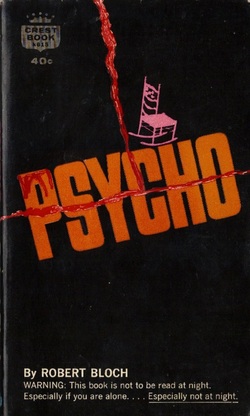
 ROBERT BLOCH’S PSYCHO ROBERT BLOCH’S PSYCHO It was publisher Dez Skinn, who first introduced me to Robert Bloch. Following the success of Warrior, the seminal British comic that unleashed Alan Moore, Garry Leach, Dave Gibbons and David Lloyd on the world, Dez decided to bring his classic horror mag House of Hammer back from the grave. Now renamed Halls of Horror the first revamped issue featured an in depth interview with Mr Bloch. I was a huge fan of Warrior so I snapped up Halls of Horror the minute I saw it in the newsagent. Bloch’s much anticipated sequel to Psycho had just been released and in the interview he spoke about his reasons for picking up the story after twenty years and dwelt at length on his long career in both Hollywood and the pulps. I remember being quite struck by his macabre imagination and his dry urbane wit. "Despite my ghoulish reputation, I really have the heart of a small boy. I keep it in a jar on my desk," Bloch quipped at the beginning of the interview. As a precocious eleven year old I had already exhausted the children’s section of my local library and was half way through the science fiction section when, a few days after reading the interview, I saw a copy of Psycho on the shelves. I checked the book out, took it home and read it one sitting. Nothing in my life has ever been the same since. The first thing that struck me about the novel was how amazingly readable Bloch’s style was. The prose grabbed you from the first sentence and kept you reading without any effort whatsoever, that’s why I didn’t look up from the page until I’d finished the book some hours later. The pace was also relentless but not at the expense of the characterisation, which was spot on. All the characters engaged me fully, even though they lived in a country and a time that were quite far removed from my own. What really floored me though, was the psychological impact of the story, especially the incredible shock ending. I was lucky enough to have read the book without having seen the film, so I had no idea what was coming. It was the first time I had ever gotten to the end of a novel only to discover that everything I thought I’d been reading up to that moment had been wrong. The effect, I must confess, has never left me. Up to this point, the only horror I’d read had been ghost stories of the M R James variety or the odd horror comic I’d been able to get my hands on. Psycho was the first psychological horror I ever read and it was also one of the first modern psychological horror stories ever written. As the 50s wore on, Bloch has been quoted as saying he was aware that in the light of the atrocities of the Second World War and the subsequent Korean War, people weren’t scared by the same things anymore. The old supernatural and gothic horrors that had so frightened him as a child, when he snuck into a showing of Lon Chaney’s silent classic Phantom of the Opera, just didn’t cut it with an audience that had seen the real horrors of war. Bloch realised: “that the real horror is not in the shadows, but in that twisted little world inside our own skulls.” Bloch even points to this transition from the supernatural to the psychological in the novel itself. (Spoiler Alert) Norman Bates believes in occult practices and discusses them with several characters, especially the secret formulas needed to bring corpses back from the dead. When we learn of the death of his mother Bloch steers us into the thinking that Norman must have reanimated her in some way. This would have been the traditional gothic explanation for the murders. This red herring makes the impact of the ending that much more horrific when we learn the truth of how Norman has really brought his mother back to life. In the last two chapters we see Bloch truly breaking new ground in the annals of horror steering us from one type of chilling fiction to a whole new world of fear. One that would prove to be more influential than most other works written in the field. After that I was hooked on Bloch’s work and hunted down everything I could find by him. Not an easy task for a young boy from a small shipyard town in the north west of England, in the days before the internet. Especially as more than half of Bloch’s back catalogue was out of print in Britain. I used to haunt second hand bookshops and jumble sales in search of anything that had Bloch’s name on it. I bought countless horror anthologies because they contained a single short story by Bloch. Many of these tattered and dog eared paperbacks sit on my shelves to this day. Hunting down Bloch stories provided my education in the history of horror, as many of these anthologies also contained stories by other masters as diverse as Seabury Quinn, Manly Wade Wellman, Ray Bradbury and Fritz Leiber. It’s also the reason I didn’t get around to reading many contemporary authors such as James Herbert, Richard Laymon, Shaun Hutson and others until much, much later. Bloch was an exceptional stylist who wrote brilliant, pared-down prose that never seemed affected or overworked. His characters are always well drawn and highly believable, yet their portrayal is never heavy handed. The themes and concepts behind his stories are endlessly inventive and riven with a dark imagination. He is also a master of the O Henry style surprise ending, catching the reader unawares again and again. More than anything though, what I love about Bloch is his mordant wit and the jet black humour that shines through in practically every line he wrote. All of these qualities had a huge impact on my work as a writer and their influence can be seen in just about everything I’ve written for the horror field. This is why I am very saddened that Bloch is not accorded the respect or the acclaim that he deserves. In the sixties members of science fiction and horror fandom used to say: “we should pickle Bloch for posterity”. These days when Bloch is mentioned he is often referred to as either a lesser writer from Lovecraft’s circle, who isn’t as important as either August Derleth or Clark Ashton Smith, or as a former pulp writer who made good in Hollywood but who isn’t anywhere near as good as his contemporaries Richard Matheson and Charles Beaumont. While I am a huge fan of Beaumont, Matheson and Clark Ashton Smith, I think that Bloch can hold his own in every way against these writers. His early Lovecraftian fiction added more elements to the mythos than any other writer in the field. It was Bloch who invented, for example, the oft-cited Mythos texts De Vermis Mysteriis and Cultes des Goules. Bloch is also the only real life person to appear in one of Lovecraft’s tales, as the fictional persona Robert Blake in The Haunter of the Dark, a story that is dedicated to him. So it’s arguable that Bloch is perhaps the most important writer of Lovecraft’s circle. Comparing Bloch unfavourably to Matheson or Beaumont, is also unfair and inaccurate. For every great episode of The Twilight Zone by Beaumont or Matheson that you could point to, such as Nightmare at 20,000 Feet, I can point to an equally great episode of Boris Karloff’s Thriller written by Bloch, such as The Cheaters. In fact Thriller in general was a lot scarier than Twilight Zone and Bloch’s many contributions to the series are considered to be some of the most frightening television ever shot. For every brilliant B-movie by Matheson that you could cite, such as The Incredible Shrinking Man, I could cite another penned by Bloch such the Amicus classic Asylum. Between them both Bloch and Matheson created the modern horror field. Although Matheson’s I am Legend is a vampire story, its influence can be seen on every post-apocalyptic zombie yarn from Night of the Living Dead onwards. However, the influence of Psycho, not to mention his other psychological horror novels such as The Scarf and American Gothic, can be seen on every slasher flick and twisted bit of torture porn from Texas Chainsaw Massacre and Halloween through to Saw and Hostel. Bloch’s impact on the horror field was immense and simply can’t be overstated. The reputation of the novel has also suffered a little in comparison to the film. In most fictional and non-fictional accounts of Hitchcock’s life and films, Bloch’s novel is seen as the tawdry little pulp novel that Hitchcock rescued and turned into a cinematic masterpiece. While Psycho is undoubtedly a seminal film, that more than deserves its huge reputation, the excellent script by Joseph Stefano (who would go on to create The Outer Limits) follows the novel pretty much scene by scene. At a time when Hollywood was routinely butchering, or often outright ignoring, its source material, Psycho proved to be an incredibly faithful adaptation. With the exception of the beautiful cinematography and the stunning performances, just about everything that people praise about the film comes directly from the book. A couple of nights ago I watched the film with my eldest daughter Freya. She had just finished the novel. I take great delight in buying her books that her English teachers consider entirely inappropriate and I’d given her Psycho for her last birthday. She too read it knowing nothing of the film. As the end credits rolled she asked: “were people more easily scared in the 1960s?” “Not especially,” I replied. “Why do you ask?” “Well, it was a good movie and everything, but it wasn’t anywhere near as scary as the book. The book terrified me, the film didn’t. The book is much better.” That is perhaps the biggest testament to the power of Psycho that I can think of. For all his undeniable brilliance as a director, the film that Hitchcock shot all those years ago has lost its power to shock new generations of viewers. More than half a century later however, the book is every bit as terrifying as when it was first written. That is why I believe it’s one of the greatest horror novels ever written. 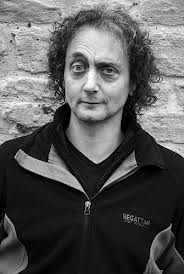 JASPER BARK JASPER BARK Jasper Bark finds writing author biographies and talking about himself in the third person faintly embarrassing. Telling you that he's an award winning author of four cult novels including the highly acclaimed 'Way of the Barefoot Zombie', just sounds like boasting. Then he has to mention that he's written 12 children's books and hundreds of comics and graphic novels and he wants to just curl up. He cringes when he has to reveal that his work has been translated into nine different languages and is used in schools throughout the UK to help improve literacy, or that he was awarded the This Is Horror Award for his recent anthology 'Dead Air'. Maybe he's too British, or maybe he just needs a good enema, but he's glad this bio is now over. 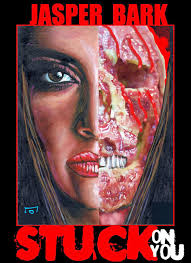 JASPER BARK STUCK ON YOU JASPER BARK STUCK ON YOU Warning! Do not buy this book, gentle reader. No really, we mean it. Move along, click away from this page and go look at some Dino porn instead. We’re not kidding. The only reason we published it is because award winning author Jasper Bark has got some serious dirt on us. Honestly, there’s no other reason to put out something this depraved. This is the sickest, filthiest and most horny novella you’re likely to read this year. It will turn you on even as it turns your stomach. Think you’ve seen everything there is to see in horror and erotica? Think again! Just when you think this story can’t get any lower it finds new depths to plumb. Why are you still reading this?! Oh God you’re going to buy it aren’t you? You can’t help yourself. You’re going to click on that purchase button and download this little bad boy. Well don’t say we didn’t warn you... PURCHASE A COPY HERE PURCHASE JASPER'S BOOKS28/4/2014 23:53:56
Excellent stuff! My God it was difficult to find books by writers like him in the 1980s wasn't it? The number of hours I must have spent in dusty old bookshops. And if you tell the youth of today that they won't believe you ;-) 29/4/2014 07:55:08
Thank you so much John.It was difficult to track stuff like that down if you grew up in a big city. If you lived in tiny out of the way towns like us it was even harder. In the days before Goodreads and other on line resources it was extremely tough to get a definitive list of publications of any one author or to know what to read and what to avoid.
Jasper Bark
29/4/2014 11:52:22
Thank you so much John.It was difficult to track stuff like that down if you grew up in a big city. If you lived in tiny out of the way towns like us it was even harder. In the days before Goodreads and other on line resources it was extremely tough to get a definitive list of publications of any one author or to know what to read and what to avoid.
Gary Stewart
29/4/2014 12:06:44
Brilliant entry Jasper
JIM MCLEOD
29/4/2014 14:46:44
And now the comments are all back. Jasper have you been playing with voodoo again 29/4/2014 17:23:28
No, my Ken doll has just been very naughty, that's all. There's no other reason that he's got a big ginger beard and lots of pins in him. Really, there's not.
Steve
29/4/2014 23:06:38
Great article Jasper, I'll have to go and get a copy of Stuck On You 1/5/2014 04:12:33
Thanks very much Steve, really appreciate the comment and the support, hope you enjoy Stuck On You. Drop me a line when you've read it and let me know what you think. 30/4/2014 05:02:33
Thanks for all the comments everyone. It's always a pleasure to have Jasper over.
Jasper Bark
1/5/2014 04:17:39
Always a pleasure to be here Jim, thanks again for having me. Comments are closed.
|

 RSS Feed

|

|