
 The Thing on the Doorstep The Thing on the Doorstep 'It’s hard to think of a single work by any author which really inspired me when I was still trying to pick my way through writing. I was always an avid reader and a moviegoer. I started out reading horror when I was relatively young, and I remember trying to read The Stand when I was around thirteen. Couldn’t finish it, plus it was my dad’s book and needless to say, he wouldn’t have approved of me reading that at such a young age. Which is not to say my parents are conservative, they just believe in such things as age limits. I suppose the one work which had the biggest impact on me in my formative period was .... The Thing On The Doorstep And Other Weird Tales I was in a bookshop, my local Waterstones as it happens, and it just kind of stood out from the shelf. I was actually in the fantasy and sf section, but they were opposite each other, so when I saw it on the horror side of the aisle, I pulled it down and started to leaf through it. 2001, I was still in secondary school and much more interested in fantasy and science fiction. I’d just read my way through The Silmarillion and I was about to start on The Hobbit. The year before, my dad gave me the first two books in Anne McCaffrey’s Pern series, but I bought this book. It was easily the first sizeable piece of horror fiction I’d read in a long time, not counting Shirley Jackson’s The Lottery we’d read in English class the year before. Perhaps that planted the seed of my renewed interest in horror? Maybe I wanted a break from epic fantasy and heading off to far off worlds, and to explore the darker corners of this one? Up until that point I’d never read any Lovecraft. I knew who he was, and while I think I’d always meant to read some of his stories, I’d never had the chance for one reason or another. There was always something else I wanted to open. Now I had twelve of them and I started into the collection on the bus ride home. I’ll be honest, I found Lovecraft a difficult read. I wasn’t familiar with his style at all, but as I read, I found myself being slowly drawn into each of the short stories. It’s sometimes hard to like Lovecraft, he gave birth to a mythos and creatures which tend to rob protagonists of their sanity and defy Euclidean geometry, but not all of his stories are so good. That being said, only an idiot would deny his influence on modern horror and weird fiction. From the twelve stories and short novels in the collection, five stayed with me for a while after I finished reading. They filled the last half of the book, beginning with Pickman’s Model. I was ready to put the collection down, thinking it was waste of money to buy it. When I finished Pickman’s Model, I realized I was wrong. I kept going. The Case of Charles Dexter Ward, with its undead wizards seeking to return to life through blood relatives seemed to me to combine elements of fantasy and horror both. I’d go as far to say it’s more dark fantasy than weird or horror, though its then modern setting probably places it more firmly in the weird category, and yet the story itself is horrific in its own way. That’s one thing about Lovecraft I started to learn, his stories seem to flit between genres without effort. The Dunwich Horror stands out for one reason and one reason alone. I could be enigmatic and tell you to go and read it, but I’ll have to just tell you it’s one of the few stories Lovecraft wrote where the insanity causing evil is banished. How? Go and read it to find out. When I was very young, my grandparents bought me Treasure Island by Robert Louis Stevenson. Adventures in far away places, pirates, buried treasure and hidden places in the world enthralled me as a boy. Why am I talking about this? When I was in university I wrote an essay examining the differing interpretations of the idea of journey in fiction. I compared Stevenson’s idea of redemptive, heroic journey, to Lovecraft’s At the Mountains of Madness. I did pretty well, getting fifteen out of twenty and my tutor said I was brave to do it. I was happy with the attempt. Mountains is often the one people think about when they talk about Lovecraft, who lived during the age of Arctic and Antarctic explorations. They were the last truly unexplored places left on Earth and it remains one of my favorites among his canon of work. It combined epic adventure, with a slowly mounting horror at the remains of the civilization discovered by our heroes, and made me think not every journey could have a good outcome. Sometimes you might not come back, and if you do make it back, you might wish you hadn’t. The collection ended with The Thing on the Doorstep, from which the collection took its name. I feel the less said about soul transfers and horrors inhabiting and using the body, the better. How did these stories influence me? The truth is they didn’t, not for a long time. I put the book away, bought a couple of other collections and enjoyed each in much the same way as I did the first, but I never wrote horror for years. It took me writing that essay I mentioned before I started thinking seriously about horror again. At about the same time, a group of university friends, also writers for the most part, started a magazine. The Open Mind was a short lived thing, though I think about reviving it sometimes. It was free, though the editing and quality were pretty good for a bunch of students. It always sold well in the campus cafes and a lot of our lecturers seemed to like it. The Master of Glen Deveron was my first published horror story. Friends or not, they had complete editorial control and if they didn’t like it, they weren’t going to cut me any slack. As it happened, they did like it. A story set in Stevenson’s Scotland, about a banquet at a manor house at the mouth of the Deveron valley. Loosely based on an unfinished country manor near my hometown in north east Scotland, let us just say the host is not all he appears and the banquet does not feature entertainment suitable for worthy ladies. Again, the horror nerve in my brain went quiet, but I kept turning ideas over and over in my head. There would be other stories. Some inspired by Lovecraft and others inspired by the likes of M.R. James and Algernon Blackwood, but Lovecraft was the first. I never got through a Stephen King novel until I was well into my twenties, and I saw Lovecraft written all the way through him. The contemporary settings, ancient and unspeakable evil beyond the understanding of men and the possibility of death or insanity for the characters, it felt familiar and comfortable. Lovecraft started it for me, and while the majority of my work tends to flow more in the direction of fantasy, I like to dabble in horror where I can. So far, I haven’t met any slumbering Gods and my sanity remains intact. Must try harder.' ABOUT R.L. ROBINSON Born in Scotland, R.L. Robinson grew up with stories. Stories about the distant past and the mythology of his home. He sold his first short story while at university and has kept himself busy with teaching and writing ever since. He currently live in the north east of Scotland with his Labrador, Maggie, who often provides the best muse when it comes to his work. 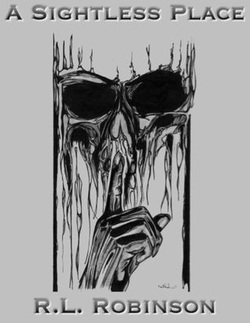 A SIGHTLESS PLACE A SIGHTLESS PLACE In the midst of a brutal war, three brigands turned sell swords leave a village smouldering behind them and cross a countryside being laid waste. A detour through a nearby forest offers the fastest way back to their army and the prospect of greater plunder. They're on the winning side and have little to fear from those they have wronged. That every tree has a face carved on it means little to these men, but nothing here is as it seems. Purchase a copy here Ginger Nuts of Horror The Heart and Soul of Horror ReviewsComments are closed.
|

 RSS Feed

|

|