
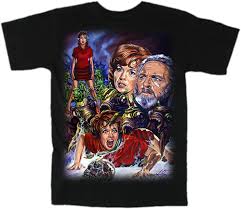
 CLICK ON IMAGE TO BUY THE TSHIRT CLICK ON IMAGE TO BUY THE TSHIRT I first saw this gem when I was a kid and have held a copy of it close to my heart ever since. Whether it was in VHS format, or Blueray the only thing that’s changed over the years is the quality of the pictures. It was written by Nigel Kneale, released by Hammer in 1967 and was the third film in the dotty professor versus the unbending ignorance of the establishment trilogy, that was originally a BBC screenplay, dating from 1958. It’s also the genre directorial debut of the acclaimed Ray Ward Baker. The film was released in America under the much less evocative title: Five Million Years to Earth. It goes like this. “One, two. One, two, three, four.” The workers, who are excavating the area of a new underground tube station around Hobbs Lane, discover the skeletal remains of ancient apes with big skulls and so they call in the Archeologists. These consist mainly of Dr. Roney, a suitably skinny intellectual with elbow patches played by James Donald and his erstwhile female assistant, the lovely Barbara Judd, played by Barbara Shelley suitably dressed in sweater and tweed skirt. 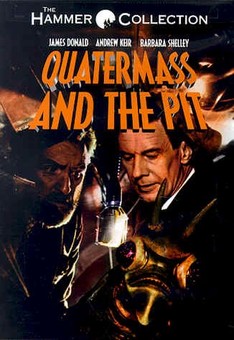 Quatermass & the Pit Further digging, reveals what appears to be an unexploded German missile, or flying bomb that was left over from the last war. The Ministry of Defence are alerted and bring in an expert on such matters, who is the self assured military man, Colonel Breen played by Julian Glover. Colonel Breen, is a brilliantly played cliche of a know it all expert, who refuses to entertain any opinions which contradict his own. Breen pompously decrees, that it’s a “Satan,” or something equally secret and menacing sounding missile. In this era, all the really scary and deadly things, had names to suit their lethal purposes. A “Death Ray,” killed people and comfortingly disguised munitions like “Cruise” Missiles, hadn’t been invented. In the late1950’s, the war had not been over too long and political correctness had not been invented. Professor Bernard Quatermass, a rocket scientist played by an earnest Andrew Kier in regulation scientist tweeds, becomes involved. He isn’t too happy with Breen’s diagnosis and argues that more investigation of the site will be needed, before any definitive answers can be gleaned. Breen, with typical arrogance, dismisses both these comments and Roney’s team and bullheadedly ploughs onward. Any thoughts about the dollops of anti German sentiment, displayed by the British Armed Forces at this point, are conveniently dismissed, along with the arrogance of British members of Parliament, portrayed by Edwin Richfield as the ubiquitous “minister.” “The German’s were full of tricks like that but thank god this one didn’t go off.” This is the point, where should you require it, that Colonel Breen is cast as the bad guy, the minister as ineffectual whilst Quatermass, is portrayed as the reasonable voice of scientific thought. “Reasonable, is not the term, I would have chosen.” Intrigued by a local police officer's mention that the area was notorious for strange disturbances, he escorts Quatermass and Barbara Judd around a deserted house in Hobbs Lane. This a wonderfully staged scene that builds suspense when the policeman starts to panic at the sight of some scratches on the wall. This episode, is one of the many priceless cliche’s, contained within this film. Quatermass ignores Breen and bombastically begins an investigation of his own assisted by Roney, Judd and his own Rocket Team. The eccentrically played Roney is seen as a sympathetic, though rather beaten down character, who is on the point of a great discovery, though he clearly doesn’t know it and needs Quatermass, to point this fact out to him. 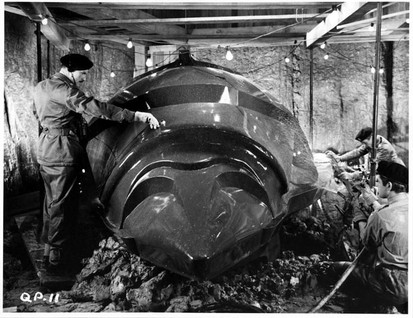 At this point, the viewer is being asked on which side of the fence they are sitting, should they bow to arrogant and ignorant authority or challenge it in the name of scientific truth. Conveniently, viewers are asked to ignore inconvenient story-lines from the previous two Quatermass movies. The first where an Astronaut came back to Earth, and transformed into a rather deadly Cactusy kind of omelette and the second where alien giant sludge eating blobs, are only defeated when Quatermass, fires his latest convenient Rocket Ship, at their point of origin. “Talk about sacrifice in the name of the greater good.” Anyway, back to the tale and the now fully exposed Bomb/Missile/Alien Craft. They notice an internal compartment which Breen assumes holds the explosive charge which he needs to disable. A Diamond drill bit has no effect but does cause severe resonance. 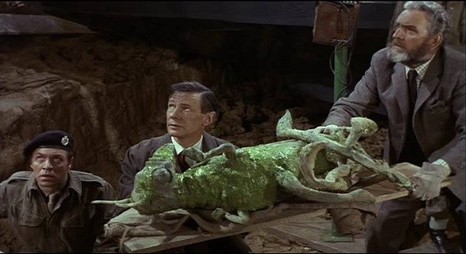 Enter the workman, Sladden, played jocularly by Duncan Lamont, with a Boron drill bit, which is claimed to be harder than diamond but looks remarkably similar, to a Black & Decker Hand Drill but no mind, things were much simpler in the ‘50’s. The drill resonates furiously but eventually the compartment fractures and falls away to reveal not explosives but creatures. On exposure to the impurities of this planet’s atmosphere, the newly liberated second species, which look like Locusts, are in dire need of preservation and begin to rapidly fall apart. Green gunk oozes from them, as they decay and the viewer is asked to be revolted by the potentially foul smelling alien slime. Incredibly and with no real evidence, Quatermass determines that they are Martians, who, in the distant past altered the brains of the Ape like creatures found close by. These are clearly supposed to be a primitive form of hominid and the implication is that Martians made us the intelligent beings we are today. Although, just how he comes to this stunning conclusion is never quite fully explained. “It came straight through the wall,” cries a plainly shocked soldier and states that his colleague is dead inside the craft. “It was horrible,” he adds before tragically collapsing and having his brow mopped. This is the first major allusion to the telepathic/telekinetic qualities and organic nature of the spacecraft. Later Sladden returns to collect his drill and Barbara to fetch a box of slides. You are then treated to the hilariously over theatrical Sladden falling under the effects of the spacecraft. 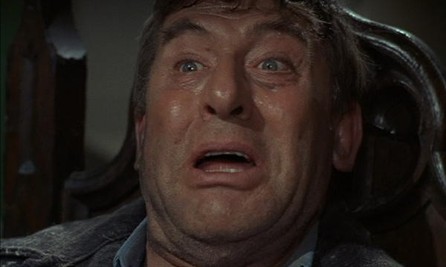 He is overcome by the powerful forces emanating from the craft and hilariously flees from the site of the dig. Barbara witnesses this, is slightly affected too and she follows Sladden out of the underground station. Sladden, eyes wide, waving his arms and stumbling like a 1960’s style drunkard staggers from view. The otherworldly telekinetic ‘force,’ follows him through the streets and shows it’s awesome power, by blowing paper around and wreaking havoc on a mobile Coffee and Burger. Eventually, Sadden again pulls himself together, as they did in those days and flees towards the sanctuary of a church. Later, at the church he tells Quatermass he saw a vision of hordes of the Locust like creatures, from the missile, “Killing,” he gasps. “Leaping, Jumping, Killing, killing,” he insists and then passes out. What had been designed as a portent of doom, in truth laughingly sounded more like it was delivered by Franky Howard. “Oh yes, misses. Ooooh and there you go then. Titter ye not, humpf.” Quatermass considers that this is ‘a race memory’ of the Martian ‘cleansing of the hives’ implanted when they altered our brains. The echoes of German concentration camps are not lost here...... the Locust-like Martians as the Master Race. Seeking proof, he returns to Hobbs End tube station, bringing with him a machine Roney has been working on which taps into the primeval psyche. At this point, it helps if you can suspend belief, as you will enjoy the rest of this classic a great deal more, if you do. “If you’re sitting comfortably, I’ll continue.” While trying to replicate the circumstances under which Sladden was affected, he notices that Barbara has fallen under its influence. Placing Roney's Mind Machine, which looks remarkably like the headpiece to an electric chair, on her head and hooking it up to a monitor, he is able to record her thoughts. For a few moments you are invited to “trip out” and observe the happenings on the planet Mars. He shows his evidence to the Government Minister, who even though it’s there in black and white, before his eyes, still thinks that Professor Q, is off his head. Meanwhile back at the dig. Colonel Breen, remember him, is still at the dig and gets caught out, by being far too close to the Martian ship, as it starts to come alive. The result of this oversight on his part, is that he gets horribly burnt and after smoking for a while, Colonel Breen dies a rather gruesome death. At this juncture, most of my friends either start laughing, or clapping. It seems that Colonel Breen, is not a very sympathetic character. 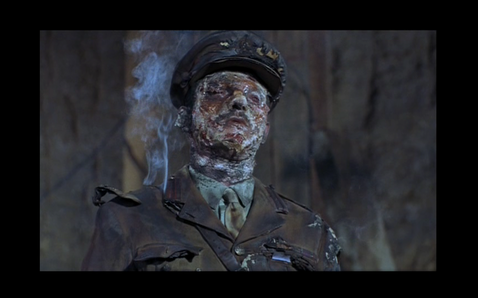 The Martian Spacecraft, now fully ‘charged’ begins to exert a malign influence on the population of London, mayhem breaks out on the streets as Martian memories and instincts buried deep within the human psyche erupt into a telepathic and telekinetic rage. The people begin to gather in groups and ‘cleanse’ the hive of those able to resist, or not ‘one of us.’ Quatermass, again escapes it’s trancelike grip on his sensibilities, this time with the aid of Roney, who appears to be immune due to a plate in his head who slaps him back to his senses. Another attempt to take over Quatermass’s mind is made by the alien force as the spectral image of an enormous Martian towers over the city, centred on Hobbs End as Barbara makes a final entrance and tries to disrupt Quatermass and Roney from rescuing the day. At this point in the movie, Quatermass has had his brain so scrambled, that he appears to be more interested in the wellbeing of Miss Judd, than the human race. He takes an age to finally realise the only way to stop her is to knock her out. At this point whilst watching this movie for the first time at my local cinema, I was dying to go to the toilet but sat riveted in my seat and even though I had entirely forgotten Barbara reappeared here, I was far was more interested in my bladder and the giant Martian devil, that was now seriously strutting it’s stuff. Upon recalling stories about how the Devil could be defeated with iron and water, Roney theorizes the alien energy could be discharged into the earth. So the idiot, whilst Quatermass attends to Barbara, climbs atop of a conveniently located enormous crane. By what seems to be willpower, though I think it maybe is supposed to be the effects of telekinetic ground disruption.....anyway it’s not very clear, swings the jib into the body of the spectre. The crane bursts into flames as it discharges the energy, killing both the Locustion Devil and the heroic Professor Roney. 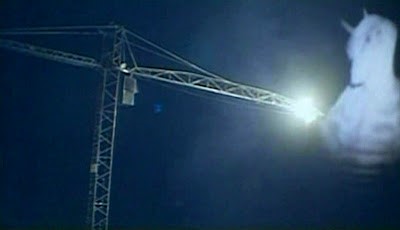 With this, the dystopian world disappears, Quatermass and Barbara Judd sit, dazed, in the rubble of the old houses at Hobbs End. I was fully expecting one, or both of them to light a cigarette in self congratulatory ecstasy. Everything was explained, except most of the film. A true classic of the genre. As the camera pulled back and the National Anthem started to play, I was outside the cinema, slowly making my way home deep in contemplation. Looking back, I realise that all the markers were there, set in place for anyone who cared to observe. This film decidedly influenced my writing. Even as a youth, hanging around just below the surface, was a propensity for “suspension of belief” of whatever distorted truth came along. This was an essential component in my later decision to write. Ever since I first watched this film, at the local cinema all those years ago, I have believed that at the end of any good story, you want your audience to be left with some mystery, some unanswered questions. The story should hold together but it should also stimulate and fire the imagination. I like the way the story builds, developing the intrigue and this is something I have used in my own writing, although I have linked this to character development, something sadly lacking in this movie. There are certain themes within this story that I find myself returning to time and again in my own works such as the conflict with established thought and oppressive nature of the establishment. Similarly, the conflict between scientific reality and the unknown is another theme I like to explore. In my novel “Powderfinger” I have also drawn on two ideas from Quatermass and the Pit that have always resonated with me. Namely, the idea of looking back through history for similar occurrences, building a timeline of events that deepen the scope and suspense of the story. Secondly the idea of things being released from or being alerted into action by the disturbance of the ground. It is the essential nature of the depths below, the unknown darkness that energises the creativity from which all number of monsters can spring forth. This story is one that has spawned many ideas that I have seen incorporated into many stories over the years, from the frying of Colonel Breen which bears a remarkable similarity to the frying of the guys at the opening of the Arc of the Covenant in Indiana Jones and the Lost Arc, to the organic ship in Farscape and other Sci Fi series. Altogether, this film, despite it’s simplicity, has been extremely influential to myself and many other writers, film and TV makers over the years. KELLER YEATS AND POWDERFINGER "Powderfinger" is a present day horror story set mainly on the decrepit and abandoned but soon to be redeveloped bank of an old canal between two towns, by an old tar works known as Raven's Gate. Nick Swann is a world weary mid-forties widower and Assistant Probation Warden at St .Joseph's Hostel for young male criminals, situated overlooking the canal and Raven's Gate. A woman is brutally killed on the bank opposite the Hostel on a night Nick is on duty and has granted many late passes for two 21st birthday celebrations amongst the hostel lads. The ensuing Police investigation involves the Hostel, though Nick believes his lads had nothing to do with it, consequently Nick is suspended for issuing too many late passes at once. Then another woman is killed and Nick becomes drawn into discovering the culprit. He works with DCI Findlay and DS Deacon as the murder toll increases. Together with help from his old friends Alan and Hugo, Nick's research uncovers a long series of similar murders in the same area stretching back through the centuries. "Powderfinger" as the killer is dubbed, appears to be some kind of ancient mellifluous, malevolent, murderous being that attacks anyone it considers to be disturbing its peace and quiet. Eventually, as the story climaxes, Findlay, Deacon, Nick and Alan set a trap to lure "Powderfinger" to his doom and rid the area of this beast once and for all but traps can swing both ways. Author Bio Keller Yeats has written several published articles about rock music and several unpublished short stories. He has several years’ experience working as a Probation Warden and he draws on this for his novel. In addition he is a published graphic artist and a qualified though no longer practicing jewellery maker and designer. He now lives together with his wife, a Siberian Husky, a Welsh Collie and three cats in a cottage by the sea in Anglesey. “Powderfinger” by Keller Yeats
Available at Amazon http://www.amazon.co.uk/Powderfinger-Keller-Yeats-ebook/dp/B00NU7FT9W/ref=sr_1_1?s=digital-text&ie=UTF8&qid=1412109156&sr=1-1&keywords=%22Powderfinger%22+Keller+Yeats Sites: Blog: http://kelleryeats.wordpress.com http://www.firsteditiondesignpublishing.com/ https://twitter.com/kelleryeats https://www.facebook.com/profile.php?id=100007470047967 http://www.shelfari.com/kelleryeats https://www.goodreads.com/author/show/9870154.Keller_Yeats http://www.booktalk.org/ http://www.librarything.com/profile/kelleryeats http://www.amazon.com/Keller-Yeats/e/B00QEFDAMU 25/2/2015 10:00:32
Hi Keller Comments are closed.
|

 RSS Feed

|

|