

 “And go outside if you want to dream. No dreaming in the house of mirrors.” One of the nicest things about reviewing books is that moment when you read something and immediately, from the beauty of the prose, the ambitiousness of the ideas and the control the author exerts, you know you are reading something special. From its opening sentence it’s clear that Honeybones (2020) is a bold work from a major new voice in speculative horror, that this is the work of an author with a unique vision, powerful aesthetics and a hunger to express them in new and startling ways. The novella doesn’t disappoint from there, never letting up its hold on the reader. Georgina Bruce has crafted something truly special here, a dark and twisted fairy tale refracted through sinister funhouse mirrors that continuously surprises and delights. The beauty of the writing and the assurance of Bruce’s skill as a writer carries the reader through a disturbing meditation on madness and abuse, resulting in a powerful and unforgettable experience. Anna Carrow is a young woman struggling with mental illness, school bullying, and the expectations of her estranged mother Sarah and stepfather Tom. A family tragedy brings her to the point of crisis, and Anna finds her life mutating into a dark and frightening fairy tale, in the thrall of the sinister cully king, a monstrous bird-like presence. Bruce tells the story out of chronological order, slowly revealing elements of nightmare and reality to the reader as the narrative twists round Anna’s central trauma. Recurring images of distorted mirrors, bodies twisted and changed into creepy laughing dolls, houses that shift and change, creepy nursery rhymes and greasy moulting birds swirl round and round, creating a disturbing and disorienting atmosphere as the reader, like Anna herself, is desperately trying to unpick illusion from reality. Running underneath it all is the threat of both schizophrenia and being institutionalised. This recalls the twisted perspectives used by Shirley Jackson in The Haunting Of Hill House (1959) and We Have Always Lived In The Castle (1962). Whilst we are being shown the world through a perspective that is teetering close to madness, Bruce is careful never to dehumanise Anna because of her mental illness. Honeybones can be read as a response to the traditional horror tropes of frightening asylums and monstered and othered sufferers of mental illness. Bruce subverts all this by making the issue of Anna’s perspective and her agency central to the story, and her character arc throughout the novella is the regaining of her self-belief and her agency from an antagonist who is intentionally trying to strip that away. Honeybones is also a powerful exploration of abuse and misogyny, and how these ideas present in both fairy tales and horror stories. Fairy tales play a large role in the DNA of Honeybones, particularly those like Bluebeard in which a female character must escape a seductive yet violent male figure, but also the traditional trope of the evil stepmother, here played with and inverted. Bruce asks, to what extent do these stories ask women to hate themselves and fear men? How can women reclaim these narratives? There is so much interesting work going on in this short novella about female embodiment and the idea of the monstrous feminine. Anna’s fraught relationship with her mother is tied into her feelings about Tom, and her anxieties about living up to ideals of feminine beauty. Sarah is a singer and an actress, her figure so thin as to almost be skeletal, contrasted with Anna’s larger physique. Anna is the victim of abuse, and she is teased and called a slut by her schoolmates. She is a young woman trying to navigate her own sexuality in a world that has told her that her sexuality is vile and dirty. It is very difficult to know where the figure of Tom ends and that of the cully king begins, one being a folklore extension of the other’s deep ingrained hatred of women, the predatory way he uses them and spits them out broken. Bruce expertly explores how Tom grooms Anna by exploiting the anxieties that a patriarchal society has placed on her from birth, singling her out as being not like other girls, isolating her from her one real friend, trying to turn her against her mother and the figure of his previous girlfriend Rose. However, for all its darkness and unflinching exploration of abuse and trauma, Honeybones is a book about regaining hope and agency. Anna gains the confidence to believe in herself and her own worldview, and to stand up to her abuser and tell him no, to reveal him in all his cowardly awfulness, that he is the monster and not she or the other women he has abused. Part of what gives this ambitious novella such a visceral, powerful impact is Bruce’s glorious command of prose. Bruce is one of those writers who has an enviable mastery of character voice and an intrinsic understanding of the innate poetry of language. I was reminded of the feeling I get when reading a master like Kathe Koja or Caitlin R. Kiernan, that here is someone whose command of the English language is unique and powerful. Bruce’s prose sings with a fractured fairy tale poetry, and her use of imagery both familiar and unusual is striking and surprising. There are images, sequences, turns of phrase from Honeybones that I know will haunt me for some time. Bruce has created a major work of dark fantasy horror fiction, and I cannot wait to see where this unique voice goes next. Review by Jonathan Thornton HONEYBONES (2020) BY GEORGINA BRUCE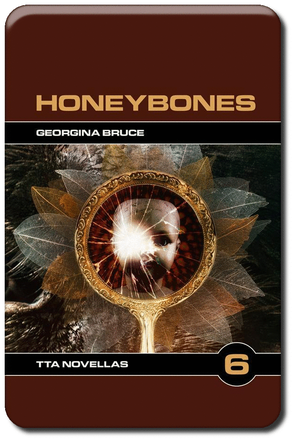 A troubled girl, a haunted book, a house of illusions and enchanted mirrors. Anna Carrow just wants to make things right between her and her mum, to please her stepdad, and keep out of the way of school bullies. But her efforts only seem to lead her further and further from reality, deeper and deeper into paranoia and delusion, until she finds herself tangled inside a twisted fairytale, face to face with the sinister cully king. Now Anna has to decide which version of reality to believe in. But how can you know who to trust, when your mind is playing tricks on you? "Georgina Bruce is casting some serious fairy magic here. Glittering and terrible, a bit sexy and totally dangerous" Gemma Webster, Fiction Unbound   Comments are closed.
|


|

|

|