
|

BY GEORGE DANIEL LEA"For my part, I had no idea, no idea, that immense, corporate outfits such as Marvel or DC were capable of producing work so deviant, so artistic; so far removed from their standard stock in trade." 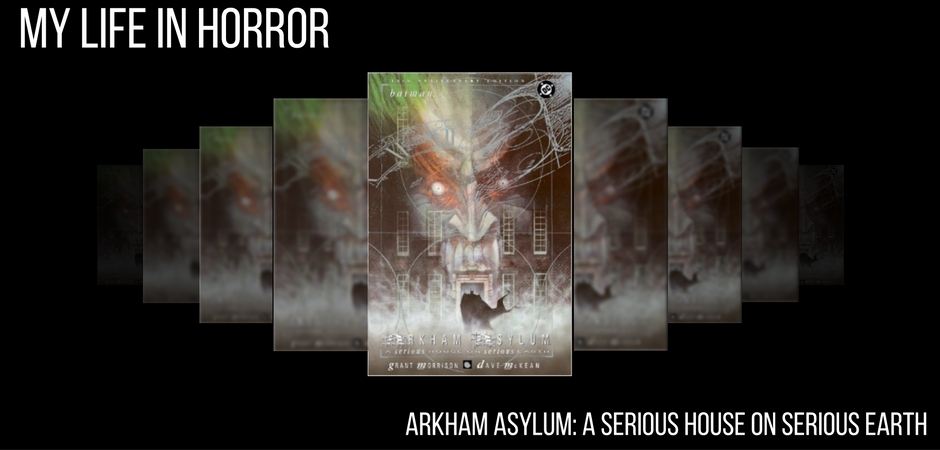 George Daniel Lea takes over Kit Power's My Life in Horror with a response to Kit's article last month on A Death in The Family. A Response: Arkham House: A serious House on a Serious Earth, is a fascinating overview on a powerful and important comic and its impact on George as a writer. My earliest experiences of comics consisted of the late 1980s/early 1990s annuals of 2000 AD that, back then, were standard stocking filler fare. A far cry from the super hero comics that dominated mainstream markets (in certain respects, outright parodying their conventions), 2000 AD consisted (and consists still) of a massive variety of on-going franchises (such as Judge Dread, Slaine, Rogue Trooper and ABC Warriors) as well as shorter-lived, experimental works that many writers of not only comic books, but also novels, TV series and even feature films cut their teeth on. Back then, I wasn't sophisticated enough to understand the nuances of those stories; their references to wider genre conventions (though I would become so, by and by): my appreciation of them was almost entirely aesthetic and highly visceral. I particularly recall a certain Rogue Trooper story, in which the eponymous clone-soldier encounters a distinctly Lovecraftian manor in which a demonic entity, summoned by arcane rites, has infested the flesh of not only one, but numerous hosts, warping and weaving it into something truly hideous; an amalgam of split, flayed, mutilated bodies operating as a single anatomy. The artwork of that story is indelibly etched into my memory; recalling, though I had no idea of it at the time, the manifold shapes taken by Jon Carpenter's Thing, as well as numerous entities from H.P. Lovecraft's bestiary, that it directly references. Being my first experiences of comic books, it was what I came to expect: the fantastic artwork, the distinctly adult tone, the almost lascivious glee with which the artists rendered scenes of horror, violence and mutilation (material that I had already developed a taste for, owing to my Mother's library of horror VHS cassettes). My experience of more standard, super hero comics was therefore somewhat distant; I knew of the likes of Spider Man and Batman (the latter intriguing me owing to the Tim Burton films that were making waves at the time), but was never particularly interested in them as reading material. That changed quite late on, when I began to discover that darker and more adult-toned material was available, even within these traditionally child-oriented franchises: I cut my teeth in my early adolescence on the likes of Spider Man's much (and not entirely fairly) lamented Clone Saga, which, despite ending terribly (essentially being used as an excuse to press the Big Reset Button, which is a convention I loathe in story telling in general), maintained some interesting and notably adult factors in its earliest chapters (an identity crisis for a now young adult Peter Parker, who discovers that he is not, in fact, the original Peter Parker, but a clone developed by one of Spider Man's lesser known enemies, the potential of a baby on the way that may have numerous problems, not only owing to Parker's irradiated blood, but also his synthetic nature etc), the X-Men's Age of Apocalypse; an alternate time-line in which the eponymous warlord has come to dominate the world and a number of other titles. Whilst initially attracted to the material within these series, I soon began to tire of the tropes and conventions that quickly became apparent: Spider Man, for all his apparent crises, will never actually flip his shit and kill someone. The X-Men's timeline, for all of its numerous alternate manifestations, will never be diverted to one of its more negative potentials permanently. My “falling out” with these franchises came with the ending of the aforementioned Clone Saga, in which, having gotten cold feet concerning how far they had genuinely advanced Spider Man's story and mythos, Marvel made a series of hasty (and, for the most part, entirely nonsensical) decisions to undo almost everything the Clone Saga had established and to hit the Big Reset Button that is part and parcel of these franchises. As an aside (and, as already mentioned), I loathe that convention. Absolutely loathe it; its conservative (pandering to those portions of the fan-base that don't want good and dynamic stories, but want everything to be as they demand it; comforting and conciliatory; the same, the same, the same, all the damn time), it is condescending and it makes whatever stories occur within these universes absolutely pointless. Nothing cane be done that cannot be undone. A character dies? No problem! Death means nothing here; just press The Big Reset Button (which can consist of any number of things, from pan-dimensional, near-god-like entities that have the power to alter reality on a whim, as Marvel fans generally lamented during the events of One Last Day, to engines or devices of insane power that can do more or less the same) and they'll be alive and kicking again before you can say “Batman's-Broken-Back.” I understand that in such franchises, where you have numerous writers all bringing their own visions and preconceptions to bear, and which there is such a wealth of contradictory material, such mechanisms are attractive (maybe even necessary) for wiping the slates clean, but I despise it for the weightlessness and insubstantial nature it necessarily entails: no story that can be “reset” so that its consequences or import mean fuck all can ever be said to genuinely qualify as such: stories are meant to change and transform, both in and of themselves and with regards to the reader. It's as hackneyed, lazy and self-filleting as the time-honoured “...it was all a dream” cliché, which, in many ways, The Big Reset Button is just a means of camouflaging. As a result of those experiences, I moved away from super hero franchises, turning instead back to the likes of 2000AD, to the then-burgeoning independent markets; the likes of Neil Gaiman's Sandman, Frank Miller's Sin City, Alan Moore's V For Vendetta, finding there material that better suited my wants and requirements; that challenged, that distressed...that engaged me both viscerally and intellectually. It would be a while before I dipped toe into super hero franchises again; during a period of self-discovery but also extreme and not entirely pleasant revelation; in the midst of a deep, deep depression, that had sustained since my school days and dogged me throughout the early years of university. Back then, media, art and fiction were my salvation; without them, I have no doubt that I would have not made it through to where and who I am today; living inside my own skull would have become unbearable, had I not the means of vicariously experiencing what went on inside others. I came across Grant Morrison and Dave McKean's Arkham Asylum: A Serious House on Serious Earth quite by accident; during a trawl through one of my regular university haunts; a Forbidden Planet store, which was one of the few places I could access the (often abstruse) media that kept me somewhat sane. Dave McKean's artwork on the cover snared my initial interest; already familiar and immersed in the man's unique blend of manipulated photography and paintings, I recognised it immediately, and much to my surprise: up to that point, I had little ides that McKean had worked on mainstream franchises such as Batman. As for Grant Morrison, the name rang a bell, but I was still quite distant at that point from super hero comics in general to realise what an influence he'd had on the phenomena. Flicking through the pages for less than a few seconds, I closed the book, instantly purchased it, then went in search of a pub or cafe where I could scour it from cover to cover. Arkham Asylum is one of those rare, rare volumes that completely transcends and defeats any assumptions you may come to it with. Even those intimately familiar with Batman lore; its characters, its settings; its consistent themes and ethos, will find things to surprise and even shock them, here. For my part, I had no idea, no idea, that immense, corporate outfits such as Marvel or DC were capable of producing work so deviant, so artistic; so far removed from their standard stock in trade. First of all, the artwork: every page is a nightmare of sub-conscious metaphors that looks to have spilled directly from McKean's own mind: there is none of the clear or defined boxes, the natural flow or progression of comic books, here; Arkham Asylum: A Serious House on Serious Earth is simultaneously an exultation and parody of the form; it does away with all natural flow and progression; relying upon the reader to engage with its artwork to a degree that very, very few comic books do, in order to comprehend what is both narratively and thematically occurring. Without a degree of close focus and interpretation, many of the pages come across as beautiful, abstract nonsense; nightmare imagery raked up from some fever dream or schizophrenic episode and splattered across the page. This is, of course, entirely deliberate; both McKean and Morrison are of symphonic accord in their attempts to arouse and engage the reader by providing something that the franchise's target audience have, perhaps, not encountered before; an example of how even articles as densely codified as super hero comic book franchises can be a source of artistry; can be something far more than they are, traditionally, allowed to be. Arkham Asylum is, as the setting itself suggests, a mad man's nightmare; a diseased mind dissected, teased open and laid naked for the reader to pick through. Many of the images that are iconic to Batman stories, including that of the eponymous vigilante himself, are present, but in abstract and distorted form: never once is there a clear or defined picture of the Bat himself; McKean renders his silhouette, his shadow, but never the man; as though he himself isn't entirely real, but an abstract; a projection of some psychological state, exploring not the depths of some archaic and labyrinthine insane asylum, but its own psyche, of which the various other characters he encounters are merely fragments or manifestations of neurosis. This is even suggested by the wildly re-imagined Mad Hatter, who appears here in a guise that is a sort of portmanteau of both his Alice in Wonderland inspiration and The Caterpillar; another character from that story, who serves in a sagacious or shamanistic role; entirely benign, at least towards Batman, in this manifestation; no attempts to harm or engage him...the Hatter seems lost in his own disturbed reveries, high on whatever substance fills his hookah, pondering on (vaguely paedophilic) urges, not to mention his own place and nature within the asylum. And Batman, being somehow aware of his own place and nature within this existential pilgrimage, listens. He does not engage in violence, save with one or two of the characters he encounters; the battles here are of a far more subtle kind, especially with his antithesis, The Joker, who is the one who “invites” him to the asylum, by staging a mass take over, and welcomes him over the threshold with warmth and smiles. The Joker is, as he has always been, the ideological antithesis of Batman, but here, also an essential part of the same whole: when he does assault Batman, it isn't directly or with violence: he immediately and automatically finds the chink in Batman's armour, by engaging with him sexually. Meanwhile, one of the psychologists who has been “treating” the Joker suggests a disturbing possibility: that he is not insane; that the condition he exhibits is a kind of hyper-evolved mental state, designed to cope with the ephemeral and ever-changing nature of post-modern existence: The Joker psychologically reinvents himself from moment to moment, which is a very handy way of explaining why he seems to have multiple origin stories, even in his own head, and why he differs dramatically from incarnation to incarnation. But it would be a mistake to take this or any element of Arkham Asylum literally; The Joker, like every character and element of the story, reflects something highly abstract; in this instance, inspiration, libido and self perception without parameters; he is a lack of definition to Batman's rigidity and introspection; just as Batman is defined by the parameters he places on himself, The Joker is the opposite, with every other member of the cast slip-sliding up and down between those two extremes. Returning, for a moment, to the Alice in Wonderland imagery, another thing that struck me from my initial reading (over a number of bottles of wine, becoming increasingly drunk as I delved deeper) was how literate this work is; it references so, so much, from classical literature to Freudian and Jungian psychological theory, from honest-to-Baphomet occultism to alchemy. And often not in any overt way; to understand the symbols and compositions occur (and their wider import), you either need to read the script (which my edition of the book comes with) or be aware of them already. Having been immersed in the likes of occultism and psychology from a very young age, I was able to appreciate how deftly both Morrison and McKean had interwoven these concepts into the artwork and narrative, not to mention how they had identified factors that already exist within the Batman universe and made them overt. The quiet cleverness of it; the fact that it does not signify these factors, but trusts the reader to either recognise them or to be curious enough to go away and research them. It's a work without condescension; that trusts its readers as curious and analytical entities, that are capable of engaging with its nuances, its implications, without having to be guided and held by the hand throughout. Like Alice in Wonderland, which is one of its chief inspirations, Arkham Asylum uses fantastical and fairy-tale imagery to metaphorically explore psychological issues. It is an intense and raw and naked experience, because it evokes certain universal concerns, neuroses via imagery that the vast majority of its readers will know, to some degree. It is not a book to approach lightly or for entertainment purposes; it is the kind of work that engages to the point that it transforms, which is something I ask -no, demand- of all media I consume. Narratively, the story consists of two interwoven strands; Batman tracing a seemingly arbitrary and directionless path through Arkham Asylum, guided by his own intuitions and instinct, and that of Amadeus Arkham, the architect of the asylum, who follows a similar course; whose life is one of grotesque tragedy upon grotesque tragedy; who eventually comes to inhabit the asylum himself, as an inmate, following the rape and murder of his wife and child by one of his own ex patients, whom he summarily murders. Amadeus Arkham seems to presage the coming of Batman and others to the asylum in his delirious ramblings, scratching spells of protection and containment into the walls, which, of course, have no effect on Batman, who, at this point in the story, has conquered and acknowledged so many of his personal demons -all manifested in the villains he faces and defeats-, he has come to transcend any applications of mythology; any constraint of prophecy: the mind is healing itself, through trauma; by being shattered and pieced back together again, according to its own patterns and intentions; not those of external forces. In that, Batman comes to echo the Joker's own condition, but in far more defined and directed way. When it comes for him to leave the asylum, the Joker escorts him to the door like a dear friend, informing him that there'll always be a place for him there, that the world outside is the true asylum. Beyond its artistic merits, the book had a profound effect on me personally; colluding with a variety of other art and literature (the work of Clive Barker, William Blake, Phillip K. Dick, Lovecraft, Poe, Giger and myriad others) to help me make sense of my own condition; to determine means of transcending it, however slow and painful the process. Without that input, I do not know what manner of writer I would be (if writer at all), do not know what manner of human being I would be (if discernibly human at all). One thing I know for certain; I would not be sat here writing this now; not as the same man, not in the same frame of mind. Whether that is something to be grateful for, I don't know, but it's certainly interesting to ponder... 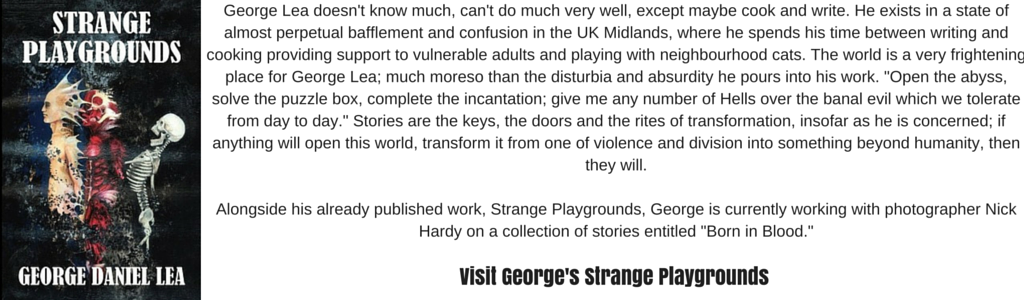 
0 Comments
Leave a Reply. |
Archives
April 2023
|
 RSS Feed

|

|