
|

MY LIFE IN HORROR: A COLD, LITTLE ROOM
30/8/2017
 Memory is a terrible medium, at least in terms of accuracy and specificity. Casually peruse any random selection of studies on the matter, and you will find ample evidence as to how distorted, malleable and epehemeral the medium can be. What we perceive and purportedly record is influenced by so many factors, even upon its initial experience, that, in the years and decades after, original events become as much fable or myth as any written or contrived story we might consume. Bias, intention, agenda; ideological or tribal identification...all of these and more impact upon the nature of memory, allowing it to be subtly softened and re-written, to the point that what exists in our minds, the events we recount to ourselves, become more matters of personal mythology than any journalistic or documentary record. We create and entertain such artefacts precisely because they are mythological, because they reinforce certain assumptions that we consider essential or sacred to our sense of self (or, at least, the self we aspire to project). As such, those artefacts are in constant flux just as our personalities are; as we are transformed by experience and contemplation, by emotion and shifting circumstance. Were we able to somehow travel back to the initial experience and to perceive it from the outside, we would find that it is almost entirely alien to the cinema behind our eyes; that details have either been lost or abandoned as redunant, that certain aspects have been re-emphasised or entirely re-written to better suit the mythology of self we wish to maintain. We are all temples of uncertain fictions, what we regard as essential to who and what we are as changeable and intangible as any urban myth or oral folktale. As such, any attempt to analyse that phenomena is immediately problematic to the point of impossibility, especially given that we are obliged to pretend objectivity in areas where objectivity is nonsense: we can no more analayse the factors that inform our sense of self than we can pluck the notion of consciousness from our own minds, set it aside and trace all of the various threads and systems of input that determine its shape and nature. We are, in a manner that is difficult to express within the bounds of language, constructs of those mythologies, informed by them on a level at least as fundamental as our own biologies. That said, the effort is far from redundant; attempting to assess why we are what we are, what factors influence our reactions and expressions, is in itself a worthy exercise; one that can facilitate self-revelation and transcendence, the flowering into new and alien contexts where we can be more than our previous, abandoned incarnations ever dreamed. A perpetual fascination, then; a morbid obsession, even: a stroll through the cemeteries of murdered and cast off selves, of ghost children all of whom bear our faces. What horror stories can memory tell? For my part, place and environment have always been significant; in the fiction I consume and create, in my dreams and idle fantasies, it is usually what establishes itself immediately and most intensely; the playgrounds in which characters can be born, in which story can swell and know itself. This is no less true in the cinema of memory, which inspiration draws from endlessly, the states and places it has recorded and embellished, allowed to rot or elaborate upon themselves to the point that no trace of the original state exists, co-mingling with the more conscious contrivances of imagination to create an internal landscape that is far more expansive, various and ephemeral than any delusion of objective reality in which I assume to operate. Places that sustain, whose aesthetics and atmospheres and sensory details I recall -or contrive- in exacting detail; that still exist, to some degree, whereas their physical equivalents have either changed beyond recognition or been lost to immediate experience...so, so many, from parks and playfields, friend's houses, farmer's fields, abandoned lanes and country roads... One of the most vivid, the most enduring, a room where I spent much of my childhood; where I learned my current love of quiet and cold and isolation, my capacity for immersion in media, to lose myself in some fantasy, to the point that I lose traction and contact with the external world: A cold little room, the smallest bedroom of my parent's house, that always felt as though the walls crawled with frost, even in the Summer months, whose curtains would flap and flail like the skirts of banshees in the slightest breeze. A triangular window extending out, allowing view of the surrounding street, the nearby fields and houses...a strange acoustic phenomena meaning that sound filtered through so clearly and from such distance, I could often hear conversations that were occurring several streets away, the barks of dogs and the wails of children from houses beyond sight. A space to retreat, to be alone; essential, for a child that never relished the company of others, that exhibited a low tolerance for heat and sunlight (a hyper-sensitivity that sustains to this day), that required silence and isolation in order to replenish himself. Back then, the room hosted our very first computer, the system on which I learned what video games were, how to operate them, what would become the tropes and traditions of digital storytelling: The Commodore Amiga, an extremely crude system, by today's standards, its video games running from (often multiple) floppy discs (a long redundant format), often taking up to five or ten minutes to load the simplest of screens or the most rudimentary of gaming environments, the sounds it used to make of a kind that would drive present day gamers to assume the thing was at fault (a strangely rhythmic series of grunts, groans and clicks whose patterns were curiously specific to each game). Even now, I not only recall its off-white keyboard and immense power pack, the ludicrously obtrusive monitor that was part and parcel, but numerous sensory details such as the incredible heat the thing would generate when plugged in (hence negating the need for a radiator in winter months), the coarse, grainy texture of its plastic shell, even the smell of the system; a sharp, burning acridity that would most cetainly be cause for concern in any present day machine. This was the system that introduced me to a medium that has proven so influential on my state of mind, on the shape and nature of my imagination, barely anything they produce or express entirely free of its influence, certainly none of the stories I've ever set to paper. Hours. Hours and hours spent immersed in its pixellated, poorly rendered worlds; imaginary states that, despite being fundamentally compromised by the technology on which they occurred, nevertheless captured and captivated in ways that many more present day, sophisticated examples fail to. Being the first, they are the measure; those whose worlds and characters, whose colours and environments and soundtracks are most indellibly scored into the stuff of memory, but also the most mutilated by time and experience; the most powerfully re-written to suit the story I ache to tell and inhabit (consciously or otherwise). Having no concept of their status as media at the time; not understanding their limitations and failures, their simplicity proved no barrier to my imagination: I did not notice the repeated layers of background or the limited palates of shapes and colours from which they drew: when I played a video game, those distant spaces were not illusory, but places I might some day reach and explore, if I only proved canny enough to find the way. One of my most vivid recollections of this phenomena derives from the very first video game I ever played; the all but forgotten Wolf Child. 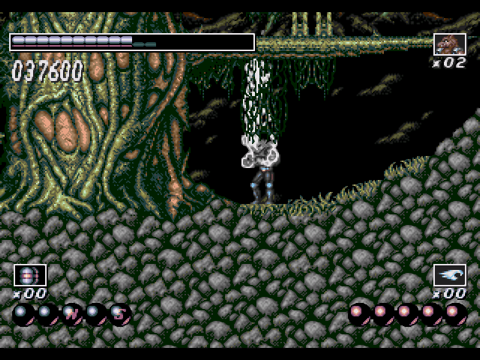 Not a fantastic game, by any definition or analysis; a fairly mediocre, side-scrolling platformer, made notable only by a fairly coherent back-story and opening cinematic (extremey rare in this era of video game). Nevertheless, my childhood self was entranced by it, obsessed with what secrets might lurk in the depths of its myriad levels, what mutated, liminal entities he might encounter along the journey. No notion or concept of the bounds that its environments evinced, that there might be places where he simply could not trespass or progress further, dreaming up and projecting mysteries and secrets onto the screen where the game itself failed to provide them. That lack of boundary or parameter, that sense of entire imaginary worlds blooming open before him...not only exhilarating beyond expression, but also terrifying. Whilst the game itself contains an extensive menagerie of bizarre, chimerical beasties (men who have been genetically spliced with animals, resulting in snake-bodied and reptilian abominations, goat-horned and hawk-winged monsters, immense, upright flies and spiders), those that the child dreamed and infested its unseen spaces with proved far more enduring; creatures that often made themselves known in moments of idle fantasy or the depths of dreams. Wilder, more exotic and abstruse by far than anything the game itself contained, these entities still exist today, in some shape or form, often finding themselves rendered in the pages of my fiction or re-purposed for a more literary environment. Most notably, the game's second level, an immense, dusk-lit forest, has endured and evolved from mere memory into something far more expansive: not merely the experience of a child's game, but co-mingling with certain mythological images and preoccupations: the shadow-haunted wood of humanity's original, collective nightmares, echoing back to when our ancestors would gather around camp fires and tell stories of the beasts and demons of the wood. A post-modern ripple of that same, fundamental fear, the wood finding expression not only in the oral traditions and folktales first told during those days, but in all that derived from them: in myth and urban legend, in conspiracy theories and religious dogma. And also here, in this infant medium, in this child's mind: the wood a nightmare that transcended my own skull and experience, that fascinated precisely because it distressed, because the superstitious, animal thing still inside responded to the image of it. The environment itself a seemingly endless expanse of black, twisted trees and inter-twining branches, even the flora grotesquely mutated into nightmarish distortions of itself: the trees monolithic, predatory plants and wildflowers erupting from the ground, fungal pods exploding to scatter venomous shrapnel. Bathed in the hazy, crimson light of a dying day, night grows deeper the further we progress into the level, until stars and a baleful moon shed their light between the boughs. 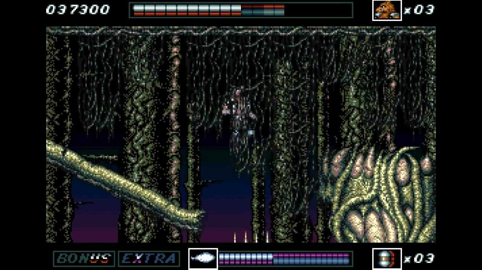 To a present day audience, whatever atmosphere my child self might have enveloped itself in no doubt seems impossible to evoke, the crudity of the level's rendering, the graphical and audial limitations...arguably a factor that many present day games lack (much as I adore them for their own qualities) is that of player engagement, not only with regards to their control systems and interfaces, but by their completeness; the fact that their worlds can be so detailed and various and textural in every aspect, meaning that players are automatically provided with everything they might contain or allow for, without the necessary space and uncertainty required for imagination to flourish. The fact that Wolfchild's forest is a linear, two dimensional scrolling environment means that imagination must necessarily be engaged in order to evoke even the slightest sense of atmosphere; its audience must commit to a certain degree of work in order to get the best out of it. Thus, my child self -precocious little ghost that it was-, invaded those non-existent depths; the illusory vistas provided by parallax scrolling, the spaces beyond the screen, infesting them with all manner of hidden places and dire secrets, with passages to subterannean temples, with caves and caverns where even more immense and elaborate mutants slumbered, with creatures far more terrible and terrifying than anything the game itself was capable of providing. That degree of engagement was hardly unusual, at the time, not only due to the nature of the Amiga's video games (where imagination was essential for selling their illusion), but also that of my child self's pupating psyche; a condition far more open and permeable than those enshrined in adulthood, in which the exercise of imagination wasn't questioned or condemned, but indulged in without compunction: a matter of everyday existence and process, whether engaging with video games, toys, comics, books...nothing at all; flying free from the constraints of a body that would soon cause the child more than a little concern, when it was on the verge of no longer being a child any more. And those woods, that cold, little room...only the first. Others followed: the “Alice in Wonderland” delirium of Harlequin's Chimerica; a world born of dreams, specifically, those of the protagonist, who grows up there in enchanted isolation from reality, before leaving behind the realm of his fantasies and forgetting. Returning to its threshold as an adult, as a Father, he finds its gates barred, its great clocktower still, silent, strewn with dust. Chimerica has decayed and come close to dying in his absence, its beating heart split into fragments by his abandonment, its many realms and recesses twisted, infested with the vermin of doubt and ambiguity. A remarkable game for its era, Harlequin's genuinely surreal stylings drew inspiration from sources as diverse as the paintings of Salvador Dahli to pop music and TV, its world a kaleidoscopic hodge-podge of influences that made an effort to legitimately echo the ephemeral, inchoate nature of a child's imagination. Shot through with a vein of sincere darkness, the game was an exercise in absurdity that strayed into realms of fantasy, comedy, metaphysics and horror, its sprawling depths and vertiginous heights packed with secrets and recesses in a way that Wolfchild's fairly linear world lacked, but which was still enough a product of its technical limitations to allow for space, that essential emptiness that is the canvas of imagination. Like many of its ilk, Harlequin bled off the screen, flowing out into the cold and darkness of that little room, painting its walls in absurdia. More, it followed me from the room, out into the wider house, to my bedroom, to school and friend's houses...even here, to this time and moment, where I can still walk its streets -albeit in distorted, altered form- when I close my eyes. I recognise in its absurdity echoes in my own work; the output of my adult imagination, that might not otherwise have occurred were it not for what it provided so long ago. That continuum, though the original recipient of the experience is long, long dead (materially as well as metaphorically, given that our cells are constantly dying and replacing themselves all the time) is a strange, almost incomprehensible notion; one that is as impossible to clearly discern as a torrent one is tossed and turned through (not to mention most likely an illusion; a product of out sensory limitations and physical spheres of operation, that technology may yet allow us to transcend). It forms a significant part of the mythology of self that so consistently fascinates, of which that cold, little room and the worlds, realms, universes it once hosted, are part and parcel. 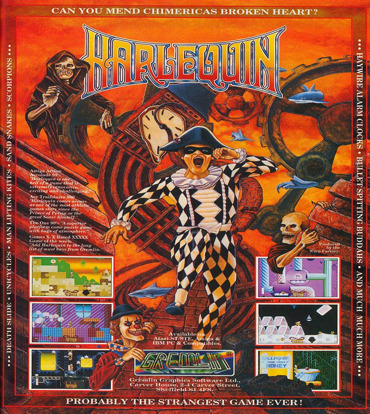 The nature of fear was also a different factor back then; not only that room but the world itself, a far less known quantity; often, the four or five steps from it, across the landing, to the bathroom, felt a limitless expanse; a haunted and terrible wasteland, where anything might lurk, especially in the depths of Autumn and Winter, when darkness had a particular density, when the nights became so cold and still and pregnant. The doors of bedrooms, partially open on the right, the descending stairs on the left, the landing window, curtains partially drawn...even the act of opening the door, peering out into the darkness, especially after being so immersed in one of the Amiga's virtual worlds, was an exercise in terror, reality and imagination still uncertain in that child's mind, meaning that every shadow and recess potentially seethed with threat, that anything might peer around one of the doorways or ascend the stairs, might materialise before or behind and spirit him away... That particularly paranoid form of fantasy ramped up by a factor of N when the games he played deliberately set out to distress or horrify. Whilst horror games were a relative rarity in those days, the Amiga was one of the few popularly available systems in the UK that boasted a reasonable crop of them. From the likes of the H.R. Giger-inspired Darkseed to Horrorsoft's Elvira and Waxworks series, the child had access to a number of materials specifically aimed at a more adult audience, which he consumed and obsessed over perhaps more ardently than any other. The aforementioned Darkseed, whilst enormously crude by present day standards, was an attempt to create a story out of H.R. Giger's peculiarly bio-mechanical artworks, incorporating the kind of imagery that makes me wince even to this day (an opening cinematic in which an alien embryo is surgically inserted into the protagonist's skull, that same entity erupting, Alien-like, from his body if you fail to complete the game within the allotted time). 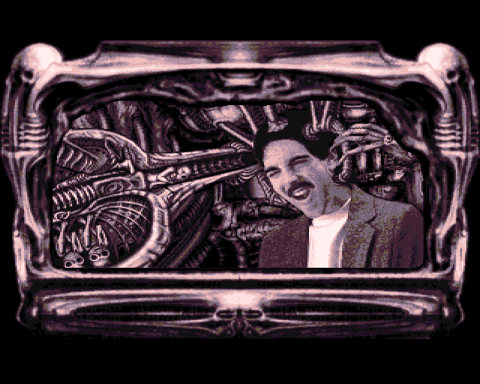 Back then, with so little to compare it to, the game was terrifying, so dense with atmosphere from the first instant, every room and screen practically pulsating with threat, that often manifested in wildly unexpected and vivid ways. Memory insists on a sense of rigid coldness, as I sat there, glued to my seat, inches away from the flickeing screen, occassionally glancing over my shoulder, at the surrounding room, the window, the door, as the eerily sinister music chimed and ticked over, images from the game often temporarily super-imposing themselves over waking reality, making shadows seem dense and fleshy, writhing as though with organic or mechanical process, faces appearing in wallpaper, in condensation on the window. Sounds from outside the room suggesting what hideousness crawled and seeped out there, waiting for me to step out, so it might spirit me away through cracks in reality. Darkseed is one of the first video games I recall not only inspiring dread through my immediate experience of it, but lingering long after, informing nightmares and moments of infantile paranoia. Not only that, but fostering a life long obsession with the work of H.R. Giger, as well as a swelling love for the experience of being disturbed by video games as I ache for from other media. 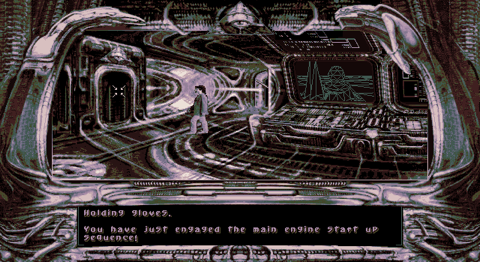 As with the other digital realms I explored within the confines of that room, it and the room itself are inextricably bound; extensions of the same environment, such that they fray apart and merge in memory, becoming portals to one another, as well as to other states and realms. Many, many writers, artists, academics etc have written extensively on the essentiality of space in the development and expression of imagination; a need for a place of stillness and silence where one can be apart from others, from input and diversion, allowing the mind's eye to turn inward, and perceive what it might otherwise deny or not wish to, what might be obscured or sublimated. That room was the first of many, for me; a physical space that not only hosted a variety if imaginative realms, but became one in its own right; a place that stil exists in my imagination, and which still recurs, from time to time; echoes and derivatives of it cropping up in myriad examples of my own work, as well as from day to day, in those instances when imagination wanders, when I or characters I conjure find themselves in similar spaces, in similar states of contemplation. Many would follow, sought out, in part, for their resemblance to that space, for their ability to echo its confines and qualities, others precisely for their contrast to it, but all, all simultaneously places in which imagination might swell and that it demonstrates a consistent penchant to devour. That cold little room, haunted by the ghosts of dead children and adolescents...mine, now; moreso than the physical structure that inspired it, as much a part of me as any other input or influence, rendered immortal, though far from immutable, by that act of assimilation. 
0 Comments
Leave a Reply. |
Archives
April 2023
|
 RSS Feed

|

|