
|
WARNING: This series contains HUGE spoilers, and is designed as discussions for people familiar with the source text. I do not wish to spoil your enjoyment of The Last Illusion, so please read it before reading this. Thanks. 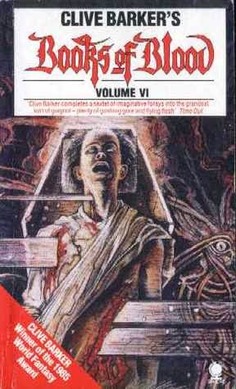 CONTAINS THE LAST ILLUSION I guess I need to start this with a shameful confession. With the exception of The Hellbound Heart, I haven't read any of the stories on this list prior to now. In my late teens/early twenties, I devoured with relish Weaveworld and Imajica, and The Thief Of Always had a lasting effect, but I never got hold of The Books Of Blood or The Great and Secret Show. So for the most part, these columns will represent a voyage of discovery for me, albeit of a writer whose talents I have huge admiration and respect for. I'm sure many of you will have a far greater familiarity with the texts than I do, and I look forward to the conversation in the comments. So, with that in mind, let's talk about The Last Illusion. I guess the first thing that occurred to me was that, as someone more familiar with Barker's epic work, the economy of the storytelling in this piece is impressive. Barker does a great job of giving broad swathes of backstory via the inference of a sentence or two. You feel immediately not just in a story, but in a world, a world with a rich, vibrant and deeply scary history. The ease and confidence with which he injects a sense of supernatural horror into an otherwise fairly standard noir setting is so impressive, you don't really even notice it until you sit down and think about it afterwards. The opening is instructive in this regard, seeding very early the concept of the real magician hiding in plain view – performing acts of spectacular magic on stage, so that people know there must be a trick to it. That’s a neat concept in its own right, but in the context of the story as a whole, it's downright audacious – like the magician, Barker himself is giving you most of the information up front, trusting that you'll assume along with the fictional audience of the show that it's an illusion, misdirection – when actually, the whole story is right there in the intro. It's stunningly assured stuff. His prose style – I've been trying to pin it down, without success. It edges on the formal, with the odd Victorian/Edwardian flourish even, but at the same time it's utterly modern, unaffected, and not just readable but downright devourable. I'll be really interested to see how this develops and changes as I go through these stories. For The Last Illusion, I'll just say that it fits the mood of the piece like a glove – the sense of a world of modern noir with an older, more powerful (and darker) underworld abutting uncomfortably, starting to seep across. True to noir standards, we have a PI, a stunningly beautiful widow, a corpse with a letter to be opened upon his death, and a haughty butler dropped in for good measure (who I naturally assumed had 'dun it', early doors at least). Our PI has a haunted past – literally – which draws him towards the case, against his better judgement. Again, I'm struck by the utter confidence with which Barker tells this story, the way he build on these stock elements to create vibrant, memorable characters, and then effortlessly weaves in increasing supernatural elements, without ever undermining or breaking the mood of the piece. The sequence where Harry, guarding the body, feels reality start to crumble around the edges is vintage Barker – cinematic, immediate, bloody terrifying. The transition from mundanity to a sanity threatening weirdness is amazingly handled, reminding me of Lovecraft (only better written – yeah, I said it). From this moment, the roller-coaster ride is well and truly in motion, and it really doesn't let up until the final page. Again, I was incredibly impressed by the fluidity of the prose, and the increasing encroachment of the weird and magical into the world we know. With brief descriptions, Barker sets up a sense of epic mythos, of dark and terrifying creatures lurking just beneath the surface of our shadows. As those creatures erupts and boil forth towards the climax of the story, I found it to be genuinely unsettling, even as I also found myself horribly fascinated by these dark creations. In this, again, the deceptive simplicity of Barker's prose masks an incredibly skilful storyteller, as the sketches he provides drive my desire to see more in tandem with D'Amour's own hypnotised state, even as, like D'Amour, I am increasingly scared of what I'll be shown. There’s also a great sequence where the ‘widow’ (actually a demonic simulacrum of same) is attempting to get the location of her husband’s body out of D’Amour. In the hands of a lesser writer, it would be an eye-rolling moment, but here, it’s much more a ‘scream-at-the-book’ experience, and it’s the supernatural element that makes the subtle difference. Add to that a well observed commentary on how deceiving appearances can be (the beautiful ‘widow’ is really a monster, while the ‘monstrous’ butler is still in service to a good, or at least just cause) and what should be a trite, hacky sequence is both nail-biting and exuberant. It's interesting to look at this story from where we are now, knowing The Gulf become synonymous with the Cenobites of Hellraiser/The Hellbound Heart. No sign of Pinhead here, but there is a glimpse of the same root imagery that will later inform Barker's own take on Hell – disfigured and distorted flesh, torn and reformed in grotesque configurations, torture that goes beyond the horrors of human to human, and the push/pull fascination/revulsion they inspire, in both characters and the reader. Also, the idea that bargains can be struck, and the awful cost of such bargains, the notion that these creatures can be caused offence, that even in Hell, there are blasphemies that are punished. All concepts that I’m sure will be explored further over the course of this read. I don’t have a huge sense of Harry as a character, yet, so I look forward to seeing that develop as this journey continues. At the moment, he seems fairly stock – PI with the heart of gold, an eye for the ladies, and a dark past, albeit with the ‘handles supernatural cases’ kink – and I’m really curious as to how Barker develops him in later work. I mean, I like the guy, but I don’t really that I know him yet. Overall, it’s been such a joy to reconnect with Clive Barker’s writing, especially getting to discover stories I’d not previously read. The sheer energy of both his storytelling and fantastic imagination are a heady mix – it’s just so much damn fun to read! I’m now really, really excited about the rest of this journey, and can’t wait to get cracking with Lost Souls. I’m also curious to hear about your own experiences with The Last Illusion, so sound off in the comments section below, and let me know what you thought. Thanks, and see you soon for part 2 of the Path to the Scarlet Gospels – short story ‘Lost Souls’ (available for free from Clive Barker’s website at http://www.clivebarker.com/html/devotion/macab/stories/lost.html#sthash.hMLWYY0C.dpuf ) KP 10/02/15 THE LOST SOULS : THE PATH TO THE SCARLET GOSPELS PART 2THE HELLBOUND HEART : THE PATCH TO THE SCARLET GOSPELS PART 3THE GREAT AND SECRET SHOW : THE PATH TO THE SCARLET GOSPELS PART 4
13/5/2015 10:09:38
Please share your thoughts on Barker and the upcoming release of the Scarlet Gospels
Paul Flewitt
13/5/2015 13:57:56
The Last Illusion was my first introduction to Harry D'Amour and I was instantly captivated by him and his sidekick. I think this is a very embryonic D'Amour here, and he becomes much more rounded in Everville, with banter between Tesla Bombeck and Nathan Grillo. In that book he becomes far more open to the beyond and has obvious seen a lot more in his life since Lord Of Illusion. As an introduction to Harry D'Amour, I think Barker gives just enough to tantalise and pique the interest. It actually surprises me that Clive hasn't written more D'Amour stories.
Paul Flewitt
14/5/2015 03:03:31
Harry is a flawed character, even in his subsequent appearances. He's a guy who really doesn't want any part in the acts that are going on around him, but the darkness seems to find him. Reluctantly, he has set up defences against the dark, but they do insist on getting to him. Really, if you see him from that point of view, he's less of a jerk and much more understandable. I'm not sure about that - I mean, he does what he does for a living, which belies his reluctance to engage with darkness - after all, there are plenty of jobs he could do other than paranormal PI that would risk less exposure. Having read his journey to date in pretty quick succession, one of the ways I think the character evolves and grows is in his own acceptance of that fascination with the darkness, and his desire to confront it. By Everville, he's prepared to lose everything just to face down the physical manifestation of all he's spent his life fighting. But I'm getting ahead of myself... :) Comments are closed.
|
 RSS Feed


|

|