

|
Calm down, you'll live longer.  RICHARD LAYMON RICHARD LAYMON One Rainy Night As it happens, the night I discovered Richard Laymon, it was rainy. Cats and dogs rainy in fact. Coincidence? Maybe. From as far back as I can remember I’ve always had a love for writing. I’m not sure where it came from, or how indeed it started. I just remember it being there, and writing the most horrendous stories in my English classes. I was proud of the big red Fs scribbled all over my work from my teachers. Who wouldn’t be, right? Reading, however, I was not a fan of. Before One Rainy Night, I’d be hard pressed to think of a single book I’d picked up before that one; I was eighteen at this point. After leaving school with little education, which was my own doing, I never thought of writing. Or reading, for that matter! Hell, I could barely string out a coherent sentence, let alone piece a paragraph together. My vocabulary was pitiful, which matched my reading skill. I was a victim of my impish youth – getting smashed on a weekend with my mates was more important to me than anything. Then, just like that, my life changed. I broke up with my girlfriend at the time, and homeward; back to good ol’ mam and dad. It was then, as I was working an evening shift at Paddy’s Goose, a local pub, that I had an epiphany. A ‘light bulb’ moment. 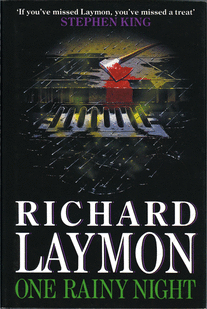 ONE RAINY NIGHT I’d started reading One Rainy Night by this time, and found it inspiring. I loved the fact that this kind of writing was ‘out there’. I thought this kind of horror was excluded from books – saved only for the silver screen. Jesus, how naïve had I been? I’d clearly been living under a rock for the past ten years of my life. From reading one novel, a massive reaction was about to take place. My life was about to become something totally different. I took up English classes in college, started reading four books a week, and put some serious hours into writing. Before I knew it, I had an impressive library, a sound education behind me, and a batch of short stories published. This from reading one book? Yes! Richard Laymon’s books taught me that you can have fun with writing. That you can write what you want, and how you want it to look on the page. There is no shame when it comes to fiction. Especially gritty horror fiction. Earlier this year, my first novel was published. My glorious path started back in 2005, right after an Iron Maiden gig in Paris. A fucking awesome gig, I hasten to add. I have sat two GCSE, two A-levels, and two University degrees. Both of them in Creative Writing. All from one book. One writer, who helped inspire the guts out of me. Richard Laymon. I’ve written many pieces of work on the man, from analysis to reviewing. What follows is a piece of interest. A biography. So sit back, read, and enjoy. Most importantly. Get inspired. A Loss to the Genre: the death of a legend “That’s how I remember Dick, as the den mother of the “Horrornet Cabal.” We were young and ready to conquer the horror genre. Dick cheered us on. We wrote, revised, and submitted. Dick guided us. We were full of piss and vinegar. Dick topped us off when we ran low. He drank with us. Laughed with us. And when we occasionally got ourselves into trouble, Dick was there to bail us out (even when he was the one that had inspired us to cause trouble in the first place). When one of us did something he liked, a story or an essay perhaps, he’d say: “The Dick is pleased.” ” (Brian Keene, In Laymon’s Terms, p68, 2011). The quote by Keene shows Laymon to be a ‘rebel’ of sorts, and he sure was when it came to his fiction. But the quote also shows something else about Laymon – that he was a good friend and advisor – a ‘go to’ type of guy. Over the course of Laymon’s career, which started back in 1981, and prematurely ended in 2001, he wrote more than forty novels, and amassed over sixty short stories, which were published in various anthologies and collections, such as his books, Dreadful Tales, Madman Stan and Other Short Stories, Out Are the Lights: And Other Stories, Fiends and A Good, Secret Place. Bibliographies of Laymon’s work show that he was pumping out between two and four novels a year, whilst churning out short stories in the process, making him a prolific writer over the course of his short career. Even after his death in 2001, Laymon’s novels were still being published. More than six new titles came after his death, starting with, Night in the Lonesome October, No Sanctuary and The Halloween Mouse in 2001, Amara, 2002, The Lake, 2004, and The Glory Bus, 2005. 2011 saw the greatest tribute anthology released – In Laymon’s Terms – a tribute to the late, great Richard Laymon. A book no Laymon fan should be without, which is packed with dozens and dozens of short horror fiction stories, essays, remembrances, poetry, and even a mini photo album, that contains handpicked photos of Laymon with his family, friends and other writers from within the horror genre such as, Jack Ketchum, Brain Keene and Bentley Little Brian Keene was one such contributor, In Laymon’s Terms, who, not only wrote a remembrance piece for the collection, but also submitted a section of his novel Castaways into the mammoth anthology. Castaways itself is a tribute to Laymon, as the ‘baddies’ within that story are almost replicas of Laymon’s from his novel, The Cellar - the notorious ‘beasts’! White, hairless creatures that are almost from the monkey species, which could eat a man whole, or rip him limb from limb whilst sexually assaulting him. “THE CELLAR (1980) was the very epitome of American Gothic grisliness - vile troglodytish creatures dwelling far beneath the site of a gruesome slaughter-scene emerge at intervals to terrorise the local inhabitants, maiming and killing the males, sexually enslaving the females.” (Richard Laymon’s obituary from Independent, 2001). Laymon continues to shock and please his audience, even though he passed away more than ten years ago. His books continue to sell, and with the rebirth of The Woods Are Dark, and the epic anthology In Laymon’s Terms, with whispers of a film adaption of The Travelling Vampire Show being made, it would seem there’s still plenty left to scream about. A New Dawn of Horror: Splatterpunk is Born “‘How old are you Joni?’ ‘I’ll be ten.’ ‘Why don’t you come along and help me clean up?’ ‘I don’t want to.’ ‘Do you want me to stab you?’ He lifted a bar of soap from its tray and began to rub her back. When that was slick, he eased her closer so she was reclining against him. Reaching over her shoulders, he soaped her chest, her belly. Her skin was warm, pliant, slippery. He pulled her more tightly against him. He put the soap in the tray. He reached down between her legs.” (The Cellar, p42-43)  THE CELLAR COVER After a few years of trying to break out into the novel field, Laymon had his first major success in 1979, when Warner Books bought his novel, The Cellar, for $3,500 dollars, and by New English Library, for $24,000 dollars. So, in 1980, Laymon’s first big publication – The Cellar – was released, and Splatterpunk was born. This book would go on to shock its readers around the world: a pervert by the name of Roy, who’s fresh out of prison for molesting his own daughter, is on the hunt for her along with his wife, who have gone on the run. They know he has been released, and will come looking from them. Whilst Roy is on the prowl, he kills numerous amounts of people, and snatches a nine-year-old girl, Joni, in the process, who he does unspeakable things to. Just three months after the first sale of The Cellar, Laymon’s second book, Your Secret Admirer, was bought by Scholastic for $3,000 dollars. After The Cellar’s publication, which states on the cover as it being a best-seller, it would have seemed that Laymon had made it. But it was not to be for several years to come… The Woods are Dark: A Career Derail “The Woods Are Dark plunges forward like a Tobe Hooper film based on a scenario by Charles Manson. Gruesome, frenetic, blood-curdling.” – Dean Koontz. In 2008, the uncut version of the novel The Woods Are Dark made it into publication, with the missing fifty or so pages replaced, and the errors gone and published in the way it was supposed to be back in 1980. The sick and twisted tale involves two families, as they struggle for survival in a wood surrounded by the Krulls: a feral and blood-thirsty tribe, who are intent on rape and murder. This novel shows off Laymon’s Splatterpunk panache with great effect. Laymon’s third book, which Warner had accepted from Laymon, was the notorious, The Woods Are Dark. This novel would go on to harm Laymon’s chances of being a successful, and full-time writer, which had only just begun. Warner, who he had a three-book deal with, did a poor job of The Woods Are Dark. In his autobiography, Laymon tells how Warner wanted him to change large chunks of the book’s storyline, and as he was young and scared, he went along with it all. After doing the revision Warner wanted, he sent the book back, and the line editor made the corrections, totally decimating Laymon’s style, and made a mess of the plot at the same time. This left Laymon shattered, and, even though he tried to make them work, he was told that it would cost too much to go with his rectification of the mistakes, and so the book was printed with all the errors. And to make matters worse, Warner had also given the book a hideous green cover, making the book a complete and utter train wreck. It undersold his first book, managing only to sell roughly 70,000 copies, which ultimately flushed his U.S career down the toilet. His second novel, Your Secret Admirer sold over a 100,000 more copies than The Woods Are Dark, casting off a whopping $8,559,000 in royalties, and selling out the first edition. However, Scholastic never reprinted it. “Apparently, an editor hadn’t appreciated my terse style, so he or she had “fixed” it for me. Fixed it, all right…The revised version of the cover won some sort of prize for its creators. But it killed the sales of The Woods Are Dark.” (A Writer’s Tale, p226-229). With his career, which had started out promising, now on the rocks in the U.S, Laymon kept on writing, and sending his work out. The years 1980-1986 were rather quiet for Laymon, even though he was selling fastback novels for small amounts of money, he still had to work whilst trying to get his writing career off the ground – the sale of one book was not enough. Back on Track While working at a law firm for $10.00 an hour in 1986, a break came when three of his books, The Cellar, The Beast House and Beware, all sold for a little sum of $5,000 dollars in 1986, before his novel Flesh was sold to Tor Publishing for $7,500 in 1987. These sales helped Laymon to cement his full-time writing career. On August 15th, 1988, he announces in his autobiography, that this was the “last day of work at the law offices!!! I resumed my career as a full-time writer of fiction”, (p.36) From 1988-1990, he wrote four books – Resurrection Dreams, Midnight’s Lair, Funland, and One Rainy Night. In 1988, Laymon received big offers on two of the novels stated here – Resurrection Dreams ($9,000), and Funland ($11,000). In 1987, he wrote the novel Tread Softly (writing as Richard Kelly) aka, Dark Mountain, along with Midnight’s Lair – both of which are hard to find written under the guise of Richard Kelly. They can be found, but will set the fan back a fair amount of money from the internet. Tread Softly was a big turn in Laymon’s career, as this was his first hardback sale, and was sold in the United Kingdom under W.H. Allen Publishing, gaining him more readers and fans. The reason the book carries his pseudonym, is because New English Library were continuing to publish it. It was originally bought from Tor Publishing for $7,500. Midnight’s Lair did just as well – earning Laymon a $5,000 advance. 1988 also saw Laymon starting work on his autobiography, which would be released with the title, A Writer’s Tale, which is now a very rare book, and costs around £250. The book is dedicated to “Everybody who wants to be a writer. Persist and prevail!” Although A Writer’s Tale is an autobiography in the sense that he shares aspects of his life and writing life with the reader as fan, it is also a “Laymon companion” for the aspiring writer. Within the pages, he parts with his rules on writing, and along with it, some very inspiring words. Rule 8 – “Persist.” “I read somewhere, “Persist, even if the world calls it doing evil – as it is most likely they will.” Persistence will win out. Show me a published writer, and I will show you a person who has kept on writing in spite of every obstacle. He has found time to write. He hasn’t let rejection stop him. Or poverty. Or writer’s block. Or people saying he shouldn’t write about that sort of thing. No matter what happens, he keeps turning out the stuff. Because he’s a writer. It’s what he does. So he does it. He persists. And through the persistence, he succeeds. (Laymon, p124). But before A Writer’s Tale was published, Laymon had amassed an array of novels and short stories, and on May 1st, 1990, the same year The Stake, and One Rainy Night were published, a very big, and important thing happened for Laymon – he received a massive contract from Headline Publishing in London, England for $154,000 dollars, through his agent Bob Tanner. This meant that Laymon would now definitely not have to ever work in an everyday job again – his status as a full-time writer now sealed, and lead to a numerous releases of books throughout the nineties. Darkness, Tell Us and Island were both published in 1991, which was followed by Blood Games and Alarums in 1992. Endless Night and Savage, both came in 1993. In The Dark, 1994, with 1995 seeing Quake make it into publication, with Bite and Body Rides both coming the year before, and After Midnight, in 1997. The releases kept coming, right up to 2001, the year that Laymon sadly passed away. 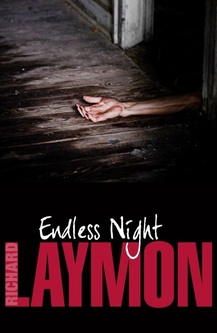 ENDLESS NIGHT COVER The Early Years In Chicago Illinois, on January 14th, 1948, a legend was born: Richard Carl Laymon: son of Hugh Kelly Laymon and Wanda Kathleen Hall Laymon – younger sibling to Robert Kelly Laymon. In Laymon’s early school years, where he attended Glenbrook High School, Illinois, Chicago, there was a sign of things to come as he was regularly writing a column for the North Brook Methodist Church called, The MYF News – Methodist Youth Fellowship. In 1962, the same year as Laymon was writing his column, two poems and a short story of his were published by his school’s literary magazine called Helicon. With the short story, “365 Days a Year”, he won $5.00. Another sign of things to come was when he was told to ‘tone down the ending’. After revision the story was seen as fit for acceptance. Even then, at a young age, it seemed Laymon knew what he wanted to write, and how he wanted to write it. Before Laymon could finish his education at Glenbrook High School, his father started up a business venture in San Francisco and moved his family across the country. Laymon would finish his High School years at Redwood High School, Larkspur. Whilst at Redwood, Laymon took two years of creative writing classes, and wrote for the High School’s monthly book review periodical called Bookmark, which he would later become editor of, between 1964-1965. The High School’s literature magazine, Orpheus also contained Laymon’s work in 1964, and again in 1965. This also shows how dedicated Laymon was even at the very beginning. After leaving school, Laymon attended Willamette University, Salem, where he gained his BA in English. More of Laymon’s poetry and short fiction found its way into the literature magazine Jason, at Willamette, between 1966-1968. In 1967, and again in 1968, Laymon won money for his writing, by winning second prize in a University Creative Writing Award contest, and bagging himself $20.00 in the process. Whilst at Willamette, Laymon attended summer school at the University of Iowa, in 1967, where he took courses on literature and creative writing. In doing this, he was able to graduate a year early from Willamette, and spent his final year at the University of Arizona, where he started an MFA degree, and managed to get more poetry published in their literature magazine, Tongue. But Laymon dropped out of his MFA degree at Arizona, with no explanation in his autobiography as to why, and decided to head to LA, where he would complete an MA in English Literature, at the University of Loyola Los Angeles. Whilst at Loyola, Laymon received his first large contract from Ellery Queen’s Mystery Magazine in 1970, for his short story, “Desert Pickup,” which was worth $75 dollars. He was just twenty-two at the time - “I went crazy wild with joy”. (A Writer’s Tale, p19). In his autobiography, Laymon recalls a tale in how he came by the idea for his short story “Desert Pickup.” “Whilst in Tucson, I took a driving trip into the desert with a friend who intended to steal a cactus. This incident inspired my first professional published story “Desert Pickup”. (A Writer’s Tale, p19). When Laymon left Loyola, he started working as a ninth grade teacher, teaching English to girls, before resigning to become an editor of a pamphlet called Smoker’s Blend, which went out of business. Over the course of the years that followed, Laymon wrote and took jobs as a clerk at a library, a library assistant, an editor, went to night school and did an MA in Librarianship, and met his wife to be, Ann Marie Marshall, who he has a daughter with, Kelly Laymon. The Scathes, Reviews and Prizes Laymon was clearly a very proud writer, and wore his collected insults, good and bad, from reviewers and critiques. Right at the start of his autobiography, he shares with us a collection of such reviews, ranging from scathing to triumphant. “Blood and guts churned out for numbskulls…[In One Rainy Night, blood is] shed in a volume that would make Saddam Hussein queasy…” - Jim White, Independent. Probably my favourite quote of the lot! Below is an example of a good review that, in my eyes, captures what Laymon was all about – simplistic with his plots, but managing to grip the reader with a fast-paced, and compelling read at the same time. “A story as basic as they come but as blood-chilling as an iceberg down the back…If you like your horror hot and strong, like Stephen King without the frills, then [Bite] is right up your alley.” Darlington Northen Echo. Having said this, Laymon wrote a scathing article of his own in 1993, where he hit back at his enemies that were hiding in the shadows, entitled: “The Lizzie Borden Syndrome Or Vicious Hacks With a Lust for Chopping Other People’s Wood, Fiction, and Necks,” for a news letter called Afraid: The Newsletter for the Horror Professional. In this article, Richard writes an attacking piece on reviewers, on the behalf of writers, “We know who you are. We know what you are doing. We’re pissed.” In the same article, Richard reveals the names of four reviewers that had given him slating reviews, which he felt had stemmed from an unprovoked dislike for him. “I want everyone who reads this article to know that their reviews of my work are based on their own little secret grudges and agendas and have little to do with the piece of fiction that they are purporting to review”. ( A Writer’s Tale, p197). Having sadly passed away in 2001, Laymon had finally been awarded the prestigious Bram Stoker Award for his novel, The Travelling Vampire Show, in 2000. He’d previously been nominated for the award twice before, with his novels Flesh, in 1988, which was voted best horror novel of 1988 by Science Fiction Chronicle, and Funland in 1990. Richard was also up for best collection in 1994, but never won. He received the Bram Stoker Award posthumously in 2001, even though he had won it in 2000, the award was not given out until 2001, to which his daughter Kelly picked up, expressing, “The Dick would be pleased.” CLICK HERE FOR AN EXCLUSIVE ARTICLE FEATURING SOME OF THE HORROR AUTHORS INSPIRED BY RICHARD LAYMONCLICK HERE FOR AN EXCLUSIVE INTERVIEW WITH RICHARD LAYMONBY DAVID OWAIN HUGHES David Owain Hughes is a horror freak! He grew up on ninja, pirate and horror movies from the age of five, which helped rapidly INSTALL in him a vivid imagination. When he grows up, he wishes to be a serial killer, with a part-time job in women's lingerie...He's had several short stories published in various online magazines and anthologies, along with articles, reviews and interviews. He's written for This Is Horror, Blood Magazine and Horror Geeks. In Feburary 2014, his first novel, Walled In, was published. Along with this, David has recently signed a three-novel contract with Permuted Press, with a short story collection planned for release early next year. After discovering Richard Laymon, David set out on a path to become the best writer he could, holding a BA and MA in creative writing.
A RETURN TO LAYMON'S BEAST HOUSE
4/3/2015
“Bring a vampire around, people start discovering religion.” ― Richard Laymon, The Stake 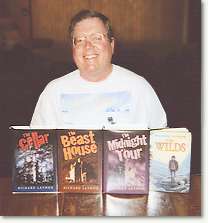 When you talk about horror authors, the same few names always crop up. King, Koontz, Herbert and Laymon.These four authors helped to shape and mould a whole new generation of horror authors. Without their input, the horror genre would not be where it is today, a genre full of great talent. But it wasn't just their writing that helped to shape the horror genre. It was the writers themselves, and probably none more so than Laymon. In stark contrast to his dark and brutal fiction Laymon was warm, generous and ever accommodating person, a man who always had time for other writers. Laymon was a true gentleman of the genre.
As a companion piece to the long forgotten interview with the man himself, I have asked a number of writers whose careers have been shaped by Laymon to tells us about what the man and his writing meant to them. A special thanks must go to Neil Snowdon, who originally printed the interview in his fanzine. It is a huge honour to be able to be able to bring this wonderful interview to a wider audience  Vincenzo Bilof Vincenzo Bilof First, I want to think Ginger Nuts of Horror for including me on their website; I appreciate the opportunity to contribute something that might be semi-worthwhile to folks who might be interested in all the great features the website has to offer.
There’s a reason why I started this article with a thank-you, because the rest of it is going to be a sort of apology. You see, this is the second article I’ve written for Ginger Nuts; the first one is sitting in my hard drive somewhere. That article was mostly about the connection between music and art, and I drew all sorts of inferences and connections between Sergio Leone, Martin Scorsese, and others. The article was certainly pompous, because I realized that most of the information was obvious; you could have Googled everything, and I would have offered nothing insightful other than the fact that I was attempting to justify why I used specific structural concepts in my new novel, Vampire Strippers from Saturn. |


Archives
April 2023

|
 RSS Feed

|

|