

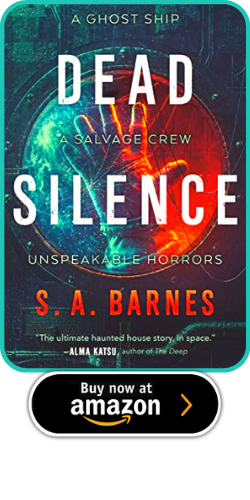
 A devastating, gripping page-turner infused with melancholy and humanity – despite society’s maddening acceptance in the face of horror. HOW SHOULD THE GUILTY BE PUNISHED? Ginger Nuts of Horror is honoured to bring you the exclusive cover reveal for The Butcher by Laura Kat Young, as well as an extract from this intriguing new horror novel publishing from the ever dependable Titan Books. When Lady Mae turns 18, she'll inherit her mother's ghastly job as the Butcher: dismembering Settlement Five’s guilty criminals as payment for their petty crimes. But then their leaders, known as the Deputies, come to Lady Mae’s house, and there in the living room murder her mother for refusing to butcher a child. Within twenty-four hours, now alone in the world, Lady Mae begins her gruesome job. But a chance meeting years later puts her face to face with the Deputy that murdered her mother. Now Lady Mae must choose: will she flee, and start another life in the desolate mountains, forever running? Or will she seek vengeance for her mother’s death even if it kills her? The Butcher is chilling, inventive, and filled with heartbreak that will thrill fans of Shirley Jackson's The Lottery and Devil's Day by Andrew Michael Hurley.  The Butcher by Laura Kat Young The children crowded around her in a circle. They shouted at her, kicked rocks and dirt into her face. They pulled her long curls out from under her bonnet and stomped on her back. They thought they had won—the butcher’s daughter lay prostrate on the ground—but as their taunting let up, as they turned to walk away, Lady Mae dragged herself up out the dust. She crawled first to her hands and knees and spat. She put her hand to her skull, the warm blood stuck between strands of hair. The children stared at her, nudged each other with their elbows and walked back, silent and wondering, towards Lady Mae. “I ain’t afraid. You ain’t nothing to me.” Her lips moved, and she heard her own voice as the words drifted in the still summer air towards the children’s ears. The children stopped moving and stood, hands hanging from their sides, their tiny fists clutching stones. They watched Lady Mae stand up and take a step forward, dragging her back foot to meet her front. Closer and closer she got to the beasts, their eyes, their little bodies, their heads shifting towards one another unsure of what to do, as though scared that they weren’t as strong as they thought. She was Lady Mae, the butcher’s daughter after all. But what they couldn’t know is that something had unmoored inside of her, and as the hot wind blew the dust up around her, she wiped the blood from her mouth leaving a grotesque smear that went down the edge of her chin. The children, who thought themselves safe from any punishments—safe because Lady Mae had never told the Deputies of the treatment she endured—saw a flicker in her eyes. She’d felt the rush before, many times in fact, but always it seemed too dangerous to embrace. When it bubbled up, she tried to push it back down for it went against her mother’s words instilled in her so long ago. It ain’t going to change nothing, her mother had said. You’re better than that Lady Mae, she’d said, those kids need forgiveness just like everyone else. But in that moment, Lady Mae wondered if she was any better than the savages and how hard she could throw a fist-sized rock and how much blood would pour from their small heads. They didn’t deserve forgiveness, and Lady Mae was tired of blaming her injuries on chores, the woodpile, her own clumsiness. Her mother never believed her anyway. She was tired of running, and so as she squared her body towards the small group of children, she felt her fear unravel and make its way out of her. “You better watch I don’t tell my mama,” she said. “Assault’s against the law.” She’d never spoken to the children other than to yell stop you can’t no please. She’d never threatened them, and because of that they thought themselves invincible. Maybe they were. But maybe she was, too. After all, she had come from her mother, had inherited her eyes and mouth and high cheekbones; might she also have gotten the same strength that allowed her mother to go to the depot day in and day out? “You ain’t gonna say nothing. We’ll make sure of that,” a boy called. It was the older Thompson boy, the meanest one, and he stood stuffed into an old shirt, dirt on his cheeks. He was ugly, and it wasn’t just because he was cruel. The younger one—too young to understand just how awful his brother was—ran up to Lady Mae and pushed her hard, back onto the ground. Edith Cummings, the only girl in the group, threw a handful of gravel at her face. But Lady Mae, whose ears still rang and with eyes still blurry, rose to her knees again, the tiny stones cutting through her skirts, and looked the awful girl in her narrowed eyes. “I ain’t afraid.” She brushed the dirt from her hands. But she was weak, and the children were losing interest, calling to one another to leave her, that she ain’t nothing but a poor girl whose mama ought to be hanged. As quickly as it had churned through her, the strength vanished, and in its place, she felt the familiar fear, the sticky panic underneath her fingernails. “Come on,” yelled Balthazar Jones. “Let’s get out of here.” Being the oldest he gave the orders and the others listened. They backed away slowly, keeping their eyes on the butcher’s daughter. When they were far enough away, they turned and broke into a run. “We’ll get you Lady Mae! Ain’t nowhere to hide.” “Come and get me,” she called after them too softly for them to hear. “Come and get me if you think you can.” And as they disappeared from her view she felt her body again, bloodied and bruised. She rose to her feet, each step like fire whipping around her bones. She turned in the direction of the depot and began walking, knowing that when her mother saw her she would take Lady Mae into her arms and press her head against her chest. There she would hear the rhythmic beating of her mother’s heart, the life inside of her undeterred. But as Lady Mae approached the depot, she slowed. What would she say to her mother this time? How would she explain the blood, the bruises, the torn dress? Lady Mae didn’t know how to hold the rage that had filled her—her mother hadn’t taught her that, and she could not tell her mother of the burning resolve she’d felt to fight back, how though she’d felt it before, that this time it was different. You ain’t give me words for it, Mama. She walked gingerly up the depot’s porch steps, her feet heavy and hot. The door was open, but before Lady Mae called to her mother, she heard a man’s voice, low and growly. Peering through the window, she saw her mother bent over the man. Her mother’s back was to the window, and the man sat in the chair, a tourniquet around his forearm. Her mother held a saw in her left hand—the same kind of saw that was in her bag at home— and the sun, which had just lifted high in the sky, glinted off the blade. The man sat still. Lady Mae ducked down and leaned her back up against the splintered wood of the shack. She wasn’t allowed in the depot, and most likely she’d be in trouble if she was found peering in through the window. So she crouched and listened to her mother’s voice. “You move the worse it’ll be,” her mother said. “I ain’t gonna move,” the man said. “That’s what you said last time.” “Just do it already.” “On three, then. One, two—” There was a choking scream, one that gurgled far back in the man’s throat, and then Lady Mae heard a familiar sound, a grinding of metal to bone that was not unlike that which she heard when it was her turn to clean the chicken for a special meal. She listened: four, five, six, seven, eight, nine. And then her mother’s voice humming softly. In the sky, a small murder of crows bent and rippled, but none cried out. She looked down at her own fingers and wondered how many layers of skin and muscle and bone there were. Would hers be warm and sticky where the skin pulled back, the phalanges jagged and sharp? What if the blood wouldn’t still and it flowed out of her until she was as dry as the earth? She felt a tightness in her jaw and the bubbling of spit in the back of her throat. Earlier that morning as she watched her mother ready herself for the day, she had wanted her mother’s hands to cup her face as she used to and tell her it was nothing, that it was just her job, that the patients really did deserve their atonements. But instead, her mother had grabbed her daughter’s wrists with each of her hands so tightly that Lady Mae saw the blood slowing as her mother’s knuckles turned white. Their arms held there, heavy and alike, in the empty space between their bodies. Lady Mae did not dare pull away. “You must believe,” her mother had said. “You must trust. But above all, you must be careful of the questions you ask; the wrong one can lead you to the butcher, even if it’s me.” Lady Mae lay the bag next to the door and crept away from the depot. The man in the chair—she hadn’t expected that, though she couldn’t be sure of what she expected. It was both exactly and completely unlike what she had envisioned in her mind. Her mother had looked exquisitely barbaric standing over him, her toes inches away from the blood on the floor. She knew there was blood—always there was blood; there wasn’t a single dress of her mother’s that didn’t have faded stains on the sleeves. But that wasn’t what had jarred her—it had been her mother’s singing, the song she then recognized as the one her mother sang her when she was hurt or tired or sad; it was her mother’s job to maim, to console, and it would soon be Lady Mae’s job, too. TODAY ON THE GINGER NUTS OF HORROR WEBSITE PAPERBACKS FROM HELL: THE AUCTIONEER BY JOAN SAMSONBOOK REVIEW: DEAD SILENCE BY S.A. BARNES the heart and soul of horror features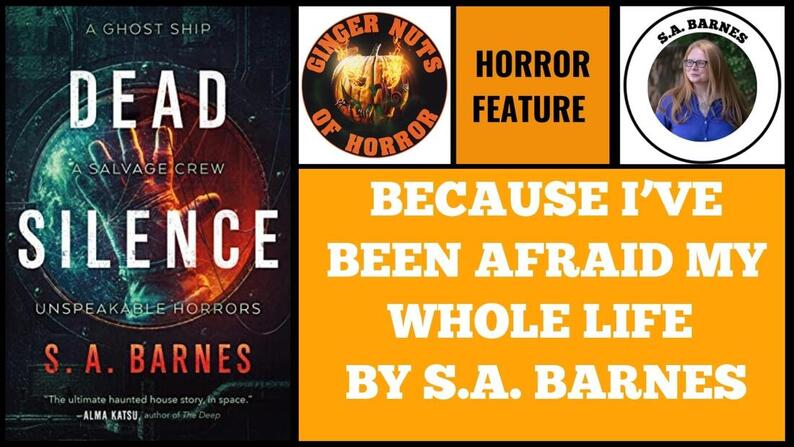 Someone asked me recently in an interview, “Why horror?” A fair question. Over the last decade, I’ve written in a variety of genres from young adult science fiction to adult romance. “Because I’ve been afraid my whole life,” was my rather glib on-the-spot response. But, glib or not, it happens to be true. I wasn’t officially diagnosed with an anxiety disorder—Generalized Anxiety Disorder with OCD—until I was in my early thirties. However, it’s been part of my life since my early teens or possibly before. One of my earliest memories is searching my neck for strange bumps or lumps—my beloved grandfather had just been diagnosed with cancer and I was convinced I had it as well. For whatever reason, my anxiety tends to present itself as worry about diseases. For years, before I started therapy, I couldn’t watch or read stories about illnesses—no matter how rare or uncommon—without obsessing over my potential symptoms. If there was a Purple Freckle Syndrome, I could find you a freckle on my skin that matched the description. And then I would spend hours obsessively symptom-checking in a sweaty anxiety spiral, imagining my eventual diagnosis and demise with Purple Freckle Syndrome. In school, I was the shy bookish kid—I read Star Trek novels in class—and I was frequently the new student in class, thanks to my family’s frequent moves. In high school, I would script interactions in my head, coming up with conversational prompts and imagining the resulting scenarios along with my response(s), so that I would never feel caught off guard or out of control. Hello, OCD! In college, one of my best friends would gently tease me about my need to have certain shirts on certain hangers. Logically, I knew that that flannel on that hanger wouldn’t have any bearing on my day being good or bad. But it felt wrong. Like, that tight feeling in your chest when you think you left the house with the door unlocked or the stove on. Just inviting destruction and danger. It was easier to put the shirt on the right hanger. Every time. As you can imagine, uncontrolled and endless anxiety at that level can take over your life. Clinical anxiety is not something you can dismiss by “thinking positively” or “focusing on something else.” Everyone has moments of anxiousness for various reasons—health concerns, job interviews, relationship issues—but one of the ways in which Generalized Anxiety Disorder sucks is that it doesn’t have a root cause. Anxiety because of a job interview goes away when the interview is done. GAD is just…there. Always. When I discovered horror novels in middle school, I couldn’t get enough. Christopher Pike (Remember Me and Weekend), Steven Charles (the Private School series), V.C. Andrews (Flowers in the Attic and My Sweet Audrina), Dean Koontz (Strangers) and then, of course, Stephen King. I read It over and over again. I’m fairly sure I was drawn—am still drawn—to horror because it made sense of my world. I could relate to the characters who were terrified and out of their depths. Their formerly safe, familiar world had become one full of dangers they couldn’t escape and didn’t know how to handle. But, unlike in real life, there was a concrete reason to be afraid. These characters would eventually determine the source of their terror and attempt to stop it. And one way or another, their fear would end. They would have closure—frankly, in most of the books I liked, they would triumph over the evil thing/person trying to hurt them. I loved that. It’s taken me years—and professional help—to see that while anxiety has certainly made my life harder, it has also had a huge influence on my writing in a mostly positive way. My obsessive focus on detail is an advantage when it comes to describing scenes. All that advance scripting I did in high school? Great practice for dialogue. That part of the book where the situation just gets worse and worse for our intrepid hero or heroine? Worst-Case-Scenario Girl to the rescue! But primarily, I think it’s led me to focus on characters who struggle with their own fears, characters who may not entirely trust themselves. In Dead Silence, Claire Kovalik, reluctant team leader of the LINA, struggles with her past trauma and she doesn’t trust her own perceptions of reality. She sees things—ghosts or hallucinations, manifestations of her own guilt—and she can’t tell which they are or what to do about them. I know that feeling. I know what it’s like to have a doctor ask about symptoms and not be able to accurately describe my own condition because I can’t tell if what I’m feeling is “real” or caused by my anxiety and obsessiveness. (Not that anxiety-induced symptoms aren’t real, but they certainly make it more difficult to accurately report what’s happening. Has that mole changed shape or color? Maybe…but I’ve also been poking at it for three weeks.) Because of my anxiety, I have trouble telling when a situation is worth worrying about. Which, basically, translates to being unable to trust my own perceptions. I love writing about an unreliable narrator because, well, I have experience with being one. I find writing about fear and uncontrollable situations therapeutic, in a way, because it makes me feel less alone. So, why horror? Because, in a small but very real way, it’s what I know. ______ Dead Silence by S.A. Barnes will be available from Nightfire Books in hardcover, eBook, and audio digital download on January 25, 2022. Dead Silence |


Archives
April 2023

|







 RSS Feed

|

|