

Top Ten facts about the bizarre Belgian painter and sculptor Antoine Wiertz (1806- 1865)While his name is mostly unknown outside a small circle of aficionado’s of the gothic and horror and dark tourism and museums, some paintings of Antoine Wiertz continue to circulate, and can be found on the cover of books such as “Buried alive” and the short stories of Edgar Allan Poe, nearly his exact contemporary and with whom he shares his taste for the bizarre, the macabre and the downright horrible. It is not for nothing that three of Wiertz’ canvases seem a perfect illustration to three of Poe’s tales: “The beautiful Rosine”, staring at her own skeleton, seems the poor heroin of “The oval portrait”, the man on “Buried alive” seems like Poe crawling out of his own coffin in his tale with the same name, while Wiertz” “One second after death” seems to illustrate the exact moment of death that Poe describes so wonderfully in his philosophical tale “The power of words”. Antoine Wiertz’ legacy lives on in his museum in Brussels, Belgium, a nineteenth century house and studio with garden that the government built at its own costs for him, and still stands bang in the middle of the hypermodern neighbourhood of the European Community. Is its very existence in danger? True to the word “Brusselization” or the government and politicians not taking care of the cultural legacy of the city, some view it as obsolete, while with a bit of fantasy and new technology the studio of the painter could be transformed into a real palace of horror and the grandiose. Here are ten astonishing facts about this astonishing artist:  10. Wiertz inadvertently became the predecessor of artistic movements such as Symbolism and Surrealism, and eventually the Grand Guignol theatre and the slasher movie genre due to the gruesome and gratuitous violence in many of his canvases. After his death in 1865 his house and studio were transformed into a museum and attracted a lot of visitors during the next decades and up to WWI. Among them were the founder of the surrealist movement, André Breton, and Salvador Dalì, who saw Wiertz as a real genius who inspired his vision on what Art should be. In this century the interest for this bizarre and macabre artist is growing, and more and more internet sites study Wiertz’ oeuvre. Wiertz himself stated that the merits of an artist can only be judged at their real value two centuries after his death. Well, Antoine Wiertz, that will be for you in 2065, but in the meantime let’s take a look at the more bizarre aspects of your work and personality. 9. Antoine Wiertz was a feminist avant la lettre and made “charity paintings”. “The burnt child” tells the true story of a widow coming home from work and finding the cradle with her baby near the chimney on fire. Wiertz makes a painting of this gruesome scene, and organizes an exhibition to help the poor mother financially so she will be able to pay the doctor’s bills for her child. The lesson of the tableau is: “S’il y avait des crèches” (if there only were nurseries): Wiertz clearly states that the government must create nurseries for the children of mothers who have to go out to make a living. 8. Wiertz was one of the very first artists to give the Devil or Satan the appearances of a handsome and sexy young man. Traditionally the Devil, be his name Satan or Lucifer, was portrayed as a kind of Pan like satyr with the horns and hoofs of a ram. But Lucifer is after all a fallen angel, and Antoine Wiertz, not indifferent to the male beauty, paints him as a seductive and fatally attractive young man, especially on his triptych “The entombment of Christ” and his canvas “The suicide”. He paves the way for the Decadents and Satanists later in his century, his idea lives on in the song “Pleased to meet you” by the Rolling Stones, and the pale beauty of Satan in Mel Gibson’s “The passion of Christ”. 7. Belgium remains one of the countries with the highest tax rates, and that was already so in Wiertz’ time. The gap between rich and poor was also much wider due to the voting system and the industrialisation, which left many people on the brink of famine. In “Faim, Folie, Crime” (Hunger, Madness, Crime), Wiertz paints a mother gone mad in her slum. She has no milk in her breasts to feed her baby, on the floor an onion and a carrot. In total despair the woman has cut off the leg of her baby and thrown it into the cauldron to make a broth out of it. On the floor a letter: “Contributions” (Taxes), the State has deprived this mother and her child from the essentials to survive, with the murder of an innocent victim as a result. 6. As a leftwinger Wiertz was resolutely against the death penalty, which was in Belgium in his epoch by means of the guillotine. He believed a guillotined head kept on living for three to four horrible minutes after decapitated, a widespread opinion since the French Revolution To prove this Wiertz hides under the scaffold at the Porte de Halle in Brussels while a hypnotiser makes him enter into the brain of the to be decapitated criminal. Wiertz keeps on talking for three minutes after the head has fallen into the basket, and describes the enormous pain, angony and fright of the criminal man before he flies away to another world. He paints a triptych: “Thoughts and visions of a severed head”, his explanatory text of the experiment under the scaffold will become a play in 1924 in the “horror” theatre of the Grand Guignol in Paris. 5. Wiertz was one of those strange geniuses who ironically died of his own invention, in this case his “peinture mate” (mat paint). Trained in the Flemish tradition he liked oil painting because it permits to works slowly and meticulously, although the surface can be shiny. The Italian al fresco technique demands a much faster brush stroke, but it has the advantage of being mat and not reflecting light. Wiertz tried to combine the advantages of these two techniques by creating his own paint formula with a lot of chemicals in it. He tried also -in vain- to sell his invention for an enormous amount of money to the tsarina of Russia, Maria Alexandrovna. Wiertz’ invention proved to be a complete disaster: the canvases he painted with his new formula have slowly been eaten by the chemicals and suffer from various stages of damage. More tragic: the toxic gazes that emanated from Wiertz’ palette also slowly destroyed his lungs, and he died deliriously during a heavy thunderstorm in June 1865 in his home due to paint poisoning. 4. Due to the industrialisation, dehumanization and population growth in the cities epidemics like the cholera were very frequent in the nineteenth century. These facts also led to one of the biggest fears of that epoch: being buried alive. Special coffins with bells were sold, Poe wrote stories about living women being buried alive in a state of catalepsy, Wiertz painted maybe his most famous tableau around the theme, “The premature burial”, a manifesto against incompetent doctors. We see a man trying to crawl out of a coffin in a crypt, on this coffin the following words are painted: Cause of death: cholera, testified by doctor Without Any Doubt. To give the viewer the impression of being buried alive, Wiertz placed the canvas and some flickering candles behind a panel with a peephole in it. And by the way, in the German silent film of 1922 by Friedrich Murnau, “Nosferatu”, the vampire comes out of his coffin in exact the same way as the man buried alive on Wiertz’ canvas. 3. As most of the Romantic artists, Wiertz was not always a mentally stable man. He suffered from depressions, mood swings, and eventually suicidal tendencies. Considering his huge canvases as “The triumph of Christ” and “The light of Golgotha” he was a Christian, although of the anticlerical kind: in “Factions judged by Christ” he shows two potential popes fighting for the papal throne while Christ closes his eyes in despair. When in 1848 Karl Marx published his communist manifesto preaching materialism, Wiertz began to doubt about the existence of God. His doubts are illustrated by the gruesome tableau “The suicide”: a young man shoots a bullet in his brains, his Guardian Angel looks on in horror while the handsome Devil smiles maliciously for having dragged another soul into Hell. The reason of the young man’s suicide becomes obvious when we look at some details. One of the books has the title “materialism”, while the goodbye note of the young man states: “Il n’y a point d’âme, il n’y a point de Dieu” (There is no God, we have no souls). 2. Wiertz predicted in the first half of the nineteenth century that Brussels would become the capital of Europe in the future. After his demise at the Paris Salon of 1839 with his huge, heroic painting of “The Greeks and the Trojans fighting over the corpse of Patrocles”, he swore an eternal hate against France and the French, resulting in a bizarre drawing: Paris is annexed as a small suburb by the ever expanding and more important capital of Europe, Brussels, Belgium, Wiertz’ slogan is: “Paris province, Bruxelles capitale” (Paris province, Brussels capital city). 1. Besides being a painter Wiertz was also a rather gifted sculptor, and although he made some projects for larger scale monuments, his sculptures are all rather small, like saucy girls in various states of undress, and warriors killing each other with knifes. And then there is the sculpture of the allegory of Light, a woman holding a torch in her uphold arm and defeating barbarism. Wiertz created it in 1862, and his intention was to construct a gigantic version of it on top of the fortress of his native city, Dinant, in what is now Belgium. The resemblance with the Statue of Liberty is striking. After Wiertz died in 1865 his atelier in Brussels became an attraction for many people, including artists from nearby Paris, like Frédéric Auguste Bartholdi, the sculptor who with the aid of Gustave Eiffel was responsible for... the Statue of Liberty. The monument was France’s gift to the USA for the centennial of the American Revolution in 1876. In a certain way Wiertz’ Triumph of Light has thus become the symbol of that continent America he never had the chance to visit. ON ANTOINE WIERTZ Antoine Wiertz 1806-1865, met bijdragen van A. MOERMAN en F.-C. LEGRAND, Parijs-Brussel, (1974) CHARLEMAGNE, A Belgian national champion. A terrible lesson from a terrible painter, in The Economist, 9 juliy2009 H. COLLEYE, Antoine Wiertz, Brussels, 1957 M. DASH, Some experiments with severed heads, post on blog entitled Strange stories. But with sources, 25 January 2011 (http://allkindsofhistory.wordpress.com/2011/01/25/some-experiments- with-severed-heads/), 18 May 2013, 00.19 GMT L. LABARRE, Antoine Wiertz. Etude biographique avec les lettres de l’artiste et la Photographie du Patrocle, facsimile, Brussels, (1866) D. LAMY, Deux jeunes filles ou la belle Rosine, in Revue des archéologues et historiens d’art de Louvain, XVII, 1984, p. 264-271 Les relations de Monsieur Wiertz, cat. exhibition, 2 volumes, Namur, 2007 A. MOCKEL, Antoine Wiertz. Esquisse d’une étude sur l’homme et son oeuvre, Brussels, 1943-44 J. POTVIN, Antoine Wiertz, Brussels, 1924 B. STOELTIE, Het minst bezochte museum van Brussel: een monument van Weltschmerz, in Vrij Nederland, 4 juni 1988, p. 22-27 B. VERSCHAFFEL, “M. Wiertz se créa un musée’. Kunst en politiek in het “geval” Antoine Wiertz (1806-1865), in De witte raaf, editie 144 maart-april 2010 L. WATTEAU, Catalogue raisonnée du Musée Wiertz, (Brussels), 1865 A. J. WIERTZ, Oeuvres littéraires, facsimile, Brussels, 1869 further reading Jan Vander Laenen (° 1960) lives in Brussels, Belgium, where he works as an art historian and translator (Dutch, French, Italian, English). He is also the author of numerous collections of short stories, plays, and screenplays which have attracted keen interest abroad. A romantic comedy, "Oscar Divo", and a thriller, “The Card Game”, have been optioned in Hollywood, while his short fiction collections, "The Butler" and "Poète maudit", and his horror play "A Mother's Revenge" are eliciting the requisite accolades in Italy. His most recent publication are the tales “A Glass of Cognac” in “Bears: Gay Erotic Stories” (Cleis Press), “Epistle of the Sleeping Beauty” in the Bram Stoker Award winning “Unspeakable Horror” (Dark Scribe Press), “Fire at the Chelsea Hotel” in “Best Gay Love Stories 2009” (Alyson Press), “The Stuffed Turkey” in “Best Gay Erotica 2010 (Cleis Press),“The Corpse Washer” in Best S/M III (Logical Lust), “Lise” in “Strange Tales of Horror” (NorGus Press), the E-Books “Skilfully and Lovingly” (Sizzler Edition) and “The Centrefold and other Stories of working Men” (Silver Press), and the Dutch and French version of his novel “The housekeeper and other scabrous tales” (‘t Verschil, Antwerp (Belgium) - Textes gais, Paris (France)), the weird tale “The bat” in the anthology “A Darke Phantastique” (Cycatrix Press), “Petit papa Noël” in the anthology “Un cadeau de noël pour le refuge” (Textes gais, Paris), and the essay “The monstrous and the fantastic in the short stories of Poe and the paintings of Wiertz” (Weird Fiction Review). Jan is a member of the Horror Writers Association and the Poe Studies Association. He presented his paper "Hypotheses on Poe's homosexuality" at the Bicentennial Congress in Philadelphia in October 2009 and “Poe as a latent homosexual, as suggested by Marie Bonaparte” at the New York Conference in February 2015. He has also given lectures on Baudelaire, Wiertz, Andersen, Guy de Maupassant, Grand Guignol and the guillotine at the universities of Porto (Portugal), Ghent (Belgium), Louisville (Kentucky), Madrid (Spain), and the Paris Sorbonne and Diderot universities. Jan performed in the successful “Gala” by French choreographer Jérôme Bel in theatres in Brussels in May 2015 and December 2017, and he is taking acting classes to study as an author “the other side” of the written page. Jan is currently working on a play/screenplay around the life of the Romantic Belgian "horror" painter Antoine Wiertz (1806-1865), a novel called "The Psychomanteum" around the practice of mirror gazing, and a screenplay around the life of Lucida Mansi. In July 2020 he finished his scandalous trilogy "Paulo or the obscene life of a gay escort" (240.000 words). He has also written recently three 30 minutes episodes for a series "Horror without frontiers", ten others are in the make. TODAY ON THE GINGER NUTS OF HORROR WEBSITETHE HORROR OF MY LIFE ALARIC CABILING THE HEART AND SOUL OF HORROR FEATURES
Yeye’s Girl by Ohne Re [An Excerpt from Zhiguai: Chinese True Tales of the Paranormal and Glitches in the Matrix]; Translated by Yi Izzy Yu and John Yu Branscum In China, many people believe that the dead visit their loved ones, especially shortly after death. Sometimes when they do, they hurt the living. They don’t mean to. But dying is a big shock, and the minds of new ghosts are often cloudy and damaged. Even those new ghosts who retain their wits can accidentally hurt you. In my family, for example, the ghost of my yeye [grandfather] would sometimes visit us. We could always tell who he had come to see because that person would get violently nauseous, and their stomach would hurt in a very particular way. This, my grandmother said, was a result of ghosts being made mostly of yin energy, while human beings were made mostly of yang energy. Whenever we would suspect my grandfather might be visiting, we would do “the chopstick test” to make sure. This is where you stand three chopsticks up in a bowl of water, while calling out the name of a spirit that you suspect is in the room. If they are in the room, after you remove your hands from the chopsticks, they will remain standing. I saw this happen several times. It was very unsettling. The following story is even more so. —YIY When I was three and a half, my yeye drank pesticide and killed himself. To understand why, you first have to know this: from the day I was born, Yeye loved me dearly. He fell in love with me, he said, as soon as he saw my tiny face. And on that very day, he asked my parents to move in so that he could watch me while they worked. In China, it is common for one grandparent or another, or even an aunt or an uncle, to move in with new parents to help look after children. But my grandfather had a characteristic that worried my parents. He was addicted to liquor and drank it every day. A lot of it. Because of this, my father denied Yeye’s request. Yeye’s feelings were hurt but not enough to quit drinking. Not at first. After all, my dad still let me stay with him and my grandmother during the Lunar New Year and Autumn Festival holidays. So for a while, he was able to have liquor and me both. However, my parents eventually started to worry about this unsupervised time too. And my dad picked me up from these visits earlier and earlier. When Yeye noticed that our time together was dwindling, he devised a strategy to avoid my father. As soon as he saw my father’s car, he would hoist me on his back and race up the mountainside behind his house to hide and play until my dad gave up looking for us. But Yeye knew his trick would not last forever. After all, my dad could just refuse to drop me off. So finally Yeye did it. He went to my parents and solemnly promised not to drink liquor anymore. At first, my parents didn’t believe him. But when he didn’t touch a drop for several weeks, they talked. Afterwards, my father called Yeye and told him that he could move in for a year and watch over me. And he could begin this new role on his birthday. That would be their present to him. Yeye’s eyes filled with tears at the news. He was so full of excitement that it was very hard for him to wait until his birthday. Nevertheless, he managed to be patient until the day arrived. But then the whole plan fell apart. It happened like this: My third uncle, who ran a bus business, was supposed to drive the couple of hours to my yeye’s village and then get him to our apartment in time for Yeye’s birthday celebration and first night as my caretaker. That was the plan. But my uncle started in a game of cards with friends early that morning and got lost in that. By the time he remembered Yeye, it was too late. Today, of course, everyone would be constantly calling everybody else to check on everything. But this all happened before there were cell phones. True, we were one of the few families with a landline. But we could only afford one. And my dad kept it in his office, which was located in another apartment in our building. That’s why when it started getting so late that something was obviously wrong, my dad decided to walk to my uncle’s. He thought that maybe my uncle had misunderstood the plan and driven Yeye to his place to wait on us. Just before my dad got out of the building, the phone in his office began ringing—over and over—and would not stop. When he answered it, he heard my grandmother’s voice. “Your father’s gone,” she said. * * * My yeye waited for my uncle a long time. He waited until he became convinced that no one was coming and that my dad had changed his mind. Sad to lose my dad’s trust again, and his chance to be with me, Yeye drank a glass of alcohol. Then another—all the while crying his heart out. When the alcohol didn’t dull the pain, he drank a bottle of pesticide. My grandmother watched him drink the pesticide—but she thought he was just drinking more alcohol. Even when she went out a little later to go shopping and came across him completely still on a sofa, she just thought he had fallen asleep. But then she came back home and tried to shake him awake. * * * The first seven days after Yeye died were filled with funeral preparations. My mom had to use up all her sick days from work to get everything done. My dad was very busy with the preparations too. So neither of them had time to look after me. That’s why on one of these days, they sent me to a daycare. I seemed okay when my father dropped me off that morning. But when he came to pick me up later, he couldn’t wake me. Not completely. I’d mumble and stir but immediately drowse off again. Worried, he asked the daycare attendant how long I had been sleeping. “Most of the afternoon,” she said. “She was asleep during snack time and also when her grandfather visited.” The attendant told my father that she was so concerned by my deep sleeping that she asked the daycare nurse to take a look at me. The nurse said that I was probably just catching a cold, and my body was fighting it. The attendant’s words didn’t make my father feel better. Not only did he still find my deep sleeping strange, but the comment about my grandfather visiting unsettled him. Since his father was now dead, this grandfather had to be my mother’s dad. But neither my dad nor my mom had mentioned to anyone that they were going to drop me off at the daycare. So how did my mom’s father know I was there? And why had he even visited? Confused, my dad asked the attendant what my grandfather looked like. She gave him a long careful description that included the wearing of a unique black fedora. My dad was so shocked he couldn’t breathe. She had described his dead father, my yeye, perfectly. My dad rushed me home, and he and my mom tried everything to wake me. Pushing pressure points. Slapping my feet. Pricking my middle fingertips with an acupuncture needle. Nothing worked. Suspecting my problem was related to the daycare visit by my yeye’s ghost, he and my mother carried me to a psychic. The psychic confirmed their worst fears. “Yes,” she told them. “You’re correct. Your daughter’s problem is her grandfather. He’s attached himself to her. He loves her very much and doesn’t mean harm. Nevertheless, the attachment is draining your daughter’s strength.” Frightened, my parents begged for the psychic’s help. She agreed but said that she couldn’t help until the next morning. That’s when the sun was powerful enough to give her the yang energy she needed to fight the ghost. When morning came, the psychic set up a square table in our living room. She sat in front of it, meditating and chanting, while my father—per her directions—walked around our yard, holding a black umbrella and shouting my name. After they’d done a bit of this, the psychic took a chicken out of a wooden carrier, cut its head off, and used the bloody neck stump to paint magical symbols on a stack of yellow papers. These she pasted all over the walls. When she finished with the last one, I woke up. The unhealthy bond between my yeye’s ghost and me was broken, the psychic explained. But I would still be vulnerable to ghostly influences for a long time. So the paper talismans should stay on our walls. The talismans stayed up until I turned eight. * * * Some people question whether the psychic and her rituals really helped. Maybe I would have woken up anyway, they say. Maybe. But I’m convinced that they worked. This is because of what I remembered when I awoke. After Yeye walked into the daycare that day, he led my spirit away from my sleeping body to a Western-style carnival. (It’s important to say here that all of this was very real and not like a dream. To this day, for example, I can still recall how things felt, tasted, and smelled at the carnival.) The carnival surprised me. I had never seen it before in our town. And, at this time of my life, I had never even been to a carnival or encountered one on TV. This was 1993. Just like phones, televisions were still rare and so were Western-style carnivals. Nevertheless, I had a really good time there. I ate a big strawberry candy, rode on a Ferris wheel, then in a bumper car, and finally on a giant car-shaped ride that swung in the air. But there was one bad thing. Or at least strange. The weather. Ever since Yeye and I left the daycare, the sky looked wrong. It was an odd, ashy gray—stained with purple. A very scary kind of color, as if a big storm was about to break. It didn’t rain though. So we kept playing and eating delicious food. But even carnival fun can last too long. And after what felt like two days passed, I was so exhausted that I could barely stand. When I complained to Yeye, he hoisted me on his back and took a couple of steps forward. Suddenly, we were no longer walking on the carnival grounds but on the mountain road next to his and my grandmother’s house. Trees lay to the sides of the road. Icicles hung from several. Yeye and I took turns snatching them off the branches and eating them like popsicles (people in the mountains did this all the time when I was a kid). I had just about finished one of these tree-sicles when abruptly I found myself back at my parent’s place, fully awake, my opened eyes taking in my parents, the psychic, and the talismans all over our walls. This is how I know the rituals really helped. * * * After I woke up that day, I rarely saw my yeye—just a dream every year or so. Three dreams were especially vivid. I think these might have been actual visits. In one, Yeye was digging a hole in the ground—a deep one as tall as a person. When he looked up from his work and saw me, he handed me some candies. “Why are you digging?” I asked him. He told me the hole was part of a highway and that he was part of a work crew. He could have chosen other kinds of work, but the highway construction project was the closest to me. He intended to stay on it another twenty years. That way, he said, he could watch out for me. The second dream occurred when I was grown up and just starting college in another city—far from where I and Yeye had once been so close. In it, I was walking across a field when I suddenly came across Yeye sitting on a stone seat outside a yard with super high walls. “What are you doing here outside the wall?” I said. Yeye told me that someone had cut down the shade tree near his house and he was sitting under the wall to get some shade. The next day I called my mom and told her about the dream. She said it was just a random dream and not to be so serious about it. But then a few days later, she called me back. “Your dream meant something,” she said. It turned out that my fourth aunt’s husband had cut down the tree in front of Yeye’s grave. The most recent dream happened in 2015. It was different from the others. While I could hear Yeye’s voice, I couldn’t see him. It was like we were standing in a large dark room. “I have to leave you, little one,” he said. “It’s time for us to let each other go. You have to look out for yourself now. Don’t fight this. It is the right thing.” I promised him I would do my best to let go. Since then I have not dreamed of him once. My yeye really, truly, so deeply loved me. Even more than my dad. No matter his faults, he constantly showed me this. If I wanted candy, he would buy a big box and then another big box. If I wanted to eat watermelon, he would get one of those big, twenty-five-pound ones. If I wanted clothes, he would buy me three outfits and let me switch from one to the other—all on the same day. Sometimes, his generosity drove my dad crazy. He would yell at me for asking Yeye for so many things. At those times, Yeye would jokingly chase my dad out into the street and threaten to beat him with a stick for scolding me. Once, a chicken that Yeye raised scratched me. The next thing I knew the chicken was cooked into a soup for me. He never raised any more chickens in his yard after that. My dad sometimes says that if Yeye were still alive, I would have turned out to be a spoiled, rotten girl. I’m not certain that is true. Anyway, it’s approaching midnight now. I miss my yeye. That’s all I wanted to say. Further Reading [Book Review] ZHIGUAI:CHINESE TRUE TALES OF THE PARANORMAL AND GLITCHES IN THE MATRIX TRANSLATED BY YI IZZY YU & JOHN YU BRANSCUM[Feature Article] SOME OF OUR FAVORITE HORROR STORIES ARE NOT FICTION: THOUGHTS ON HORROR CREATIVE NONFICTION BY YI IZZY YU AND JOHN YU BRANSCUM About Yi Izzy Yu In 2011, Yi Izzy Yu left Northern China for the US, with nothing but $500 in her pocket and a love of Chinese horror and paranormal stories that she'd inherited from her grandmother. Since then, she has acquired a PhD in Applied Linguistics, taught Chinese and English in high schools and universities, DJ'ed a radio show on K-pop, and married John Yu Branscum. Her work has appeared in such magazines as Strange Horizons-Samovar, New England Review, Passages North, Dusie, and Cincinnati Review, been nominated for awards ranging from the Year's Best Microfiction to Sundress Publications' Best of the Net, and has placed as a finalist for the international [Gabriel García Márquez] "Gabo" Award for Translation and Multilingual Literature. Currently, she lives outside of Pittsburgh, where she teaches and translates Chinese and investigates shadows. She loves so many things. About John Yu Branscum Egregore, writer, and translator John Yu Branscum has published book-length work with Sarabande Books, Argus House Press, and Empress Wu Books. His short form work has appeared in journals ranging from New England Review and Apex Magazine to Passages North, Samovar, and Cincinnati Review. He is a past recipient of the Ursula Le Guin Award for Imaginative Literature, the Linda Bruckheimer Award for Literature, the Appalachia/Affrilachia Award for Poetry, and the Gabo Award for Translation and Multilingual Literature (as a finalist). He enjoys family rave night, durian fruit, lucid dream vacations, and roaming around his neighborhood in a werewolf costume during full moons. Currently, he is in the middle of a long-term performance art project that involves working as an English professor. ZHIGUAI: CHINESE TRUE TALES OF THE PARANORMAL AND GLITCHES IN THE MATRIX: 1  In this collection, award-winning writers and translators Yi Izzy Yu and John Yu Branscum share paranormal and glitch in the matrix tales from across present-day China. Confided by eyewitnesses, these true stories uncannily echo Western encounters with chilling dimensions of reality and supernatural entities. At the same time, they thrillingly immerse the reader in everyday Chinese life and occult beliefs. Zhiguai: Chinese True Tales of the Paranormal and Glitches in the Matrix includes such accounts as: *The reincarnation of a teenager whose fate eerily mimics his predecessor’s *A girl who dies in the womb but nevertheless continues to communicate with her twin *Terrifying shifts into demonic parallel universes *Walls desperately painted with blood to save a family from tragedy *Huge populations that disappear into thin air *The revenge-seeking ghosts of murdered cats *Weird temporal shifts *Occult murders From the terrifying to the uncanny, this collection will not only change your understanding of China but of reality itself. TODAY ON THE GINGER NUTS OF HORROR WEBSITEFILM GUTTER REVIEWS: THE TOXIC AVENGER (1984) DIR. MICHAEL HERZ AND LLOYD KAUFMAN the heart and soul of horror features
Comic-books are a medium, not a genre; they can tell any story and suit any palate. You want horror? I've got bottles of the stuff. Welcome to 'Splashes of Darkness.'  SPLASHES OF DARKNESS: THE LITTLE SISTERS OF ELURIA |

![YEYE’S GIRL BY OHNE RE [AN EXCERPT FROM ZHIGUAI: CHINESE TRUE TALES OF THE PARANORMAL AND GLITCHES IN THE MATRIX];TRANSLATED BY YI IZZY YU AND JOHN YU BRANSCUM](../../uploads/3/4/5/1/34519054/yeye-s-girl-by-ohne-re-an-excerpt-from-zhiguai-chinese-true-tales-of-the-paranormal-and-glitches-in-the-matrix-translated-by-yi-izzy-yu-and-jo)


![[FEATURE] DOCTOR TERRIBLE’S HOUSE OF HORRIBLE: A RETROSPECTIVE BY DAVID COURT](../../uploads/3/4/5/1/34519054/feature-doctor-terrible-s-house-of-horrible-a-retrospective-by-david-court_orig.jpg) | It was no longer sufficient to have the star power of Christopher Lee glaring menacingly off camera – sex was needed to sell your movie as well; a perfect storm of boobs, bodices and blood. |
[FEATURE] DOCTOR TERRIBLE’S HOUSE OF HORRIBLE: A RETROSPECTIVE BY DAVID COURT
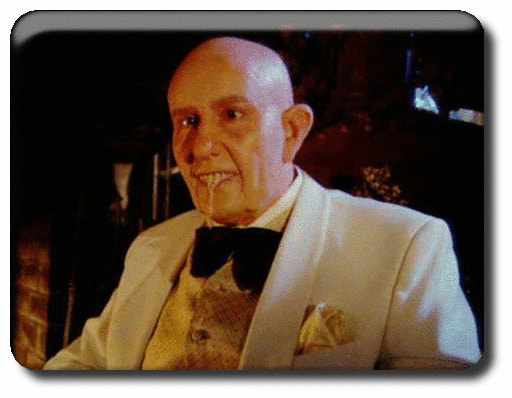
“Good evening. I’m Doctor Terrible. Welcome to my House of Horrible.”
The late nineties/early 2000s were a fantastic time to be a fan of horror on Britiish Television; from Channel 4’s gritty Vampire-series-that-never-mentions-the-V-Word “Ultraviolet”, Channel 5’s Horror anthology “Urban Gothic” (discussed on these very pages at length by the awesome John McNee) through to the superlative Garth Marenghi’s Darkplace.
Creeping in in the year 2001 was a series that arrived with little fanfare and achieved so few viewers that it was never recommissioned for a second series. This was despite a stellar cast, lead actor Steve Coogan’s star still being (mostly) in the ascendance, and the already proven track record of relatively newly formed production company Baby Cow Productions.
That series was Doctor Terrible’s House of Horrible, and it was truly diabolical (and not to be confused with the similarly named Doctor Horrible of Sing-along-blog fame).
Doctor Terrible’s House of Horrible was a satirical, yet affectionate spoof (and tribute) to the 1970s British horror films of Amicus and Hammer, consisting of a total of six episodes. Each episode was a spoof of a style of horror film, rather than a direct snipe at any film in particular.
Steve Coogan portrayed the eponymous host beneath several layers of prosthetics, a creepy bald white-suited individual sat in his study, open fire blazing. He opens and closes each episode like a slightly less sinister and anti-Semitic Roald Dahl with choice words of wisdom. The concept of a horror host is more familiar to American audiences (for instance, Cassandra Peterson as Elvira) but the framing mechanism here provides a familiar continuity, much as the same technique used in the earlier series of Tales of the Unexpected – the old tradition of being read a ghost story before bedtime. He’d star in each episode as well, mostly as the lead. Well, it was half his production company, after all.
Creeping in in the year 2001 was a series that arrived with little fanfare and achieved so few viewers that it was never recommissioned for a second series. This was despite a stellar cast, lead actor Steve Coogan’s star still being (mostly) in the ascendance, and the already proven track record of relatively newly formed production company Baby Cow Productions.
That series was Doctor Terrible’s House of Horrible, and it was truly diabolical (and not to be confused with the similarly named Doctor Horrible of Sing-along-blog fame).
Doctor Terrible’s House of Horrible was a satirical, yet affectionate spoof (and tribute) to the 1970s British horror films of Amicus and Hammer, consisting of a total of six episodes. Each episode was a spoof of a style of horror film, rather than a direct snipe at any film in particular.
Steve Coogan portrayed the eponymous host beneath several layers of prosthetics, a creepy bald white-suited individual sat in his study, open fire blazing. He opens and closes each episode like a slightly less sinister and anti-Semitic Roald Dahl with choice words of wisdom. The concept of a horror host is more familiar to American audiences (for instance, Cassandra Peterson as Elvira) but the framing mechanism here provides a familiar continuity, much as the same technique used in the earlier series of Tales of the Unexpected – the old tradition of being read a ghost story before bedtime. He’d star in each episode as well, mostly as the lead. Well, it was half his production company, after all.
Lesbian Vampire Lovers of Lust (Originally shown on BBC2 on November 12th, 2001)
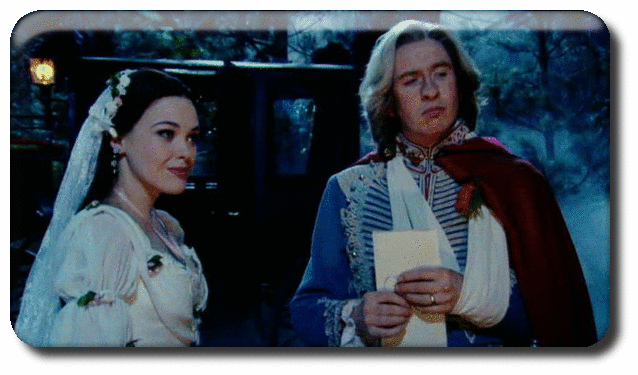
“Sappachu Vampiricism; the love that dare not spell its name. But surely, you say, there’s no such thing as vampires, or lesbians. But what’s that under the bed? And who’s that in the closet?”
Setting its stall from the outset (and if that title isn’t going to attract viewers to a new and unproven series, nothing will) Lesbian Vampires of Lust is a gentle piss-take of Hammer’s late sixties and nineteen-seventies obsession with acres of pale-skinned cleavage (“The Vampire Lovers”, “Twins of Evil”, etc). It was no longer sufficient to have the star power of Christopher Lee glaring menacingly off camera – sex was needed to sell your movie as well; a perfect storm of boobs, bodices and blood.
In the tale, Coogan plays the dashing Hans Brocken, a perfectly coiffured dashing Military captain whose hand is, erm, broken (That’s the level of satire, folks – and it’s all the better for it). It’s 1877 and Brocken, and his new wife, are travelling to a remote castle in (Upper) Carpathia for their honeymoon. Little does he suspect that he and his virgin bride are heading into Vampire Territory ruled by Ronni Ancona’s Countess Kronsteen. Honor Blackman (as Transeet Van Eyre) gently lampoons the type of roles she was playing in the seventies, and the episode also features a never-camper Ben Miller. It’s one of the stronger episodes in the series, and is a great introduction to the style of humour that will continue over the short-lived series.
It’s of interest that this is the first transmitted episode, but it’s the fourth episode on the DVD.
In the tale, Coogan plays the dashing Hans Brocken, a perfectly coiffured dashing Military captain whose hand is, erm, broken (That’s the level of satire, folks – and it’s all the better for it). It’s 1877 and Brocken, and his new wife, are travelling to a remote castle in (Upper) Carpathia for their honeymoon. Little does he suspect that he and his virgin bride are heading into Vampire Territory ruled by Ronni Ancona’s Countess Kronsteen. Honor Blackman (as Transeet Van Eyre) gently lampoons the type of roles she was playing in the seventies, and the episode also features a never-camper Ben Miller. It’s one of the stronger episodes in the series, and is a great introduction to the style of humour that will continue over the short-lived series.
It’s of interest that this is the first transmitted episode, but it’s the fourth episode on the DVD.
Frenzy of Tongs (Originally shown on BBC2 on November 19th, 2001)

“The last time I saw you, Chang, you were dead.”
“It takes more than death to kill me.”
“It takes more than death to kill me.”
It’s easy to forget that, interspersed with his Hammer Work, Christopher Lee made six Fu Manchu films, the last of two which – “The Blood of Fu Manchu” and “The Castle of Fu Manchu” - with Jesús Franco. Fu Manchu was a villain created by the English author Sax Rohmer, featuring in fourteen of his novels between 1913 and 1959. Fu Manchu even ended up with a moustache named after him, which is no small feat.
Well, Steve Coogan never forgot. “Frenzy of Tongs” is a shrewd – yet slightly offensive – look at that character, a villain created to stoke up anti-Chinese sentiment. A make-up plastered Mark Gaitiss plays Hang Man Chang, a Chinese villain attempting to get the population of London hooked on his drugs. Plastered in make-up that slants his eyes and yellows his skin, it’s not a good modern look. Coogan plays Nathan Blaze, the Peter Wyngarde-esque dashing hero (and I’m beginning to notice a theme here…)
It’s one of the more forgettable episodes in the series, only really memorable for spoofing something from an era that was best left forgotten.
Well, Steve Coogan never forgot. “Frenzy of Tongs” is a shrewd – yet slightly offensive – look at that character, a villain created to stoke up anti-Chinese sentiment. A make-up plastered Mark Gaitiss plays Hang Man Chang, a Chinese villain attempting to get the population of London hooked on his drugs. Plastered in make-up that slants his eyes and yellows his skin, it’s not a good modern look. Coogan plays Nathan Blaze, the Peter Wyngarde-esque dashing hero (and I’m beginning to notice a theme here…)
It’s one of the more forgettable episodes in the series, only really memorable for spoofing something from an era that was best left forgotten.
Curse Of the Blood of the Lizard of Doom (Originally shown on BBC2 on November 26th, 2001)
Curse Of the Blood of the Lizard of Doom (Originally shown on BBC2 on November 26th, 2001)
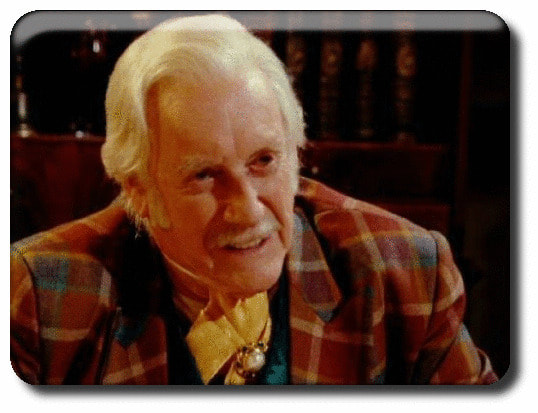
“Tell me, have you ever had the opportunity of working with those unfortunate flame-haired Celts with low skin pigmentation? Let me be frank, Miss Latimer. I’m talking about Gingers, Ginger-nuts, carrot-tops, d’ye ken? This is what I’m presenting to the board. The ultimate challenge. If I can restore the scorched skin of a ginger to its pre-singed freckled majesty, then man will be able to say – I am non-flammable.”
Doctor Donald Baxter (Coogan) is trying to find a cure for skin regeneration in order to cure burns victims. Eventually, frustrated with his lack of progress, he injects himself with an experiment lizard serum and finds himself transformed himself into a giant reptile. Part “Jekyll and Hyde”, part “The Reptile” (a Hammer film starring a young Jacqueline Pierce, 12 years before she’d portray Servalan in “Blake’s 7”), it’s a loving pastiche of the “Good scientist going to evil extremes” trope. (Warning: Contains Steve Coogan and Simon Pegg doing thick Scottish accents)
And Now the Fearing (Originally shown on BBC2 on December 3rd, 2001)
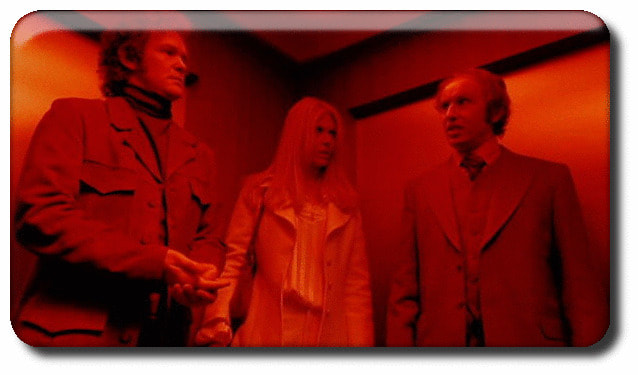
“We all have dreams from time to time. The other night, I found myself back at my old school, in the headmaster’s study. I was thwacking his naked buttocks with a triple-pronged bamboo-backed leather tawse, whilst his wife peed into a Ming vase. Later that night, I had a dream. I wish I could remember what it was.”
This is the first episode on the DVD, but was transmitted as the fourth episode on the original broadcast. It’s my personal favourite of the six, containing three short stories – an anthology within an anthology. It’s a clear spoof of the portmanteau The Vault of Horror in which three people in a new high rise development (Amicus(!) Towers) end up trapped in a lift. TO pass the time until their rescue, they get chatting and end up discussing recent nightmares they’ve all been having, each segueing into one of the three tales.
Coogan plays Denham Denham, the owner of the Amicus building, Julia Davis plays Stephanie Wise and Pointless Lead singer Alexander Armstrong plays Michael Masters. It’s the strongest narrative out of all six episodes, and of course ends up as one of the morality tales that all such portmanteau horror tales ended up being. Evil – be it selfishness, envy or greed - is punished, seemingly for all time.
This is the first episode on the DVD, but was transmitted as the fourth episode on the original broadcast. It’s my personal favourite of the six, containing three short stories – an anthology within an anthology. It’s a clear spoof of the portmanteau The Vault of Horror in which three people in a new high rise development (Amicus(!) Towers) end up trapped in a lift. TO pass the time until their rescue, they get chatting and end up discussing recent nightmares they’ve all been having, each segueing into one of the three tales.
Coogan plays Denham Denham, the owner of the Amicus building, Julia Davis plays Stephanie Wise and Pointless Lead singer Alexander Armstrong plays Michael Masters. It’s the strongest narrative out of all six episodes, and of course ends up as one of the morality tales that all such portmanteau horror tales ended up being. Evil – be it selfishness, envy or greed - is punished, seemingly for all time.
Voodoo Feet of Death (Originally shown on BBC2 on December 10th, 2001)
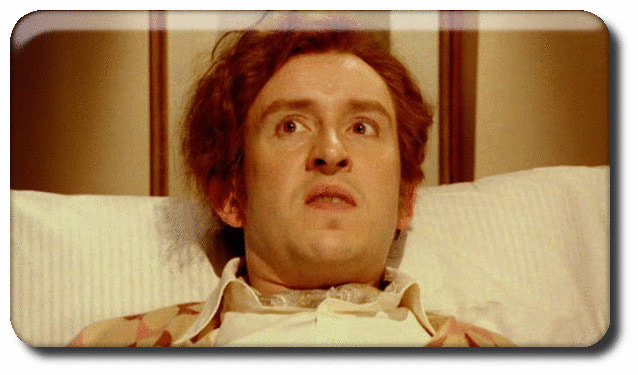
“The operation?”
“It was a complete success. See for yourself.”
“They’re… on the wrong way around!”
“No, Darling., You’ve got your legs crossed.”
“It was a complete success. See for yourself.”
“They’re… on the wrong way around!”
“No, Darling., You’ve got your legs crossed.”
In the sixties and seventies, you couldn’t move for limb transplants being carried out by unethical doctors. Legs, arms, even little fingers, the denizens of Harley Street were all at it – defying their peers to prove that their old science was dated. Little were they to know that, inevitably, and for reasons not ever fully understood, some vestige of the previous owner would remain in the transplanted part. And, invariably, the part would always have come from a psychopath (“Hands of Orlac”, etc)
Voodoo Feet of Death sees Coogan play Lester Crown, a 1930s World Champion Ballroom dancer whose career is cut short when he loses both of his feet in an accident involving a freakishly large pair of scissors. Doctor Lorimer Maitland - Heads, Shoulders, Knees and Toes specialist and Europe’s pioneer in Foot Transplantation – arranges for a foot replacement, but at a terrible cost.
It’s a tale of bitter jealousy that can only ever end one way. Coogan and Sarah Alexander are clearly having their time of his lives playing Crown and his ever patient girlfriend, plummy upper-class English accents and all.
Voodoo Feet of Death sees Coogan play Lester Crown, a 1930s World Champion Ballroom dancer whose career is cut short when he loses both of his feet in an accident involving a freakishly large pair of scissors. Doctor Lorimer Maitland - Heads, Shoulders, Knees and Toes specialist and Europe’s pioneer in Foot Transplantation – arranges for a foot replacement, but at a terrible cost.
It’s a tale of bitter jealousy that can only ever end one way. Coogan and Sarah Alexander are clearly having their time of his lives playing Crown and his ever patient girlfriend, plummy upper-class English accents and all.
Scream, Satan, Scream (Originally shown on BBC2 on December 17th, 2001)
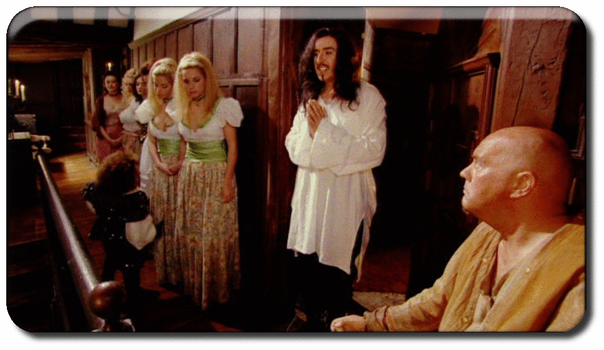
“The last recorded burning of a witch in this country was one Molly McTiernan who weas torched at Walmsley Manor House in Suffolk last Thursday. I can still hear the screams ringing in my ears. Tonight’s tale, however, does not have such a happy ending.”
No series such as this would be complete without spoofing witches, a common trope amongst Hammer and its ilk. In “Scream, Satan, Scream”, Coogan plays Captain Tobias Slater, Witch Locator - clearly based on Matthew Hopkins (as portrayed by Vincent Price in the excellent “Witchfinder General”). Warwick Davies plays Tygon, his assistant (named after the production company behind that same movie).
Tobias Slater is as corrupt as they come, using his position as an excuse to defile as many attractive young virgins as he can. It’s another cleavage-heavy episode, and – of course – Slater gets his just desserts.
The humour feels a little more forced than the other episodes – it certainly has the feel of “Carry on” meets “Witchfinder General” - but it’s still a worthy conclusion to a series which is a loving tribute to the horror genre. If you’re a fan of the double (or in many cases, single) entendre, you’re in for a hoot.
“That was truly diabolical.” – Doctor Terrible
“Doctor Terrible’s House of Horrible” is an absolute steal on DVD from Amazon UK, and well worth picking up. So often it’s the case that our memories of a series are better than the actual rewatch, so it was good to see it hold up. I’d argue it’s only the Fu Manchu episode that remains the weakest, feeling somewhat like a spoof so far – the humour in it has aged badly. Generous extras too; an interesting “Making of” documentary and full audio-commentary with the cowriters and the director.
Tobias Slater is as corrupt as they come, using his position as an excuse to defile as many attractive young virgins as he can. It’s another cleavage-heavy episode, and – of course – Slater gets his just desserts.
The humour feels a little more forced than the other episodes – it certainly has the feel of “Carry on” meets “Witchfinder General” - but it’s still a worthy conclusion to a series which is a loving tribute to the horror genre. If you’re a fan of the double (or in many cases, single) entendre, you’re in for a hoot.
“That was truly diabolical.” – Doctor Terrible
“Doctor Terrible’s House of Horrible” is an absolute steal on DVD from Amazon UK, and well worth picking up. So often it’s the case that our memories of a series are better than the actual rewatch, so it was good to see it hold up. I’d argue it’s only the Fu Manchu episode that remains the weakest, feeling somewhat like a spoof so far – the humour in it has aged badly. Generous extras too; an interesting “Making of” documentary and full audio-commentary with the cowriters and the director.
Further reading/viewing:
As mentioned earlier, John McNee did an excellent series of articles on the TV series Urban Gothic, the first part of which can be found here
The BBC details on “Doctor Terribles House of Horrible” are limited, but can be found here – there are a few clips.
The BBC details on “Doctor Terribles House of Horrible” are limited, but can be found here – there are a few clips.
About the Author
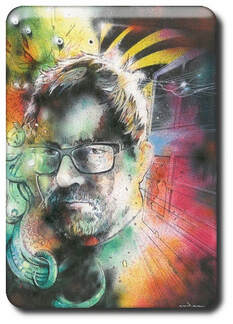
David Court is a short story author and novelist, whose works have appeared in over a dozen venues including Tales to Terrify, StarShipSofa, Visions from the Void, Sparks, Burdizzo Mix Tape Volume One and Corona-Nation Street. Whilst primarily a horror writer, he also writes science fiction, poetry, and satire. His newest collection, Contents May Unsettle, was released in 2021 and his debut comic writing has just featured in Tpub’s The Theory (Twisted Sci-Fi). As well as writing, David works as a Software Developer and lives in Coventry with his wife, three cats and an ever-growing beard. David’s wife once asked him if he’d write about how great she was. David replied that he would, because he specialized in short fiction. Despite that, they are still married..
TODAY ON THE GINGER NUTS OF HORROR WEBSITE
UNBURIED: A COLLECTION OF QUEER DARK FICTION , EDITED BY REBECCA ROWLAND (BOOK REVIEW)
THE HEART AND SOUL OF HORROR FEATURES
![[HORROR NEWS] YOU WANT HORROR MOVIES? WE'VE GOT HORROR MOVIES](../../uploads/3/4/5/1/34519054/horror-news-you-want-horror-movies-we-ve-got-horror-movies_orig.jpg) | “Hellbender is an absolute stunner. I am obsessed with every frame and couldn’t be more excited to partner with Shudder for the release of such an ambitious and unique movie,” said Justin Timms at Yellow Veil Pictures. |
RAW HORROR KNOWS NO BOUNDARIES!

A TV station employee takes a camera crew out to an abandoned factory to investigate a purported snuff film that was made there, only to end up running for her life.
"Put yourself in the shoes of Japanese late night-talk show host Nami: You receive a mysterious VHS in the mail. When you pop it in and press PLAY, you are shocked to see what appears to be a genuine snuff film; Before your eyes in living video color, a helpless woman is brutally tortured and murdered. Now, what would you do if confronted with the possibility of a snuff videographer sending you mementoes in the mail? Would you (A): Immediately alert the police? Or (B): Gather a group of your TV station coworkers to trace the source of the tape, regardless of the obvious possibility of danger? Well, luckily for us, Nami chose option B, and “Evil Dead Trap” (1988) is a roller-coaster nightmare ride!" - 80's Horror Movies
"Put yourself in the shoes of Japanese late night-talk show host Nami: You receive a mysterious VHS in the mail. When you pop it in and press PLAY, you are shocked to see what appears to be a genuine snuff film; Before your eyes in living video color, a helpless woman is brutally tortured and murdered. Now, what would you do if confronted with the possibility of a snuff videographer sending you mementoes in the mail? Would you (A): Immediately alert the police? Or (B): Gather a group of your TV station coworkers to trace the source of the tape, regardless of the obvious possibility of danger? Well, luckily for us, Nami chose option B, and “Evil Dead Trap” (1988) is a roller-coaster nightmare ride!" - 80's Horror Movies
Evil Dead Trap is available August 24, 2021
as a brand new 4K scan restoration for blu-ray
from Stephen Biro and Unearthed Films!
Plus you can pre-order it right now!
Pre-order from Unearthed Films
Pre-order from DiabolikDVD
Pre-order from Grindhouse Video
Pre-order from Amazon in the US
Pre-order from Amazon in Canada
as a brand new 4K scan restoration for blu-ray
from Stephen Biro and Unearthed Films!
Plus you can pre-order it right now!
Pre-order from Unearthed Films
Pre-order from DiabolikDVD
Pre-order from Grindhouse Video
Pre-order from Amazon in the US
Pre-order from Amazon in Canada
10/31 PART 2
ON DEMAND AND DIGITAL AUGUST 13
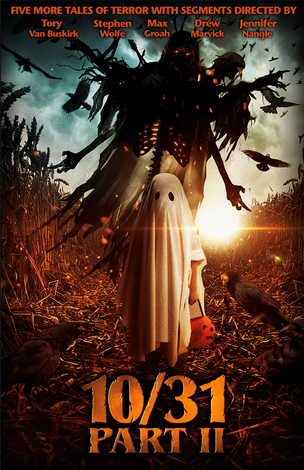
10/31 Part II is the second installment of the popular Halloween themed anthologies that taps the best directors, actors and composers from the indie film world and brings them all together to make one terrifying feature.
Premiering on Demand and Digital August 13 from Terror Films, the film stars Jennifer Nangle, Anastasia Elfman, David E. McMahon, Tim Robinson, Rhema Srihartiti and London Grace.
“As a huge fan of horror growing up, especially anthologies like Creepshow and Tales From the Crypt, I was thrilled to be able to work with a group of such talented writers, directors and actors to make our own anthology film come to life”, says producer Rocky Gray.
10/31 Part II on Demand and Digital August 13.
Premiering on Demand and Digital August 13 from Terror Films, the film stars Jennifer Nangle, Anastasia Elfman, David E. McMahon, Tim Robinson, Rhema Srihartiti and London Grace.
“As a huge fan of horror growing up, especially anthologies like Creepshow and Tales From the Crypt, I was thrilled to be able to work with a group of such talented writers, directors and actors to make our own anthology film come to life”, says producer Rocky Gray.
10/31 Part II on Demand and Digital August 13.
SHUDDER ACQUIRES HELLBENDER
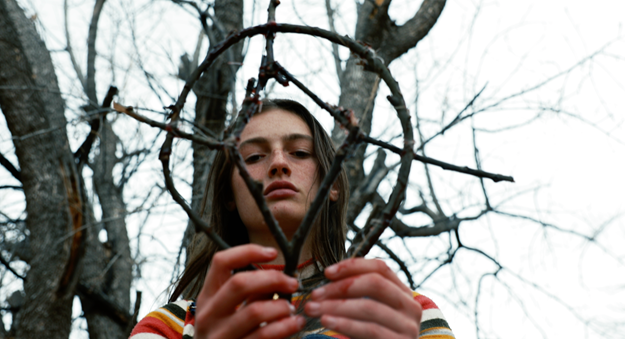
Shudder, AMC Networks’ premium streaming service for horror, thriller and the supernatural, has acquired the occult horror feature Hellbender ahead of its world premiere at Fantasia International Film Festival. Shudder will release the film, which is written and directed by Toby Poser, John Adams and Zelda Adams, in North America, the United Kingdom, Ireland, Australia and New Zealand in early 2022.
Said Craig Engler, general manager of Shudder, “We are thrilled to bring this family-focused folk nightmare to Shudder with such a talented actual family in front of and behind the camera. With Hellbender, Wonder Wheel Productions has made their most polished feature yet, and we know our audience will delight in the film’s shocking visuals and scares.”
“Teaming up with Shudder was at the top of our bloody bucket list. They’re the pinnacle of beautiful horror, and to be a part of that is beyond thrilling for our family,” added Toby Poser, Zelda Adams and John Adams.
“Hellbender is an absolute stunner. I am obsessed with every frame and couldn’t be more excited to partner with Shudder for the release of such an ambitious and unique movie,” said Justin Timms at Yellow Veil Pictures.
The acquisition deal was negotiated by Emily Gotto and Samuel Zimmerman on behalf of Shudder and Hugues Barbier, Justin Timms, and Joe Yanick of Yellow Veil Pictures on behalf of the filmmakers.
In Hellbender, 16-year-old Izzy (Zelda Adams) suffers from a rare illness that has kept her isolated on a mountaintop with her mother (Toby Poser) her whole life. As Izzy begins to question her sickness, she pushes back against her confinement and secretly befriends Amber (Lulu Adams), another girl living on the mountain, but her newfound happiness is derailed after she eats a live worm as part of a juvenile game and finds an insatiable and violent hunger awakened within her. To understand the hunger, Izzy must learn the dark secrets of her family's past and the ancient power in her bloodline.
Hellbender is the sixth feature from Wonder Wheel Productions, the family-run production company founded by Poser and Adams and their children, Zelda and Lulu. The family also produced the music for the feature with tracks from their experimental punk band H6LLB6ND6R. In 2019 the Adams family first screened at Fantasia with their award-winning The Deeper You Dig.
Hellbender will world premiere virtually August 14 as part of the 25th Fantasia International Film Festival, which kicks off August 5 as a hybrid event with in-person screenings in Montreal, Quebec and the virtual slate geo-locked to Canada. The film is part of the festival’s esteemed Cheval Noir competition.
Said Craig Engler, general manager of Shudder, “We are thrilled to bring this family-focused folk nightmare to Shudder with such a talented actual family in front of and behind the camera. With Hellbender, Wonder Wheel Productions has made their most polished feature yet, and we know our audience will delight in the film’s shocking visuals and scares.”
“Teaming up with Shudder was at the top of our bloody bucket list. They’re the pinnacle of beautiful horror, and to be a part of that is beyond thrilling for our family,” added Toby Poser, Zelda Adams and John Adams.
“Hellbender is an absolute stunner. I am obsessed with every frame and couldn’t be more excited to partner with Shudder for the release of such an ambitious and unique movie,” said Justin Timms at Yellow Veil Pictures.
The acquisition deal was negotiated by Emily Gotto and Samuel Zimmerman on behalf of Shudder and Hugues Barbier, Justin Timms, and Joe Yanick of Yellow Veil Pictures on behalf of the filmmakers.
In Hellbender, 16-year-old Izzy (Zelda Adams) suffers from a rare illness that has kept her isolated on a mountaintop with her mother (Toby Poser) her whole life. As Izzy begins to question her sickness, she pushes back against her confinement and secretly befriends Amber (Lulu Adams), another girl living on the mountain, but her newfound happiness is derailed after she eats a live worm as part of a juvenile game and finds an insatiable and violent hunger awakened within her. To understand the hunger, Izzy must learn the dark secrets of her family's past and the ancient power in her bloodline.
Hellbender is the sixth feature from Wonder Wheel Productions, the family-run production company founded by Poser and Adams and their children, Zelda and Lulu. The family also produced the music for the feature with tracks from their experimental punk band H6LLB6ND6R. In 2019 the Adams family first screened at Fantasia with their award-winning The Deeper You Dig.
Hellbender will world premiere virtually August 14 as part of the 25th Fantasia International Film Festival, which kicks off August 5 as a hybrid event with in-person screenings in Montreal, Quebec and the virtual slate geo-locked to Canada. The film is part of the festival’s esteemed Cheval Noir competition.
Lionsgate UK present Antebellum on digital download, Blu-ray and DVD now

From the producer of Get Out and Us, Antebellum stars Janelle Monáe as a woman who finds herself trapped in a terrifying reality and must uncover the brutal truth
before it’s too late...
Successful author Veronica Henley (Janelle Monáe) is finishing a book tour before she returns home to her husband and daughter. But a shocking turn of events is about to upend Veronica’s existence, plunging her into a horrifying reality that forces her to confront her past, present, and future — before it’s too late.
From directors Gerard Bush and Christopher Renz comes this tense and provocative thriller with a terrifying twist. Antebellum also stars Eric Lange (Lost, Narcos), Jena Malone (Donnie Darko, Nocturnal Animals), Jack Huston (Boardwalk Empire, Fargo), Kiersey Clemons (Zack Snyder’s Justice League) and Gabourey Sidibe (American Horror Story, Empire).
Certification: 15 Run time: 106 mins
Antebellum is on Digital Download, Blu-rayTM and DVD 2 August from Lionsgate UK
before it’s too late...
Successful author Veronica Henley (Janelle Monáe) is finishing a book tour before she returns home to her husband and daughter. But a shocking turn of events is about to upend Veronica’s existence, plunging her into a horrifying reality that forces her to confront her past, present, and future — before it’s too late.
From directors Gerard Bush and Christopher Renz comes this tense and provocative thriller with a terrifying twist. Antebellum also stars Eric Lange (Lost, Narcos), Jena Malone (Donnie Darko, Nocturnal Animals), Jack Huston (Boardwalk Empire, Fargo), Kiersey Clemons (Zack Snyder’s Justice League) and Gabourey Sidibe (American Horror Story, Empire).
Certification: 15 Run time: 106 mins
Antebellum is on Digital Download, Blu-rayTM and DVD 2 August from Lionsgate UK
the heart and soul of horror news
 | Irreverently, it could be said that Antoine Wiertz was the Ed Wood among the Romantic painters because of his clumsy tech- nique, though digging a bit deeper reveals a fascinating person whose canvases now, almost two hundred years later, increasingly manage to excite the interest of enthusiasts all over the world on account of their incredibly original and almost avant-garde approach. |
The fantastic Belgian painter and sculptor Antoine Wiertz is unfortunately not very well known yet outside the circles of aficionados, although he is, with all his Romanticism, fantasy, and megalomania, almost the ideal person to spin an extremely creepy biographical and historical novel, play, or film around.
Antoine Wiertz was born in Dinant, the present French-speak- ing area of Belgium, in 1806 --barely three years earlier than the famous American author Edgar Allan Poe, with whom he has something in common--and died in Brussels in 1865, not at the age of forty and from alcohol poisoning like Poe, but in his fifty- ninth year from paint poisoning: the new method devised by Wiertz to combine the Flemish oil painting and Italian al fresco techniques with each other, and which he called peinture mate, gradually burned and destroyed his lungs.
The American writer Poe and the Belgian painter Wiertz, both products of the first, “Romantic,” half of the nineteenth century, do have something in common, although they may never have known of each other’s existence. The first bit of evidence of this could well be a book published in 2001 and which takes the wide- spread phobia from their epoch with a pinch of salt: Buried Alive! by Jan Bondeson. The back cover states the following: “Read- ers of Edgar Allan Poe’s tales may comfort themselves with the notion that Poe must have exaggerated: surely people of the 1800s could not have been at risk of being buried alive?” The front page is illustrated with a detail of a painting by Antoine Wiertz: The
Antoine Wiertz was born in Dinant, the present French-speak- ing area of Belgium, in 1806 --barely three years earlier than the famous American author Edgar Allan Poe, with whom he has something in common--and died in Brussels in 1865, not at the age of forty and from alcohol poisoning like Poe, but in his fifty- ninth year from paint poisoning: the new method devised by Wiertz to combine the Flemish oil painting and Italian al fresco techniques with each other, and which he called peinture mate, gradually burned and destroyed his lungs.
The American writer Poe and the Belgian painter Wiertz, both products of the first, “Romantic,” half of the nineteenth century, do have something in common, although they may never have known of each other’s existence. The first bit of evidence of this could well be a book published in 2001 and which takes the wide- spread phobia from their epoch with a pinch of salt: Buried Alive! by Jan Bondeson. The back cover states the following: “Read- ers of Edgar Allan Poe’s tales may comfort themselves with the notion that Poe must have exaggerated: surely people of the 1800s could not have been at risk of being buried alive?” The front page is illustrated with a detail of a painting by Antoine Wiertz: The
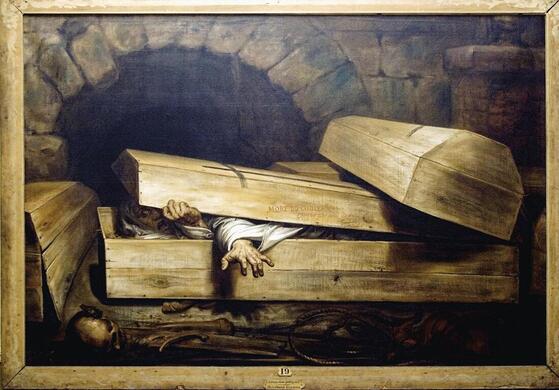
Antoine Joseph Wiertz, The Premature Burial, 1854. Oil on canvas, 160 x 235 cm. Musée Wiertz, Brussels.
Premature Burial, exactly the same title as Poe’s short story deal- ing with this obsession. So it appears that both had a tendency toward the macabre.
And yet, beside the fact that they both worshiped the arts, were blindly ambitious, and had an extremely high opinion of their own literary and artistic talents and almost gave their lives for this--alcohol and paint poisoning--they might well have not appreciated each other’s company. They were both too egocentric for that; or, to quote Poe’s very own words: “I cannot conceive of any being superior to myself.” The course of their lives was also very different, as were their characters, something that can perhaps best be demonstrated by their portraits.
An early daguerreotype of Edgar Allan Poe dates from 1849, the year in which he died, and perhaps nothing can describe his facial expression better that the phrase from Poe’s French translator, Charles Baudelaire: “Il a beaucoup souffert pour nous” (He suffered a lot for us). His life story reads almost like a night- mare--an even worse nightmare than he actually committed to paper, according to biographer Van Doren Stern: his father, an alcoholic actor, simply disappeared in Poe’s early years; his young mother, a talented actress, pining for two-year-old Edgar, suc- cumbed to tuberculosis in a musty boarding house in Richmond; he was to see his older brother, William, die of alcoholism in his early twenties; and his sister Rosalie was bordering on oligo- phrenic. The three children were placed in foster homes, Edgar in Richmond with a surly trader in tobacco, among other things, by the name of John Allan and his childless wife, who was to die of consumption before Edgar reached the age of twenty. Edgar’s relationship with this foster father was, however, very cool, unlov- ing, and problematic on account of their diverse characters, and the latter therefore never legally adopted Edgar or helped him financially with his university studies, for example, and did not even mention him in his will.
The tragic tone was set for Edgar’s future life and he was spared little misery, from the death of his niece-bride, Virginia, whom he worshiped--in his own asexual way--to severe financial prob- lems and scandals, as well as periods of chronic dipsomania and a
“death in the gutter.” And yet, despite all this adversity, he never laid down his pen, witnessed by some fifty poems, one novel, two novellas, seventy short stories, and a roughly equal volume of essays and articles.
Besides the fact that he is also dressed in black and is wearing the black cravat fashionable at that time, the contrast of Wiertz’s look and general posture in his self-portrait at the age of forty- nine could not be greater compared with that of his contem- porary Poe, who had passed away in the meantime. There he stands, his arms crossed and looking arrogantly at the viewer, the brilliant painter and sculptor who wanted to surpass Raphael and Michelangelo as well as his compatriot Rubens, who obtained the necessary funding to enable him to become proficient in his art in Paris and Italy, and Rome in particular, and could always
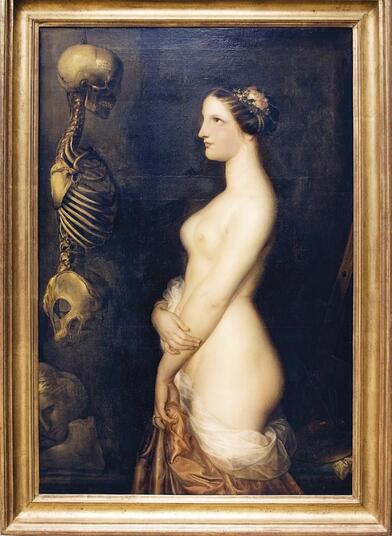
Antoine Joseph Wiertz, Two Young Girls, or The Beautiful Rosine, 1847. Oil on canvas, 140 x 100 cm. Musée Wiertz, Brussels.
count on the necessary political and financial support during his further career. Later in his life he got the Belgian state to go as far as building a studio and adjoining house for him in Brussels, which had to be transformed into a museum after his death in his honor. The museum is one of the least visited in the European capital.
And yet, he has something endearing, this Antoine Wiertz. He adored women and was certainly not averse to the carnal, whether paying for love with them or not, in contrast to Poe, who did not even consummate his marriage and possibly had homosexual ten- dencies. Wiertz, however, regarded his artistic vocation as being so important that he never wanted to marry so as not to be dis- tracted. Furthermore, his view of women is, in a way, denigrating. Two quick examples of this: a beautiful young girl is initiated as a witch (the phallic aspect of the broom handle is striking); and a voluptuous lady is handed forbidden books by the devil which prompt her to indulge in indecent acts.
Antoine Wiertz was also socially committed. When he was around forty, he must have realized his own mediocrity all too painfully, especially compared with his heroes, Raphael, Rubens, and Michelangelo, and then proceeded to lead his life as a bene- factor of mankind, denouncing various social injustices with his canvases. Two quick examples of this are Hunger, Madness, Crime, featuring a widow who cannot pay her taxes, whose breasts do not contain any more milk for her infant child, and who is so hungry that she cuts off her baby’s leg to make soup from it. The Suicide concerns a young man who has read rather too many writings by the communist and atheist Karl Marx--notice the book entitled Materialism --and writes in his farewell letter, “Il n’y a point d’âme, il n’y a point de Dieu” (there is no soul, there is no God), and then puts a bullet through his head in the presence of his guardian angel and a devil.
The most endearing aspect of Antoine Wiertz’s personality is, however, that he is now remembered for a very different reason from what he might have imagined: no, compared with the Renais- sance and Baroque masters, he became a wretched dauber, though his extravagant and macabre choices of subject, from Napoleon in Hell to the Visions of a Guillotined Head among others, have turned him into a well-known figure in those circles preoccupied with horror and the fantastic.
The Parisian poet Charles Baudelaire translated many of Poe’s short stories into French during his stays in Brussels, and it was also during one of his stays there that he visited the studio of Antoine Wiertz. It is generally known that he regarded Poe as a genius, a poète maudit, while he dismissed Wiertz as a charla- tan and profiteer. And yet, Wiertz and Poe might have had more in common than Baudelaire may have realized. What follows is a comparison between three of Poe’s short stories and three of Wiertz’s paintings.
Being buried alive: this has been a death penalty and one of the most controversial and intense phobias through the centuries.
Sigmund Freud may well have argued that this fear was nothing more or less than the unconscious desire to return to the safety of the womb; but, in the era of Poe and Wiertz, the terror of being buried alive--i.e., prematurely--took on obsessive proportions. In his standard work L’Homme devant la mort (Man before death), historian Philippe Ariès provides a scientific basis for this age-old fear and explains why this anxiety had taken on psychotic forms precisely at the time of Poe and Wiertz. His finding is that, in an increasingly secular society, there was a tendency to pay increas- ingly less heed to the rituals surrounding death, as these were sometimes ignored completely during the Industrial Revolution with its depersonalization, population growth, and epidemics. According to the author, these rituals served precisely to avert the risk of premature burial.
Poe’s shortstory entitled“The Premature Burial”has an umber of surprising aspects. The narrator cites, by way of introduction, a number of historical examples, then describes how he, as a well- to-do hypochondriac, has more than sufficient financial resources at his disposal to renovate his family crypt and have a cozy coffin tailor-made for himself so as to be able to reappear effortlessly among the living in the case of a possible premature burial, but then ends with a decidedly humorous “twist” that shows his per- sonality in a quite different light. After first describing with an accumulation of frightening expressions how he arrived at the most dreadful conclusion during the slow awakening that he had been lowered into the ground in a coffin while still very much alive--the smell of earth, a cloth around his head, a really eerie place--he manages to let out a loud cry, a primal scream that is answered immediately in a rather facetious manner by a trio of male voices asking what in the devil’s name is wrong with him. The narrator is, in fact, quite simply lying in an extremely narrow bunk in the cabin of a cutter transporting earth. The experience appears to have the effect of a catharsis on the narrator: he is henceforth forever cured of his catalepsy attacks, stops wallowing in macabre fantasies about death, and decides to lead a healthier and more active life.
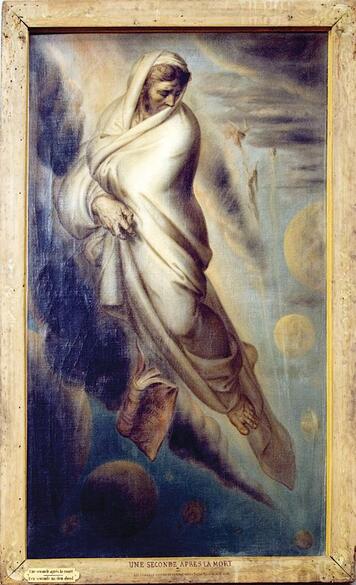
Antoine Joseph Wiertz, One Second After the Death. Oil on canvas. Musée Wiertz, Brussels.
Wiertz was, in contrast to Poe, a bothersome do-gooder who believed in “progress,” as evidenced by the way he treated the topic: there is no question of humor or perspective or of depicting the expensive funeral “touches” that Poe describes so charmingly. No, the coffin the possibly indigent, apparently dead person is trying to crawl out of is hammered together hurriedly, with a cross painted on the lid in a rudimentary manner, the floor covered with some straw, and lowered into an anonymous catacomb in an equally hasty manner, without any pomp. The direct provocation for Wiertz’s creation was the cholera outbreak that occurred in Antwerp in 1853, with the epidemic then spreading across the other towns and cities of Belgium and claiming thousands of vic- tims who had to be hurriedly buried (still alive?) in order to stem further disease. Wiertz leaves no doubt with regard to his reason for painting this canvas as the following can be clearly read on the coffin: “Mort du choléra, certifié par nous Docteurs Sans Doute” (dead by cholera as pronounced by doctor Without Any Doubt), including stamp--thus an open indictment of the physicians.
In Poe’s very short story entitled “The Oval Portrait,” a traveler retreating at night to a deserted castle in the Italian Apennines is fascinated to read the comments on a virtually lifelike painting of a young girl. According to this observation, the poor painter was, with each stroke of his brush, actually drawing, like a vampire, the life from his young bride and model, who grew increasingly weak until he found her dead on her chair when applying the final touch and uttering the words “This is indeed Life itself!”
The definitive version of “The Oval Portrait” --which initially bore the title “Death in Life” and had a longer introduction con- cerning the effects of opium on the mind--dates from 1842, the year of Virginia’s first hemorrhage due to tuberculosis. Besides the underlying theme that art can therefore, so to speak, overcome or
“avert” physical death and can make a person “eternal,” Poe also inadvertently reveals two other intimate, and asexual, aspects of his marriage to his cousin: firstly, he portrays the painter as some- one who gives priority to his artistic vocation over his love, which he therefore cannot or does not want to experience physically; and secondly, he admits with the necessary feelings of guilt how this vocation does not even enable the painter to feed and clothe his loved one and will eventually rob her of her life. All that is pre- served of their relationship for posterity is a literally lifelike oval portrait...an oval portrait in the “vignette” style, so typical of the time, and which, in Poe’s imagination, must have had much more of the features of his very own and perhaps virginally deceased child bride than those of his late mother, Eliza, or his late foster- mother, Frances Allan. Ironically enough, however, Poe was never able to gather together the financial resources to hire an artist with a view to producing a genuine likeness of his young wife, with the result that only one portrait of his cousin-bride remains preserved, painted a few hours after her death. Truly macabre...
Wiertz’s best-known painting is La belle Rosine, a model that is much more bare, as well as less virginal and asexual, than the model from “The Oval Portrait” by Poe. And yet, it deals with the same theme in an almost identical way, namely that art can overcome or “avert” physical death and can make a person “eter- nal.” Rosine, in contrast to many of Poe’s female personages, is indeed a girl of flesh and blood, as Wiertz had painted her a few years previously while she was doing her makeup, proof that they were lovers and had carnal contact with each other on more than one occasion.
And the skeleton here? For the sake of convenience, the canvas could be completed as an illustration for “vanitas” in the form of “Death and the Maiden” if it were not for Rosine assisting in anything but a chaste manner and a small detail lending a “twist” to the picture, i.e., with a label bearing the words “La belle Rosine” stuck to the skull. In this way, Wiertz makes the model stare into the hollow eyes of her own cranium, i.e., a chronologically impos- sible situation, though this did receive much acclaim among the later Symbolists and Surrealists such as André Breton and Salva- dor Dalí.
However, what does Wiertz actually mean by this brutal “state- ment”? La belle Rosine is perhaps both a hymn to her earthly beauty and a firm refusal to make her his wife: Rosine will shortly lose this earthly beauty she has and turn into a skeleton, with the result that Wiertz will prefer to devote the time allocated to him on this earth to painting “eternal” canvases rather than loving a transient woman. And yes, Poe’s Virginia and Wiertz’s Rosine do continue to live in their short story and canvas--Virginia as the heavenly beautiful girl and wife of a destitute artist, Rosine as the volup- tuous model of a painter who treats this evidently well-to-do lady almost like a prostitute.
One of the lesser-known short stories by Edgar Allan Poe, “The Power of Words,” is a philosophical jewel. A self-assured “Oinos” (Greek for wine, although the Norton Critical Edition suggests that it refers to the Hebrew word for “man”) flies toward the immeasurable universe for a moment after his death and, in all his confusion, is immediately welcomed by a spirit named “Agathos” (Greek for “good”), who explains the theories of the universe to him. Very briefly, it could be argued that, according to these theories, God created the world and humans, who then continue to create with their thoughts and words, prompting actions that will, however, remain ad infinitum. Because the universe is thus so dynamic and endless and “restless,” it is not omniscience that brings supreme happiness but, rather, the gathering of further knowledge. The only thing that the Creator does not know, according to Agathos, is that he is omniscient. In order to illustrate this power of words at the end, Agathos points to a planet with the most beautiful flowers and volcanoes belching the most lava and, half crying, tells Oinos that this planet was created by a passionate love poem he jotted down three centuries earlier for a beloved.
“Its brilliant flowers are the dearest of all unfulfilled dreams, and its raging volcanoes are the passions of the most turbulent and unhallowed of hearts.”
This is a splendid vision of the universe, a vision in which not one single thought, word, or action is lost but can, on the con- trary, bring about a “butterfly effect,” as it were, and also a vision in which Poe praises the immortality of the soul. In this story, he depicts himself after his death as “a spirit new-fledged with immortality!” which, with his poems--Poe regarded himself pri- marily as a poet --created the most exotic planets. Was he aware that his work would become such a source of adoration and study after his death?
Wiertz’s painting Une seconde après la mort or Les grandes choses de la terre vues à 500,000 kilomètres de ce globe (One second after death or the great things on the earth seen from a distance of 500,000 kilometres) depicts the same scene as Poe’s narrative in a virtually identical manner: a man in a shroud flies into the immea- surable universe and will be met by another soul. As optimistic and profound as Poe’s version is, however, the picture painted by Wiertz during the latter years of his life is equally pessimistic and embittered. The man --a self-portrait perhaps --looks back nostalgically at his planet earth, which now has the importance of a shriveled pea, and lets a thick book slip from his hands --“Gran- deurs humaines” (Human greatness). This is the “statement” of an artist who feels he has failed (he could never be the equal of a Rubens or Raphael or Michelangelo), who realizes that he could never achieve his grandiose ambitions (he has doubts about the “eternal value” of his work and has not even been responsible for bringing any children into this world), and who then bids a bitter farewell to his life of failure. Indeed, one of his last utterances on his deathbed reads: “A quoi me sert mon imagination à présent. On se détache facilement des misères humaines” (To what good is my imagination now, one grows so quickly indifferent to human misery)...Grandeurs humaines, actually, or Sic transit gloria mundi...
Antoine Wiertz. Edgar Allan Poe. Contemporary artists of their time on either side of the big pond. Poe always saw himself as an aesthete and a poet, though he is nowadays mainly revered for his macabre and frenetic short stories published in inferior magazines of the time. Wiertz wanted to be the equal of the great painters, though he only arouses interest now on account of his rather bizarre and macabre pictures and, as already explained, these do have something in common with Poe’s stories in terms of the associated themes and shock effects.
Irreverently, it could be said that Antoine Wiertz was the Ed Wood among the Romantic painters because of his clumsy tech- nique, though digging a bit deeper reveals a fascinating person whose canvases now, almost two hundred years later, increasingly manage to excite the interest of enthusiasts all over the world on account of their incredibly original and almost avant-garde approach.
In Poe’s very short story entitled “The Oval Portrait,” a traveler retreating at night to a deserted castle in the Italian Apennines is fascinated to read the comments on a virtually lifelike painting of a young girl. According to this observation, the poor painter was, with each stroke of his brush, actually drawing, like a vampire, the life from his young bride and model, who grew increasingly weak until he found her dead on her chair when applying the final touch and uttering the words “This is indeed Life itself!”
The definitive version of “The Oval Portrait” --which initially bore the title “Death in Life” and had a longer introduction con- cerning the effects of opium on the mind--dates from 1842, the year of Virginia’s first hemorrhage due to tuberculosis. Besides the underlying theme that art can therefore, so to speak, overcome or
“avert” physical death and can make a person “eternal,” Poe also inadvertently reveals two other intimate, and asexual, aspects of his marriage to his cousin: firstly, he portrays the painter as some- one who gives priority to his artistic vocation over his love, which he therefore cannot or does not want to experience physically; and secondly, he admits with the necessary feelings of guilt how this vocation does not even enable the painter to feed and clothe his loved one and will eventually rob her of her life. All that is pre- served of their relationship for posterity is a literally lifelike oval portrait...an oval portrait in the “vignette” style, so typical of the time, and which, in Poe’s imagination, must have had much more of the features of his very own and perhaps virginally deceased child bride than those of his late mother, Eliza, or his late foster- mother, Frances Allan. Ironically enough, however, Poe was never able to gather together the financial resources to hire an artist with a view to producing a genuine likeness of his young wife, with the result that only one portrait of his cousin-bride remains preserved, painted a few hours after her death. Truly macabre...
Wiertz’s best-known painting is La belle Rosine, a model that is much more bare, as well as less virginal and asexual, than the model from “The Oval Portrait” by Poe. And yet, it deals with the same theme in an almost identical way, namely that art can overcome or “avert” physical death and can make a person “eter- nal.” Rosine, in contrast to many of Poe’s female personages, is indeed a girl of flesh and blood, as Wiertz had painted her a few years previously while she was doing her makeup, proof that they were lovers and had carnal contact with each other on more than one occasion.
And the skeleton here? For the sake of convenience, the canvas could be completed as an illustration for “vanitas” in the form of “Death and the Maiden” if it were not for Rosine assisting in anything but a chaste manner and a small detail lending a “twist” to the picture, i.e., with a label bearing the words “La belle Rosine” stuck to the skull. In this way, Wiertz makes the model stare into the hollow eyes of her own cranium, i.e., a chronologically impos- sible situation, though this did receive much acclaim among the later Symbolists and Surrealists such as André Breton and Salva- dor Dalí.
However, what does Wiertz actually mean by this brutal “state- ment”? La belle Rosine is perhaps both a hymn to her earthly beauty and a firm refusal to make her his wife: Rosine will shortly lose this earthly beauty she has and turn into a skeleton, with the result that Wiertz will prefer to devote the time allocated to him on this earth to painting “eternal” canvases rather than loving a transient woman. And yes, Poe’s Virginia and Wiertz’s Rosine do continue to live in their short story and canvas--Virginia as the heavenly beautiful girl and wife of a destitute artist, Rosine as the volup- tuous model of a painter who treats this evidently well-to-do lady almost like a prostitute.
One of the lesser-known short stories by Edgar Allan Poe, “The Power of Words,” is a philosophical jewel. A self-assured “Oinos” (Greek for wine, although the Norton Critical Edition suggests that it refers to the Hebrew word for “man”) flies toward the immeasurable universe for a moment after his death and, in all his confusion, is immediately welcomed by a spirit named “Agathos” (Greek for “good”), who explains the theories of the universe to him. Very briefly, it could be argued that, according to these theories, God created the world and humans, who then continue to create with their thoughts and words, prompting actions that will, however, remain ad infinitum. Because the universe is thus so dynamic and endless and “restless,” it is not omniscience that brings supreme happiness but, rather, the gathering of further knowledge. The only thing that the Creator does not know, according to Agathos, is that he is omniscient. In order to illustrate this power of words at the end, Agathos points to a planet with the most beautiful flowers and volcanoes belching the most lava and, half crying, tells Oinos that this planet was created by a passionate love poem he jotted down three centuries earlier for a beloved.
“Its brilliant flowers are the dearest of all unfulfilled dreams, and its raging volcanoes are the passions of the most turbulent and unhallowed of hearts.”
This is a splendid vision of the universe, a vision in which not one single thought, word, or action is lost but can, on the con- trary, bring about a “butterfly effect,” as it were, and also a vision in which Poe praises the immortality of the soul. In this story, he depicts himself after his death as “a spirit new-fledged with immortality!” which, with his poems--Poe regarded himself pri- marily as a poet --created the most exotic planets. Was he aware that his work would become such a source of adoration and study after his death?
Wiertz’s painting Une seconde après la mort or Les grandes choses de la terre vues à 500,000 kilomètres de ce globe (One second after death or the great things on the earth seen from a distance of 500,000 kilometres) depicts the same scene as Poe’s narrative in a virtually identical manner: a man in a shroud flies into the immea- surable universe and will be met by another soul. As optimistic and profound as Poe’s version is, however, the picture painted by Wiertz during the latter years of his life is equally pessimistic and embittered. The man --a self-portrait perhaps --looks back nostalgically at his planet earth, which now has the importance of a shriveled pea, and lets a thick book slip from his hands --“Gran- deurs humaines” (Human greatness). This is the “statement” of an artist who feels he has failed (he could never be the equal of a Rubens or Raphael or Michelangelo), who realizes that he could never achieve his grandiose ambitions (he has doubts about the “eternal value” of his work and has not even been responsible for bringing any children into this world), and who then bids a bitter farewell to his life of failure. Indeed, one of his last utterances on his deathbed reads: “A quoi me sert mon imagination à présent. On se détache facilement des misères humaines” (To what good is my imagination now, one grows so quickly indifferent to human misery)...Grandeurs humaines, actually, or Sic transit gloria mundi...
Antoine Wiertz. Edgar Allan Poe. Contemporary artists of their time on either side of the big pond. Poe always saw himself as an aesthete and a poet, though he is nowadays mainly revered for his macabre and frenetic short stories published in inferior magazines of the time. Wiertz wanted to be the equal of the great painters, though he only arouses interest now on account of his rather bizarre and macabre pictures and, as already explained, these do have something in common with Poe’s stories in terms of the associated themes and shock effects.
Irreverently, it could be said that Antoine Wiertz was the Ed Wood among the Romantic painters because of his clumsy tech- nique, though digging a bit deeper reveals a fascinating person whose canvases now, almost two hundred years later, increasingly manage to excite the interest of enthusiasts all over the world on account of their incredibly original and almost avant-garde approach.
JAN VANDER LAENEN

Jan Vander Laenen (° 1960) lives in Brussels, Belgium, where he works as an art historian and translator (Dutch, French, Italian, English). He is also the author of numerous collections of short stories, plays, and screenplays which have attracted keen interest abroad.
A romantic comedy, "Oscar Divo", and a thriller, “The Card Game”, have been optioned in Hollywood, while his short fiction collections, "The Butler" and "Poète maudit", and his horror play "A Mother's Revenge" are eliciting the requisite accolades in Italy.
His most recent publication are the tales “A Glass of Cognac” in “Bears: Gay Erotic Stories” (Cleis Press), “Epistle of the Sleeping Beauty” in the Bram Stoker Award winning “Unspeakable Horror” (Dark Scribe Press), “Fire at the Chelsea Hotel” in “Best Gay Love Stories 2009” (Alyson Press), “The Stuffed Turkey” in “Best Gay Erotica 2010 (Cleis Press),“The Corpse Washer” in Best S/M III (Logical Lust), “Lise” in “Strange Tales of Horror” (NorGus Press), the E-Books “Skilfully and Lovingly” (Sizzler Edition) and “The Centrefold and other Stories of working Men” (Silver Press), and the Dutch and French version of his novel “The housekeeper and other scabrous tales” (‘t Verschil, Antwerp (Belgium) - Textes gais, Paris (France)), the weird tale “The bat” in the anthology “A Darke Phantastique” (Cycatrix Press), “Petit papa Noël” in the anthology “Un cadeau de noël pour le refuge” (Textes gais, Paris), and the essay “The monstrous and the fantastic in the short stories of Poe and the paintings of Wiertz” (Weird Fiction Review).
Jan is a member of the Horror Writers Association and the Poe Studies Association. He presented his paper "Hypotheses on Poe's homosexuality" at the Bicentennial Congress in Philadelphia in October 2009 and “Poe as a latent homosexual, as suggested by Marie Bonaparte” at the New York Conference in February 2015. He has also given lectures on Baudelaire, Wiertz, Andersen, Guy de Maupassant, Grand Guignol and the guillotine at the universities of Porto (Portugal), Ghent (Belgium), Louisville (Kentucky), Madrid (Spain), and the Paris Sorbonne and Diderot universities.
Jan performed in the successful “Gala” by French choreographer Jérôme Bel in theatres in Brussels in May 2015 and December 2017, and he is taking acting classes to study as an author “the other side” of the written page.
Jan is currently working on a play/screenplay around the life of the Romantic Belgian "horror" painter Antoine Wiertz (1806-1865), a novel called "The Psychomanteum" around the practice of mirror gazing, and a screenplay around the life of Lucida Mansi. In July 2020 he finished his scandalous trilogy "Paulo or the obscene life of a gay escort" (240.000 words). He has also written recently three 30 minutes episodes for a series "Horror without frontiers", ten others are in the make.
Readers on "Epistle of the Sleeping Beauty
The stand out story for me was clearly "Epistle of the Sleeping Beauty" by Vander Laenen, quite possibly the most brilliant horror short story I have ever read. If for no other reason, reading this story is worth picking up a copy of the anthology. Yes, it's that good.
“Epistle of the Sleeping Beauty” by Jan Vander Laenen is a truly delightful tale reporting an unusual erotic adventure on the gay side taking place in the famous pineta (pinewood) of Viareggio, Italy.
Belgian writer Jan Vander Laenen's “Epistle of the Sleeping Beauty” was translated into English for the anthology, and is among the most unsettling of the stories: a man on holiday, hiding his homosexual cravings from his wife and children, seeks risky public sex and discovers a naked, dying, young man in the woods. This like many of the tales in the collection divulges the horrifying lengths some will go to fulfill lust, and is more cutting and critical than celebratory of many gay lifestyles.
"Epistle of the Sleeping Beauty" by Vander Laenen was ...disturbing but isn't that what horror is supposed to do?
A romantic comedy, "Oscar Divo", and a thriller, “The Card Game”, have been optioned in Hollywood, while his short fiction collections, "The Butler" and "Poète maudit", and his horror play "A Mother's Revenge" are eliciting the requisite accolades in Italy.
His most recent publication are the tales “A Glass of Cognac” in “Bears: Gay Erotic Stories” (Cleis Press), “Epistle of the Sleeping Beauty” in the Bram Stoker Award winning “Unspeakable Horror” (Dark Scribe Press), “Fire at the Chelsea Hotel” in “Best Gay Love Stories 2009” (Alyson Press), “The Stuffed Turkey” in “Best Gay Erotica 2010 (Cleis Press),“The Corpse Washer” in Best S/M III (Logical Lust), “Lise” in “Strange Tales of Horror” (NorGus Press), the E-Books “Skilfully and Lovingly” (Sizzler Edition) and “The Centrefold and other Stories of working Men” (Silver Press), and the Dutch and French version of his novel “The housekeeper and other scabrous tales” (‘t Verschil, Antwerp (Belgium) - Textes gais, Paris (France)), the weird tale “The bat” in the anthology “A Darke Phantastique” (Cycatrix Press), “Petit papa Noël” in the anthology “Un cadeau de noël pour le refuge” (Textes gais, Paris), and the essay “The monstrous and the fantastic in the short stories of Poe and the paintings of Wiertz” (Weird Fiction Review).
Jan is a member of the Horror Writers Association and the Poe Studies Association. He presented his paper "Hypotheses on Poe's homosexuality" at the Bicentennial Congress in Philadelphia in October 2009 and “Poe as a latent homosexual, as suggested by Marie Bonaparte” at the New York Conference in February 2015. He has also given lectures on Baudelaire, Wiertz, Andersen, Guy de Maupassant, Grand Guignol and the guillotine at the universities of Porto (Portugal), Ghent (Belgium), Louisville (Kentucky), Madrid (Spain), and the Paris Sorbonne and Diderot universities.
Jan performed in the successful “Gala” by French choreographer Jérôme Bel in theatres in Brussels in May 2015 and December 2017, and he is taking acting classes to study as an author “the other side” of the written page.
Jan is currently working on a play/screenplay around the life of the Romantic Belgian "horror" painter Antoine Wiertz (1806-1865), a novel called "The Psychomanteum" around the practice of mirror gazing, and a screenplay around the life of Lucida Mansi. In July 2020 he finished his scandalous trilogy "Paulo or the obscene life of a gay escort" (240.000 words). He has also written recently three 30 minutes episodes for a series "Horror without frontiers", ten others are in the make.
Readers on "Epistle of the Sleeping Beauty
The stand out story for me was clearly "Epistle of the Sleeping Beauty" by Vander Laenen, quite possibly the most brilliant horror short story I have ever read. If for no other reason, reading this story is worth picking up a copy of the anthology. Yes, it's that good.
“Epistle of the Sleeping Beauty” by Jan Vander Laenen is a truly delightful tale reporting an unusual erotic adventure on the gay side taking place in the famous pineta (pinewood) of Viareggio, Italy.
Belgian writer Jan Vander Laenen's “Epistle of the Sleeping Beauty” was translated into English for the anthology, and is among the most unsettling of the stories: a man on holiday, hiding his homosexual cravings from his wife and children, seeks risky public sex and discovers a naked, dying, young man in the woods. This like many of the tales in the collection divulges the horrifying lengths some will go to fulfill lust, and is more cutting and critical than celebratory of many gay lifestyles.
"Epistle of the Sleeping Beauty" by Vander Laenen was ...disturbing but isn't that what horror is supposed to do?
TODAY ON THE GINGER NUTS OF HORROR WEBSITE
[BOOK REVIEW] TRENCH MOUTH BY CHRISTINE MORGAN
the heart and soul of horror features


Archives
April 2023
March 2023
February 2023
January 2023
December 2022
November 2022
October 2022
September 2022
August 2022
July 2022
June 2022
May 2022
April 2022
March 2022
February 2022
January 2022
December 2021
November 2021
October 2021
September 2021
August 2021
July 2021
June 2021
May 2021
April 2021
March 2021
February 2021
January 2021
December 2020
November 2020
October 2020
September 2020
August 2020
July 2020
June 2020
May 2020
April 2020
March 2020
February 2020
January 2020
December 2019
November 2019
October 2019
September 2019
August 2019
July 2019
June 2019
May 2019
April 2019
March 2019
February 2019
January 2019
December 2018
November 2018
October 2018
September 2018
August 2018
July 2018
June 2018
May 2018
April 2018
March 2018
February 2018
January 2018
December 2017
November 2017
October 2017
September 2017
August 2017
June 2017
May 2017
April 2017
March 2017
February 2017
January 2017
December 2016
November 2016
October 2016
September 2016
August 2016
July 2016
June 2016
May 2016
April 2016
March 2016
February 2016
January 2016
December 2015
November 2015
October 2015
September 2015
August 2015
July 2015
June 2015
May 2015
April 2015
March 2015
February 2015
January 2015
December 2014
November 2014
October 2014
September 2014
August 2014
July 2014
June 2014
May 2014
April 2014
March 2014
February 2014
January 2014
December 2013
October 2013
September 2013
August 2013

 RSS Feed

|

|