

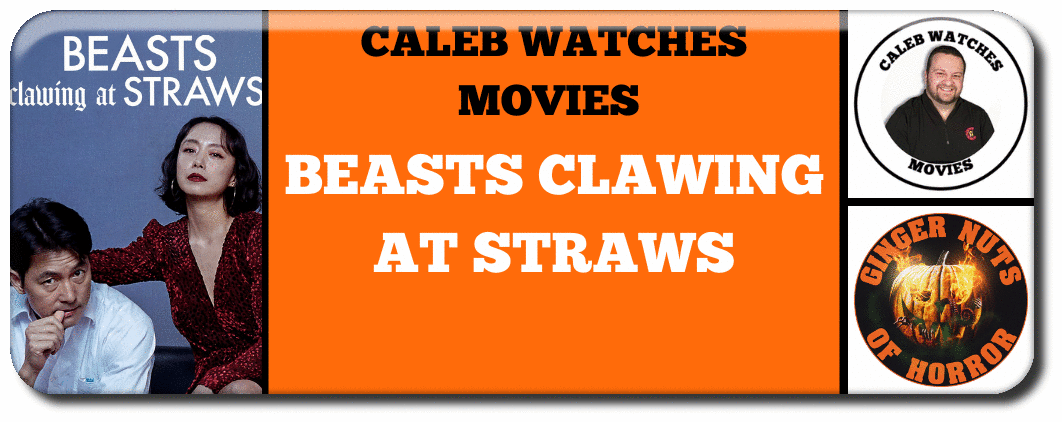
 Beasts Clawing at Straws is a 2020 South Korean crime thriller film written and directed by Kim Yong-hoon as his debut feature film. Based on the 2011 Japanese novel of the same name by Keisuke Sone, it stars Jeon Do-yeon, Jung Woo-sung, Youn Yuh-jung, Bae Seong-woo, Shin Hyun-bin, Jung Man-sik, Jin Kyung and Jung Ga-ram. It was released on February 19, 2020. The film had its world premiere at the 49th International Film Festival Rotterdam on January 25, 2020 in the Tiger Competition. SYNOPSIS Joong-man, stuck in a thankless job and forced to care for his ailing mother, finds a huge bag of money left in a sauna. Tae-young, a customs officer in debt to criminal Mr. Park, plots with one of Park's henchmen to run a lucrative scam on a "sucker" attempting to flee the country. Mi-ran, an escort with an abusive husband, finally sees a way out when one of her clients offers to murder him in exchange for a cut of his life insurance policy. The three characters all cross paths with dangerous people and get themselves into increasingly deeper trouble as they attempt to cheat their way towards the ultimate payout. The film is separated into six chapters: Debt, Sucker, Food Chain, Shark, Lucky Strike and Money Bag. 
ANYTHING FOR JACKSON – FILM REVIEW
18/12/2020
 I earnestly hope there’s more horror to come from these folks, if this has whetted their appetite for darker fare, because I reiterate: Anything for Jackson is one of the best horror films released this year. I’ve said before that I tend to be a bit leery going into a horror feature when I see that the people behind it don’t have a history of horror/horror-adjacent projects. Let me just say how wrong and ignorant I was about that, as along come director Justin G. Dyck and writer Keith Cooper to make me eat those words. They both have a history of family-friendly Christmas movies, with titles like ‘A Puppy for Christmas’ and ‘A Very Country Christmas’ – good wholesome stuff that’s a million miles away from ghosts and demons and gore. Yet with Anything for Jackson they have delivered what is undoubtedly one of the best and outright scariest films of the year. Anything for Jackson is about an elderly couple who kidnap a pregnant woman in order to use her unborn child as a vessel so that their dead grandson Jackson can be reborn. Henry (Julian Richings, Supernatural’s Death) is a doctor, which places him in prime position to nab his patient Shannon (Konstantina Mantelos) once they’ve decided she’s the perfect candidate. He and his wife Audrey (Sheila McCarthy) have had plenty of time to plan it all out, and with all they’ve learned from the local Satanic coven they’re certain they can pull this off. But occult rituals and deals with the devil are never as simple as they seem… There’s a beautiful economy of storytelling in the film. Cooper wastes no time and ensures we hit the ground running, and from there no scenes are wasted. We’re introduced to what seem like a kindly couple, then they immediately drag Shannon into their house and up the stairs. You’d think that there would be some beating around the bush but nope! Once Shannon’s securely shackled to the bed they tell her straight away that they want her baby for Jackson. Then you’d think there would be some is-it-real-or-are-they-cRaZy deliberation for the first act – but nope! We’re shown right away that this is a supernatural horror. At this point I thought that the bulk of the film would maybe be Shannon trying to outsmart the couple and maybe escaping and being recaptured and basically doing everything she can to prevent the ritual – but nope! That’s the predictable route. Instead the story takes a left turn into terror as the ritual appears to work but the house is suddenly filled with ghosts. And what ghosts! From the woman who flosses just a tad too vigorously to the bone-bendingly twisty man under Shannon’s bed, each visitor is stranger and more chilling than the last. It seems Jackson isn’t the only potential new tenant for Shannon’s child, and the otherworldly petitioners are getting impatient. From here on it’s heart-in-your-mouth and stomach-in-your-shoes time, right to the inevitable bloody climax. Anything for Jackson scared the absolute pants off me. I haven’t watched a film through my hands while muttering ‘Christ on a stick’ so many times since Host. After the credits rolled I had to sit back a moment to catch my breath. It’s rare that I find that pretty much every element of a film works perfectly for me, but this was just such a beautifully put-together film. It sucks you in, grabs you by the hand and pulls you along until suddenly it’s all over and you barely noticed any time had gone by. The spooky set-pieces are as gorgeous as they are tense, and while there’s no shortage of jumpscares they never feel cheap; Dyck knows when to shock and when to creep out, and more often than not goes for the latter to tremendous effect. The performances are flawless – Henry and Audrey seem like a perfectly lovely couple aside from the abduction and dark magic. They’re surprisingly funny and tender. Had Jackson lived then theirs would doubtless be a life of cookies and fishing trips, but their devotion to Jackson and to each other pushes them to some dark dark deeds. They’re not cackling devil-worshippers or torturous maniacs; they’re actually very apologetic and almost caring towards Shannon. It’s this humanity that hooks you and almost against your will you start to root for them by the end – but only up to a point. To paraphrase Jake Peralta, ‘cool motive, still abduction and ritual sacrifice’, you know? I earnestly hope there’s more horror to come from these folks, if this has whetted their appetite for darker fare, because I reiterate: Anything for Jackson is one of the best horror films released this year. Get thee to Shudder post-haste and give it a stream. Review by Sam Kurd   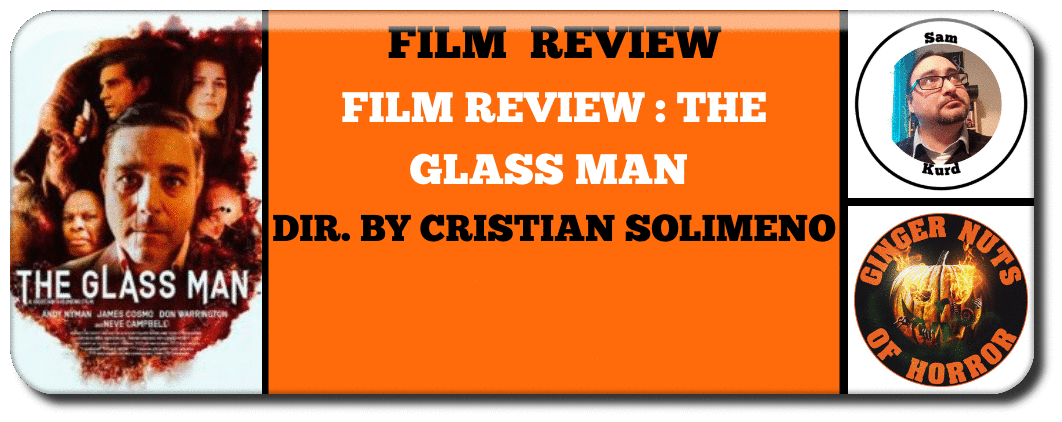 The Glass Man had a fantastic cast and a decent if cliched premise, but only delivered on its promise in the middle third of the film. The rest of it was limp, disappointing build up and poorly-handled obvious ending. If it weren’t for the talent of Nyman and Cosmo, there’s be almost nothing to praise here at all. When I saw the cast list for writer/director Cristian Solimeno’s The Glass Man, I knew I had to give it a watch. Andy Nyman’s a very talented man and too rarely is he given the chance to carry a film with a lead role. James Cosmo is always brilliant, and Neve Campbell is Neve Campbell fer cryin’ out loud. Then I saw that it was first screened at Frightfest in 2011. I thought it was a typo, until I double-checked. This film has been in distribution hell for nine years. Nine years! I did a quick search and I couldn’t find anything on why it had taken so long for someone to snap it up. Having now watched the film, I think I can put forward a tentative hypothesis of my own… It’s not very good. Or at least, most of it isn’t very good. The Glass Man follows Nyman’s hapless schlub Martin Pyrite (I’ve just got the pun in that surname and I’m not impressed) as he struggles to cope in the aftermath of the recent financial crash. It’s 2011, remember, so the economic misery and horror haven’t quite sunk in yet, at least not for Martin’s peers. He works in a generically high-flying corporate job, but some recent undisclosed shenanigans have left him fired by his abusive boss (played with delicious evil sleaze by Don Warrington). He keeps this secret from his wife Julie (Campbell, with a very enjoyably plummy accent) but his troubles are just beginning – ruthless underworld debt collector Pecco (Cosmo) turns up on his doorstep one night to inform Martin that he’s inherited a debt from a junkie friend and that payment is due. Immediately. Pecco takes a liking to Martin though, and offers him a deal: come with him tonight, do a couple of jobs, and his debt will be wiped away. Otherwise… It’s a solid premise for a thriller. A good (if flawed) man, backed into a corner, forced into danger and made to commit unspeakable acts. What’s his breaking point? Will he turn the tables on his tormentor? Will he succumb to darkness? Perhaps not hugely original, but it’s what you do with it that matters. Sadly Solimeno fumbles at nearly every turn, right from the very beginning. It opens in the most cliched way possible – with the main character in bed, waking up and going about his routine. First we’re treated to riveting close up footage of Martin in bed as the credits play over it,. I’d never wondered what the inside of Andy Nyman’s nose looks like, but now that mystery’s solved. Then, as if the film suddenly remembers it’s supposed to be a thriller, we’re treated to a jump scare while Martin shaves – does it add anything? No. He doesn’t even cut himself shaving, which would at least be something happening. It’s just a nothing of a scene. That’s the biggest problem I had with The Glass Man – it’s full of scenes that just left me shrugging and thinking ‘ok, and?’. Stuff that doesn’t add anything, or that outstays its welcome long after establishing what they’re there for. It doesn’t help that the dialogue is so repetitive too. Perhaps that’s supposed to be symbolic of how Martin’s life is circling the drain? If so then sure, it’s clever, but it’s not interesting to watch. Things immediately pick up when Pecco walks into Martin’s life. Up to now there’s been nothing to suggest this is a thriller beyond Martin being bullied into handing his watch to a stranger, but here Solimeno starts to build real palpable tension as Pecco inspects Martin’s home for goods he can repossess, risking waking Julie. When the offer is made, it’s clear that poor Martin has no way out of it, it’s an offer he literally can’t refuse. And when their night gets underway, things really start to get interesting. This is where Solimeni grips you by the face and demands your attention. There’s an especially memorable sequence that, on paper, should be dull as the proverbial dishwater. Martin has dropped Pecco off for an unknown nefarious purpose and is waiting in his car when a traffic warden waves him off, so he drives around the block. Sounds simple, but with the camera in the passenger seat staring unflinchingly at Martin as he sweats and frets and mumbles for one long shot, it’s just superb. It gave me hope that the film had finally come into its own and it was all going to be a nice gripping thriller from here. Unfortunately it soon ground to a halt and never recovered, especially with the reveal of The Twist. I’m not going to spoil The Twist for you here, but suffice to say that as soon as it happens you’ll nod and roll your eyes and go ‘oh, yeah, this old chestnut, ok’. It’s well-worn ground, possibly the most obvious twist in this kind of film – and yet I didn’t see it coming. And that’s not because it wasn’t set up or seeded well; in retrospect it makes sense with some of the dialogue that happens earlier. Perhaps it didn’t occur to me because it was so obvious and I was holding out for more originality? From there it’s all boringly downhill to the ending, which once again serves to remind us that Mentally Ill People Are Dangerous And Will Kill You. Andy Nyman does a great job despite the material. He has to struggle to hold our attention through a tepid first act, then acts his face off throughout the rest of the film, even the boring bits and the obvious ending. He and James Cosmo have perfect chemistry together, the hard man and the soft man, the strong and the weak. Cosmo is great when throwing his weight around but it’s his subtlety and pathos that shine, in the quieter moments where the two bond. The surprise weakest link is Neve Campbell, who’s given nothing at all beyond one effective emotional scene and the chance to please her dialect coach. Such a waste of a talented actor. The film looks cheap, which works to its advantage during the part of the film where it’s actually being a thriller but just adds to the dullness elsewhere and makes it feel amateurish. In one scene the colour grade noticeably changes from cold to warm in the same shot, like they’re cranking up the slider while you watch. The sound mix is pretty poor too – clattering utensils and roaring traffic drown the dialogue out, which is pretty inexcusable from a professional. The Glass Man had a fantastic cast and a decent if cliched premise, but only delivered on its promise in the middle third of the film. The rest of it was limp, disappointing build up and poorly-handled obvious ending. If it weren’t for the talent of Nyman and Cosmo, there’s be almost nothing to praise here at all. It’s worth bearing in mind that it’s been a while since 2011, so hopefully Cristian Solimeno is getting better with every film he makes. Perhaps it’d best if he doesn’t return to thrillers for a while though. Review by Sam Kurd   The members of Bloodhound Pix are trying something new with the Dead and SudBuried Film Festival by tackling all the films they received in one article. Death Ranch Writer/Director: Charlie Steeds Starring: Deiondre Teagle, Faith Monique, Travis Cutner  1970s USA, Three African American siblings on the run from the police take refuge at an abandoned Tennessee Ranch, unaware their hideout is on the hunting grounds of a cannibalistic Ku Klux Klan cult...Trapped and tortured, the three must fight tooth and nail to escape alive and take down the bloodthirsty Klan. Special Guest, Dan Johnson. *SPOILERS* (To start with at the very top: I hope the three leads of Death Ranch, Deiondre Teagle, Faith Monique and Travis Cutner, are able to have long and successful careers as actors, and that, if nothing else, Death Ranch might be able to launch them on to bigger and much better things.) There’s a story my Dad told me a lot growing up, about one of the scariest experiences he can remember. An experience he had from long before he moved up north – landing in several places, but eventually in Michigan, where he met my mom and settled down. Back from when my Dad was still living in Alabama, where he was born, when he was about ten or eleven, so – 1965 or 1966. My dad was woken up one night, from a dead sleep, by his uncle. His uncle had a shotgun. He told him to be quiet and stay close. It was bright outside somehow, even though it was the middle of night. My Dad managed to peek through a window. The local chapter of the Ku Klux Klan had left a burning cross outside his uncle’s house. I share my Dad’s story to say this: is it necessarily my place to tell any particular artist – Black, white, queer, straight – what topics they can and can’t touch on as artists? Nope. What I would say is that, particularly if the art they choose to create depicts a history or culture outside the realm of their particular experience, that artist would do well to understand the specific history and context of the experience they’re attempting to work in, and how the art they create might affect those who do or have lived that particular experience. Or – they could not, and choose to treat history and culture as decontextualized, apolitical grab-bags of images, sounds, and data untethered from any human experience or meaning, but that can be endlessly combined in whatever combination the artist thinks is the most fun, or the most potentially provoking, or will sell the most. Which – again, they’re free to do. However, if that’s the approach they take, and if the end result is something like director Charlie Steeds’ film Death Ranch – in which three Black siblings in 1971 Tennessee run into a gang of cannibalistic Klansmen – then an audience member who might happen to have experience with, say, being Black in America, or experiencing racism, or knowing a family member who was personally terrorized by the Ku Klux Klan, is free to critique that result. To wit – Death Ranch is a pandering, inconsistent, and reckless piece of trash. It (sort of) attempts to use Blaxploitation as a touchstone (though really it’s more of a set dressing, and perhaps an excuse), while forgetting (not knowing?) that, stereotypical as those films frequently were, they centered Blackness – Black people, yes, but also Black experiences, Black culture, Black perspectives, Black concerns. I am absolutely sure that a good, or even great, horror film could be made from similar subject matter, but such a movie would require being willing to, for instance, engage the actual history and context of the Ku Klux Klan and their campaign of violence and terror against Black lives in the United States, or the history of white violence against Black lives in the United States in general, as a foundation for storytelling. Death Ranch is uninterested in that, so much as it is seeing Quentin Tarantino make Django Unchained (which, for all the critiques that can be made, did at least somewhat attempt to consider the historical context and brutality of American antebellum slavery) and going “Hey! I can do that too!,” but then getting tired of doing the hard work a third of the way in and deciding to patch the holes with bloody violence, because – Black people beating the shit out of the Klan and calling them “motherfucker” = anti-racism? Can you tell this movie got me all the way fucked up, reader? “But that’s unfair! It’s meant to be modern exploitation! Exploitation is fucked up!” Sure. Maybe white artists shouldn’t choose to exploit Black history, suffering and pain in such a facile and pandering way? Take a sequence in which our hero, Brandon (Deiondre Teagle), after escaping being whipped and having his genitals burned by a cannibal Klansman (did you know that castration was a frequent method of torture inflicted on slaves or lynching victims in the United States? That’s a fun little tidbit anyway back to the movie), and watching his brother, Clarence (Travis Cutner) die in front of him, finds out that his sister, Angela (Faith Monique) is trapped in the evil Klansmens’ “fuck pit,” and goes to rescue her. Donning a bloody Klan outfit, he goes down into the fuck pit to see Angela, duct-taped and tied down on top of a filthy mattress, being barked at to “open those legs” by a Klansman straddling her on his knees. The Klansman also barks at Brandon (who he mistakes for a Klansman named Cletus), telling him to get out because “you done had your turn a half-hour ago!,” and fellow Klansman Joe Bob (Christa Jones), who he orders to hand him lube because “this bitch done gone dry.” *sigh this fucking movie* So – of course Brandon kills Joe Bob (with the prerequisite one-liner: “Where you goin,’ Joe Bob? You wouldn’t want to miss your turn.” #CivilRights), and the Klansman who’s straddling Angela, and is able to free her from the fuck pit. However – ...WHAT THE FUCK?! ...who exactly is this scene for? 1.) Rape/the threat of rape is an worn-out, tired, dramatically ineffective, and now generally accepted as a wildly offensive trope in general. 2.) Rape/the threat of rape against a Black woman (who, historically speaking, have been marginalized and stereotyped in American society in general, let alone in media) is particularly worn-out, tired, and offensive. Especially when the aggressor is a racist white American male, because (and I do hate to keep bringing racism up in discussing a movie featuring Black people trying to survive murderous racists, but) – y’know, lines getting drawn between fantasy depictions of racist white men raping Black women and actual documented history of racist white men raping Black women, and being confused about the point of using that particular scenario in a piece of entertainment, because literally no Black woman in America would thank Death Ranch for it (even with #progressive values because she’s not completely naked so - y’know, #feminism) 3.) It’s not even effective as a means of raising tension/stakes, because the Klansman straddling Angela, in confusing Brandon for Cletus, tells him he already had his turn a half-hour ago – meaning Angela has already been raped. The scene (like much of the violence against the Klansmen) is framed as victorious, righteous, kick-ass vengeance, but – the worst has already happened. Great that Brandon is able to prevent it from happening again, but it’s already happened. (Which the movie doesn’t want you to consider, in the same way it doesn’t really want you to fully consider any of the violence done to Black bodies – it’s the strange film that wants to have its colorblind, apolitical cake and eat its Blaxploitation revenge-fantasy cake too). So again – what the fuck? And who is this scene for? Certainly not for Black women, and not really for Black people in general, but almost certainly for Charlie Steeds, and his particular idea of what Black audiences would want to see – which is to say, Black people sticking it to cartoonish racists. (The scariest moment in the actual movie actually occurs much earlier, when Brandon discovers a woman, played by Jade Alexandria, being dragged, screaming and alone, in front of a burning cross, surrounded by Klansmen. The weight and context of that particular moment, thoughtfully considered and expanded upon, could have easily developed into a much better movie. Alas.) The problem with a white person unilaterally deciding what representation looks like for a group that they aren’t a part of, though, is that – well, some of the people you’re deciding to speak for might have problems with how you’re speaking for them. And I definitely have problems with how this movie thinks I, as a Black person, am supposed to be entertained – without context, without care (did Charlie Steeds consider the kind of place he has asking Faith Monique, as Angela, to put herself in as a person and a performer during the “fuck pit” sequence? I would argue that, by asking her to do it in the first place, the answer is “no”), without an actual centering of perspective, but merely depictions of Black characters beating down interchangeable boogey-man racists and being asked to applaud the “representation” and “progressiveness.” Which also – whether Steeds, and white audiences who applaud this movie for “representation” and “progressiveness” might like to admit it or not – lets them off the hook. Because they’re making fun of racism, get it? Because racism is a gross, disgusting and abhorrent concept and practice and should be made fun of – and yet, by placing racism as something completely and cartoonishly outside of themselves, they fail to see how enabling movies like this, or making them in the first place, allows them to take the vantage point that racism, in more commonplace and everyday circumstances, isn’t something they may be personally responsible for, or complicit in. So – Death Ranch, ultimately, is yet another movie that panders to Black people, however ineffectively, and reassures white people about racism. AWESOME. (Does this seem harsh? Well, I thought it was a little harsh that Steeds decided to signify how evil the ultimate bad cannibal Klansman at the end was by having him use the word “nigger,” but hey white people have said “nigger” so it’s a fact and I can’t be mad, right? Besides how would I know how evil and racist the leader of a cannibalistic gang of Ku Klux Klansmen was if he didn’t say the word “nigger?” I mean – duh) It’s competently shot. The music is frequently annoying. Check out the work of Tananarive Due, watch Brotherhood of Death (a movie Steeds said in an interview he was inspired by) or check out literally almost any other Blaxploitation movie instead. The end. 1 out of 5 (the one star is for everybody who wasn't white involved in this film ) Redwood Massacre: Annihilation Writer/Director: David Ryan Keith Starring: Danielle Harris, Damien Puckler, Gary Kaspar  The hunters become the hunted after a stranger obsessed with the Redwood Farm murders convinces bereaved family members to venture into the wilderness in hope of proving the existence of the notorious burlap masked maniac. Kyle: Redwood Massacre: Annihilation is dead on arrival. A sequel to Redwood Massacre (2014), a film I’m assuming no one saw. I certainly didn’t. This film follows Tom Dempsey (Jon Campling), best selling author of a true crime book on the Redwood Massacre, a mass murder that claimed the life of his daughter. Max (Damien Puckler), a serial killer with a morbid fascination with the Redwood Massacre (what a surprise), lures Tom and his other daughter Laura (Danielle Harris) into a search for the Redwood Killer. Tom and Laura call in two friends Jen (Tevy Poe) and Gus (Gary Kaspar) to watch their backs, friends who just so happen to be special ops commandos armed with machine guns…and then all five characters behave like ex-military types. They discover a strange military-like complex and find evidence that the Redwood Killer may have been part of a group of genetically engineered masked killers, which is a cool idea that isn’t used enough. There’s lots of dumb tough guy back and forth and a few gratuitous murder scenes to try and establish Max as an utterly sadistic killer, but they are painfully banal. Despite his close proximity to the protagonists, there’s no real tension there, and Puckler plays the killer angle so blatantly that it’s excruciating to wait for him to be finally unmasked. While it’s visually polished with decent make up effects and superficially well made, the film is soulless. The actors do what they can, but the script is devoid of drama, humor, character development and anything else that might make this watchable or engaging. It drags along with a monotonous Hallmark movie energy, as flat as a dead man’s EKG. I’d rather be massacred than watch this again. 1 out of 5 Slaughterhouse Killer Director: Sam Curtain Writers: Sam Curtain, Benjamin Clarke Starring: Craig Ingham, James Mason, Kristen Condon  A passion for slaughter keeps Box in line at the local abattoir where he can quench his thirst for blood. When Nathan, a young parolee arrives in town, Box is instructed to take him under his wing, and soon the two men bond over a murder. Unable to resist the bloody temptations, the two form a friendship revolving around their sickness for killing. A friendship which is bad news for everyone in town. Kyle: Slaughterhouse Killer follows Box (Craig Ingham) and the recently paroled Nathan (James Mason) who both work at a slaughterhouse and befriend each other. Box is ridiculed by the other slaughterhouse workers and then they turn their sights on Nathan. This immediately makes us relate to Box and Nathan, and we totally understand when they cross the line and murder the head bully Blake (Dean Kirkright). Afterwards we discover that Box has killed before and he inducts Nathan into his twisted serial killing world, echoing the sick duo at the core of Henry: Portrait of a Serial Killer. Unfortunately, the film then descends into more and more gruesome murders rather than delving into the perverse psychology of the characters. The performances were solid and they made good use of the low budget, but the script wasn’t quite deep enough to add anything new to the serial killer genre. Still it was a welcome change of pace and I think filmmakers have potential. 2.5 out of 5 Chestersberg Director: Jamie McKeller Writer: Jamie McKeller Starring: Natalie-Clare Brimicombe, Paul Coulter, Sonia Francesca Di Lorenzo  Chester Mapleforth first seceded his cul-de-sac from the United Kingdom in the early 1990s, and the first thing he did was to make murder legal. D. Is it weird to describe a movie that features beheadings, disembowelings, random acts of masturbation and homicidal mayhem left, right and center as somehow charming, or even downright quaint at times? Weird it may be, but director Jamie McKeller’s splatter-comedy Chestersberg is indeed quaint in its way. Set in pastoral Yorkshire (and drolly presenting its rural, tea-and-Battenberg-loving murderers as merely another type of English eccentric), Chestersberg feels like a throwback; it’s cheerfully gory without being gruesome, it flirts with horror without ever crossing the line into genuine dread or terror, and manages to (mostly) sustain a tone that’s both ridiculously silly and completely deadpan. It’s a high concept held together, more or less, by situational set-pieces and bits of gross-out humor (though again – without ever being truly gross), but then it knows that, unlike many other movies that it might remind you of, you’re not really in the audience to deeply consider complex moral or ethical questions – you’re there to have a good time watching people with lilting northern English accents slay and slaughter as messily as possible. Chester Mapleforth (Andy Love) was a man who wanted only one thing out of life – the ability to live in peace in the English countryside and murder whenever he wanted. After becoming fabulously wealthy, he was able to (somehow) secede from the United Kingdom and create his own territory – Chestersberg, an idyllic land where, within its borders, murder is, to quote Chester, “nice.” (Outside Chestersberg, murder is, of course, very “naughty.”) Along with his wife Beatrice (Rosy Rowley) and feral daughter Trixie (Sonia-Francesca Di Lorenzo), Chester has managed to build a small, relatively peaceful community of like-minded neighbors, and even inspired copycats (indeed, Chestersberg informs us that there are not one, but three murder villages oop North). However, all is not crumpets in Chestersburg – there’s tension (of all sorts, including sexual) between the neighbors, a rival murder-village may be plotting a takeover, there’s the annual Murderfest to deal with, and of course, our man Chester wants to expand the borders of Chestersberg, which the beleaguered-yet-powerless lawman on the outside, DI Matthews (Alexander King, who co-wrote Chestersberg with McKeller) very much does not want. To a one, the main cast involved know exactly what kind of movie they’re in, and overplay accordingly. With that said, it’s committed, serious overplaying, and, even while going comedically broad, there are several genuinely great character performances, including from Paul Coulter (as Martin, a loon even by Chestersburg standards whose repeated pleas to join the community go ignored), Matt Pattison (as Thomas Fulford, the violence-abhoring nebbish in charge of the increasingly complicated task of body disposal in Chestersberg), and Natalie-Claire Brimicombe (as Natalie, Thomas’s more murder-inclined wife, who not-so-secretly longs to become the next Mrs. Chester Mapleforth). As Chester himself, Love, while being as ridiculous as the rest, manages to nevertheless remain both charming and dangerous, with a gaze and presence that can (and does) turn from twinkling to chilling in a flash. The special and makeup effects (by Simon Brodie, with additional makeup by Charlotte Clemit and Ceri Roberts) takes the more-is-more approach (why merely bleed when you can gush blood in torrents?), which is, of course, why we’re all here anyway, and is delightful throughout. Chestersberg is a movie that would be very easy to boil down as a cross of movies that you’ve seen before, but what sets it apart is the fundamental gentleness of everything. Again – it’s not meant to make you think too much, it’s not meant to gross you out (too much), there’s not necessarily a grand point to any of it, but it is there to make you laugh, make you marvel at the sheer amount of splattery goodness the film is able to pull off, and ultimately provide, to quote Chester himself, “release.” It’s the easy, breezy, deviant-village-of-crazed-yet-very-proper-English-murderers-mockumentary the whole family can enjoy. Which again – feels a little weird to say about a movie that features a murder-by-drowning in a bin full of the victim’s own bodily waste, but there you are. 3 out of 5 Nefarious Director: Richard Rowntree Writers: Matthew Davies, Richard Rowntree Starring: Nadia Lamin, John Vangdal Aamaas, Richard Rowntree, Toby Wynn-Davies  Darren, Lou, Jo and Mas live a meager existence on the fringes of poverty. Indebted to the criminal kingpin of their social housing development, they routinely fear for their lives. On the other side of town, the already wealthy Marcus and his disabled brother Clive receive a windfall in the form of a winning lottery ticket. When their worlds collide following a botched robbery, the would-be criminals get more than they bargained for, and will be tested to their limits in a desperate attempt to survive a predator of monstrous proportions. C. While it has become a common response for reviewers to say that they don’t like giving “bad reviews” right before they eviscerate (which I have no intention of doing) a movie. Well if you’ve read or listened to my prior reviews you will know that to be true but here we are. Nefarious markets itself as a gritty British crime film (awesome) mixed with Don’t Breathe and Hostel, which has the potential to either be a lot of fun or incredibly intense for fans of those types of movies. From the first scene we are presented with a common plot device in many crime films as our known surviving character (not a spoiler) is being interrogated by detectives about the events that occurred. Though a lot of the movie isn’t really from her perspective so how would she be able to provide that information to the detectives? Normally if the story is engaging enough then narrative mistakes like that can be forgiven. However, it’s just one of the many elements that leads to the bitter aftertaste. I don’t have a lot to say on this because it’s like a project made so the cast/crew could test their abilities or get content for their sizzle reels. For those reasons, great! Snatch two solid minutes within the feature to showcase your skills. Not that the movie doesn’t make sense but it’s a carbon copy of more effective examples. Watching it gives the feeling that those involved saw Don’t Breathe, said “I’d like to make that,” and that’s the extent of the creativity and passion they put into it. Maybe they are film students or learning by trial and error, still on their journey to discover their own artistic voice. I’d normally support that if it wasn’t so offensive to the audience’s intelligence and its representation of certain characters, mainly shown through the portrayal of a character with a mental illness and one with a substance abuse problem. They are juvenile representations (done by adults) that one would expect from an untrained middle schooler acting student, in South Park or Scary Movie or “Simple Jack” from Tropic Thunder but this isn’t meant to be a parody. I don’t want to harp on this stuff because it’s a small part of the whole but this doesn’t even meet minimal expectations. One could maybe forgive a fraction if there was some self-aware humor to the piece but the fact that it tries so incredibly hard to be this intense, thought-provoking, crime horror only makes these issues standout all the more. It’s insulting. It makes a feature-length worth of time, some people got to practice their crafts, and a lot goes into making a movie, even if it’s bad so for that I’ll show my respects. At the end of the day, Nefarious was made as a bragging right so someone could say, “I made a movie.” I would continue to explain more of the movie and its heist-turned-torture plot but it’s not worth anymore of my words. 1 out of 5 Witchstars Writer/Director: Federico Sfascia Starring: Guglielmo Favilla, Raffaele Ottolenghi, Giulia Zeetti  On Halloween, with the help of some sexy girls, four friends must confront an alien invasion that will force them to face monsters of any kinds, including the ones from their past. Kyle: Witchstars is a horror comedy that boils down to an alien invasion siege film. On Halloween night stars crash down from the sky and interrupt the holiday plans of our cast of characters. There’s some convoluted backstory about the stars being related to witches, but then they mutate people into aliens and this is when it would make sense to note that Federico Sfascia made a film called Alienween in 2016 and this is apparently a re-edit of that film. There’s lots of broad and bold flourishes, some very off putting homophobic humor, fun and well done effects, Ed Wood style miniatures, a bit overbaked in its color correction and post production, but overall the film is swinging for the fences and you can’t help but admire it for that. It’s very much in the vein of a midnight movie, so a lot of criticisms would be taking the film more seriously than the filmmakers themselves did. 2.5 out of 5 Butchers Director: Adrian Langley Writers: Adrian Langley, Daniel Weissenberger Starring: Simon Phillips, Michael Swatton, Julie Mainville  A family of sadistic butchers has dug into the backcountry and, from the deep freeze of winter to the dog days of summer, anyone who crosses their path is dead meat. C. I’d love to see a backwoods horror movie where the villains aren’t generic southern hillbillies. This is even in the snow and the characters are still given all the cliche tropes out of the Texas Chainsaw Massacre or The Hills Have Eyes playbook. You know the story already, young, good-looking people find their car breaking down on a specific stretch of backroads, where they are then hunted, tortured, killed and/or raped/used to continue their lineage. Despite what comes with these types of movies, Butchers falls into the indie filmmaking trap of having a ton of drawn out information dump or dialogue-heavy scenes used as filler to make that feature-length time. Those scenes are cut with quick flashes of creepy imagery to remind us we’re watching a horror movie of course. Really it’s one of those plots with the synopsis and influences listed above you should be able to know where the movie will go without having to watch it. Your version might even be more entertaining. I will say they start off during the winter, which feels like a nice change of pace from the summer sundrenched stylings associated with those films but that’s quickly dropped for the story to jump several months ahead to… a sundrenched summer scenario! What Butchers is commendable for attempting is it takes a very well known horror film story and tries to make a character-driven drama within the confines of the paint-by-numbers backwoods horror tropes. If that was the intention, and I’m not reading too much into it to salvage the movie, then they would have really invested in the acting and character development to create something unique. However, the characters themselves fall into cliches of cheating on each other or fighting for patriarchal dominance in the butcher family, lazy character plot devices we’ve seen a million times in the genre used to create quick tension and inner turmoil. There’s nothing unique to draw us in and allow Butchers to stand on its own. As I write this review I’m getting excited at the potential of a character-study movie that is set in a Texas Chainsaw/Hills Have Eyes world… that’s fascinating. On a technical level the film is decent and the story that they tell plays out well. There’s just very little to say, it’s one that I just finished as I started writing the review and am already forgetting most of what happened besides the general plot points. The case of Butchers is either fans of the previously stated films wishing for their version but have nothing to add or someone trying to bank on a tired horror subgenre in hopes that it can ride the wave of the next Texas Chainsaw Massacre reboot. 1 ½ out of 5 Game of Death Directors: Sebastien Landry, Laurence Baz Morais Writers: Sebastien Landry, Laurence Baz Morais, Edouard Bond Starring: Sam Earle, Victoria Diamond, Emelia Hellman, Catherine Saindon, Erniel Baez D  Kill or be killed is the golden rule of the Game of Death. Sucks for seven millennials who ignored that rule. Now each one's head will explode unless they kill someone. Will they turn on each other to survive, or will this sunny day be the last for the innocent people of their middle-of-nowhere town? C. No, this doesn’t have any connection to the famous Bruce Lee film of the same name. Normally I wouldn’t care about using the same title (since there’s a lot of stuff coming out nowadays) but Game of Death is one of those iconic films that has inspired and been parodied by others since its release in 1978 (though it was shot in 1972) that it is difficult to separate the title from the martial arts flick… Anyway, now onto the review. Game of Death opens with an amazing introduction with a score and visuals like something out of an original Playstation game. It provides the mystique that we are being led into some creative, unique world and I am all for it. Unfortunately all we’re led to is awkward scenes of dialogue, masturbation, doing drugs, moaning/loud breathing, and hanging out by the pool/lake juxtaposed with Snapchat-like stories so we can kinda get to know our characters. This all feels like an attempt at creating a natural, slice-of-life opening mixed with video poetry that’s a knockoff of a Terrence Malick-knockoff. As much as I’m all for supporting the mumblecore style it’s one of those movies that would have benefited from a more standard cinematic approach. The artistic stylings ultimately don’t fit leaving us with two versions (the “fun” version and the arthouse version) of the movie battling throughout the feature’s runtime for supremacy. The filmmakers deserve credit for trying to tackle this type of premise, which would actually be a really intriguing concept if they gave into the satire or excitement that’s associated with the game horror subgenre (Saw, Would You Rather, Ready or Not, Escape Room, Beyond the Gates, etc.). There are moments throughout that embrace the absurdity and gore, allowing for something miraculous based on the budget. However, when one of those delicious moments happens we’re instantly pulled back into the other version of the movie because someone wants it to be “elevated” or taken “seriously.” Game of Death is a decent enough calling card for those involved if they’re working on a project with someone willing to guide them and force them to better hone their artistic voices for craft and consistency… or maybe it was a case of too many cooks in the kitchen. 2 out of 5 Bloodhound Pix is made up of: Craig Draheim, Josh Lee, and Kyle Hintz They are joined by Dan Johnson for the Dead and Sudburied Film Festival.  Follow them at https://www.twitter.com/BloodhoundPix https://www.facebook.com/BloodhoundPix/ https:/www.instagram.com/bloodhoundpix/ If you wish to hear more of their thoughts on the festival, be on the lookout for new episodes of the Bloodhound Pix Podcast every Tuesday. Available on Itunes, Spotify, Google Podcasts, Anchor, and Youtube.    Hall Director: Francesco Giannini Writer: Derrick Adams, Francesco Giannini (story by), Adam Kolodny Starring: Carolina Bartczak, Yumiko Shaku, Mark Gibson Several scattered guests have to maneuver their way down a long hallway to the exit after a virus spreads throughout the hotel. This seems like the hotel version of Train to Busan or 2009’s La Horde, but despite the synopsis and trailer, this virus is given more realism (deadly virus, not zombies) and the “flash” of the two movies mentioned above are exchanged for an intimate thriller about women freeing themselves from abusive relationships. This is one of those concepts and executions that lends itself completely to becoming an effective low budget horror film. Minimal location, takes place over the course of one-night, small cast, and a focus on relationships/characters over the spectacle, which there are some great makeup effects for the infected. Throughout the first 20ish minutes Hall presents us with two timelines to show what is about to come, while presenting the story chronologically. These timelines are mainly connected to the two leads of Val (Carolina Bartczak) and her family taking a vacation where it’s insinuated, she has been planning on leaving her husband (Mark Gibson), who is on the trip with them. The other timeline is that of an infected and pregnant, Naomi (Yumiko Shaku) crawling down the hall to the exit. Naomi is overseas on a business trip that she is not planning on returning from, because she has already made the decision to leave her abusive partner, something Val is still struggling with. The intention of showing an already infected Naomi attempts to add more foreboding to Val’s story, because it becomes clear very early on that this isn’t the ensemble piece it markets itself to be. Which is a shame. The idea of having and ensemble of characters with equal importance stuck in a hotel with a deadly virus is way more intriguing than what unfolds onscreen. Even Naomi’s story offers some amazing variation, but unfortunately her depth is thrown out to be the movie’s sacrificial minority for the white woman and her child. This happens toward the end as well when a chunk of time is dedicated to show an older couple that had no importance to the story up until that point (or after) but are provided a substantial spotlight. If the story were just about Val getting her daughter out of this hotel then it would be fine. Instead other character involvements feel like filler to reach an appropriate feature-length mark. Since these timeline changes and side characters are not constant enough, they inevitably do not fit. It should be noted that the themes of domestic violence play very well with a realistic subtly more akin to these actual relationships. The husband isn’t shown as some caricature associated with the cinematic representation of an abuser, but instead there’s the nuances of control, manipulation of their daughter, subtle remarks geared at breaking down Val’s self-esteem. This is where the Hall shines and could radiate for a feature’s worth of time. Unfortunately, he is taken out of the picture as a major threat early when he deteriorates from the virus. Yes, he shows up as hallucinations and is a threat in the psychological sense, but it’s not enough to keep the tension going. The possibility if Val trying to get her daughter out and facing a healthy, angry husband, probably would have been. Overall, as many of these go lately, the film is very well made, the acting superb, but it comes down to the lack of focus on a plot that needed another solid rewrite to tackle obvious storytelling issues. On a side note, Naomi, who is alone, is infected quickly, yet Val and her daughter who have been in close proximity of an infected individual and interacted with other guests weren’t? That’s Hall in a nutshell. 2 out of 5 Review by Craig Draheim  FILM REVIEW – WELCOME TO THE CIRCLE
25/11/2020
 Welcome to the Circle is a disappointment, especially after it had such a promising start. David Fowler clearly knows how to direct as he drums up tension well and is a dab hand at hiding the limitations of budget. It’s just such a shame that it’s wasted on a story that takes pride in making no sense at all while trying to convince us that that’s because it’s actually, like, totally deep and meaningful, man. It feels like Fowler watched The Endless and said ‘Pfft, I can do that’ but didn’t understand any of the real human mechanisms behind why that film works so well. From the satanic panic of 80’s suburbia to the more tragic real life events of Jonestown and Heaven’s Gate, cults hold a strange fascination for many of us. A charismatic leader preying on the vulnerable, placing himself in a position of absolute power over them, isolating them from their families and the ‘real world’. Perfect fodder for a horror film! Welcome to the Circle is the horror debut of writer/director David Fowler, who until now has mostly made… er… wildlife documentary features. For Disney. Normally when a filmmaker jumps straight into horror features without dabbling in shorts it sets off my alarm bells, but in this case the trailer intrigued me; it had a compelling premise and some shots that promised creepiness to come. So I figured I’d give it a shot. It starts very strongly. We meet Greg (Matthew MacCaul) and his young daughter Samantha (Taylor Dianne Robinson) on a camping trip. A midnight mauling from a bear sees them rescued by the members of The Circle, a tiny mysterious cult who live alone in the woods. At first it all seems very hippy-dippy, with cult members greeting their guests with ‘Love and Blessings’ and taking pictures for their ‘healing wall’. But it quickly becomes apparent that all is not as it appears, and everything takes a turn for the sinister. Can he and Samantha make it out alive? The first third of the film makes for great viewing – apart from the breakfast scene, which is almost unbearable; more on that in a moment. Fowler’s clearly got a good eye for how to convey a potentially expensive set-piece (say, a bear attack) on a budget without it coming across as hilariously naff (sharp chaotic edits, suggestive sound). He also has great form when it comes to disorienting and unsettling the audience; there are some great moments where space and time seem to bend, done simply and effectively. These are few and far between until the third act, but they’re when the film truly shines. Splicing in grainy black-and-white footage is a weird choice but it works really well in context, taking the story out of its small setting and cleverly suggesting a deeper and grander scope to the story. Even the tried-and-tested ‘creepy mannequins’ trope is used well, as the film tries to have you questioning what might be real and what might be a hallucination. Unfortunately, about 40 minutes in, the film starts to fall apart faster than a Cadbury’s Flake in a tumble-dryer. It’s about this point that we abandon the father-trying-to-protect-his-daughter narrative completely and we’re introduced to an entirely new set of characters, who’re on a mission to rescue one of the cult members. Their guide is our new protagonist Grady (Ben Cotton). You know Grady is a A Badass because because he growls his expository lines in a monotone so quiet he can sometimes barely be heard over the music. The film’s pacing and structure go out the window here too as everything slows to a crawl and we’re treated to endless scenes of people talking for ages but not saying very much at all. By the film’s midpoint I was irretrievably bored. This is indisputably the weakest of the film’s ingredients. The dialogue is already a bit dubious at times (“I see that old photograph on the wall has caught your eye,” says one character just after we see that old photograph on the wall catch Greg’s eye – come on, trust your audience to fill in the blanks). That breakfast scene I mentioned earlier is a stark foreshadowing of the bulk of the rest of the film: everyone talks in riddles and cod-metaphysical declarations like “to meet Percy Stevens is to be Percy Stevens, and to be Percy Stevens is to meet Percy Stevens, and to meet Percy Stevens is” and so on ad nauseam. I get it – the circle, circular, fair enough. But they belabour the point so much that the scene just took forever to end. And most of the rest of the film is like that. Lots and lots of dialogue about the nature of The Circle and its mysterious founder, and how life is death because death is life and doing nothing isn’t doing anything but sometimes you have to do nothing to do something and oh my god just shut up already. The thing about profound revelations about the nature of the world is that hearing them is supposed to instil you with a sense of awe. It should make the hairs on the back of your neck stand up as you realise you’re close to understanding a fundamental truth that’s just out of your grasp but if you could just somehow comprehend it… But this is way off that mark. And it just goes on and on and on. At one point, one of the rescuers complains that the logic of the cult doesn’t make any sense, and she’s certainly right. There’s actually numerous moments like that. Hand-waving your film’s logic by having a character point out it doesn’t make sense isn’t cute, it’s annoying and just draws the audience’s attention to the fact that your film’s logic doesn’t make any sense. The worst part is that Fowler seems to know that it, so he doubles down and has his characters insist that that’s the point. The cult’s logic relies on illogic. It’s meant to sound like utter nonsense, because it’s all a cosmic joke, get it? It’s so shallow that it’s circled back around to deep again, you see? This just doesn’t wash. It’s lazy writing poorly disguised as meaningful philosophy, and frankly it’s insulting the audience. This is compounded by a poor sound mix that makes the dialogue difficult to parse at times, especially between Cotton and Robinson who both whisper to each other in a monotone that’s all but drowned out by Reid Hendry’s otherwise excellent score. Most of the performances are good enough, and while Robinson is sometimes a bit wooden she’s quite young and early in her career so she has plenty of time to learn and grow. The standout is MacCaul, who does a fine job portraying fatherly concern and confused horror as the shit hits the cult fan. I just wish there had been more of him and his story, which is what sold me on the film in the trailer. Welcome to the Circle is a disappointment, especially after it had such a promising start. David Fowler clearly knows how to direct as he drums up tension well and is a dab hand at hiding the limitations of budget. It’s just such a shame that it’s wasted on a story that takes pride in making no sense at all while trying to convince us that that’s because it’s actually, like, totally deep and meaningful, man. It feels like Fowler watched The Endless and said ‘Pfft, I can do that’ but didn’t understand any of the real human mechanisms behind why that film works so well. This is a rare instance of a film that’s left me angry at having spent time on it. I may have to go watch one of his nature documentaries to calm down. Review by Sam Kurd   Director: Damien LeVeck Writers: Damien LeVeck & Aaron Horwitz Starring: Ryan Guzman, Kyle Gallner, Alix Angelis Another successful "exorcism" streamed online - or so it seems. Can the "exorcist", producer and their team bring the ratings up? Ratings skyrocket, when a real demon gets involved. The Cleansing Hour takes a new approach to the exorcism/possession genre. Max (Ryan Guzman) plays the priest in a live stream reality exorcism show run by his friend Drew (Kyle Gallner). The show is a moderate success with a decent social media following and branded merchandise. Max craves celebrity and Drew just wants to grow the business by branching out into ghost hunting and other supernatural content. At their next live stream, an actor no-shows and Drew’s girlfriend Lane (Alix Angelis) reluctantly agrees to play the part and pretend to be possessed. That’s when things take a turn for the worst as we discover that Lane is really possessed and Max, the pretend priest, must face off against a real demon. It’s a brilliant twist on what we all know is a tired genre. The Exorcist has never been topped and most of the genre has been uninspired knock offs. So the original concept is much appreciated. The actors do a great job of grounding the piece in the first act, so that we’re actually invested in the characters before things amp up. Kyle Gallner in particular is the core of the piece, being the more likable foil for Guzman’s narcissistic faux priest. Ultimately, the story does lead us to a somewhat familiar conflict as Max and Drew scramble to exorcise the possessed Lane. It culminates in a nice twist, that I won’t give away. Overall, it’s definitely worth checking out, especially if you’re sick of the often stale offerings from this subgenre. (3.5 out of 5) edit.  DICK IN A BOX – THE SPECIAL (2020)
20/11/2020
 The Fly 2 (1989) - especially when compared to its superlative predecessor - is a mediocre film except for one standout moment. In the final act of the movie, the main antagonist - businessman Anton Bartok (gleefully played by Lee Richardson) - has fallen foul of a teleporter accident, emerging from the pod as something else entirely. In the closing scenes we Bartok slowly and painfully drag his new monstrous bloated maggot-like form across the sawdust floor of his pit, a single eye staring helplessly on. Does some fragment of human consciousness exist in there? Is he aware of his awful, horrifying predicament? Despite his villainy, it seems almost too harsh a punishment – to think of Bartok’s once brilliant and now fractured mind unable to do anything else but be forced to contemplate his cruel lifelong fate. I think it was being introduced to Cronenberg in the late eighties through the cult BBC2 movie series Moviedrome that got me into Body Horror. I’d be watching them late at night in my bedroom on my portable colour TV, my face almost pressed to the screen – not in homage to Videodrome, but as a result of my headphone lead not being quite long enough to support secretive nocturnal viewings. It’s a genre that stuck with me, and if I’m ever asked to think of my favourite moments in horror, my mind will invariably leap to The Fly, or the ending of The Fly 2, or to the frenzied black and white metallic chaos of Tetsuo and its sequel. (And, as a moment of non-horror, the moment in the otherwise laughable Superman 3 where Vera (Annie Ross) is captured by the computer, screaming for mercy as she’s painfully transformed into a cyborg. It might sound daft, but I imagine this scene holds similar terrifying memories for those subjected to it at a tender age.  Which, in a roundabout way, leads us to The Special (2020). Directed by B. Harrison Smith and based on the novella of the same name by James Newman and Mark Steensland, it’s an independent horror film that is doing the festival circuit and is now doing the rounds on various Video on Demand services. The poster intrigued me, selling it as “Fatal Attraction meets The Blob” in that lurid pink and purple popularised by Nicolas Cage Horror films (namely Color Out of Space and Mandy). The poster is a little too on the nose for me, giving away a little bit more of the film than I wish I’d known in advance, but it could be argued it sold me on it. Davy Raphaely plays Jerry, husband to Lisa (Sarah French). Jerry suspects that Lisa is having an affair and discloses his worries to friend and work colleague Mike (Dave Sheridan). Dave has the ideal solution to Davy’s woes – a visit to a brothel in a secretive location to have sex in revenge. But not just with any woman, oh no. Jerry is to demand the titular “The Special”. The location of Madame Zhora’s brothel in question is kept hidden from Jerry, driven there with a bag over his head. Upon arriving, Jerry’s initial awkwardness reticence dwindles when he sees the women available. Mike pulls him away and introduces him to Madame Zhora, asking her to give Jerry “The Special”. Jerry is taken to a small bedroom, the door locked behind him. To his confusion, there’s nobody else here. Other than some sparse furnishings, the only item of interest in the room is a sealed box with a single hole, with a simple instruction written upon it. “Stick it in here.”  Barely pausing for breath or to check the edges of the hole for splinters, Jerry just does that. And whatever is inside that wooden box rocks Jerry’s tiny world. Passing out with the sheer ferocity of the resultant orgasm, he awakes in Mike’s car, already half-way home. What unfolds is a tale of addiction, as an obsessed Jerry becomes compelled to seek the same experience again, a sensation he’s even willing to murder for. His work, health, friendships, and marriage suffer as he becomes singularly fixated on both protecting and screwing whatever lurks within that tiny wooden frame. Shot around Pennsylvania, The Special is a film that does a lot with a small budget, with some frankly beautiful aerial drone photography of the streets and roads. The locations all feel suitably grubby, and there’s a thin membranous film of sleaze to every shot. I was reminded of the work of Frank Henenlotter on more than one occasion, particularly with his work on Brain Damage and the Basket Case series – all films sharing a DNA that make you feel like having a particularly thorough scrub down and shower afterwards. Both direction and performances are perfectly adequate, and the story moves quickly along to an invariably grim conclusion. Films about addiction rarely end well, and The Special is no exception. My wife and I viewed the film together and both had our suspicions about how it was going to end – we were both right, but neither of us were disappointed. An excellent film can be ruined by a bad ending (I’m looking at you, Kill List), or an average film uplifted and rescued by a good one. The Special is a good film with an amazing ending. It’s now been two days since I’ve watched it, and I’ve thought about the ending multiple times. Like the fate of Anton Bartok, it’s one that will stick with me long after my memories of the finer details of the film have subsided and faded. The Special is not without its faults, and I’ll address my primary one here. Addiction is a common trope in horror, and for good reason. There’s a structure to it which we can all anticipate, and there’s an entertainment to watching a character deteriorate and change – be that physically, mentally, or both. The aforementioned Frank Henenlotter’s Brain Damage (1988) is a good example, with a seemingly normal Joe becoming obsessed with the reality-warping psychedelia that the small turd-like creature attached to his brainstem can provide. Joe Begos’s excellent Bliss (2019) is another, with the lead Dezzy becoming addicted to a powerful hallucinogen to overcome a creative block. In the case of both movies, we as an audience experience the effects of the drugs in question. We experience the euphoria and sensory shifts and the shift and flux of reality and can therefore see the appeal. This lets us sympathise with the leads to a certain extent, because whatever they’re doing looks like some damn good shit. In The Special, despite Jerry’s first explosive knock-out cum-stained-trousers experience, it never seems that incredible. In fact, rather soon in the film than I’d expected, it almost becomes a little mundane. Jerry goes to ridiculous lengths to satisfy his urges, and both the direction and his performance are never quite good enough to convince me that those lengths are worth it. But - Fuck man, that ending.  About the Author David Court is a short story author and novelist, whose works have appeared in over a dozen venues including Tales to Terrify, StarShipSofa, Visions from the Void, Sparks, Burdizzo Mix Tape Volume One and Corona-Nation Street. Whilst primarily a horror writer, he also writes science fiction, poetry and satire. His last collection, Scenes of Mild Peril, was re-released in 2020 and his debut comic writing has just featured in Tpub’s The Theory (Twisted Sci-Fi). As well as writing, David works as a Software Developer and lives in Coventry with his wife, three cats and an ever-growing beard. David’s wife once asked him if he’d write about how great she was. David replied that he would, because he specialized in short fiction. Despite that, they are still married. Website: www.davidjcourt.co.uk Twitter: @DavidJCourt   It Cuts Deep Director: Nicholas Payne Santos Writer: Nicholas Payne Santos Starring: Charles Gould, Quinn Jackson, John Anderson, Chloe Roe, Jackson Quinn Gray It Cuts Deep is released today and to mark it's birthday we have a review from Craig Draheim, and if you scroll to the end an interview between Craig and the director of the film and star of the Nicholas Payne Santos and Charles Gould The man-child with commitment issues strikes again! But like the tired character trope, it has been made clear that the audience and the other characters are exhausted by its jokes and gimmicks. It Cuts Deep tells a story of Ashley (Quinn Jackson) and Sam (Charles Gould), who venture to Sam’s childhood home for an intimate Christmas vacation. While Ashley is looking to begin settling down, Sam consistently avoids the topic with sexual humor. However, when Nolan (John Anderson), an old acquaintance of Sam’s, comes into the picture, Sam begins growing possessive of Ashley and tries to fight off Nolan’s advances. The movie opens with a quick slasher-esque kill of two fornicating teenagers, then we are immediately transported to Sam and Ashley at a rest stop on their way to the house. Within their first moments of screen time, Ashley talks about getting married and having children, which Sam deflects with anal jokes. Instantly we know these people and wonder how they are even still together. Ashley is not subtle about how she feels, and Sam’s jokes are not cute, like how that character-type is normally packaged. The two are on different frequencies and don’t have enough chemistry to love each other. However, they convey having been together long enough that they have fallen into a complacent routine. We have/know someone who has been in a similar relationship, so the generic portrayal is identifiable. The acting is great all around and fits right into that indie/mumblegore (the horror version of mumblecore) style, where it is meant to be more of a dialogue, character-driven piece than it is something with a lot of spectacle. Even the moments that don’t work feel appropriate within the world that has been created, which mainly comes from Charles Gould. This has been marketed as Gould’s starring vehicle and his big transition from standup to acting, which has some of those clichés. Usually when a standup comedian is transitioning into film, they’ll have their character provide a lot of “jokes,” one-liners, or gags. This is the case for It Cuts Deep, but its benefit is that these don’t land, and it’s made clear they’re not supposed to, especially as the movie begins to take a sinister twist. Overall, it is a solid, self-contained, indie feature that looks great, which with today’s technology is very easy to obtain. Credit must be given to the production design or location scout for providing a pre-snow winter aesthetic. All the dead trees and brown leaves turn the environment into its own character, and I am always for more cold-based horror movies. As mentioned above, based on the type of movie it is, the plot isn’t that intricate, building its whole premise off the notion is Nolan sinister or is Sam crazy, even for non-horror fans, you’ll figure out the answer long before Nolan ever enters the frame. Like many in its category, It Cuts Deep showcases a strong emerging voice from all involved, yet if they had a little more experience under their belts and some fine-tuning, they could’ve created a true knockout piece. 3 out of 5  FILM REVIEW: DARKNESS IN TENEMENT 45
12/11/2020
 Ultimately, Darkness is Tenement 45 is a let-down. What should be a taut psychological horror about a group of people from diverse backgrounds forced to shelter in place together is instead a dull plodding chore with nothing to say beyond ‘adults don’t listen to kids and mental illness is dangerous’. As I write this, England is entering its second national lockdown. While it’s not quite a shelter-in-place order, it is round two of claustrophobia and isolation for many of us, and with the nights drawing in as Winter stalks towards us, what better time to watch Darkness in Tenement 45, a horror film about being trapped in your home for fear of a deadly microscopic threat outside? The year is 1953. Stalin has hold of a biological weapon, and Eisenhower gives the order for New York City to be evacuated. Despite this, hundreds of people refuse to evacuate and barricade themselves in their buildings to wait out the threat. We follow the trials of the inhabitants of one such building – Tenement 45. It’s been one month. Supplies are dwindling and morale is low. Level-headed leader Felix (David Labiosa) is just barely able to keep things from falling apart, while overbearing matronly type Martha (Casey Kramer) keeps a close watchful eye on her teenage niece Joanna (Nicole Tompkins) who suffers from a mysterious condition referred to as “the darkness”. When Felix sets out into the possibly-biochemically-hazardous city to forage for supplies, the cracks in the small community of families begin to widen and tempers run high. With Martha’s power growing and waifish Joanna struggling to contain her symptoms, is the danger indoors greater than the danger outside? Darkness in Tenement 45 is writer/director Nicole Groton’s first foray into horror – and sadly it shows. Neither she nor cinematographer Carissa Dorson have a background in horror film, and there’s little evidence of a love for the genre in the film itself. While everyone starts somewhere, it’s odd to see a horror film made by a crew who mostly don’t seem to have even dabbled in horror shorts before embarking on an ambitious feature. The same can be said of the cast, with the notable exception of Nicole Tompkins who knows a thing or two about bioweapons, having been both the voice and the mo-cap actor for this year’s Resident Evil 3 video game remake. The proof is in the pudding, and this pudding is sadly a bit bland and tasteless. Everything feels flat, from the performances to most of the shots and the pacing. On a positive note, the score by Logan Rees starts out well, dark and moody, especially when played over the stylish opening credits. It starts to go off the rails later when it’s not used appropriately to fit the tone of the scene. Case in point – one of the building’s inhabitants is Felix’s son Tomas (Nicolas Aleksandr Bolton) who lives with his older sisters. He pervs on them, is obsessed with their busts and hides himself away in the closet to masturbate while they’re in the room. This is horrifying stuff, but the music chosen to accompany all this is an old song played on a record, the type you’d see a couple slow-dancing to in most films set in this period. It makes an already uncomfortable scene more uncomfortable to watch, but not in a satisfying knot-in-your-stomach type way. That’s the biggest problem with the film, I think. Lack of tension. The film should feel tight and claustrophobic, to sell the sense of a group forced to huddle together and falling apart as egos clash. Or the cast should be smaller, dwarfed by the space in the building’s rooms, to mirror the isolation you’d feel if you weren’t sure if you were the last people in your city. Instead, everything feels like business as usual, just in dingy run-down rooms. It doesn’t help that they open the front door so many times that it really doesn’t feel like there’s the slightest danger of an airborne toxin being around because if there were then they’d all be dead already. The cast try their best to make us feel like they’re in dire straits, but they’re just not selling it, and the adults vs. kids climax is unintentionally hilarious with an ending that can be seen coming a mile away. The weakest link in the cast is Kramer as Aunt Martha, whose attempts to be authoritarian are strained and forced. Tompkins is game, giving Joanna a kind of wide-eyed concern at everything around her and doing her best to make Joanna’s ambiguous condition interesting. At first I thought The Darkness might bring a supernatural twist, and wondered if there was some sort of demonic presence involved. Sadly no, it’s yet another Mystery Hollywood Mental Condition that manifests itself in weird dreams (shot in that ugly blue/red light I hate) and bursts of violence against others for no real reason. It’s interesting that despite the presence of two African-American foster kids and the Hispanic family in the building, there’s not a single sign of any racial prejudice going on. In this film that’s set in America in the 50s. Perhaps this was a conscious decision, as this is ground that’s well-trodden in things like Lovecraft Country, but it’s very conspicuous by its absence. I’m not at all saying that if you make a film set in the 50s it should be wall-to-wall racial slurs; it just breaks the suspension of disbelief when the main conflict is between the adults and the kids as a monolith, without any sense or even mention of the injustice and inequality that would likely have been in play. Characters use the word ‘orphan’ to refer to the foster kids with almost as much malice as they’d use a slur, so maybe this was an intentional substitute. It just feels like the filmmakers didn’t trust themselves enough to handle it maturely so they just ignored it. If only they’d done the same with the mental health issue. Ultimately, Darkness is Tenement 45 is a let-down. What should be a taut psychological horror about a group of people from diverse backgrounds forced to shelter in place together is instead a dull plodding chore with nothing to say beyond ‘adults don’t listen to kids and mental illness is dangerous’. Avoid. Review by Sam Kurd
|

Archives
April 2023
|
 RSS Feed

|

|