

BY TONY TREMBLAY
Tony Tremblay makes the first of three stops at Ginger Nuts of Horror to celebrate the launch of of his new novel The Moore House . Tony has written three articles about his real life experiences with the supernatural, they are not fiction, these are not stories, these a Trio of Tangible Terror.
Every serious writer starts out as a reader. In my case, I’ve been reading horror fiction since I was old enough to read the old testament on my own. My thirst for supernatural tales led me to contemporary authors whose work I devoured. This was in the 1960’s, long before the age of Facebook, before the age of horror based websites, hell, it was decades before the Internet even caught the attention of Al Gore. I couldn’t help but wonder who these authors were that wrote of monsters, ghosts, and all things evil. I naively assumed that their lives were shrouded in mystery, spending their days worshiping the devil or conjuring spirits with ouija boards. When the Internet finally came onto its own and horror websites were ubiquitous, I asked a famous author how much of his fiction was based on his real life. The author was Tom Piccrilli, and this is how he responded:
“Never confuse an author with the author’s work.”
Tom’s answer was simple and to the point. I never forgot those words, and after meeting so many other writers in my life, I’m reminded of them often.
I write about the supernatural, a genre I’ve enjoyed since picking up my father’s bible when I was around eight years old. Part of the reason for this is because, even when I was quite young, I’ve experienced many weird circumstances which couldn’t be easily explained. While Pic taught me that you should never confuse an author’s work with the author, in my case, these weird occurrences might explain why I write the type of horror fiction I do. In this series of three short essays, I am going to relate instances when the supernatural shaped my imagination. These instances are not fiction, they occurred to me as I describe them, however, I have changed the names of some individuals, and I have related the dialog as best as I can recall. This first episode took place over forty years ago. When I attended high school in the late sixties through the early seventies, Tom was one of my best friends. We worked at the same fast-food joint and did just about everything together. He was responsible for getting me a fake I.D. that allowed us to buy beer at the illegal age of sixteen. His mother was a single parent and very trusting, too trusting, really. We would often drink beer at Tom’s house on weekends or meet up there before going to parties. Tom’s mother and I were friendly and we talked often. We got along well so when Tom got into trouble, she would share her concerns with me. Time passed, and Tom and I remained friends after high school and throughout our college years. After our schooling, Tom was hired as a schoolteacher in our hometown, and I worked as a manager at a local plastic company. One evening Tom called me up and asked if I wanted to go out to a local club with him. I said sure, and drove over to his house. Arriving, I parked in the driveway, got out of the car and waited next to it. Tom came out the door, his mother behind him. When I saw Tom’s mom, I froze. My mind went blank, and I started to shake. She wore a cadaver’s face. Her skin had shrunken tight to the bone. The flesh was beyond pale, its tone yellowish. The woman’s eyes were wide, empty, and dull—there was no life in them. Her lips were so thin they could have been nonexistent. I gasped, but said nothing. She waved to me, patted Tom on his back, and watched as we both entered my car. Once inside, I sat back without saying a word. I was shaken, not sure what I saw or what to say. Tom turned to me, saw my expression, and asked me what was wrong. In response I told him, “Tom, your mother, she’s going to die.” To this day, I’m not sure why I blurted that out. He stared at me for a few moments, not sure what to say. Finally, he said something dismissive like, “we’re all going to die, let’s get going.” We went to the club, but I didn’t enjoy myself. I couldn’t get that image of his mother out of my head all evening. A week later, Tom’s mother died. From what he told us, she was in the bathroom, felt dizzy, and called Tom’s work for him to come home. When he arrived, he found her passed out on the floor. The ambulance took her to the hospital, but she didn’t make it. Neither one of us mentioned our conversation the week before. Two weeks later, I had a nightmare. In the dream, Tom’s mother came to me. Her expression was sad, desperate. I heard her say she had something very important to tell me. Something Tom should know about, and that I should pass it on to him. Though it was a dream, I was scared shitless. It seemed so damn real. “What do you want me to tell him?” I asked her. “First,” she said, “I have to show you this.” She came closer and stood in front of me. After making two fists, she lifted her arms. Blood trickled out of one of them. The trickle turned into a geyser, the blood spurting out everywhere, and all over me. Her flesh was parted near the wound, and I could see it flapping from the pressure of the flowing blood. Terrified, I screamed in the dream. The next thing I remember was sitting straight up in bed, breathing heavily. Unable to get back to sleep, I thought about the nightmare. I came to the realization I was a coward. Her message for Tom never came through, because I was too scared to wait for it. The next morning when recalling the nightmare, I decided it was simply a bad dream and there was no point in mentioning it to Tom. A few months later, Tom, another friend, and I went out to a club. Tom was acting weird after we arrived and had a few drinks. He would blurt out phrases such as, “it really does smell like copper”, and “it was everywhere.” Finally, I asked him what was he going on about. He told me his mother’s death had affected him badly, and that he couldn’t get the image of her on the bathroom floor out of his mind. After we discussed it for a bit, I decided to tell him about my vision when I saw his mother a week before she died. Moreover, I told him about the nightmare. He listened to me, his posture stiff, his eyes never leaving mine. He did not interrupt me. When I finished, he told me that he, too, had something to share. “I was a work when I got a message that my mother called,” Tom began. “The message was odd, so I left school and went right home. When I got there, I found her in the bathroom. She was in a pool of blood. My mother had slit her wrist. She committed suicide. She had cancer, and didn’t want to be a burden on me.” Stunned, I didn’t know how to respond. “Now, Tony,” he went on, “when she lifted her arms in your nightmare, which arm spurted blood?” That scene has never left me—even today, I can picture it clearly in my mind, so I answered him right off. “It was her left arm, Tom.” Tom stared at me, and then said, “She slashed her left wrist.” I remember tensing up, feeling shocked and speechless. After a moment, Tom asked, “did she tell you what she wanted to tell me?” I almost cried when I answered him. I was so ashamed. “No,” I said, “I was too scared.” Tom nodded. As I mentioned earlier, Tom and I remain friends. We never spoke of the nightmare again. 
Tony Tremblay is the writer of numerous short stories that have been published in various horror anthologies, horror magazines, and webzines under his pen name, T T Zuma. Tremblay has also worked as a reviewer of horror fiction for Cemetery Dance Magazine and Horror World. In addition to his print work, Tremblay is the host of That Taco Society Presents, a cable T. V. show (also available on You Tube) that features discussions on horror as well as guest interviews with horror authors. The author lives in New Hampshire. The Moore House is released next month by Haverhill House Publishing, but in the meantime make sure to to check out Tony's other books by clicking here
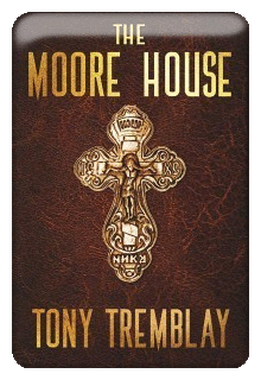
With The Moore House, Tony Tremblay (author of The Seeds of Nightmares) takes us on a terrifying journey. Three excommunicated nuns, Nora, Agnes, and Celeste, join a paranormal unit sanctioned by the Catholic Church, in the hopes for redemption in God’s eyes. As empaths, their jobs are to verify reports of demonic possession, and when their boss, Father MacLeod, is persuaded to investigate a house in a small New Hampshire town, the three women are chosen to assess these claims. Goffstown police files detail numerous extraordinary occurrences at the Moore House, including seven gruesome, unsolved killings. For this reason, the three empaths are instructed not to enter the dwelling, but to employ their abilities while circling outside the house. Nora, Agnes, and Celeste proclaim it free of supernatural forces, but they are wrong…dead wrong.
The three women discover their presence is part of a larger plan. The Moore House is not only possessed, but it soon possesses them, forcing them to relive the sins that had resulted in their excommunications. Their belief in God and redemption dissolving, they becomes pawns in a demonic scheme, a means to an end, in which Father MacLeod is their only hope. But Father MacLeod has made his own deal with the devil, and the devil is ready to collect. The Moore House, a novel described as Ghost Story meets The exorcist, will posses you as well. COMING SOON From Haverhill House Publishing
ALL INTERNAL BY TERENCE HANNUMComments are closed.
|


Archives
April 2023
|
 RSS Feed

|

|