

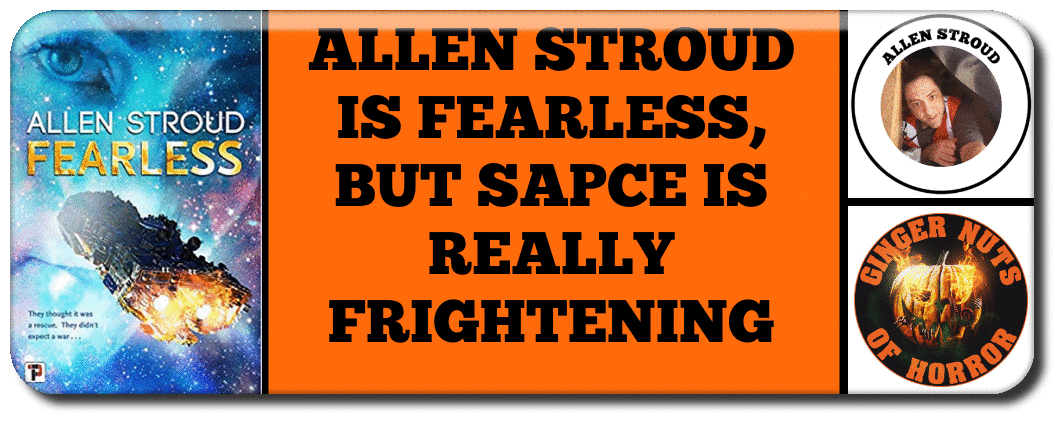
 Space is frightening. When I was young, in my teens, I read 2001: A Space Odyssey. One evening, I got to the bit where HAL refuses to let Dave Bowman back into the ship. That moment affected me. Not specifically because of the computer AI gone wrong, but more because the writing conveyed the vastness and uncompromising dangers of space itself. The vacuum and emptiness, the way in which we try to picture or imagine that. The idea resonated with me deeply. As a child, I’d suffered from night terrors, something we’d managed to link with when I’d been running a fever. I would fall asleep and then dream I was in deep space, floating in front of planet, an asteroid or something else. What scared me about that was that I couldn’t determine how far away the object was, whether I was falling towards it, or how big it was. My mind kept trying to reconcile all of those issues but couldn’t. All I knew was that I was insignificant in comparison. A tiny object hurtling or not hurtling towards something huge or incredibly small. That’s what always panicked me. When I was very young, the fevered visions had made me delirious and terrified. As I got older, they became a strange trip that I enjoyed. They were always so vivid and powerful. 2001: A Space Odyssey caught me in a moment when I was still young enough to remember the fever terror. The writing took me right back to that place, being half awake, half within the dream. I remembered that feeling when I started writing my 2020 novel, Fearless. There was something I felt I absolutely needed to convey about space. Something about the way in which that vast emptiness is totally uncompromising. In the 21st century, Humanity has something of an uneasy relationship with nature. We see aspects of our environment as things we need to conquer. Sometimes that view is justified, sometimes it is not. We say we want to understand our world, but for some that understanding is a way to master and control everything around us. Space is not something you ever really control. You might move through it, survive it, exist within it for a short time, but that great nothing contains none of the fundamental elements we need to survive. Our understanding of space has gradually improved. The public perception and visualisation of the environment comes to us through movies. Whilst scientifically we might know you cannot hear anything in space, we still remember the screaming engines of a TIE-Fighter, or the low rumble of the Nostromo. We still suspend our disbelief when we watch those films, but they aren’t real to us anymore, or at least, they aren’t what we think space is like when we actively think about it. Instead, the real images of astronauts and cosmonauts in space that we get from NASA, SpaceX and other agencies show us people living in cramped conditions, trying to manage the vagaries of micro gravity, or fumbling around outside in huge unwieldy suits that protect them from vacuum and radiation. That cramped claustrophobia is a huge contrast to the vastness I mentioned before. The safety of tight spaces, their pressurized context is a quality that can bee useful to a writer. The safety of a spaceship or a space station can be threatened or flipped. The fragility of its hull, escaping oxygen, a fire, all of these things risk the brittle equilibrium. Additionally, reversing that safety and using the confines as part of a vicious fight between characters serves to add something to the moment. Characters are trapped, they cannot escape as escape beyond the walls leads to a cold dark empty where nothing survives. All of these environmental qualities can add so much to a scene, or a moment within a story set in space. The way in which an author writes tends to emphasize the different qualities of their story. Approaching Fearless, I had a selection themes that were important to me. The portrayal of disabled characters in a science fiction story was probably the biggest priority. I didn’t want the story of my principle character, Captain Ellisa Shann, to be about overcoming her disability to achieve something, those kind of narratives have become something of a trope. Instead, I wanted Shann’s story to be about who she is, as she is. She was born with no legs. There is technology that can assist her, but she lives in a zero-gravity environment and is comfortable with being as she is. That was important to me. Other characters then provided an opportunity for me to explore different attitudes. Ensign April Johansson has a ‘plug-in’ mechanized prosthetic arm. Her attitude to her disability isn’t the same, she has adjusted her self-image to include the prosthesis, so when it breaks, she finds herself struggling to adjust. However, where both characters, and indeed, several other characters in the story of Fearless find common ground is in their healthy respect for the dangers of space, and the way in which they experience trauma. The tag line for Fearless on the front cover gives the reader a very clear idea of where we’re going: “They thought it was a rescue, they didn’t expect a war.” He genres of military science fiction and space opera explore and describe the circumstances of violent combat. In some, there is a triumphalism, or a romanticisation of those moments. An area which I feel is less explored at times is the effect of war on the individual. The moments of danger that force a person to narrow their world view down to good vs bad or them vs us, has an effect on how we are. When soldiers revisit their actions in the aftermath of those moments, then the emotions kick in, and the self-criticism comes out. This is another horror that deserves exploration, not in a cheap ‘for kicks’ way that might lead to excessive introspection, undue angst or a self-absorbed story, but a way that offers a very human exploration of tragic circumstances. The cost of our actions, on who we are, the effect of them on how we are in our lives as we move forward is very important. This is trauma. How we deal with our trauma is an essential part of who we are. Captain Shann’s story is a story of struggle, sacrifice, loss and trauma. But her personal story doesn’t end with trauma. Again, there is a type of story where the writer puts away their heroes when the quest is done and they have suffered for their happy resolution, to leave the next problem to the next generation, etc. That’s also not for me. For me, characters who have lived through trauma and found a way to cope – not overcome or forget completely, but cope – are interesting characters, layered characters with depth. At times, the trauma comes back. That can be a positive or a negative. Experience teaches us lessons we might never learn otherwise. I have recently agreed a contract with Flame Tree Press for the sequel to Fearless. It’s called Resilient and continues the story of Captain Ellisa Shann and her crew as they come to terms with what happened to them in the first book and move forward with their lives. I can promise readers more scenes in space, where the uncompromising vast emptiness will make a return, and where individuals have to make the same kind of emotionally difficult, life or death decisions as before. There are other themes too. An exploration of identity, of worth, agendas, politics, power, all the big themes a writer can try to examine in a story with large enough scope. The claustrophobic tension of the first book can’t be repeated, but it does play a part in the second, as the perspective widens to establish the context of humanity’s colonial efforts in 2118 AD. Not anything especially new in some of that, you might say. I might say the same. But every time, I write about space, that fever dream comes back to me, taking me back to those nights when I woke up in a sweat, crying, reminded of my insignificance in the void. Fearless by Allen Stroud 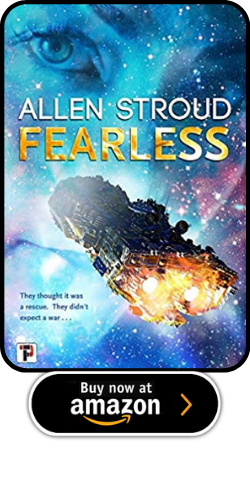 “Fast-paced, gripping hard SF with death in hard vacuum waiting at every turn.” ― Arthur C. Clarke Award winner Adrian Tchaikovsky AD 2118. Humanity has colonised the Moon, Mars, Ceres and Europa. Captain Ellisa Shann commands Khidr, a search and rescue ship with a crew of twenty-five, tasked to assist the vast commercial freighters that supply the different solar system colonies. Shann has no legs and has taken to life in zero-g partly as a result. She is a talented tactician who has a tendency to take too much on her own shoulders. Now, while on a regular six-month patrol through the solar system, Khidr picks up a distress call from the freighter Hercules… FLAME TREE PRESS is the new fiction imprint of Flame Tree Publishing. Launched in 2018 the list brings together brilliant new authors and the more established; the award winners, and exciting, original voices.  Allen Stroud is a lecturer and Chair of the British Science Fiction Association. He has work published as novels, short stories and in computer games. His first novel with Flame Tree Press, Fearless was praised as “hard sf”, offering glimpses of a vivid future for humanity as it colonises the solar system. WEBSITE LINKS https://www.flametreepublishing.com/Fearless-ISBN-9781787585423.html https://www.amazon.co.uk/dp/B08C5M9YT1/ref=dp-kindle-redirect?_encoding=UTF8&btkr=1 http://www.allenstroud.com http://www.bsfa.co.uk http://www.hwsevents.co.uk    Comments are closed.
|


Archives
April 2023

|
 RSS Feed

|

|