

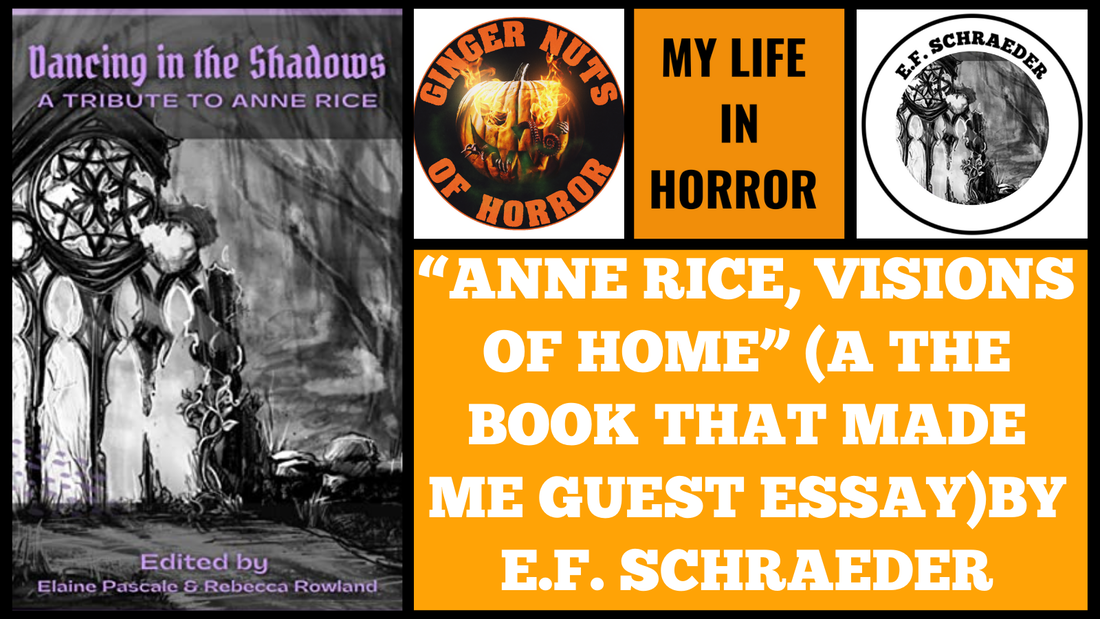
 I grew up in a family of readers, always passing books around and talking about characters we read about like they were part of our extended relations. In a way, they were. So it was nothing surprising for my mom to pass a book to me. Except for one time when the moment itself seemed a little strange. Slower. More deliberate. More self-aware. “This isn’t the same as a lot of the books you read, but I think you’ll like it,” my mom said. She handed over a copy of Interview with the Vampire. The title centered in glorious red, nearly bleeding from the stark white cover art. The images featured lots of lacy, luscious details in shades of white and gold including a top hat, cane, silky gloves, a carnation, an elegant brooch nested on a small cushion. Flipped over, I found a what looked like an old-time family photograph of two men, neatly dressed in white tuxedos, one seated and one standing. The queer content nearly sizzled on the surface of that image, the longing, intense expressions on their faces. A small curly red-headed girl stood beside them, her eyes somehow brooding and angry. When my mom handed me this well worn copy of Interview with the Vampire, I was already very much a horror geek. Reared on vintage Vincent Price, 70s vampires, and Hammer horror movies, reading Poe, Stoker, and Mary Shelley wasn’t uncommon, but I hadn’t yet been steeped in much by way of modern gothic traditions. I hadn’t yet read many overtly queer horror books either, though queer subtexts often thrived in the shadows. So the idea of vampires and horror weren’t new, but there was something about this moment that suggested I might have been too young for something. Too young to be fully turned, perhaps a bit like Claudia herself. “It’s different than a lot of other scary stories you read. This one is really beautiful. More like reading F. Scott Fitzgerald’s version of a vampire story.” Mom said something like that too. I can’t remember her exact words of course because it was a long time ago, but along those lines. I soon discovered the sensibility of an Anne Rice book was quite an experience of its own, rushing with the scent of a new literary tradition born of flair, unafraid of flourish, and loaded with rough undercurrents of emotion and sensual tensions. Anne Rice’s sense of place and home thrilled me. Her descriptions transported me, immersed me into another world book after book. Her vampires reckoned with other urges than bloodlust, and I reveled in these relatively new and formative experiences as a reader. Swept into their world, I spent more than one midnight perched in a window seat reading and pausing to stare at the stars, wishing vampires really existed. Maybe after all I wasn’t quite prepared for reading about such existential hungers, but maybe that’s why my introduction to Anne Rice was so powerful, so meaningful, and so lasting. It had the feel of a delicious, risky secret— something to savor and devour. When the opportunity to write a tribute story to Anne Rice arose, I knew immediately I wanted to center a mother-daughter relationship. More than school age or years, my life is organized like a library, bookended by writers whose words, characters, and stories are written into moments and meanings that made me. This concept map of influences ties me to the folks who recommended various books, and while Anne Rice is certainly mother to generations of contemporary queer and gothic writers, it was my own mom who led me to her. It’s a debt and an honor I hope my story in Dancing in the Shadows in some small way acknowledges. Dancing in the Shadows: A Tribute to Anne Rice |


Archives
April 2023
|


 RSS Feed

|

|