

DEATH STRANDING: ANTICIPATING APOCALYPSE
14/6/2019
 I make it a matter of conscious effort not to get caught up in hype, particularly from the video game industry, which is infamous for its ability to make even the most egregious pustule seem like a rarely blossoming flower. In recent years, we have not only had video game studio executives lying through their teeth in order to hock their wares, misrepresentations, distortions, proclamations of common enthusiasm, to name but a few, but also some far more scurrilous deceptions such as trailers cobbled together specifically for the purposes of promotion that contain no actual in-game footage, despite being marketed otherwise, trailers which promise elements that do not appear in the finished products, spokespersons making claims that have kindled infernos of excitement amongst video game playing communities only for them to be revealed as hyperbole at best upon launch. Furthermore, we have experienced numerous examples of titles that have continually promised Eden, only to deliver barely function sewerage plants. The likes of Duke Nukem Forever, Fallout 76, Anthem, to name but a few, have demonstrated that promotion for video games is a minefield for the consumer, that we must navigate with extreme caution, if only to preserve our souls from being further ravaged. You can therefore understand my reticence when it comes to even broaching the subject of Death Stranding, perhaps one of the highest billed, most hyped, enthusiastically promoted, anticipated and generally desired games of the current generation. Already more than just a game, politics and history shroud the product, fuelling the anticipation and speculation surrounding it. Video game auteur Hideo Kojima, most infamous for the genre-defining Silent Hill and Metal Gear Solid franchises, has always been a fascinating voice in video game conception and design. Following his less-than-salubrious split from parent studio Konami a number of years back and that company's infamous maltreatment of such beloved franchises -not to mention the cancellation of projects such as Silent Hills-, the video game playing public have been hotly anticipating this first example of the man's independent career. Far more than a mere new release from a much beloved visionary, Death Stranding represents a significant blow for creativity and inspiration against corporate corruption and callisthenics. The bloated, cancerous nature of monoliths such as Konami has been a subject of some heated obsession amongst the video game playing public for some years now, its treatment of not only beloved franchises (which it has largely either neglected or driven into the dirt with myriad uninspired, lazy instalments) but also its employees, its customer-base and the general status of video games as a medium is generally regarded as corrosive to the point of toxic, leaving dreamers and creators like Kojima to seek alternative sources of support and expression. Likewise, Guillermo del Toro, film-maker, writer, artist, director and general imaginer, has had little success -and more than a little heartache- regarding the video game industry. Owing to how fragile and conservative it can be, numerous projects the man has been involved with have folded or failed, sometimes taking the studios they belonged to with them.  In Hideo Kojima, he seems to have found the perfect partner; an ideal collaboration of transgressive imagination. Kojima has made his mark by introducing imagery and concepts to video games that few -if any- could even conceive of, for not merely revolutionising genres, but defying their constraints to create truly interactive mediums of storytelling and philosophical exploration. His voice, his stamp, is entirely unique, beyond constraints of market demand or traditional proscription: everything he produces is an experiment and, as such, is necessarily deviant, strange and often abstruse. Guillermo del Toro exhibits similar qualities in his own work, cinematic pieces such as The Devil's Backbone, Pan's Labyrinth, Chronos etc demonstrating an imagination and a storytelling penchant that flies in the face of template and proscription. The marriage of these two creators for the now long-dead project, Silent Hills, was, for many, one made in some surreal and visionary Heaven. Many purchased consoles solely on the promise of this game, whose promotional material -a playable horror demo esoterically entitled P.T.- is now, in itself, promoted as a genre-defining piece of work. Then Konami happened. The details of the split between Kojima and Konami are difficult to determine, as the company has done all in its power to keep the story behind closed doors. However, it is known that the company could not reach an agreement with Kojima and his creative team regarding a number of projects, and so they were forced to part ways. The result? The cancellation of any and all projects Kojima was even tangentially involved with, including Silent Hills, which would have beena license to print money, were it a good game or not. 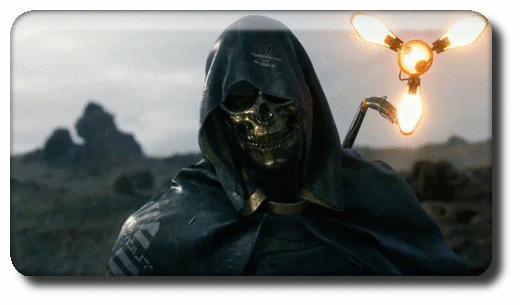 This left something of a wound at the heart of video game culture, a void that many feared would be a permanent disfigurement, especially given del Toro's various negative experiences in the industry. However, rather than surrender their work, their collective vision, the pair -along with others-, went away and created their own studio, one -ideally- free of the bloated, corporate pollution of old sews like Konami, where they would be unrestrained by market forces regarding the story they want to tell, the imagery and ideas they want to explore. Enter Death Stranding. As marketing goes, the project has been nothing short of genius, thus far. Deliberately tight-lipped regarding the nature of the game and its mechanics, the earliest videos reveal nothing, instead bombarding the viewer with some of the most disturbing, surreal and patently “Kojima” imagery that has ever graced our screens. Images of apocalypse, images of war and birth and death. And Norman Reedus. And Mads Mikkelsen. And of Guillermo del Toro himself, who features as a character in the game. Suggestions of some sort of metaphysical or existential apocalypse, some event that has fractured not time but probability, resulting in numerous states of being all co-existing, overlapping, colliding. Some sort of metaphysical threat: invisible, shapeless things that detect breath and heartbeat, that drag those they sense down into some olagineous condition; a Purgatorial non-space where time and state collapse together. We see fragments of various wars being fought: the trenches of WW1, the landings and bombings of WW2, the rainforests and swamplands of Vietnam and so on and so forth. Also, what appears to be a foetus in a synthetic womb, a device that is attached to the bearer via an umbilical chord and acts as a kind of detection for the invisible entities that now infest our shattered state of being.  It's insane. It's surreal. It seems to operate on various states of narrative and reality in the manner of existential science fiction such as Inception or the various works of Phillip K. Dick. The ethos of this early material is extremely nightmarish, lacking any clear indication of what the back-story is, the state of play, what the protagonist's purpose will be in this condition. The material is deliberately oblique, impressionistic and highly, highly disturbing. Then, nothing. Barely a whisper or rumour for months on end. The game left as a kind of promise, a rumour on the breeze, the lingering memory of an old nightmare. An entirely deliberate exercise, of course: Kojima, del Toro and the other creators involved clearly want to keep this project as oblique as possible, up to the point of release. Now, for most video game studios, that would be a huge red flag: similar denials of access, review embargos etc have occurred in recent years because the studios in question knew they had a total dog on their hands and wanted to make some money back on sales before word started to spread. That's clearly not the case here. The creators have a specific plan and strategy for how to market this work, the obliqueness and general mystery of its nature eliciting no small amount of intrigue and speculation. If anything, the vacuum left by lack of material and explanation has fostered an abiding and passionate sub-culture on various platforms. Go to YouTube, type in “Death Stranding speculation” or “Death Stranding meaning,” and you will be subjected to a torrent of videos dissecting and analysing every image, every statement, every suggestion within the material we have been subjected to thus far. Theories on what is happening within the game range from metaphysical apocalypses to some pan-dimensional disaster facilitated by military science or physics humanity should never have played with. The overt imagery of birth and death has fuelled even more abstruse speculation as to the philosophical underpinnings of the game, which, given both Kojima and del Toro's backgrounds, are sure to be abstruse, complex and ambiguous. In recent weeks, we have been given some spare glimpses into the game itself, the first indications of what “type” of game it is going to be, how it will play, but even they, for all of their detail, lack any definite clarity: It seems to have elements of open-world exploration and RPG, alongside resource management, survivalism, action-oriented set-pieces, stealth and no small amount of horror. 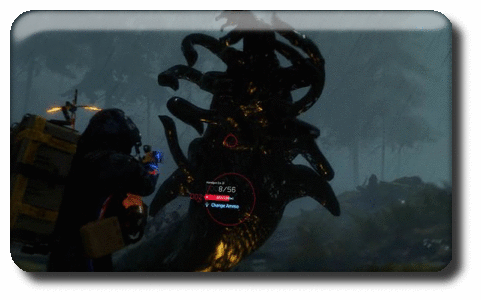 The world of the game is clearly broken, a shattered and uncertain place in which not only the environment or society are falling apart, but reality. This is the kind of horror that verges on cosmic science fiction, a vastness of scope to make Lovecraft blanche. Environments seem to shift and change around the player, flickering from one condition to another, from one time to another, floating spectral entities appear and disappear in the air. Immense, partially invisible entities that seem to be out of phase with reality stalk the world, dragging away those they sense and dissolving them into the common muck of history. There is so much in what has already been released to explore, so much that warrants analysis and dissection. Assuming the game collects on this promise, it could potentially be that rarest of things: something genuinely new, if not in game mechanics, then in terms of its story. Something we have not seen in this format before, and that will inspire debate and obsession for decades to come. Given the passions it has already aroused, I can only pray that it succeeds, for the sake of its ideas, for the sake of the industry and of video game culture.   Comments are closed.
|


Archives
April 2023

|
 RSS Feed

|

|