

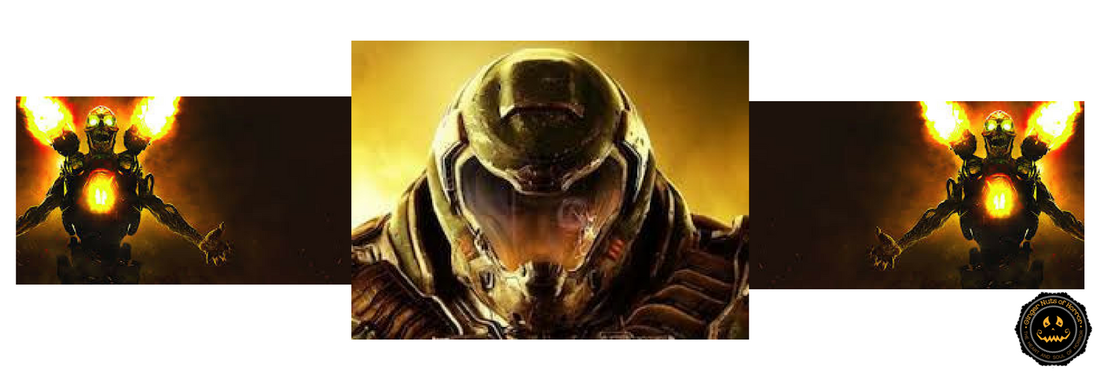
 When Francis Ford Coppola came to direct his adaptation of Bram Stoker's Dracula, he did so knowing that everyone on Earth was already well familiar with the beats, details and rhythms of the story; having become so ingrained in culture's collective consciousness, even those who have never read the book or seen any of the (many, many) film adaptations could likely recreate it with a high degree of accuracy and very little in the way of uncertainty. As a result, he acknowledged that there was no way, no way, to play this story straight. Instead, he opted for an almost parodic approach; foregoing the murk and monochromatic palette of his predecessors; the quiescence and earnestness, the final work one of sumptuous colour, of absurd hyperbole and exaggeration, that throws so many knowing winks at the audience, it has developed something of a squint by the time its credits roll. Whether successful or not is a matter for individual tastes (personally, I adore the film, absurdity and all. Apart from Keeanu Reeves and Winona Ryder, of course), but the effort is one that can work, with a deft enough hand. The most recent incarnation of the less iconic, more legendary Doom franchise is arguably one of the finest examples of this I've ever come across. The game knows that you know it; it assumes that you are intimately familiar with, if not previous games in the franchise, then examples of the genre (first person shooters) that it popularised. In that, it is a giant, indulgent, seething mass of adolescent joy; it panders to its audience in the most charming, brilliant, self-effacing manner. There is nothing, nothing of complexity or ambiguity here; only near-perfect rhythm, game design, blistering action, amazing visuals: an experience that (arguably) serves as a more legitimate descendent of the original Doom than the previous Doom 3, which, whilst entirely successful in its own right, opted for a more mean and moody, atmospheric and narrative piece. This is the inversion of that game's slow build and shadows; this is Big Trouble in Little China, this is Brain Dead, this is ridiculous, absurd, hyperbolic, technicolour violence, gore, highly visual and stylised horror with a degree of self awareness and raw wit to make it laugh out loud hilarious. 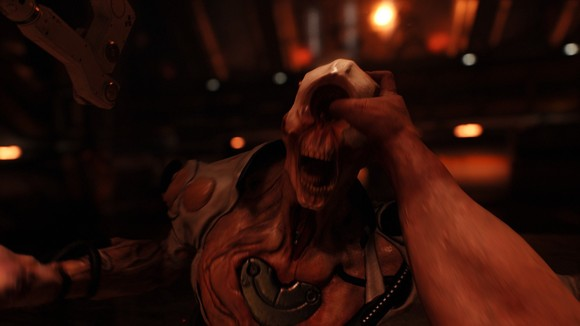 You know the drill; there's nothing to this: you awaken as the classic Doom marine, who has seemingly been entombed in Hell for some significant time, but has been exhumed and roused in time to find Hell having been perforated once more, hordes of demons pouring through, no time for exposition or chit-chat: your first act to graphically (and hilariously) murder the possessed scientists responsible for your waking. From that point on, the game becomes little more than a rarefied first person shooter; you kill things, collect power ups, move on; find keys, press buttons, open doors, kill things, move on, kill things, kill things, kill things...It's what might be called simplistic, were it not so joyous, were it not so exquisitely designed, paced and considered. This is where all of Doom's artistry lies; not in heaving, conflated narrative, in complex choices, in moral quandaries; it's in the balance and heft of weaponry, in the raw, visceral feeling of it all. The sheer amount of enemies the game throws at you at any one time should, by rights, become boring after the first twenty minutes, yet it doesn't, because those enemies are beautifully designed, hideously clever and massively challenging (the AI in this game is incredible; the various demons and possessed human beings, of which there is an insane variety, acting both in concert and conflict with one another, utilising landscape and environments, tactics and animalistic instinct to such a degree, it often feels like playing against a horde of human opponents in multiplayer death match). Most of the enemies are derivations or re-imaginings of those familiar to the Doom franchise, from possessed human beings (basic cannon fodder, for the most part; little more than moving ammo and health repositories, though they can overwhelm in numbers) to immense, demonic entities such as the Mancubi, Hellknight and Cyber-Demon, all are present and accounted for, all instantly recognisable to those familiar with the franchise, despite their often significant redesigns. 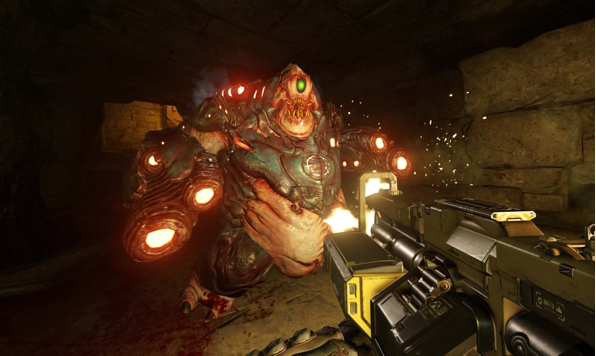 As in the original games, the monsters -particularly the larger and more distressing breeds- are treated with reverence in this game; they are, in many respects, the core of its appeal; what keeps players wading through the horde upon horde of the familiar, just for a glimpse of the bigger, nastier monstrosities that Hell can vomit up. Each of the larger specimens is introduced in extremely organic set-pieces, the game-play not pausing or even slowing to allow the player time to breathe or revel in their monstrosity; the likes of the Hellknight and Cacodemon hurling themselves into the fray the instant they emerge, requiring lightning-quick reflexes and timely adaptation, if you are to survive. Each of the creatures also has their own idiosyncratic behaviours, sounds and favoured environments, lending them a degree of character that has arguably been absent in previous Doom titles. This demonstrates yet another area in which the game utterly excels: sound design. From the thumping, pseudo-metal soundtrack (most music tracks adaptations of those found in the original two games) to the ambience of Mars's many locations, the game's aural element is exceptional, evocative and even highly functional: the player will be required in many instances to rely upon their ability to recognise the calls of particular enemies, the sounds of their attacks hurtling through the air, in order to pin point them; to target them or avoid an impromptu death at the hands of an errant fireball or laser-blast. Both aesthetics and soundtrack escalate wildly when the environment switches to the depths of Hell itself, the previous suggestions of disturbia (overt as they are) escalating to lunatic degrees: the design of Hell echoes that within previous games, but is emphasised and exaggerated to the power of N, its levels consisting of vast, shifting labyrinths and temple complexes, edifices of intertwined bodies and living flesh, the aesthetics alone enough to sell the game on, the gameplay (which becomes infinitely more devious and dangerous at this point) providing an assault course for the lessons learned in the previous, Martian complexes, where every trick and technique the player has accrued must be brought to bear and then some, if they are to survive. 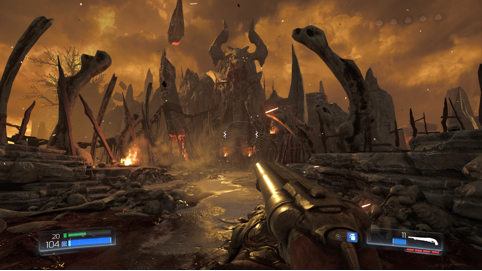 Faults?; For some, the game will inevitably be too shallow and simplistic; this is not an experience that purports Fallout 4 degrees of complexity, or even more straightforward shooters. Whilst some lip-service is paid to a cheap and cheerful upgrade system, the game is not one to be played for depth of experience; it is pick up and play, without pre-amble or ambiguity: visceral, violent, welcoming and immediate fun; it does not seek to draw the player in with slow tutorials or a gradually steepening learning curve: it's the gaming equivalent of a roller-coaster or a ghost-train ride, and, in that, it excels. Others may be put off by the game's insistence upon itself as exactly that; whereas the overall trend in video games over the last few decades has been away from their status as merely electronic forms of entertainment and towards a medium of narrative and aesthetics comparable to television or cinema, Doom is deliberately retrograde; it is a gamer's game; highly competitive, surrendering immersion and verisimilitude for functionality; the Doom marine glides over environments as though they are coated in teflon, the level design is achingly reminiscent of very early first person shooters (another deliberate choice rather than example of poor design) and the overall product doesn't particularly care about evoking the entrail-churning, sanity-shattering horror of Hell so much as dazzling with pyrotechnics and coaxing laughter with the sheer bravura of its violence. A game to approach with a (somewhat ironically) considered eye; anyone looking for a rich, evocative, narratively driven and ambiguous experience will get nothing here. Those with an inkling for something more refined than the recent crop of first-person action-RPGs will find the game addictive; an affectionate throwback to video gaming days of yore and a stunning example of how to evoke nostalgia without descending into sickly sentimentality.  Comments are closed.
|


Archives
April 2023

|
 RSS Feed

|

|