

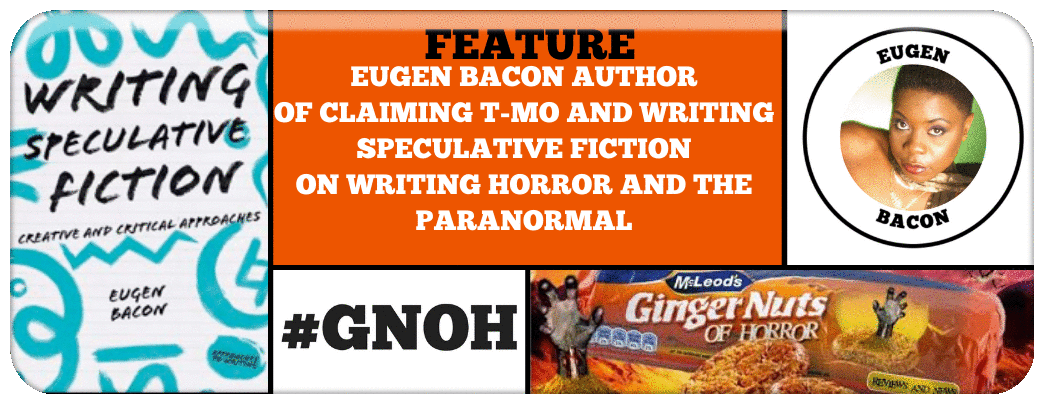
 On Writing Horror and the Paranormal by Eugen Bacon, author of Claiming T-Mo and Writing Speculative Fiction Eugen Bacon loves chocolate, sake, Toni Morrison and Ray Bradbury. She has sold many stories and articles, together with anthologies. Her stories have won, been shortlisted and commended in international awards, including the Bridport Prize, L. Ron Hubbard Writers of the Future Contest and Copyright Agency Prize. Recent publications: Writing Speculative Fiction, Macmillan (2019). Claiming T-Mo, Meerkat Press (2019). In 2020: A Pining, Meerkat Press. Black Moon, IFWG. Inside the Dreaming, Newcon Press. Writing horror and the paranormal You think horror, you think Bram Stoker, Alfred Hitchcock, Ridley Scott, M. Night Shyamalan, Dean Koontz, Stephen King, Eleanor Lewis, H. P. Lovecraft, Shirley Jackson, Mark Danielewski, Mary Shelley, Robert Louis Stevenson, Anne Rice, Poppy Brite … Guy de Maupassant who wrote across many genres. In his book Danse Macabre, King paid homage to Jorge Luis Borges and Ray Bradbury in his list of ‘six great writers of the macabre’. As far as storytelling goes, horror can be an exhausted genre, and artists and producers are continually hunting ways to tap into audience curiosity by reinventing it. Horror films like Alfred Hitchcock’s Psycho (1960) and Wes Craven’s Scream (1996) typecast horror, and copycat stories emerged, exhausting fans with parodic slasher narratives, blood and gore, until zombies burst into the spotlight; the appetite for them has stayed rich. Is horror the jet black eyes of a silent entity, an atmosphere in a room that creaks, footsteps on a wooden floor, objects changing position, pictures turning to snow on the television screen, things falling when no one else is home, a shadow at the edge of your sight, a spectre on a fence by the road, staring little girls dressed in white, weeping walls, crying babies, songs behind a wall, barking dogs, horses going ape, an aura behind a headstone, a silhouette in every photograph, two sets of the same person out of nowhere, poltergeist? Clarkesworld in its online guidelines for authors says it looks for horror that ‘can be supernatural or psychological, so long as it is frightening’, but warns against ‘zombies or zombie-wannabes’, ‘stories where the climax is dependent on the spilling of intestines’. Horror.org admits that answering what is horror is a tough question—where your mind leaps to Freddy Krueger or Michael Myers, someone is looking for Shelley’s Frankenstein or Stevenson’s Dr. Jekyll and Mr. Hyde: The popularity of the modern horror film, with its endless scenes of blood and gore, has eclipsed the reality of horror fiction. When you add to that a comprehension of how horror evolved as both a marketing category and a publishing niche during the late eighties—horror’s first boom time—it’s easy to understand why answering the question of what today’s horror fiction actually is has become so difficult. Horror is personal. A spider may be horror to you. A snake. Height. Blood. Rot. A dead body. A ghost. In An Evening with Ray Bradbury, the author invited his listeners to ‘list ten things you love, and ten things you hate’ and then to write about those loves and kill those hates—also by writing about them. Do the same with your fears, he said. Bradbury shared a story on fear. He went to his doctor’s when he was 23 years old. ‘Take some aspirin and go home,’ the doctor said. Bradbury started thinking about tendons and muscles, all the things in his body he hadn’t noticed. The medulla oblongata, a crack in your head that hasn’t filled in yet. The action of the jaw itself. The knee caps. The toes. He went home feeling his bones. That afternoon he wrote the story of Mr Harris who goes to see his doctor. ‘You’re only nervous,’ the doctor says. ‘Let’s see your fingers. Too many cigarettes. Let me smell your breath. Too much whiskey. Let’s see your eyes. Not much sleep. My response? Go home to bed, stop drinking, stop smoking. Ten dollars please.’ But Harris stands there. The doctor looks up from his papers. ‘You still here? You’re a hypochondriac!’ he says. ‘But why should my bones ache?’ asks Harris. ‘You realize you caused most of the soreness,’ the doctor says. ‘Leave yourself alone. Take a dose of salts. Get out of here now!’ But, alone, Harris examines himself and, in pushing his spinal column, ‘fears and terrors answered, rushed from a million doors’; there is something there, a skeleton inside him. It starts manipulating him, determining whether he is to sit or to stand, a horrible gothic thing inside him. It is squeezing his brain, his vitals. His head aches, his chest is constricted. In an image of life and death, it becomes a competition about being true to himself or the skeleton. This is how the story ‘Skeleton’ came about. By being true to his own fears Bradbury was able to write speculative fiction stories. ‘Go back in time and collect up your fears,’ he advised. His short story ‘The thing at the top of the stairs’ was also birthed from a personal nightmare: When I was a kid, the bathroom was upstairs, single light half-way up the stairs. I had to run halfway up the stairs and turn on the light. But I always made the mistake of looking at the top of the stairs, and there was something there waiting for me. So peeing like crazy I fell back down. He recalled his fear and wrote about it. This is a great start to writing startling horror and the paranormal. *First published in Eugen Bacon’s Writing Speculative Fiction, Macmillan (2019) Writing Speculative Fiction: Creative and Critical Approaches (Approaches to Writing) by Eugen Bacon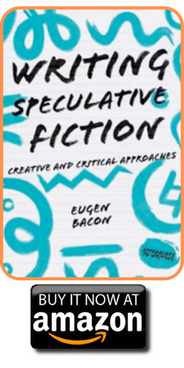 In this engaging and accessible guide, Eugen Bacon explores writing speculative fiction as a creative practice, drawing from her own work, and the work of other writers and theorists, to interrogate its various subgenres. Through analysis of writers such as Stephen King, J.R.R. Tolkien and J. K. Rowling, this book scrutinises the characteristics of speculative fiction, considers the potential of writing cross genre and covers the challenges of targeting young adults. It connects critical and cultural theories to the practice of creative writing, examining how they might apply to the process of writing speculative fiction. Both practical and critical in its evaluative gaze, it also looks at e-publishing as a promising publishing medium for speculative fiction. This is essential reading for undergraduate and postgraduate students of Creative Writing, looking to develop a critical awareness of, and practical skills for, the writing of speculative fiction. It is also a valuable resource for creators, commentators and consumers of contemporary speculative fiction.   Comments are closed.
|


Archives
April 2023
|
 RSS Feed

|

|