

EXPLORING THE LABYRINTH 17: CASTAWAYS
25/4/2022
 Because such scenes are a staple of pulp horror, and rarely appear in more “literary” works, I feel like the ability to write scenes like this effectively don’t get the respect and attention they deserve. I’ve read enough mediocre examples to appreciate it done well, and Keene does it as well as anyone, and better than most.
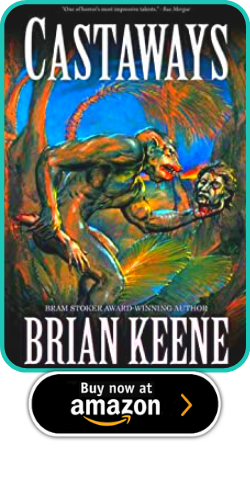
In this series, I will be reading every Brian Keene fiction book that has been published (and is still available in print), and then producing an essay on it. With the exception of Girl On The Glider, these essays will be based upon a first read of the books concerned. The article will assume you’ve read the book, and you should expect MASSIVE spoilers. I hope you enjoy my voyage of discovery. 17: Castaways We’re back in the land of splatterpunk/extreme horror here, as Brian Keene’s 17th outing takes aim and fires at ‘reality TV’ competition show Survivor, hitting the shipwrecked cast with the double whammy of a vicious tropical storm, and an even more vicious tribe of literal Neanderthals. What follows includes scenes of extreme violence, including sexual violence, and I’ll be discussing those themes as part of the essay, so please do bear that in mind. And you know what, let’s start with what damn genre this even is, as we’ve brought it up. Keene’s defined the difference between Splatterpunk and Extreme Horror (I paraphrase, and he knows where to find me if I fucked this up too badly) as Splatterpunk having a politically/socially conscious angle to boundary-pushing graphic content, with extreme horror having a tight focus on boundary-pushing for its own sake. Keene’s also clear that he has worked in both genres (and many others), and that both are artistically valid, providing they have heart. Now, the central plot of Castaways, concerning a dying tribe of inbred Neandertals attacking a group of gameshow contestants who have been stranded on the island in a Survivor-style ‘reality TV’ program certainly has its roots in pure pulp, and given the story portrays unflinching, graphic scenes of violent dismemberment, cannibalism, and rape, we’re absolutely ticking the ‘extreme horror’ boxes. And given both genres contain heart, the question becomes whether or not there’s sufficient political/social commentary here for this to tip over into Splatterpunk. I think there are two main components that represent evidence of a Splatterpunk sensibility. The first is the choice of a Survivor-type gameshow as being what brings the victims to the island in the first place. In a pure pulp setup, a boat or plane wreck would be the easiest way to set things up; sure, there’d be people looking in such a case, but with the island being hit by a tropical storm just as the tribe begins its assault, I think the core narrative would still work. Now, sure, Survivor was a hot TV property in 2009, so it did provide a plausible alternative to a wreck, which may have gone through trope and into cliche at this point; it’s also not going to hurt on the marketing side, having a novel riffing on something so much a part of the immediate pop culture. But the way Keene plays with the format of the TV show is interesting. For starters, it allows him to set up animosities and rival groups within the protagonists that feels not just plausible but inevitable, which makes a nice change; a pet peeve of mine is how, in disaster movie type situations, the survivor group immediately falls to infighting and rivalries, despite all available evidence showing that, in reality, humans exhibit an enormous capacity for cooperation when dealing with life-threatening situations. It’s not merely a (very) tired trope, in other words, but it cuts against any attempt at psychological realism; at which point, as a reader, I’m left honestly kind of non-plussed. Like, if you don’t have enough understanding of human nature to get something as basic as this right, how can I deeply invest in whatever else your story is trying to sell? Here, though, by setting up the characters as part of a gameshow process that’s been rolling for a while, in a highly unusual and artificial, hypercompetitive atmosphere, Keene pre-loads us to accept that there are built-up layers of mistrust and animosity which are likely to be exacerbated by the extreme circumstances. To add to the fun, the initial attacks go undetected because of the tropical storm, which has driven most of the film crew away and is playing havoc with communications. Convenient? Sure, but, you know, it’s a horror novel; readers will by and large swallow fairly large coincidences, providing the coincidences complicate/endanger the heroes. When it comes to fiction, good luck is verboten; but Murphy's Law can be piled on all day. But back to the gameshow setup; it feels to me like there is some social commentary happening here. Because, check it; we’ve got a bunch of people in a survival situation, being persuaded to act in competition rather than cooperation because of a cash prize that awaits at the end of the process; as a consequence of this, when the survival stakes get cranked from ‘losing the game’ to ‘getting killed’, they’re not well prepared to shift to what we know is the natural psychological state for such situations, i.e. enlightened cooperation. I mean to say, money motivates people to work against their own self-interests, acting in competition rather than cooperation, shortly before the environment straight-up tries to kill them. You can feel me looking over the top of my glasses, right? We’re back in Don’t Look Up territory, no? Feels like it to me. Now, sure, that may not have been the intent of the author, but that doesn’t mean the work doesn’t contain the metaphor, or that it doesn’t support this reading. And then we have the small matter of Matthew. Now, sure, The Sons of the Constitution’s political position circles a few half-truths alongside a few fairly outrageous lies without ever landing on anything approximating a coherent philosophy. But that’s equally true of both the major political parties in Keene’s country and my own at this point, so I can’t really fault them for that. They may not be coherent, but they’re plausible as fuck; indeed, I’d argue the QAnon crowd would kill for an approach this well thought out. As we’ve discussed before, aspects of Keenes' work that might have seemed satirical turned out to be lowballing what reality would dish up, and that gives me no pleasure to report, but here we all are. The point is, here we are in a situation where not only are there a bunch of survivors that have been programmed by the pursuit of wealth to act in competition in a survival situation, but one of them has been radicalised to the extent that he’s prepared to kill his fellow contestants before the real carnage has even been unleashed. At this point, I’m peering so hard over the top of my glasses they’re about to fall off the end of my nose. Now, look, sure, the novel doesn’t develop these themes, that’s true. Once the storm hits and the Neandertals attack, we’re firmly in pulp horror/grindhouse mode, with shades of Canabal Holocaust/The Hills Have Eyes. Fundamentally, the concern of the novel, once the fur starts flying is… well, in the words of the infamous movie poster, Who Will Survive, And What Will Be Left Of Them? And Keene doesn’t shrink from depictions of violence, gore and terror, as the contestants are subjected to terrifying, relentless attack. There’s also a superb second half where survivors of the initial beating decide on the lunatic plan to go down into the lair of their attackers, in a bid to rescue those who were taken. The reason this last was so effective for me was, as someone seventeen books into the Keene canon, there was no guarantee any of them would make it out. From The Rising on, Keene’s demonstrated an admirable commitment to let the story fall where it will, and if that means no one gets out alive, so be it. We’ll return to this sense of threat when we discuss the following novel, Urban Gothic, but for now let’s just acknowledge that having the metatextual knowledge that the author is willing to Go There changes the reading experience; or at least, it does for me; there’s an extra level of horror in knowing it really could all be for nothing. This is the opposite of a complaint, to be clear; one of the things this project is making me think about is just how ‘safe’ even some of my favourite, big names in the genre are, comparatively speaking, the pull of some kind of ‘happy ending’ (or at least survival, for a select few) seemingly irresistible. Not with Keene. And so it was with some trepidation that I followed the would-be heroes into the neanderthal burrows/caves, the odds feeling very much stacked against any kind of positive outcomes, and I got a well-earned endorphin rush when at least a small number of the gang, some of whom I’d grown to enjoy a great deal, actually made it to the damn chopper. In the afterword of the author's preferred text edition, Keene discusses the story's origin as part of a Richard Laymon tribute, and how the initial short story was retooled and reconstituted to slot into the Keene multiverse. There’s also an interesting… apologia isn’t quite right, but exploration/explanation about the portrayals of sexual violence in the novel. As a writer who has both on occasion produced work with similar scenes, and who has similar instinctive misgivings about doing so as Keene expresses here, I appreciated the conversation. Overall, the common Keene elements are here; a large ensemble cast that is nevertheless very well realised, with no character feeling vague or shortchanged, even though most of them end up as meat; I wasn’t trying to predict who’d make it and who wouldn’t, but, again, the feeling that nobody was safe was certainly enforced repeatedly to good effect. And Keene can write action-horror sequences with a level of skill and visceral feel that is enviable. Because such scenes are a staple of pulp horror, and rarely appear in more “literary” works, I feel like the ability to write scenes like this effectively don’t get the respect and attention they deserve. I’ve read enough mediocre examples to appreciate it done well, and Keene does it as well as anyone, and better than most. There is one other thing I want to get into before I close because it’s nagging at me. I mentioned Cannibal Holocaust earlier, and one of the other tales I was reminded of as I read this was the legend of remote Japanese islands where soldiers, unaware that WWII was over, lurked, ready to attack any ‘invaders’ that landed there. Just behind these stories is Victorian pulp ‘adventure’ fiction, featuring plucky white European explorers in jungles or remote islands, encountering… well, let’s avoid the language those texts would employ, and say instead unfriendly locals. Now, to note that Victorian pulp fiction, written during the nation's imperial phase, contains racism is surely not merely uncontroversial but almost goes-without-saying obvious. Similarly, Hollywood pictures depicting remote communities in the 30’s and 40’s… I mean, I love King Kong with a ferocity, but it took movie makers until Skull Island to find a way to depict the indigenous population of Kong’s home that didn’t lean to some degree or another on some pretty troubling/awful racial stereotypes. In that context, I can’t deny that there were moments when these descriptions of a tribe of bestial humanoids attacking a bunch of westerners felt… uncomfortable. And I want to be super clear about what I am saying and not saying, here. Keene is absolutely alive to this. In addition to being a prolific author, he’s a rabid fan of the genre, and its history. He’s aware of, and skillfully avoids, most of the potential pitfalls of the situation by being explicit about the attackers; they are Neandertals, a subspecies of human that were, in evolutionary terms, succeeded by people-as-we-know-them/us - homosapiens - though there was a period of history where the two species coexisted (and, recent DNA evidence suggests, were capable of making babies together). By positing that a small number of these… well, here’s where language starts to get difficult, right? Creatures? Subhumans? Oh, no, I don’t like that. And yet… Well, there it is, I guess, the root of my discomfort. Neandertals were real. By having a tribe of them be the antagonists of the story, Keene undoubtedly bypasses the many awful stereotypes such ‘westerners-on-an-island-attacked-by-brutal-locals’ narratives are loaded with. But I can’t help but feel the ghost of those stories, and the stereotypes they evoke, under the surface of this tale. And I just don’t dig that feeling. I want to be crystal clear; I don’t think this is a racist work, and I don’t think Keene is a racist author. And it’s absolutely not that authors shouldn’t be ‘allowed’ to write stories set in such environments that explore such themes. ‘Racist against Neandertals’ is not a thing, IMO. It’s just that since I read Castaways, on and off, I’ve been worrying at this aspect of it, and trying to figure out how one might find a way to tell a version of this story that employs these tropes but avoids the pitfalls/resonances entirely. And I’m finding, to my dismay, that, so far, my imagination simply isn’t equal to the challenge. It seems to me that any story that is a ‘clash of tribes’ type survival horror story is forced to ‘other’ the attackers. The brutality is a core component of where the horror comes from; the fear of being in a situation where you’re surrounded by ‘people’ who are interested only in your destruction and/or suffering. There’s something elemental about that kind of story, I think. It’ll always have a pull. But the problem is, when you have this setting, and the identification characters/heroes are westerners, and the locals aren’t… Look, this is one middle-aged white guy from the UK, going through the work of a middle-aged white guy from the US. I do not have answers for any of this. And, fucking hell, horror’s not meant to make you feel comfortable, is it? It’s meant to get under your skull, send out nagging mindworms that keep you turning ideas over after you’ve finished writing, right? And, if so, mission spectacularly accomplished. Also, I’m not going to pretend; I run this project one book ahead - at the time of writing this essay, I’ve read Urban Gothic, and some of these themes will be picked up and developed there. And, mildest of spoilers, I think the way that novel handles those themes and navigates these issues is superior in basically every way. So, okay, let’s call this part 1, to be continued, for now, and let’s just acknowledge that this one bothered me on levels beyond the immediate visceral horror of the subject matter. Which, I reiterate, is not necessarily a bad thing. Next up: Urban Gothic. Which I’m sure will be easier going… :/ KP 12/3/22 Castaways |
 |  |
THE HEART AND SOUL OF HORROR PROMOTION WEBSITES
Comments are closed.


Archives
April 2023
March 2023
February 2023
January 2023
December 2022
November 2022
October 2022
September 2022
August 2022
July 2022
June 2022
May 2022
April 2022
March 2022
February 2022
January 2022
December 2021
November 2021
October 2021
September 2021
August 2021
July 2021
June 2021
May 2021
April 2021
March 2021
February 2021
January 2021
December 2020
November 2020
October 2020
September 2020
August 2020
July 2020
June 2020
May 2020
April 2020
March 2020
February 2020
January 2020
December 2019
November 2019
October 2019
September 2019
August 2019
July 2019
June 2019
May 2019
April 2019
March 2019
February 2019
January 2019
December 2018
November 2018
October 2018
September 2018
August 2018
July 2018
June 2018
May 2018
April 2018
March 2018
February 2018
January 2018
December 2017
November 2017
October 2017
September 2017
August 2017
June 2017
May 2017
April 2017
March 2017
February 2017
January 2017
December 2016
November 2016
October 2016
September 2016
August 2016
July 2016
June 2016
May 2016
April 2016
March 2016
February 2016
January 2016
December 2015
November 2015
October 2015
September 2015
August 2015
July 2015
June 2015
May 2015
April 2015
March 2015
February 2015
January 2015
December 2014
November 2014
October 2014
September 2014
August 2014
July 2014
June 2014
May 2014
April 2014
March 2014
February 2014
January 2014
December 2013
October 2013
September 2013
August 2013
 RSS Feed

|

|