

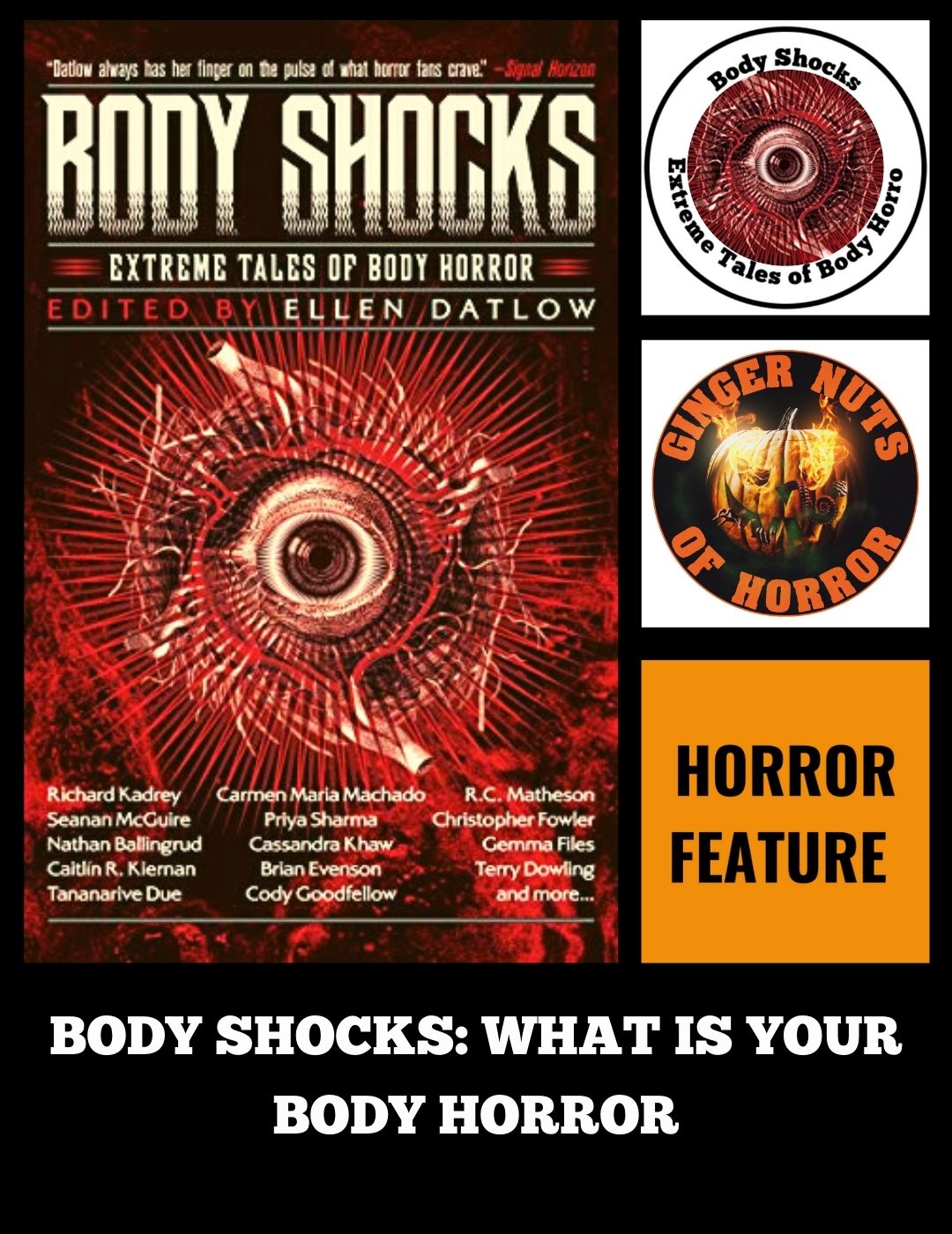
To celebrate the release of the new anthology edited by Ellen Datlow, Ginger Nuts of Horror has invited a some of the authors featured in the the anthology to tell us about "What is Your Body Horror?" and "What is their favourite Body Horror?". We would also like to thank Kasey Lansdale who is the publicist for the anthology, for setting up and corralling the authors for the feature. It is always wonderful to work with publicist like Kasey. And if you haven't checked out our review of Body Shocks check it out here Seanan McGuire "What is your body horror?" Teeth. Anything to do with teeth. I grew up in the American welfare system, and we had access to very unpleasant dentists who resented working on poor kids for free. They yelled at me so much that I became afraid of my own teeth. Teeth are terrifying. Violence toward teeth is even worse. "What body horror do you love?" Grey Matter, by Stephen King, is one of my favorite stories of all time. ED: Not sure this is appropriate, but I'm terrified of a gorgeous, sharp, brand-new bread knife I bought to replace one with a cracked handle. The reason I'm terrified? First (and only) time I used it, it slipped and cut my finger and I bled like a pig and was worried I'd have to go to the ER to stop the bleeding. Happy ending (bleeding stopped) for me, but I put the knife back into its protector and have never used it since. I'm still using my old, cracked handle bread knife, several year later. My favourite "body horror" movie is Alien -I've watched it multiple times and still jump at the chest buster scene. Pat Cadigan: In response to ‘What is your body horror?’: I have terminal cancer. Nothing scares me. There’s nothing left to be afraid of. (I asked if it was okay to share this and she linked me to her blog which talks about it further and candidly) Cody Goodfellow: I've been fortunate not to have any serious medical conditions so far, but notions of health as a function of positive mental outlook drive me to distraction, because if the body is an expression of the mind, I'm fucked and my doctor just doesn't know it yet. A biology professor once told me that a cell goes malignant in our bodies every day, on average, and the body (almost always) stops it. With all that chaos struggling to turn into tumor fruits, the moment our minds are turned away from diligently proclaiming our fitness, the body will start destroying itself. It's enough to give one a stress-related heart attack. In "Atwater", I tried to capture this self-perpetuating fear, as the protagonist encounters various victims of their own mental and emotional issues manifesting as surreal physical maladies, and comes to wonder what's going on inside himself... I'd have to say my favorite body horror novel is still Blood Music by Greg Bear. It's only science fiction in the sense that it extrapolates from the frightening idea––what if a retrovirus was perfecting your body, whether you like it or not––to extremes that elude most horror novels and films. While everybody's favorite The Thing (1982) wisely stopped short of escalating beyond the isolation of Outpost 31 because the fear dissipates when it dilutes into mass action, Blood Music goes from the intimate war inside Virgil Ulam's body to the infection and alteration of the species without letting the tension go flat. Angela Slatter “What is Your Body Horror?” Okay, so it’s not connected with my story, but it’s my personal body horror “thing”. I’ve had a couple of broken bones and some major operations that can best be described as “someone taking an angle-grinder to my body”, but the thing that freaks me out is … my bellybutton. No one can touch the bellybutton. This is because I have a deep and completely rational (yeah, you read that right) fear that that is how I will be unravelled. Think the hybrid Alien that Ripley gives birth to in Aliens 4? When it’s sucked out the window into space, one meaty strand at a time? That’s how I’m utterly certain the bellybutton body horror show is going to go … “What is Your Body Horror Love?” I’d have to go with a Classic and say the original Clive Barker Hellraiser. I remember seeing it the first time (probably at an inappropriately young age) and watching it through my fingers (because we all know that helps). Frank stealing his brother’s skin; then the whole end of Frank with the fishhooks and chains. Coincidentally, it’s probably the inspiration for parts of my story, “Cuckoo”. The whole inhabiting other bodies, peeling off of skin, the idea of false identity, of being betrayed when someone removes their mask (which, let’s face it, is also a bit Scooby-Doo and Old Man Withers cursing those meddling kids). Also the idea that any disguise you pull on would never fit properly, and you’d burst out of it eventually, which is why my story contains this description: “The flesh was still warm, which is best – too hard to shrug on something in full rigor – and I crammed my bulk into the small body much as one might climb into a box or a trunk to hide. A fold here, a dislocation there, a twinge of discomfort and curses when something tore, stretched just too far.” Ray Cluley When it comes to body horror, what scares me most is the body mutating. It’s an important part of evolution, of course, necessary for any species to survive, but it can also be cancer. That scares the hell out of me. That’s my biggest real-life fear. There’s a line I remember from the TV series Hannibal (I can’t recall if it was in any of Harris’s books) where Bella Crawford explains her cancer as a cell from her liver that wandered into her lung and tried to make another liver (something like that), and isn’t that kind of biological accident frightening? Add to that the things we do to ourselves that can cause our body to turn on us, the things we eat, and drink, and smoke, the drugs we take… The idea that the body is a complex but fallible and fragile biological machine is both humbling and terrifying. But also any mutation or transformation that dehumanises the body or causes it to devolve, that’s frightening. That’s horrifying. Kafka’s The Metamorphosis is a big one here, for me. That, and The Fly, both the 1950s version and the Cronenberg remake (can anyone talk about body horror and not mention Cronenberg?). Brundlefly is no superhero mix of human and insect, he’s a splicing accident that continues to mutate, the corruption of what is human made more and more apparent in the way his body changes. One minute, Jeff Goldblum is marvelling at his new strength and stamina, the next he’s preserving the parts of him that are falling off and puking all over his food in order to digest it properly. He loses his sense of self, and his potential greatness is wasted in becoming something so other and monstrous. That said, for all the grossness of Cronenberg’s remake, it’s the 1950s version that disturbed me most, and the ending in particular has haunted me ever since I first saw it. My story in Body Shocks draws on all of the above. The Metamorphosis and The Fly are both clear influences (although funnily enough only the Kafka was intentional; that ending from The Fly just got caught up in there all by itself) and I use them to explore the idea of wasted potential and the loss of self. The body’s transformation, its mutation, provides the physical horror, but it’s also a representation and consequence of giving up on your dreams or being too cowardly to pursue them. Of letting them mutate and diminish into something more monotonous and mundane. There’s horror here not only in becoming something other but in becoming just like everybody else. Priya Sharma I’ve always had a fear of limbless things. As a child I was horrified by the humble worm, soil-eater, earth-turner, essential to the garden and the field . When my mother dug over her vegetable beds and brought up a knot of them, their flailing pink segmented bodies made me feel sick. This fear extended to snakes even though I’d never seen one firsthand. I couldn’t even look at a photograph of one without my hindbrain screaming at me. I was asked to write an original fairy tale for an anthology. My jumping off point was princesses in a tower, albeit in a modern tower block. As I tried to work in the other fairy tale tropes it stalled and so it languished while I wrote something else. Certain stories don’t go away, or rather they don’t leave you alone. To paraphrase the legendary Pat Cadigan, one idea is a premise and two ideas make a story. I’d heard an urban legend about someone who worked for a housing association and found a man’s bloated corpse with a pair of fang marks in his neck. It was also a story from an area not dissimilar to that of my incarcerated princess. It’s only when ideas collide that something interesting happens. I imagined something from Roald Dahl’s short story of “Poison”. (SPOILERS) So, I had a princess and snakes. I took out my story notes and fragments, in which my princess had to go to the villain to make a bargain. In one version she was saved by her prince. My princess yawned, not at all politely. In another, by her mother à la “The Bloody Chamber” by Angela Carter. My princess looked a bit more hopeful, so I had to ask her what she wanted. Her own princess and that they save themselves. Giving them the power of snakeshifting was to give them agency and autonomy in a world where their sex and sex itself was used against them as a means of control. I wanted to offer them physical power in a world where they had none. (SPOILERS END) To make the story work, I needed to understand my nemesis. My experience of snakes up until that time had been limited. My parents are from India. My mother’s favourite childhood story was of her visits to an old woman she knew. She was told to sit on a chair and not to move. The old lady poured water into a saucer and they waited. A cobra slid into the room and reared up, its hood expanding. My mother held her breath. When the cobra was ready, it lowered its head and drank. My mother swears it’s true. And that the snake only visited on a Thursday between the hours of one and two o’clock! I like research. It throws up things that can change the course of a story, or at the least give it colour. I went to an exhibition called Sssnakes Alive at the excellent Liverpool World Museum. It seems like a minor thing as I write this, but for me it was an experience akin to the psychological technique of flooding for curing phobias. Snakes of every sort looked out at me from giant canvases; they were exquisitely rendered portraits. There were boa constrictors in tanks. There were videos from Liverpool’s School of Tropical Medicine of herpetologist’s milking venom from mambas. There was a Burmese’s python skeleton and a giant game of snakes and ladders. I was on the edge where revulsion becomes fascination. A king cobra’s venom can kill an adult elephant in a few hours. The inland taipan’s venom is a heady mix of paralysis agent, neurotoxin, and procoagulant. It will stop you breathing while you haemorrhage and your muscles waste. The black mamba can travel at 11 kph. Pythons don’t unhinge their jaws. Instead its attached with a ligament that stretches, sometimes wide enough to swallow a crocodile. I understand that snakes are sensitive and shy creatures. They symbolise medicine and knowledge (there’s a serpent wound around the Rod of Asclepius, Greek deity of healing and medicine). I know that their skin is dry and warm, not cold and slimy. I know all these things but I still recoil. Fear is still preprogrammed in my inherited memory somewhere. The snake is coloured for camouflage so I might inadvertently risk its wrath, or it is highly coloured signalling danger. They have venom or crushing coils, either choice a terrible death. They hunt by infrared and by smell. Their black eyes are inhuman. The difference is that now I’d admire them. If I had to crawl along on my belly, vulnerable in the face of the world, I’d too want every possible method of defence. ### My favourite body horror is The Beauty by Aliyah Whiteley. It’s an audacious and important piece of work. She’s never afraid to make readers feel uncomfortable. Her portrait of a post-women society goes to unexpected places, exploring gender roles, storytelling and memory. Tom Johnstone 'What is Your Body Horror?' My own personal body horror, in keeping with the anthology's cover, is the eye, its vulnerability and status as evidence of consciousness, 'windows of the soul', making its absence or deadness a key aspect of the uncanny. Ocular occlusion motivated the murder committed by the narrator of Poe's 'The Tell-Tale Heart', while the trauma inflicted on Gloucester's 'vile jelly' in Shakespeare's King Lear makes metaphorical blindness viscerally literal. This fear touches me personally because, in my regular work as a gardener, I have suffered superficial but excruciatingly painful corneal abrasions from time to time. Other body horror fears are losing control of breathing and of bodily functions more generally. Naturally, these fears become more acute the older I get! The current pandemic has also intensified the first of these, and is a source of inspiration for what may be a new sub-genre of horror fiction, one of my own contributions to this being 'Untogetherness', which explored the body horror of a fictional virus that caused flesh to grow over human airways and appeared in the anthology Corona-Nation Street (Burdizzo Books, 2020). At the time of writing, few knew about Long Covid, or other strange symptoms such as loss of taste and smell, so perhaps it's just as well I invented my own disease! Having said that, neither of these are what my story in Body Shocks is about. Basically my young daughter gave me this story prompt: What if there was a machine which you fed a picture in, perhaps of a monster, and it somehow produced the real, live thing? Over the years, I worked on the story, and heard about emerging technological innovations like 3D printers, and meat or human organs grown artificially, which I fed into the tale of 'What I Found in the Shed'. Possibly the body horror classic it most resembles is David Cronenberg's The Fly (see below), or perhaps the grandmother of all such tales, Frankenstein, notably Bernard Rose's film version. 'What is Your Body Horror Love?'. It's difficult to know where to start with this one. There are so many! My first literary encounters with body horror were in the Pan Book of Horror Stories series, which featured many memorably gruesome examples of the form, often in colonial settings, so often unsettling for all the wrong reasons -- in their unselfconscious racism, that is. Often framed as a cautionary tale told in the smoking room of a gentleman's club, the typical narrative sees an arrogant or foolhardy Englishman falling foul of a tribal shaman, who takes revenge using supernatural means. The classic example is Edward Lucas White's 'Lukundoo', in which an explorer is tormented by carbuncles that turn into little homunculi crawling out of his body, rather like the chest-burster in Alien, but repeatedly! The Pandaemonium blog, (pandaemonium.blogspot.com) devoted to this anthology series, says of the story 'Imagine if you can that David Cronenberg had filmed Heart of Darkness'. Another unforgettably excruciating tale is 'Boomerang' by Oscar Cook, which is one of many Pan horror tales to acquire a certain notoriety among the generation that grew up reading them. Speaking of Cronenberg, there are few things more tragically funny than Jeff Goldblum's Brundle putting fallen bits of himself into a museum he keeps in his medicine cabinet in The Fly. A more recent movie that really got to me though was Swallow, about a woman with a compulsion to ingest increasingly outrageous objects. Something about it reminded me of the quietly terrifying Todd Haynes picture Safe, a movie that derives its body shock not from icky prosthetic effects but from Julianne Moore's mesmerising central performance. Returning to the printed word, I do try to read outside the horror genre, but that's where I encountered one of the most insanely memorable examples of literary body horror: Irvine Welsh's Filth, parts of which are narrated by a tape worm in the gut of a corrupt police detective! Finally, a great body horror moment I treasure from The Creeping Flesh (1973): when Peter Cushing starts cleaning the middle finger of his fossilised missing link skeleton with water, which causes veiny flesh to form on it; he then amputates the obscene-looking thing and plops it into a preserving jar. Livia Llewellyn “What is Your Body Horror” My story, "Cinereous," is about vivisection and dissection, beheadings, and zombieism. To be honest, I'm really not concerned that any of those things will happen to me (I hope…). Of course, zombification is about disease and infection, and the possibility of the decline of your health to the point of death, which of course I've become almost pathologically afraid of – as I think many of us have become in this global pandemic. But in a way, my fear is of something that's at the moment very abstract: There are certain universal symptoms when someone is infected with COVID, but I don't know what will happen to my specific body if it does occur – it could kill me, or it could give me a manageable flu-like experience, or I could end up as a long-hauler, spending the rest of my life battling a variety of severe medical problems. Now that terrifies me – being trapped in a body that for the next 30 or so years was constantly failing me in such profound ways that essentially my entire life would be reduced to doing nothing but trying to stay alive. Which, uh, sounds a lot like being a zombie. I guess my story is quite prescient, then, apologies for that. FYI, I also have a severe, life-long fear of broken and diseased teeth, partially due to a particularly traumatic cavity filling when I was a child (the dentist didn't use Novocain, the drilling and the pain were life-changing), and partially due to that one photo of Shane MacGowan that author Nick Mamatas posts every year on Saint Patrick's Day. It's terrifying, Google it at your own risk. “What is Your Body Horror Love” As much as I'll always love and promote books, especially dark fiction and horror, I have to say that my favorite body horror "works of art" are found in movies. When it's happening in front of you on a two story-high theater screen in front of several hundred screaming audience members, it really does make a greater impact. There are so many body horror movies that I love, but I think that the one that has had the most profound impact on me is David Cronenberg's Dead Ringers. It's not just that the body horror scenes are exquisitely beautiful and grotesque, it's also Jeremy Iron's (double) performance, which is operatic in its arrogance, insanity, sadism, and sorrow. What Elliott and Beverly go through (and deliberately put each other through), the levels of emotional manipulation and torture they put themselves through, is in itself a form of body horror. It's a magnificent and deeply disturbing film – if you're a fan of body horror films and haven't seen it, I can't recommend it enough. Body Shocks: Extreme Tales of Body Horror |


Archives
April 2023
|

 RSS Feed

|

|