

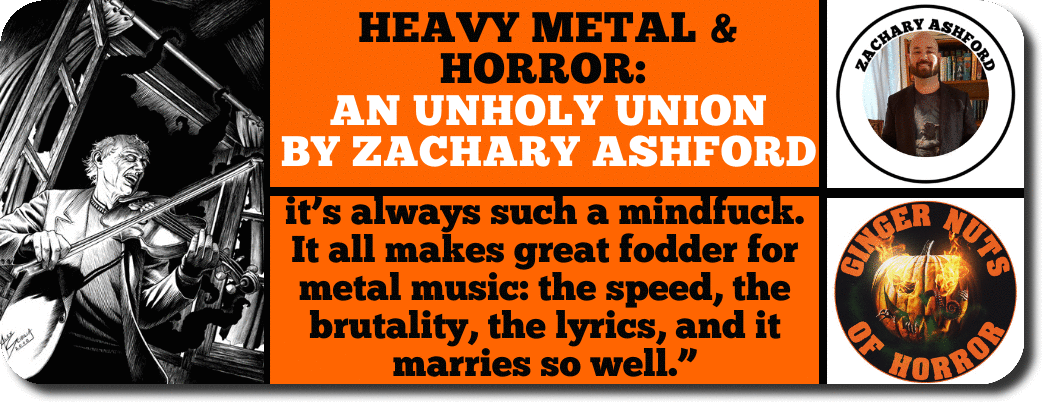
 Bathed in the flickering glow of a flaming torch, a skeleton lies in in an open coffin. Apart from one small detail, the sarcophagus looks like all the others hiding in the darkened recesses of the sealed mausoleum. Yes, centuries of dust drown bas-relief etchings in layers of grime and long-dead grave beetles dangle from ancient cobwebs hung from its decorative corners, but it’s not until you get closer to the coffin that you see the wooden stake. Driven through the corpse’s ribcage, it takes us from the tourist walk of an ossuary to the pages of genre fiction. 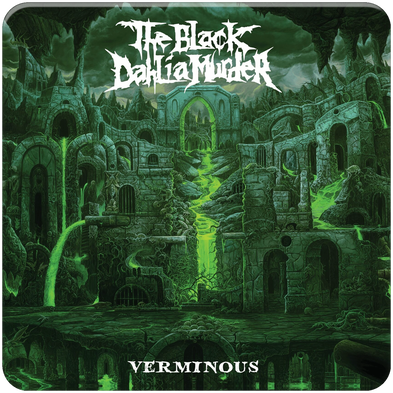 For many of us, it’s the kind of image we’d expect to see in one of our favourite books. For others, it’d be perfectly at home in Full Moon’s Sub-Species movies. For Trevor Strnad, lead-vocalist of The Black Dahlia Murder, it’s the perfect inspiration for a metal song. So perfect in fact that it’s an image he’s kept close to his own heart for some twenty to thirty years. “Removal of the Oaken Stake is definitely my favourite song from the record. It’s influenced by the pen and paper role-playing game Rifts. There was this comic-strip of a vampire who had a stake in his chest. In the first panel, he was just a skeleton, but then somebody pulled it out, and you watched the sinew and skin and muscle and everything grow back over his bones. By the last panel, he was a full-blown vampire again.” The fore-mentioned track is one of the best cuts from the band’s new album Verminous, and given the fact Strnad has sat on that visual for so long, it’s fitting that he sees it as much more than just a macabre image. 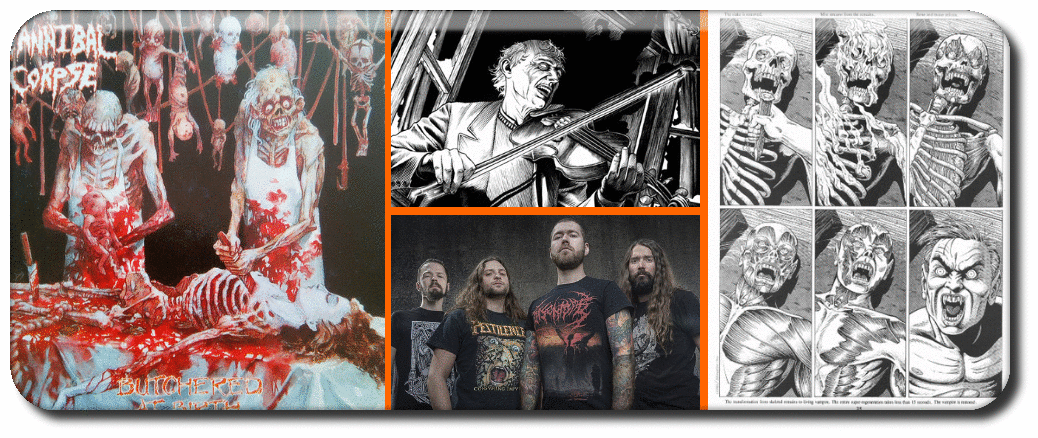 “I heard the song’s melancholic vibe, and I thought of that lyric about being caught in purgatory, just sitting there waiting for somebody to pull the stake out so you could come back and stop just watching human history go by.” Obviously, it’s a damn cool set piece, but that thematic hook is a direct signifier that for many, metal and horror are two sides of the same coin. Strnad is one of those people. With a catalogue that now incorporates nine albums, he’s written about as many types of horror as you’d care to name. “When I was a little kid, I got into horror before metal and I feel like one led to the other. I used to cruise the metal aisle at the record-store and look at all the album covers. I didn’t know what the music was like, but I thought ‘Wow! There’s definitely some common ground here!’ I was definitely drawn to it.” That common ground is one that his band now revels in. For years, they’ve toured the globe and driven moshpits into states of chaotic rapture with songs about werewolves, vampires, zombies, serial killers, cultists, sorcerers, and even the Evil Dead. “Blood and guts go a long way with me, and in the world of death metal; just by being into it, you’re exposed to so many horror aspects. Just as people like to go on a rollercoaster, people into horror like subjecting themselves to something that’s going to scare them. But they know that, and they know that it’s fun. It’s a release in a way. It’s catharsis.” For David Davidson, the man responsible for vocals and lead-guitar in another of modern death metal’s premier acts, Revocation, the fact the two genres go hand-in-hand starts with something basic, the artwork. “We experience everything with our eyes first. When I was a kid going to Blockbuster, I would go straight to the horror section because those videos always had the coolest covers. Then, when I was getting into metal, it was a similar thing. I was like ‘Cannibal Corpse! Butchered at Birth! What the fuck!’ and then obviously, the music matched the brutality of that artwork.”  In what’s becoming a recurring theme, and yet another name-check for New York’s biggest death metal export, author Patrick Lacey’s tastes in music and fiction share a similar genesis. “One of my earliest film memories is Nightmare on Elm Street,” he says. “I was five. So the horror seed was planted early. Metal was a natural progression. I remember sifting through CDs at my local FYE and coming across Butchered at Birth and Gallery of Suicide by Cannibal Corpse. I couldn’t get those images out of my head.” It’s only fitting then that Lacey, who’s paid his dues with Decibel Magazine, probably THE death metal publication, has a soft spot for The Black Dahlia Murder. “First off, the neo-classical vibe of the music is basically just Castlevania with double bass. A Hammer film played in C standard. Trevor’s lyrics are the equivalent of a horror movie stripped down to the best kills. It’s nightmare imagery front and centre and it meshes like butter with the music. Much like Decibel, I appreciate that the band loves their genres (metal and horror) but isn’t afraid to shed a light on both of their excesses. It’s that dichotomy I appreciate, like if Carcass and Manowar had a sitcom.” 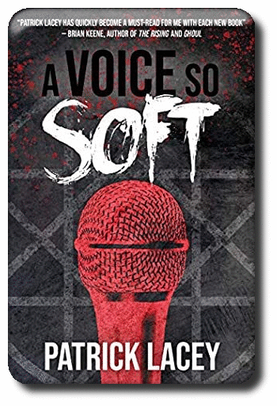 And it’s those excesses offered by the death metal genre that allow Strnad to flip one of horror’s key tropes. Whereas much of the horror that flies off shelves features protagonists succeeding – even if it’s occasionally in pyrrhic fashion – against all-powerful beings or supposedly insurmountable odds, his lyrics often see him assuming the role of the villain. “I hope to take people on a lyrical ride and give them a peek of the forbidden, to portray that all-powerful, evil character. It’s kind of fun to ride shotgun with the bad guy in that world of ultimate power and fearlessness.” Musicians aren’t the only ones who can flip tropes, though. Lacey’s latest novel, A Voice so Soft, deals with one of the classics. There’s no doubt we’re all familiar with that idea of metal bands leading our children down the left-hand path, but for Lacey, the artist in question had to have a much broader appeal. “It’s a riff on the 80’s satanic panic movement, when stuffy politicians were convinced Slayer equalled Satan and the youths were getting skilled at ritual sacrifice. I wish. But in my book, instead of a metal band, it’s a Taylor Swift stand-in who’s won a talent show that’s definitely in no way inspired by American Idol. The number one single that follows makes her fans want to do terrible, terrible things.” 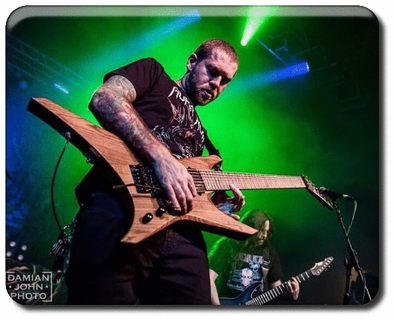 For Davidson, the power of this kind of commentary isn’t to be overlooked. “In thrash there can be this political edge, and they’ll shock you with that. Horror can be political in different ways or provide a commentary on things, and then there’s the gore and the cool special effects.” It’s apt then, that Davidson name-checks Carpenter’s 1982 classic, The Thing, a movie that serves as a perfect allegory for McCarthyism, and it’s apt in more ways than one. Yes, it’s got political tones, but it’s also got something that has become a central component of Revocation’s work. Lovecraftian themes. The band’s most recent album, 2018’s The Outer Ones pays as much homage to Lovecraft’s elder gods as Carpenter’s film does to At the Mountains of Madness. “When you think about supernatural creatures, they pander to the earthly realm. You have the ghost of a person, or a werewolf is a person who turns into a creature, and even the vampire is a human being that’s turned into a creature. With Lovecraft bringing in this idea that his beings are outside of the boundaries of what we consider reality, it’s always such a mindfuck. It all makes great fodder for metal music: the speed, the brutality, the lyrics, and it marries so well.” 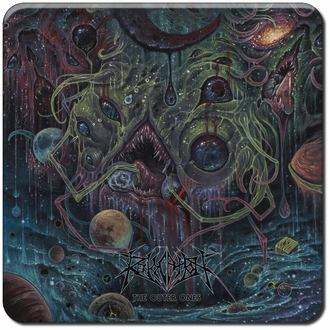 Of course, whether you’re talking about the visceral slashers, intergalactic sci-fi horrors, or even the deep-dive psychological horror of modern life so often unleashed on viewers by the likes of Ari Aster and David Eggers, one thing will always ring true in the extreme worlds of death metal and horror. Despite the fact those within the genre know that the two sets of fans are amongst the nicest you’ll meet anywhere, not everyone gets it. Whether opponents of the genres claim that the two fields are satanic, incite violence, expose their audiences to ‘worldly themes’ or are just plain trash, neither metal or horror are going to disappear anytime soon. According to Lacey, this is because “the average person doesn’t want to ponder things like death and suffering and corruption, but horror and metal? That’s business as usual. They were made for each other. It’s a true peanut-butter-and-jelly situation.” Strnad agrees. “It’s not for everybody. On face-value, it scares people or it makes them uncomfortable. In a way, there’s a test of your will to be into it.” Ultimately, it might be this one thing that unites the two genres. While there’s no way every horror fan likes their metal or vice-versa, Lacey believes the two share one core facet. “Horror fans and metal heads, they’re both nerds, right? They want to show you the most obscure slasher from 1983 that is, for some reason, eighty per cent stock footage of a state forest, and they also want to show you this thrash band’s one-off album that was really more of a side project but still rips.” Perhaps then, it’s fitting that we end on another Lovecraft-influenced tune from Revocation’s catalogue, Madness Opus. If you’re familiar with the story of Erich Zann and his nightly battle with the interdimensional deity trying to enter the earthly realm from a portal outside of his window, you’ll see the poetic irony in the crowd-favourite live track. “We play to these heavy metal heathens every night, and we’re trying to quench their thirst for metal. It was inspiring to find commonalities with that story and loosely basing it on what a metal band is doing. Once I had that idea, I really dove into that story more and wrote lyrics around that work.” For us, it’s a great point on which to end. Just as The Black Dahlia Murder are delving deep into the realms of horror to write songs for legions of metalheads around the world, so are Revocation, and it seems that as time goes on and more stories are told, the links between the two ‘outsider genres’ are only going to get stronger and stronger. In that sense, it’s only fair to ask which of the modern horrors lining your shelves will be the inspiration for the metal bands of the future?  Author Bio: Zachary Ashford’s latest work is Sole Survivor, a Rewind or Die novella from Unnerving Magazine. He also wrote the Demain Short Sharp Shock! The Encampment by the Gorge & Blood Memory. You can find his other works in the Elements of Horror: Earth anthology, Dark Moon Digest, Things in the Well's 7 Deadly Sins anthology and online with TellTale Press. When writing, he's listening to metal while surrounded by action figures and a stuffed werebear. He also writes for Ozzy Man Reviews, a rock n roll radio station, and teaches English. The Black Dahlia Murder’s latest album, Verminous is out now via Metal Blade. Revocation’s latest album, The Outer Ones is also available via Metal Blade. Patrick Lacey’s latest novel, A Voice So Soft is available Grindhouse Press.   the heart and soul of horror promotionComments are closed.
|


Archives
April 2023
|
 RSS Feed

|

|