

 A bleakly beautiful and magnificent beast, that transcends its own promise to become more than might be initially assumed. Many may be wondering: why on Earth is a game like Hollow Knight being reviewed on a horror website? Isn't it a cutesy, Metroidvania style platformer involving amusing bug-people who inhabit a subterranean fantasy kingdom in the manner of a Studio Ghibli animated feature? Yep. It most certainly is that. Hollow Knight follows a fairly well-trodden road in many, many respects: an independent, two-dimensional platformer, it nails it's colours to the wall from the get-go as a dyed-in-the-wool Metroidvania title, mechanically differing from others in the tradition hardly at all. Anyone who has ever played the likes of Super Metroid, Castlevania: Symphony of the Night, Harmony of Dissonance, Blasphemous, Axiom Verge or any of a hundred others will know this game intimately from a few minutes play. That's not to say there's nothing of note in the control system; it's worth pointing out that, as Metroidvania titles go, this is a very, very solid one; the controls tight, immediate and intuitive. Even those not terribly familiar with the tradition it occupies will be able to figure it out just through experimentation (making it an ideal title for both children and parents). As the game progresses, its control systems become gradually more complex, layering in numerous moves and spells and abilities all of which will be technically familiar, but also flourished with aesthetics and mythological flourishes that make them far more than a standard “double jump” or “charge attack.” This is where Hollow Knight starts to distinguish itself; one of the first things any player is likely to notice is its aesthetics: The game is gorgeous. And on numerous levels; as a two-dimensional game, it is operating in a saturated market. Opting for a highly distinct, cartoonish style, the game feels like a strange and faintly off-piste animated feature or TV series that the player has some agency over. The underground world of Hallownest is a dark and ruinous place, infested with invertebrate life of all descriptions. As the player moves through the various screens, they will notice not only the highly distinct architecture -which varies from the hollowed-out remains of fossilized creatures to cultivated, abandoned cities, temples and great gardens left to run riot-, but also the little environmental flourishes that lend every area distinct personality. From the moribund village of Dirtmouth, one of the first areas of the game, which features a perpetually blowing breeze, a certain hollow quiescence that evokes a sense of quiet despair, to the lush and vibrant Green Path; overgrown with all manner of -often lethal- vegetation and infested with numerous forms of fungally-infested life, the game's environments are rich, sumptuous and often quite distracting in their unutterable beauty and meticulous attention to detail. Two dimensional games have, traditionally, always struggled evoking a realistic sense of depth or dimension, given that the player often operates on only one layer or level of play. Here, the game's developers have made sublime use of multiple, independently-scrolling layers in which the silhouettes of flowers blooming or butterflies taking flight might be witnessed in the foreground, whilst in the background waterfalls splash and spume, machines twist and churn or bugs go about their business, unconcerned by what is taking place elsewhere. Meanwhile, each area exhibits its own redundant -but brilliantly effective- environmental elements and textures that help to invest the crumbling and decrepit kingdom of Hallownest with enchanting animus: In certain areas of the game, fungal spores dance and sift across the screen, erupting from both infested enemies and the gigantic mushrooms that might be used as platforms or trampolines to reach higher areas. Others are saturated with a faintly maddening pink light from crystals that erupt from the walls and floor. In the magnificent City of Tears, rain falls perpetually, pattering against the stone ground and pouring into culverts, streaming down windows that the Hollow Knight passes by. The overall effect is of a living, functioning eco-system that, albeit slowly breaking down, is still capable of arresting with its magnificence. 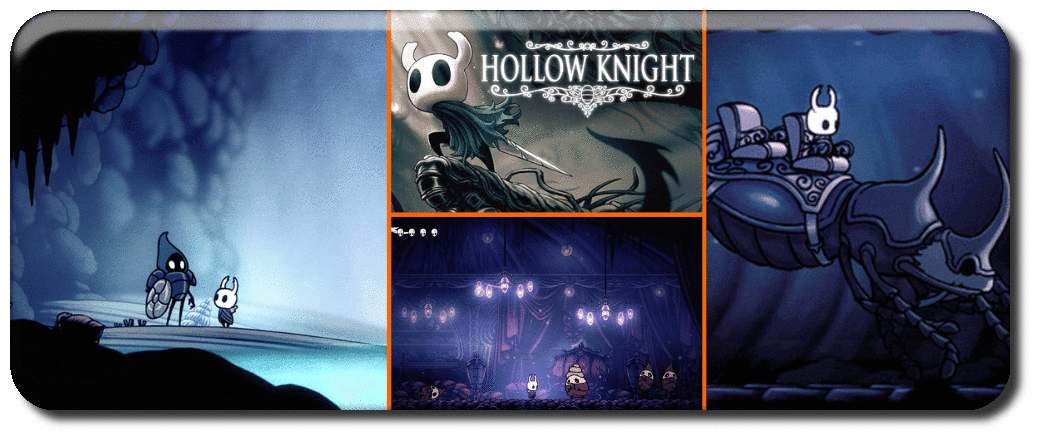 Every area is simultaneously beautiful yet also suffused with a subtle despair that mounts and mounts as the game progresses. This is where the peculiar subtlety of Hollow Knight's horror becomes apparent; rather than marketing itself as a game that includes such elements, it allows the player to discover the fact for themselves. Even from the first instant, it is clear that Hallownest is near enough post-apocalyptic; some great cataclysm or collapse has occurred at some point in the past, leaving most of the kingdom empty or infested with monsters, the mad and the corrupt. Much of the formerly-great kingdom is in a state of ruin or has become overgrown by rampant forms of vegetable or fungal life, making it extremely treacherous to traverse. Meanwhile, numerous characters warn of an incipient and pervasive “madness” that overtakes those who delve too deeply into the depths, the nature of said corruption not becoming apparent until the game's latter chapters. This sense of foreboding slowly escalates as the game progresses, as the areas become darker, more corrupt and dangerous, and the enemies the player encounters grow more monstrous and mutated. Early on, the player is afflicted with a sense of mourning for those they are forced to slay; most of the enemies seem to be little more than fellow delvers from above or even old citizens of Hallownest who have fallen prey to varying forms of madness or infestation (orange is a significant spot-colour in this regard; whilst much of the world tends towards shadowy blues, blacks, organic greens and fungal greys, danger is often indicated in the same manner that it is in nature; with extremely vibrant splashes of orange, pink and yellow). Initially, the nature of that madness is oblique; very little indicates its cause save for a faint orange tinge in the sufferer's eyes and the fact that they are mindlessly aggressive. However, as the game progresses, it becomes apparent that Hallownest is ripe with numerous maladies, from the biological to the metaphysical: a gruesome orange fungus rises from the forbidden depths of the kingdom, tainting and corrupting all that it touches. Worse, the fungus itself seems to have an eery and monstrous sentience that allows it to control those it infests like puppets. Worse, many touched by it undergo hideous transformations, swelling and fruiting with its flowers, but also growing bigger and more predatory. Latter areas of the game lead the player into the depths where the fungus originates, where it has infested almost every cavern and corridor. Here, they find creatures that have become so swollen and altered by the malady, they have become living factories and repositories of it, producing the grotesque stuff in their abdomens and vomiting it around the surrounding areas. Likewise, the metaphysics at play is a font of horror; Hallownest is a fantasy realm of magic and curses, of arcane traditions and revenants from the past. At various points, the Hollow Knight himself is harassed by three ghosts in particular, whose image can be found in statues and architecture throughout the world. These three attempt to hamper the Hollow Knight in his unspoken quest, doing everything in their power to waylay him. Whilst the game's back-mythology is communicated in a highly implied and ambient manner, it is apparent that these three are revenants from Hallownest's past who maintain its current, dilapidated condition and ensure that its secrets remain uncovered and undisturbed. Mysterious and overtly threatening, these three do everything in their power to undo the Hollow Knight, including spiriting him away to the same broken and delirious dream-realm that they occupy (a part of the game that is as amazingly beautiful as it is surreal). Throughout the game, the player will encounter numerous NPCs who each have their own unique story-arcs and may aid or obstruct the quest, depending on numerous factors. In true Dark Souls fashion -which is, despite the stark difference in tone and aesthetics, a clear influence on this game-, the vast majority come to dark and grizzly ends, some of them sincerely tragic, given how pleasant and innocent those characters seem upon first contact (anyone who does not shriek in sincere grief at the end of Myla's story arc has no soul). This is not immediately apparent in the game's early stages; there is a deliberate attempt by the designers to lull the player into a false sense of security, based on their experience with games of a similar type and aesthetic. The cute, cartoonish style of the characters and their world does not immediately suggest depths of dark tragedy or cruel twists of fate, but that is precisely what awaits most who inhabit Hallownest,from former allies descending into depths of violent madness to others succumbing to obsession with exploration or notions of suicidal martial honour. This is a significant and sincere part of Hollow Knight's horror; it tricks the player into certain assumptions which it then gradually undermines, leading to revelations and circumstances that evoke extremely powerful and unexpected reactions; much, much moreso than if the game were more overtly dark or horrific in its demeanour. This factor is also manifested in the various enemies and encounters throughout the world: Hallownest is infested with monstrosities of numerous stripe and species, from the aforementioned infested and maddened citizenry to fungally-warped and bloated monstrosities, ancient evils from the deep past and spectres from beyond the grave. As the game progresses, the nature of those enemies subtly shifts from their initial cutesiness to more horrific conditions, the characters the player encounters become more disturbed -and, indeed, disturbing- and often reveal facets and agendas that weren't apparent before. Likewise, the environments alter and transform in response to certain criteria; after upgrading the Hollow Knight's signature “nail” weapon a few times, certain areas of the game become infested with the oriange fungus from the deepest depths, making them considerably more dangerous and visually distressing, as well as mutating the monsters they contain. Likewise, after draining the water from the sewers, new areas become accessible that lead to some of the most grotesque and horrific encounters in the game. This trick of constantly altering the familiar whilst also introducing new elements is the core of Hollow Knight's appeal but also the most aposite expression of its peculiar horror: at the beginning, it is presented almost like a children's cartoon or illustrated story book: the beats and concepts and character archetypes are all familiar, endearingly cute and amusing. However, as the player progresses, an extremely dark and moribund lore becomes apparent; one that is still unfurling before their eyes, leading inexorably to a grim and dolorous climax. The unspoken ethos of Hallownest; that of a world that has already ended, and is now in the process of a more profound, metaphysical decay, is derived directly from the game's other key inspiration: Dark Souls, a franchise with which it shares more than might be immediately apparent, given the disparity in their aesthetics (whereas Dark Souls is overtly and unremittingly bleak from the first instance, Hollow Knight swathes itself in the panoply of something far more innocent, gradually revealing its underlying darkness by slow suggestion and ambience). Like Dark Souls, there is a lore here that suggests a long-dead civilisation; one that was once great and powerful, but was destroyed from within by its own corruption. Like Dark Souls, Hollow Knight suggests a world that is in the process of wrapping up and winding down; a metaphysics that is long broken, and to which the player is merely an observer, discovering as they plumb the secret and forbidden depths, stirring what has been hidden for so many years. Nor is the effect brazen or clumsy; there is no moment of lurching revelation, no whiplash as the game “turns” or unveils some M. Night Shyamalan style twist; the escalating despair of the game is slow and granular, seeping into the player's consciousness over long hours of play, until it insidiously becomes the new status quo. Even at that point, the funnier or more amusing aspects of the game don't disperse, but are woven into the wider tapestry to lend emphasis by contrast. And nowhere is that more apparent than in the silent, faceless protagonist; the simultaneously cute and sinister Hollow Knight itself. Like the anonymous protagonists of Dark Souls, Blasphemous, Bloodborne and numerous others with which it shares DNA, the eponymous Hollow Knight is a mysterious and unsettling figure who seems to originate from somewhere outside of Hallownest, yet is connected to it in a way that doesn't become apparent until late in the game's narrative. A strange and violent figure, he seems to instigate as much strife as he prevents, many of those he comes into contact with coming to bad ends, often ostensibly as a by-product of actions he undertakes within the gaming world. Throughout, there are suggestions that the Hollow Knight is the footstep of doom in this world; a bit of grit in the engine rather than a functionary or product thereof; suggestions that are borne out by the game's climax. Furthermore, there is a strange metaphysics surrounding the Knight whereby he cannot die, but is returned and resurrected whenever he perishes, leaving behind a sinister black phantom that must be then found and defeated so as to restore him to full power. This darkness, this shadow at the heart of the Knight, makes him an unsettling character to play, especially given that he seems to invariably bring misfortunate to those he encounters. The sense of dread and mystery the game builds is beautifully contrasted -and thereby emphasised- by the cartoonish and endearing nature of its design, aesthetics and the sheer gorgeousness of Hallownest itself. The fact that its more horrific elements aren't immediately apparent, but slowly accrue and reveal themselves over time, is a rare and brilliant quality, expertly pitched and orchestrated. Apart from the sophistication of its horror, it is also simply a beautifully conceived and realised game; technically precise and proficient, endlessly absorbing and intriguing. It is a sincere delight to play and lose oneself in, and has an appeal that transcends any parameter of age or target audience (in that regard, it stands as an excellent introduction for younger players to distressing or disturbing subject matter). A bleakly beautiful and magnificent beast, that transcends its own promise to become more than might be initially assumed. By George Daniel Lea   Comments are closed.
|


Archives
April 2023

|
 RSS Feed

|

|