

 I suppose it’d be interesting to argue whether writing fiction involves formulating lies, or conveying the truth. I suppose the simplest answer is: both. It’s making stuff up, isn’t it? But then again, nothing is truly invented – every fictional scenario draws on experience. I could tie myself in knots about this. But writing about writing is another matter. I try to be honest about that. So, I’m going to write about writing Hope Island, a novel which is published in the UK more or less right now, and I’m going to try to be honest. I’m not a writer that has pure ideals about how a writer should work. That is, I’ve never managed to make creative decisions without considering external factors. Perhaps there one or two of my short stories weren’t mediated by thoughts of What do people want to read? or Which venue might publish this? or, more often and more convoluted, What kind of a writer do I want this to make me seem? I’m self-conscious in all aspects of life; writing is no different. I’ve always wanted to be a writer. Now that I’ve had novels published, I want to continue being a writer. I love writing, and all its associated tasks – creating plots, outlining, drafting, editing… all of it. I want to be allowed to keep writing and I want to be allowed to justify spending more and more of my available time writing. A slightly different point, related more to identity than practicalities: I want to continue being able to consider myself a writer – specifically, a novelist. Taking the decision to dive into a new novel project is complex. I’m happy to spend many hours doing what I love – for example, when I started out, I drafted two novels and didn’t submit them anywhere, wanting only to make mistakes and in doing so learn the ropes – but nowadays I need each new novel to fulfil a basic requirement: it mustn’t prevent me from writing the next novel. Now that I’ve got started, I don’t want to stop. My previous published novel, Snakeskins, was intended to appeal to a wider readership than my earlier ones, and it was also intended to secure me an agent. The structure was modelled on the TV shows I’d been binging at the time, such as Deutschland 83, with multiple viewpoint characters and short, snappy scenes. And it worked! I got an agent and it was published by Titan Books. In fact, Titan offered a two-book deal. If they’d requested a follow-up to Snakeskins, I would have written one. Frankly, I would have done my best to turn my hand to anything they might have wanted. But they were happy to let me suggest ideas for the second book. I pitched Hope Island and, with a few tweaks to my synopsis, it was approved a month or so after the initial contract was signed. As it happened, I’d been working on the synopsis for several weeks before the Titan offer, at which point I’d rather lost faith in my Snakeskins manuscript. Initially, this new idea was an even more direct attempt to appeal to a wider readership. In spirit, it would be a follow-up to John Wyndham’s The Midwich Cuckoos, about a group of children behaving strangely. It would feature lots of high-stakes setpieces and what one agent I’d spoken to had called ‘primary-colour storytelling’ – that is, a direct and visceral style, without being drawn into psychological grey areas. I would set the novel in the USA rather than the north-west of England, to avoid alienating the largest readership. It would be called The Children: a blunt title for a blunt book. I don’t know what happened, after I began work on what would become Hope Island. Perhaps the fact that it already had a publisher affected the authorial decisions I was making. Perhaps I recognized, subconsciously, that the book I’d originally envisaged wouldn’t have worked, or that I wouldn’t have liked it. Perhaps I’m just not the sort of writer that thrives on ‘primary-colour storytelling’. Hope Island became a calmer novel, yet also knottier and weirder. The creepy children are present and correct – but somewhere along the line I allowed myself to dwell as much on the agonies of ordinary parenthood as the threat of killer kids. In place of high-stakes setpieces, I succumbed to the whim to make silence one of the themes of the novel, and indulged myself in channelling some of my favourite minimalist and field recording artists such as Alvin Lucier and Chris Watson. The specific threats to the main characters, a British mother and her daughter, became harder to pinpoint; the fact that they couldn’t communicate their fears became their biggest obstacle of all. The final act of the novel became literally groundless, and was written in a flurry of caffeine and to a pounding soundtrack of Mika Vainio. There are two ways to view this transition. Either I lost sight of the original vision that set me off working on the novel… or the novel became what it would always have become. Back when I decided to write an accessible horror novel, I certainly hadn’t intended to produce what early readers would call ‘The Wicker Man directed by David Lynch’ or ‘Midsommar for working mothers’. But there it is. As it turns out, that’s what I wrote. Here’s the thing, though. I’m proud of it. I think it’s good, the best thing I’ve written yet. And I think it’s better than the novel I’d been pretending to write. It’s quiet and quietly weird, rather like me. Though I’m happy to be upfront about my ambition to be a ‘working writer’ – that is, a writer content to (try to) fulfil the requirements of publishers or readers – I’m left wondering if it’s a mirage, this idea of stepping outside of one’s own head while creating something. I suspect that Hope Island is as personal a novel as if I’d set out to ignore the market entirely. How can you spend 200 hours working on a novel and not introduce yourself in every scene, in every sentence? Anyway, there it is. Hope Island is out now, and I think some of you may enjoy it, but I honestly don’t know. Maybe that’s just how these things are.  Tim Major’s books include Hope Island, Snakeskins, short story collection And the House Lights Dim and a non-fiction book about the 1915 silent crime film, Les Vampires, which was shortlisted for a British Fantasy Award. His short stories have appeared in Interzone, Not One of Us and have been selected for Best of British Science Fiction and Best Horror of the Year. Find out more at www.cosycatastrophes.com HOPE ISLAND BY TIM MAJOR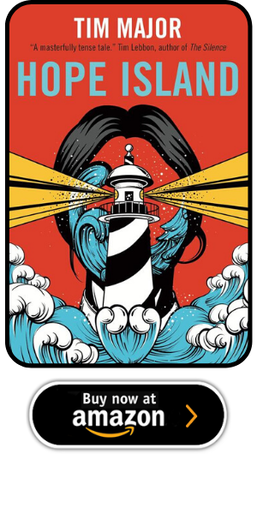 A gripping supernatural mystery for fans of John Wyndham's The Midwich Cuckoos from the author of Snakeskins. Workaholic TV news producer Nina Scaife is determined to fight for her daughter, Laurie, after her partner Rob walks out on her. She takes Laurie to visit Rob's parents on the beautiful but remote Hope Island, to prove to her that they are still a family. But Rob's parents are wary of Nina, and the islanders are acting strangely. And as Nina struggles to reconnect with Laurie, the silent island children begin to lure her daughter away. Meanwhile, Nina tries to resist the scoop as she is drawn to a local artists' commune, the recently unearthed archaeological site on their land, and the dead body on the beach...   THE HEART AND SOUL OF HORROR PROMOTIONComments are closed.
|


Archives
April 2023
|
 RSS Feed

|

|