

I Have No Mouth and I Must Scream
11/5/2016
it plays like a symphony of “trigger warnings,” and is so grim for the most part it could easily induce states of profound depression Barring the Terminator franchise (which may or may not be...derived from Mr. Ellison's work on the old science fiction show, The Outer Limits), I'm a relative late-comer to the work of Harlan Ellison. It's only thanks to his (finite) involvement in video games that I am aware of him at all (for some reason, despite being extremely lauded in the U.S., he doesn't seem to be that well known or marketed here in the U.K., certainly not in comparison to the likes of Stephen King, who can be found on the shelves of every book store in the country). My first exposure to his work was, like many, via the loose video-game adaptation of his seminal short story, I Have No Mouth and I Must Scream. Often cited as a work of extreme nihilism and misanthropy (a fairly picayune reading of the story, to be certain, but one that sustains and pervades), the story involves a day-after-the-day-after tomorrow scenario in which humanity has been eradicated in the last World War; a conflict between the U.S.A, China and Russia, as the result of the super computers created to orchestrate the war merging and becoming self aware, giving birth to an entity of supreme, almost divine power, but also infinite and infinitely imaginative cruelty. The entity “AM” is mankind's greatest creation; the sum of all of its technological innovations, its experiments in physics, chemistry and consciousness, but also a reflection of every dark and tribal impulse to beat in the species' collective breast. AM is hatred unending. AM is elemental loathing and misanthropy; He despises His creators in ways that cannot be comprehended or adequately expressed, murdering all of humanity in a single, apocalyptic instant, save for five individuals that it plucks randomly into its subterranean complex, sustaining them in conditions of the most inventive and horrendous torture for decades, perhaps even centuries on end. Having a degree of control over molecular reality, AM can reshape not only their world, but also their very bodies, ensuring that every moment is a fresh Hell, the God of their own creation taking every opportunity to mock and belittle, to deride and torment from its celestial perspective. The short story takes a great deal of satisfaction in describing the elaborate and often cruelly ironic torments AM inflicts on His captives, from the physical degeneration of the formerly handsome Benny into a twisted, mutilated monstrosity to the intimate alteration of his physiology and neurochemistry so that the formerly gay man can now only be sexually satisfied by his female fellow damned soul, Ellen. It is a litany of miseries so myriad, so ironic and intense, that the only hope lies in death, which the characters only achieve thanks to the supreme self sacrifice of one of their own, Ted, who takes his own opportunity to murder them all, even knowing that AM will make his continued (and eternal) existence a Hell beyond any he has thus far known. The video game adaptation -an obscure “point and click” adventure from the mid 1990s- is an odd affair, massively flawed, in many respects; troublesome from conception, in that it is a game that is all but impossible to win; even the very best ending one can achieve is one in which the player characters achieve death, and therefore some semblance of peace. This makes for an unusual and extremely morbid experience; the palpable atmosphere that pervades the game (despite its graphical and technical crudity) one of filth, of despair and suffering. It is a rare beast, in that regard; even many of the darker titles from this era provide some slither of hope to the player; the possibility, however distant, of dispelling the demon, conquering the monster, unmasking the murderer. Not so here; from the opening sequence, in which the computer AM (voiced with vim by Harlan Ellison himself) details His own history, as well as His utter, incomprehensible contempt for His human creators. The game is structured in a highly non-standardised way; each of the player characters is derived from one of those named within the book, but expanded upon -and, in some instances, changed significantly- from the minimal descriptions it provides. Each has their own particular forms of torment to experience; their own demons to face, settings to explore and puzzles to solve. The player can tackle the characters in any order, though some scenarios are certainly more difficult than others. Each character not only has their own narrative and background to explore (all of which touch upon subjects that would be considered near-the-knuckle in the medium, even now) but also their own observations about AM and His nature, their own relationships with one another and the God Machine. Benny, for example, is here represented as the ape-like monstrosity AM has reduced him to, and is plagued by perpetual, gnawing hunger that informs much of his “quest” (Benny consistently interrupts the player with complaints of how hungry he is, until the player finds a means of “feeding” him). As with all of the characters, Benny's scenario is essentially a redemptive one, in which he confronts the ghosts of his own past; learns to see past his own suffering and perceive that of others. However, that only occurs in the very best case scenario, in which the player does and says everything “right.” Each character has a “portrait” in the lower left corner of the screen, surrounded by blackness, which represents their despair, their self-loathing, their torment. The purpose of the game is to conduct actions which makes that darkness slowly brighten towards green and then white, which will end the character's scenario. Unfortunately for the player, this is near impossible: the game is deliberately unfair, to echo the situation in which the characters find themselves: actions which may seem ostensibly “correct” actually end up having negative consequences or selfish motivations, which diminishes any chance the player has of achieving the best outcome. It is entirely possible to ruin a play-through of the game without knowing it, doing or saying something wrong in one scenario which, ultimately, makes the game unwinnable when it comes to the final encounter. Similarly, the puzzles the player confronts (which are standard point and click fodder, albeit often abstruse and bizarre) are often counter-intuitive or symbolic to the point of insanity; not a fault or flaw of the game's design, but a deliberate aspect of it, intended to mirror the impossible situation in which AM has placed his victims. It is a game that is almost impossible to “win” unless one has a walkthrough handy or, as players of the era had no choice but to experience, through fairly tortuous trial and error. That said, it is such an interesting piece of work, so inventive and richly atmospheric, that it is worth playing through multiple times, to see the myriad ways in which the characters reveal themselves and in which their scenarios can end. From Ellen's confrontation of the abuse that was inflicted upon her to Nimdock's acceptance of his part in genocidal atrocity, the game is rife with morbid and violent subject matter, broaching so much in the way of human evil, abuse and atrocity, it can leave the player feeling glutted with negativity (an effect that is no doubt deliberate, but which prospective players should certainly be aware of). There is also an issue in that, with the sheer scope of subjects the game broaches, some are inevitably glossed over or not given enough time or attention to explore in any great depth. This is particularly true of Nimdock's scenario, in which subjects such as the Holocaust, eugenics, dehumanisation, tribal scapegoating etc are not really explored in any great depth, but are merely provided as a backdrop against which the character can either realise his own follies or sink deeper into them. The climax of the game is also problematic, in that, despite Ellison's fairly overt insistence, the creators seem to have felt obliged to provide some smidgen of hope; a token affair in which it is technically possible to take AM down with his victims as they finally achieve the deaths they have prayed for. This...does not fit with the rest of the game; it feels incongruous and unsatisfying, especially given that it is so, so difficult to achieve (again, the delicacy with which one needs to tread through the entire game to achieve the “best” ending is insane; every word, every motion, every act can potentially undo it). Something more in keeping with the nihilism of the rest or even the bleaker form of symbolic hope provided at the end of the original short story would have been far more fitting. That said, if you're into work of dense, grimly delirious atmosphere, the darkest of all science fiction visions for humanity, you could certainly do worse than dredging up a copy of this... “game,” for want of a better. Just be prepared, especially if you happen to suffer from psychological conditions such as depression; it plays like a symphony of “trigger warnings,” and is so grim for the most part it could easily induce states of profound depression (a truly fantastic effect for a video game to achieve). 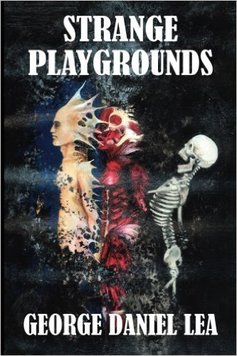 A vile waking... There are places we walk; cold and dusk-lit; places where the wind whispers, carrying echoes of forgotten games. ...a storm of sadism, more loving than any embrace or caress he'd ever known... There are places where we are naked; where the grass and weeds rasp across bleeding wounds, exposed nerves, their dew glistening red. ...we are all sick; some are simply sicker than most... Places where the silence cannot be broken, its insect chatter fraying thought, fracturing sanity. ...shadows swarming around their intertwined bodies, whispering, congealing... These are the Strange Playgrounds; places where we meet our murdered or abandoned selves, and join their desperate games. Come and play awhile.
Discover George's writing on Amazon Comments are closed.
|


Archives
April 2023

|
 RSS Feed

|

|