

IN DEFENSE OF HORROR BY DUNCAN RALSTON
24/9/2014
 I realize I'm preaching to the choir here, defending horror on a website devoted to it, but stick with me for a minute. Recently I found myself in a heated debate with someone who claimed to dislike horror. "What did you think of Silence of the Lambs?" I said, having heard this claim a dozen times before. "That's not horror," the supposed horror hater said. "Okay. Well, did you like Misery?" Same answer. Misery. Not horror. A book/film written by the most famous horror writer in the world, Stephen King, in which a maniacal nurse kidnaps her favorite author and psychologically and physically tortures him into resurrecting her favorite literary character. Not horror. Annie Wilkes and Thomas Harris’s Dr. Hannibal Lecter, two the most frightening characters of all time—clearly monsters, right? But they're not quite horror enough for our horror hater. And neither, it seems, for today’s rabid horror fan. Somehow in the past ten years or so, with the addition of countless subgenres of horror (eg. Apocalyptic, new weird, bizarro, dark fiction, extreme, gothic, magic realism—to name a few), we horror fans got the idea that for something to be truly considered "horror" it has to contain bizarre creatures, ghosts, telekenisis, extended torture scenes and/or buckets of gore. Don't get me wrong, I love a good jump scare (a good one; don't throw a cat in front of me and expect me to wet myself in terror). I love a spooky atmosphere. I love a good cheesy monster movie, so long as it’s got something more than CGI/makeup effects to offer (see: Pumpkinhead, Child’s Play, and yes, even Clive Barker’s bizarre Nightbreed). I love vampires and zombies and werewolves and aliens and kids who can blow shit up with their minds. But why should we limit what horror can be to these same old tropes used in the same old tired ways? Is Se7en's John Doe any less frightening a monster than Freddy Kreuger, Chucky or Pinhead? What makes Bram Stoker's "Dracula" an exemplar of horror and Bret Easton Ellis's "American Psycho" not? Why do we, as horror fans, feel the need to pigeon-hole horror and our tastes for it? Are we scared to let it spread its wings, to grow into something larger and more meaningful? Are we truly so afraid of allowing metaphor and theme and subtle menace creep into our horror that we have to recycle the same old chainsaw maniacs and possessed children and mindless zombies? There are countless articles posing these same questions. And why? Because we fans won’t let horror branch out, like the limbs of Deadite-possessed trees. There seems to be an anti-intellectual snobbery among some horror “purists” who believe it shouldn’t or can't have any aspirations other than to scare the balls off the viewer. As if any “pretension” to art will somehow sully (or in this case, gussy up) its grisly reputation. Fortunately this prejudice only seems to apply to movies and TV. Horror novels and short stories seem to be mostly immune, likely because reading is an inherently intellectual exercise. Even if you're reading the Twilight saga, you still have to fill in visual details with your imagination, while also, likely, thinking ahead to figure out what's going to happen next (if whatsername will end up with the werewolf or the vampire, say). Watching is predominantly passive. Reading is active. Reading requires you to use your brain to interpret ideas, to wear the skin of its characters (a bit like Buffalo Bill), while movies and television, with the exception of mysteries and thrillers, ask you to turn off your brain and let the images and sounds happen to you. The protagonist is your surrogate. Stephen King is quoted as having said he writes horror to exorcise his own fears and demons. I write it (and read/watch it) for a similar reason: to understand the things that terrify me, that horrify and shake me, to deconstruct them, to diminish and contain them, while also hoping to tell/read/see an entertaining story. (Please don’t think I’m in any way comparing my efforts to the Master of Horror’s. I can only hope my stories could be as good as his most mediocre ones.) I do enjoy horror for the sake of horror. I want to be scared, shocked, titillated, mortified. But if that's the only thing a movie or book has to offer, why bother? Why not just go bungee-jumping? Or pick a fight? Or sit in on a murder trial? The best horror, in my opinion, attempts to tell an oft-told tale in a fresh, interesting and often gruesome way. The best horror doesn't just frighten, it challenges. It illuminates the darkened corners in the minds of others, of ourselves. Think of Stephen King's The Shining. It's as much a tale of a haunted house and a boy with powers as it is the real life terror of alcoholism and child abuse. Robert Louis Stevenson’s The Strange Case of Dr. Jekyll and Mr. Hyde is as much about a man possessed by his own vices as it is the world's first "werewolf" story. In Mary Shelley’s “Frankenstein” the true horror is unchecked scientific advancement, not Frankenstein’s curiously verbose monster. Compare the film versions to the books, and their themes are virtually unidentifiable. Is that because we don't want meaning in our horror movies, or because Hollywood thinks so little of us they don't think we'll get it? I realize I'm going to be accused of snobbery myself, but stick with me a minute longer. I've always loved horror. But lately, at least as far as the movies go, it can be reallydifficult to defend. I feel like Chris Rock struggling to find reasons to endorse post-‘90s hip-hop despite its rampant misogyny. Modern horror movies tend to have a similar problem: the “final girl” trope, in which the female lead has to be the only character surviving the events of the film, forcing what used to be thought of as a predominantly male audience to identify with a female protagonist, has become so prevalent that it’s accomplishing the opposite. We root for the girl to die, if only to subvert our expectations. We revel in her various tortures. Something like Haute Tension comes out, or You're Next, or The Purge, and we praise them for their originality, perhaps rightly, even though they're hitting all the same markers as every other slasher flick before them. These are probably the freshest examples of the slasher/home invasion subgenre (I'll include Triangle and Funny Games, though the twist in the former is pretty laughable, and the latter plays games with the audience as much as its characters); there are plenty more that don't even bother to tweak the formula. There's an even bigger evil facing horror movies these days: it's dirt-cheap to make, and too many wannabe auteurs believe it's an easy first step into the industry. So, for everyHalloween and Evil Dead and The Last Exorcism there are two Hostel movies, two Human Centipedes, and a half a dozen Paranormal Activity sequels. For every first season of The Walking Dead there's any other season of The Walking Dead. (Survivors/The Hoarde: please send your hate mail to @userbits.) Because it’s so cheap to make and the profits can be (relatively) enormous, there’s very little innovation—let alone a decent script—required. We get warmed-over anthologies like V/H/S and The ABCs of Death, with maybe five decent shorts out of twenty-six. We get infinitely more found footage—which can, and has, been done well, but hasn’t since Matt Reeves’s Cloverfield. Even Bobcat Goldthwait’s eagerly anticipated found footage bigfoot movie, Willow Creek, was a well-acted disappointment. We get another slasher/rape/torture porn movie with characters so blatantly stupid it's impossible to care. Another teen vampire melodrama/abstinence PSA. Another zombie franchise. In spite of all the bad horror flooding the market, taking advantage of our undying love for the genre like a rock star humping and dumping his groupies, there are still gems to be found. Scouring Netflix you can easily discover a lost classic from the ‘70s or ‘80s, like Richard Matheson’s The Legend of Hell House, Burnt Offerings, or Dreamscape. And occasionally something new surprises us with unexpected twists on the genre--Let the Right One In, for instance, Cabin in the Woods (a spectacularly underrated horror flick, in my opinion, from its wild concept to its flawless execution and balls-to-the-wall ending), and the intimately horrifying Sinister (Insidious’s far more interesting cousin). It’s movies like these I’ll point to when someone asks me why I love horror. So why do you love horror? Let me know on Twitter @userbits.  DUNCAN RALSTON DUNCAN RALSTON Duncan Ralston enjoys scaring the bejeezus out of people. In the 2nd grade, he came to class dressed as the Devil for Hallowe'en. The teacher rolled his eyes and said, "How appropriate!" He has worked behind the scenes in television for ten years. In 2011, his period comedy-drama, "The Valley," won 1st place in the Fresh Voices TV Pitch Contest. He lives with his girlfriend and their dog in Toronto. His collection of short stories, novelettes and novellas, "GRISTLE & BONE," is available on Amazon, Barnes & Noble, iTunes and Smashwords, in all formats, including the elusive paperback. LINKS: www.duncanralston.com www.facebook.com/duncanralstonfiction Twitter @userbits Amazon shortlink: http://amzn.com/e/B00F23Y41Q 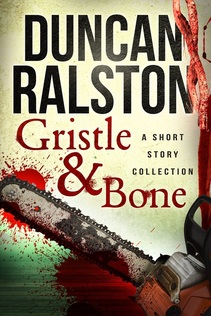 When successful restaurant owners Jim and Leanne Taymor confess to a grisly series of small town murders, their neighbor learns the gruesome truth that led them to kill. A young couple discovers the secret of a tourist town's prosperity may lie in its sinfully delicious cuisine. Gonzo pornographers learn a brutal lesson following a tragedy they caused when life imitated "art." Disgraced soldier Dean Vogel returns to his hometown and confronts the bullies, and a traumatic event, from his past. A reporter uncovers what really happened to the latest internet sensation, a troubled girl who disappeared on camera. Gristle & Bone includes the novella, Scavengers, 4 novelettes, and 2 short stories. Cannibalism, monsters, vengeful spirits, the apocalypse--chock-full of blood, mayhem, psychological horror, and good old fashioned gross-outs, Gristle & Bone is a tasty treat for horror fans! THE HEART AND SOUL OF UK HORROR WEBSITES
GREAT article, Mr. Ralston.
Thanks for your reply, Kit! Couldn't agree more. TV is really going through a Renaissance right now, and not just with horror. Some of the best writers, directors and actors are working on the small screen, even the internet.
Stuart Young
25/9/2014 00:43:03
Nice article.
Very true, Stuart.
Very true, Stuart.
Very true, Stuart. 30/9/2014 11:36:53
I think horror is a lot more ubiquitous then people (especially horror haters) think. It's simple to write off a great movie like Silence of the Lambs as "not horror" but it terrifies us, and maybe more so than other horror stories, because this type of person is very capable of having a real-life counterpart. Comments are closed.
|


Archives
April 2023
|

 RSS Feed

|

|