

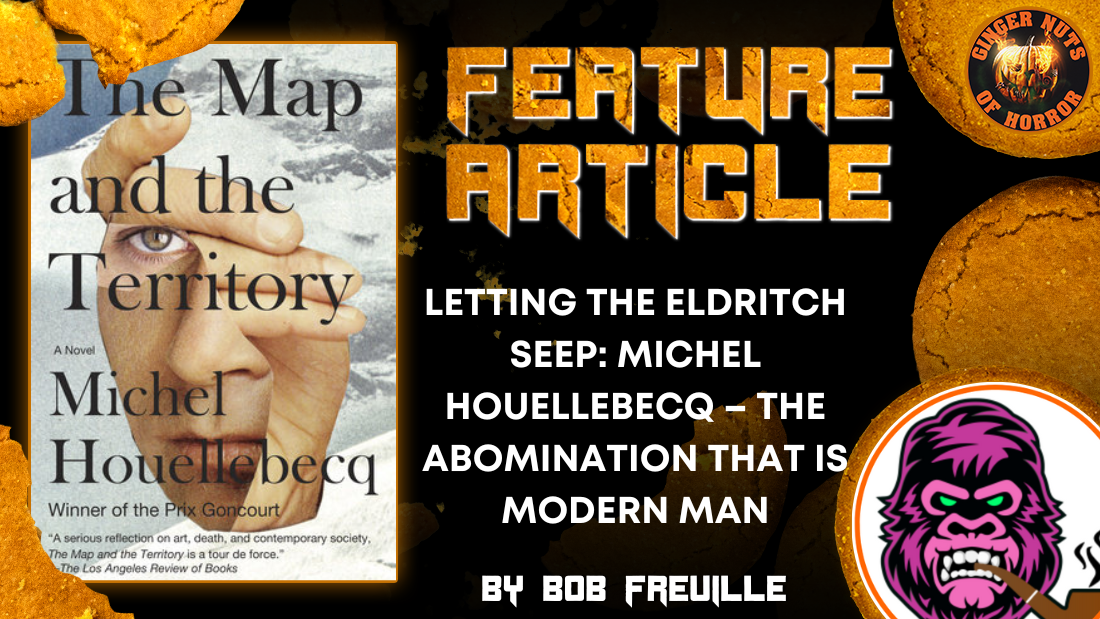
 In one long paragraph, the literary novelist managed to eschew his entire reputation as an author of bourgeois dramas, while simultaneously besting some of the greatest western-horror writers working today. Letting the Eldritch Seep: Michel Houellebecq – The Abomination That is Modern Man by Bob Freville Welcome to Letting the Eldritch Seep, a column where we disinter and dissect artistic artifacts of popular culture that smack of the dark, fucked up, gory, grotesque or weird. Letting the Eldritch Seep is a celebration of those rare occasions where the specter of horror and the camp of the bizarre managed to jump the turnstile and hitch a ride on the Establishment's own gravy train. I should apologize in advance to Mr. Houellebecq's legion of fans, many of whom may get annoyed by my repetition of certain “facts” about the French author and his notoriety. In conceiving of today's column, I chose to consider the experience of those unfamiliar with the best-selling cultural curmudgeon and his work. Michel Houellebecq is a world-renowned and much-scorned novelist whose books are typically filed under General Fiction or Literary. If you find yourself in a brick-and-mortar book store, you're just as likely to find his latest novel on a Bestseller table or New Releases rack as you are to find them anywhere else. Because they sell. A lot. But I contend that they sell for the same reason Stephen King's books sell—because they speak to the fears and inadequacies in all or, at least, most of us. From the very start of his career in fiction, Michel Houellebecq walked a tightrope between popular fiction and genre fiction. His first long form novel, Atomised (released stateside as The Elementary Particles), tells the tale of two brothers, one a sexless, shiftless school teacher, and the other a solitary molecular biologist (cleverly named Michel in an early example of the author's flirtation with autofiction) whose solitary toilings give scientists the ability to clone humans.  In addition to its obvious riff on the concepts of doppelgangers, eugenics, shadow selves, and the misery of the human project, Atomised plays with the familiar trope of the abusive parent producing sociopathic offspring. It also has fun teasing ancillary elements that would take center stage in straight horror. For example, the object of the protagonist's affection is seduced by a Hippie commune luminary who later proves to be a Satanist and a serial killer. The novel is brimming with darkness, including abortions and diseases galore, seedy sex orgies that would make Caligula blush, and not one but two principal characters committing suicide. It's kind of like the literary equivalent of a late cycle Lars von Trier movie, except much more antiseptic and far less fun. By the time Atomised arrived on the scene, Houellebecq was already the author of a little-read poetry collection, myriad essays in French, a book-length work of non-fiction, and one significant short novel (Extension du domaine de la lutte, released in America and the U.K. as Whatever). But it was Atomised that made him the enfant terrible of international letters as if he were some overnight sensation. Soon, everyone from the Independent to the Paris Review were profiling this strange creature whose books were selling faster than heroin. Over the ensuing twenty-five years, the enfant terrible may have matured into a slightly more distinguished version of himself. Or, maybe, he's just fucking with people when he keeps company with wealthy politicians and accepts their dubious awards; the author who has repeatedly excoriated his birthplace in book after book after essay recently accepted the Legion d'honneur, France's highest honor.  Although his success in the United States is negligible compared to the reputation he has garnered in other countries (Croatia, France, Georgia, Germany, and Italy count themselves among his most avid readers), the American press has spilled more ink (and tea) about the man than almost any other place save for his native France. Unsurprisingly, his work has served as petrol powering outrage culture. It doesn't help that the man is as inflammatory as his books. Houellebecq has insulted Islam, kept company with far Right radicals, praised the actions of America's first President to be indicted, formally denounced euthanasia (as if anyone was asking for his opinion on something so personal), and even performed in an avant-garde Dutch porno before threatening to sue the producers if they released the professional Triple X film with his unsimulated sex scene intact. Regardless of what you make of his personal life or political views, Houellebecq the author has been nothing if not wildly popular. His novels transcend age, gender, and sexual orientation, even as they lampoon all three. Despite narratives overflowing with age-related decline, misogynistic observations, and sexual dysfunctions, Houllebecq has managed to connect with young readers, female readers, and LGBTQ+ readers.  Some of this interest undoubtedly owes to the abovementioned notoriety, but there is a case to be made that everyone reads Houellebecq not for the notoriety but for the singular voice of a genre stylist in disguise. Some authors, such as Bret Easton Ellis and Chuck Palahniuk, are a bit more unabashed and open about their muses and intentions. By contrast, Houellebecq has always been cagey about his genre influences. Occasionally, we will get an on-camera interview in which he recounts his early experiences reading children's books, fairy tales, fables, and the like. But it is rare that Houellebecq makes any mention of the macabre. Still, it is telling that the author's first published book was a 118-page thesis on the progenitor of cosmic horror entitled H.P. Lovecraft: Against the World, Against Life. The man's work has always been promoted as literary fiction—even when absurdist fiction, ego fiction, existential fiction, or pity fiction might have been more apt descriptors—and it has been treated as such by the mainstream literati. Houellebecq's mainstream novels have scooped up prestigious honors across the globe, winning everything from the Prix Goncourt (2010's The Map and the Territory) and the Interallié Prize (2005's The Possibility of an Island) to the Prix Novembre (1998's Atomised) and the International Dublin Literary Award (2002's Frank Wynne translation, The Elementary Particles). Regardless, Houellebecq's work is awash in blood, cum, dread, and terror. From his first short novel, it was obvious that something was off with Houellebecq in the best (or worst) possible way. What was ostensibly presented as a sort of literary Reality Bites for the information age proved to be a Gen X pipe bomb concealed in the raincoat of a miserable flasher. Whatever is a 155-page screed that reads very much like the suicide note of a bitter incel. At various turns, the novella's computer software employee protagonist curses women for being drunken sluts, laments the genetic lottery that leaves the ugly male to die alone, chain smokes cigarettes until his chest locks up, drinks himself senseless with a priest, and pens Gogol-worthy philosophical tracts in the voice of barnyard animals (hence the uncanny jacket image of a cow). All of this before his ultimate meltdown, in which he drunkenly stalks a biracial couple to a beach, removes a knife from his glove compartment, and encourages his physically unattractive colleague to go on a “career of murder” where he can “feel these women trembling at the end of your knife.” That his colleague fails to commit the bloody act and is instead killed himself in a terrible auto accident underscores the brutal randomness of Houellebecq's universe. Similar fates befall all of the characters in his popular novels, including those which have won him the most acclaim and attention. The seeds of this leit motif were apparent long before he became a literary rockstar. Houellebecq's early poetry, much of it written in between stays at mental institutions, reads like the literary equivalent of deleted scenes; one can easily imagine them feeling right at home in the margins of his novels. In The Art of Struggle, Houellebecq writes: “He's walking at night, his eyes full of death, The wind in the streets lashes his bones Already a year without making love: Humans brush past and slip round his body. He's walking in the city with his own secret thought, How interesting to see others live, To look at life like reading a book And even forget the taste of regret. He punches the buttons and lets himself in An icy breath settles on his soul There must be a mistake, surely there must, And the radio is getting him down. Now he's alone and the night is immense He skims over his things with a tentative hand Yes they are there but his reason is not He uses the night to look for a way.”  This poem evokes horror in its most visceral human form; it is easy to imagine it being read over footage from William Lustig's Maniac or Nicolas Winding Refn's Drive, stories of lonely maladjusted insomniacs full of love, lust, and rage. If Houellebecq's early flailings fit comfortably within a syllabus of existential horror (Camus, Gogol, Kafka, et al.), his middle period (Platform, Lanzarote, The Possibility of an Island) belongs to the realm of body horror in all its queasy permutations. While many wrote Platform off as a Boomer's horny attempt at Gen X pamphlet literature, categorizing it as Islamaphobic pornography, the truth is probably less sensational. Like American Psycho and The Beach before it, Platform concerns itself with the misplaced male of the late-nineties/early-2000s and his position in a world governed by dream makers (cruise lines, escort services, travel agencies, etc.), dream takers (youthful, attractive men and radical terrorists in this case), and the tenuous relationships that develop between mortal humans only to tear our hearts from our chests when they end in tragedy. Along the way, the novel addresses child sex trafficking, the male inability to connect (“Men live alongside one another like cattle; it is a miracle if once in a while they manage to share a bottle of booze.”), and matters of a more Kafkaesque nature: “A cockroach appeared just as I was about to get into the bath. It was just the right time for a cockroach to make an appearance in my life; couldn't have been better. It scuttled quickly across the porcelain, the little bugger; I looked around for a slipper, but actually I knew my chances of squashing him were small. What was the point in trying? And what good was Oon, in spite of her marvellously elastic vagina? We were already doomed. Cockroaches copulate gracelessly, with no apparent pleasure; but they also do it repeatedly and their genetic mutations are rapid and efficient. There is absolutely nothing we can do about cockroaches.” The body horror of Houellebecq's work reaches it epoch in 2005's The Possibility of an Island, a New York Times Notable Book whose summarist claimed it was laugh-out-loud funny. We probably should have known something wicked was afoot when The Economist called it funny. After all, picturing the staff of The Economist smiling, much less laughing, is a bit like picturing Houellebecq fucking—it's not something easy to imagine and certainly not something most would invite. Nevertheless, The Possibility of an Island manages to be amusing in many ways, even in its choice of such an ironic title. The narrator is a selfish, sexist stand-up comedian who hates the poor, but loves his dog. It's good news for him, then, that he will be cloned throughout time, along with his canine companion... or is it? At the risk of spoiling this one for you, I'll say that Daniel, the narrator, faces an outcome that would be right at home on an episode of The Twilight Zone... assuming The Twilight Zone was riddled with such zingers as, “Do you know what they call the fat stuff around the vagina?... The woman.” Most reviews of the book prefer to focus on the chauvanism of the main character, but it is worth repeating that this book was marketed as a literary comedy. Which is absolutely bugfuck... until you remember it was published in 2005, a time when the publishing industry was run by men who probably failed to notice the bloodshed while they were busy laughing at the book's many drooping cunt descriptions. But this is not what merits discussion. The body horror of Houellebecq's aging man and woman is the least repulsive element in this Vintage“literary fiction” release that also happens to be a sci-fi story written by multiple clones. The real attraction for fans of horror should be the barbarism of the book's final third. Houellebecq has often been criticized for lacking style, aesthetic merit, or technical proficiency, a charge that is bolstered by the plagiarism scandal that attended his fifth novel. But, of course, this is a subjective truth if it is a truth at all. If we want to bring technical into the conversation, technically the author's act of plagiarism was no different than what any collage artist does with magazines, newsprint, and other ephemera. The author, who has compared the act of writing to cultivating parasites, may not be for everyone, but it is my argument that he is most certainly one for fans of horror. Frankly, I'm surprised that no one has ever bothered to mention the following scene in reviewing The Possibility of an Island:  “The most corpulent one seemed in difficulty, he had lost a lot of blood. On a signal from the chief, the fight resumed. The fat one staggered to his feet; without wasting a second, his adversary leaped onto him and plunged his dagger into his eye. He fell to the ground, his face spattered with blood, and the scramble for the spoils began. With lifted daggers, the males and females of the tribe threw themselves screaming onto the wounded man, who was trying to crawl out of sight; at the same time, the drums started to beat again. At first they cut off bits of flesh that they roasted in the embers, but as the frenzy increased they began to devour the body of the victim directly, to lap his blood, the smell of which seemed to intoxicate them. A few minutes later, the fat savage was reduced to bloody residue, scattered over a few metres in the prairie. The head lay at the side, intact except for the gouged eye. One of the assistants picked it up and handed it to the chief, who brandished it under the stars, as the music was silenced again and the members of the tribe sang an inarticulate threnody, slowly clapping their hands. I supposed that it was a rite of union, a way of strengthening bonds within the group—at the same time as eliminating weakened or sick members; all of this seemed to conform to what I had been taught about mankind.” In one long paragraph, the literary novelist managed to eschew his entire reputation as an author of bourgeois dramas, while simultaneously besting some of the greatest western-horror writers working today. If this section doesn't showcase technical and aesthetic prowess, then I'll pack up and leave. Fuck you very much! Good day, sir! But this isn't even Houellebecq at his bloody best. In The Map and the Territory, Houellebecq creates an acidulated satire of the modern art world that devolves into a funereal police procedural, one revolving around the brutal death of a hermetic author named Michel Houellebecq. This novel, which owes a debt to the whodunits of Agatha Christie and Patricia Highsmith and the who-cares of Elfriede Jelinek and Thomas Bernhard, may well be Houellebecq's masterpiece. The author uses the third person omniscient narrator (for the first time in his novelistic career) to Kubrickian effect, staging his own grisly murder to push the distanciation of Brechtian theater to its literary conclusion. The effect is one of being told one's own story, experiencing your sad failures and ultimate demise through the glacial but oddly empathetic voice of a ghoulish septuagenarian. Houellebecq has (almost) always chosen the first-person narrative device when writing fiction. This choice has often caused the voice of his main characters to be confused with the authorial voice. Some would contend that this is a deliberate choice on the part of the impish novelist, the stylistic flourish of a born provocateur who relishes in misleading critics, interviewers, and those who would read his books merely because of something scandalous they heard about him in the media. To be sure, Houellebecq's droll style and meandering essayistic novels are the consummate revenge against the pseudo-literate, especially those who would only read something with the intention of disapproving of it. To read one of his novels from cover to cover is to suffer, to be challenged, and to be confronted by the greatest horrors of all—our inexplicable birth, our hideous existence, our grotesque sex, and our unfortunate (or fortunate) mortality. Bob Freville Bob Freville is the author of Battering the Stem (Bizarro Pulp Press), The Proud and the Dumb (Godless) and The Filthy Marauders (The Evil Cookie Publishing). He is the director of the Berkeley TV favorite Of Bitches & Hounds, and the Troma vampire film Hemo. He is writing and producing the forthcoming Norwegian drug comedy The Scavengers of Stavanger. Creep on him at: https://moderncustodian.substack and @bobfreville check out today's horror book review below THE HEART AND SOUL OF HORROR PROMOTION WEBSITES
0 Comments
Leave a Reply. |


Archives
April 2023

|
 RSS Feed

|

|