

RACKING THE MUCK
19/10/2015
 We all know the big ones; your Resident Evils, your Silent Hills, your Dead Spaces, Amnesias et al. But there's more than you'd ever imagine when you pare beneath the surface of horror in video games, not only obscure independent titles (I'm Scared, SOMA, Slender etc) but also overlooked commercial releases: obscurities and curios that never made much of an impact on the market, but which, thanks to the internet, have begun to enjoy something of a cult status in recent years. I Have No Mouth and I Must Scream, an adaptation of Harlan Ellison's short story of the same title, is a bizarre point and click adventure that takes the basic premise of the short story (super A.I. Murders all of humanity, becomes almost omnipotent, spends the next several centuries elaborately and ironically torturing the handful of humans it decided to spare) and expands it across a variety of strange psycho-scapes; environments which reflect the neuroses and apparent sins of the characters themselves, all of whom were broken long before AM (the self-christened A.I.) got to them. As a game, it is no great shakes: a frustrating point and click role-playing piece whose puzzles are often oblique to the point of surrealism (much of what you have to do relates to symbolism that is pertinent to each character; the slightest misstep can make the entire game unbeatable). However, what the game lacks in technical finesse it more than makes up for in atmosphere. This is not a game that you play to win; in which you rise up to conquer the pervasive malevolence of AM. Instead, the purpose of the game is to die; for the characters to find what peace they can in suicide, after first exploring enough of themselves in AM's twisted, tortuous mind games to get over their own demons. A pervasive sense of darkness and depression hangs over the entire game; an impermeable gloom that is sumptuous and wonderful to experience. It is also monstrously grim, taking cues from the original short story and expanding them into more developed arcs, many of which are absolutely horrendous. The characters you play are universally flawed, some of them having histories that are entirely monstrous. Nevertheless, by playing them, you gain a sense of empathy, of understanding: even the most flawed, the most wicked in their former lives, isn't worthy of the eternal and constant torment that AM provides. As for AM himself, he is not only deliciously sadistic and endlessly inventive (as only a man-made God of pain can be), he is also contradictory and lunatic at times, presenting the characters with no-win situations, that no amount of struggle in their part can undo. That is the deliciousness of the game: there is no victory, no celebratory component: even if you “win,” you and all of humanity loses. A wonderful thing for any work of horror to achieve, but doubly so in a video game, which all too often tend to shy away from such ambiguities. Another favourite, that has attained quite a significant following, though still not enough to elevate it to “mainstream” status, is American McGee's Alice and, to a lesser extent, its sequel, The Madness Returns: adaptations of Lewis Caroll's seminal Wonderland books, the games take place several years after Alice's adventures in her day-dreaming fantasy realm: now a young woman, Alice's waking self is confined to a mental asylum, following the burning down of her family home and the death of her family. Wracked with guilt, she is catatonic, retreating into a twisted, distorted version of Wonderland which reflects her degenerating mental state. 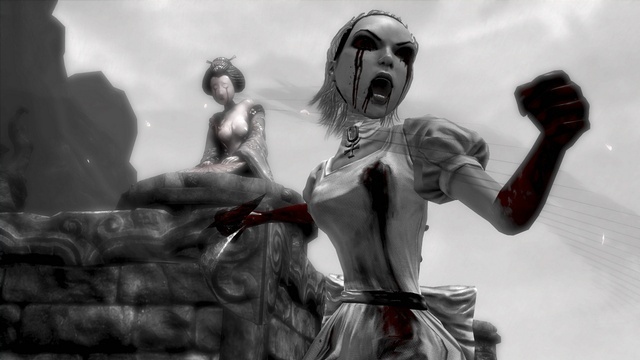 Again, the game is no marvel technically speaking; a fairly decent, 3D platformer of the era, its great strength lies in its awe-inspiring design work: each environment, every enemy, is an exercise in phenomenal, disturbing beauty: Wonderland is a fractured fantasy realm, a polluted dreamscape, its miraculous nature subverted by disturbing and freakish elements, from structures made of twisted, screeching clockwork to spires of flesh and bone, the architecture and environments of the world are breath taking in both their concept and realisation. Enhancing the impact of its aesthetic beauty is the depth created by knowing that everything in Wonderland is metaphor every weapon, every character, every environment, represents some facet of Alice's crumbling psyche, from the myopic obsessions of the Mad Hatter to the fiery guilt manifested by the Jabberwock, the dream-self the player manifests represents the last shred of sanity; the final scrap of self that Alice clings to, culminating in a conflict with The Red Queen, who is the core of Alice's insanity; every neurosis she contains collated and given its own, malevolent will. The game, like I Have No Mouth and I Must Scream, is not frightening in the conventional sense; there is little here that will make you jump or scream. Its horrific qualities are of a much more nuanced nature: it is fractious and disturbing, the imagery it presents simultaneously inspiring and twisted, increasingly so as the game progresses, and Alice travels deeper into the very heart of her own madness. The phenomenal Queen of Hearts land, which waits at the end of the game, is an exercise in visual disturbance, every inch of the Red Queen's palace made from her own flesh; spires and buttresses of bone, pools of blood and lymphatic fluid, tunnels that resemble bowels and birthing canals. There is also an edge of urgency and tension to the game, created not by some clock or timer, but by the sense that Wonderland is corroding around you, that Alice's mind is perpetually on the verge of breaking. It's a beautiful experience, and one that bears repeated delving into. Another extremely rare example of obscure horror in video games derives from the short lived “FMV” or “Full Motion Video” era, which came about in the mid to late 1990s, when CDs were just becoming a viable format for home systems. At the time, it was believed that full motion video would eventually replace pixels and polygons, providing, as it did, movie-like qualities to video games; real sets, real actors, real environments. However, owing to the incredible costs involved in creating such projects, not to mention the fact that most of the “games” created during the era were appalling (barely interactive, poorly realised films for the most part), the era was short lived, and served to bury several notable companies that were at the very top of the field during the early days of home consoles (Gremlin, Psygnosis). Realms of the Haunting is an odd title; a British made game from the now defunct Gremlin, a part FMV, point and click adventure, part RPG, part first person shooter, it stands in a genre entirely of its own: an imperfect, often fairly ropey affair, but whose ambition and inspiration shine through its technical limitations. 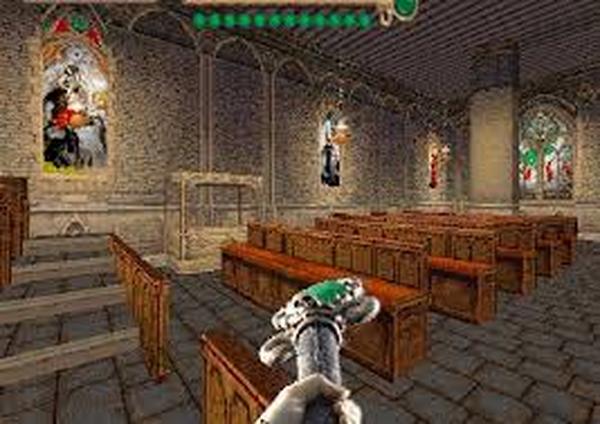 The game is a horror title for the PC, spread across dour discs; a huge undertaking, both for the creators and those few of us that actually played it. By current standards, the game is phenomenally crude, both in terms of its graphics and its scares. However, like many obscure horror titles, it maintains an atmosphere that helps to divert attention from its technical short comings and ensure that it has maintained a small, cult following to this day. Following protagonist Adam Randall, the game starts almost as a bog standard “haunted house” story: Adam is called to a house in the fictional town of Helston, Cornwall, where his deceased Father purportedly resided. Once there, he encounters many bizarre and disturbing phenomena, not least of which is a visit from his Father's ghost, who informs him that he is caught up in events far deeper and more dangerous than he could possibly imagine. What follows is a kind of dungeon crawl throughout the mansion (which contains more surprises and secrets than anyone could guess), across time and dimensions, in a battle for the state of all reality, at the heart of which lies Adam Randall himself. The game, in attempting to do multiple things at once, is master of none: its shooting segments are underbaked, its puzzle segments often ill timed and frustrating, the rest frankly bizarre. One of the most notable problems is the style of shooting and direction: involving live actors and projected, green screen environments, it's often the case that the actors barely react to the most bizarre circumstances: they can be standing in the middle of other-worldly gardens, in arcane temples, at the very gates of Hell, and it's as though they are standing in a friend's hallway, slipping off their shoes. This tends to dilute what is otherwise a fantastically realised back mythology, which is the main appeal of the game (deriving influences from apocryphal, Abrahamic texts and Biblical traditions, obscure occultism, Satanism, paganism and gnosticism, the game is phenomenally well researched, making reference to some truly obscure and niche traditions, and doing so in such a manner that weaves them together into an all singing, all dancing uber-mythology. What kept me playing and what has drawn me back time and again is delving into this incredibly rich background, much of which is utterly essential to understanding the game). In terms of its horror, it wavers between the hackneyed and hokey (one of the earliest attempts you come across is quite literally the eyes moving on a painting) to the inventive and disturbing (an inkless type writer seemingly typing with no human agent: “We live, we live, we live, we live...” over and over and over, an old gramophone that, when turned on, endlessly plays an extremely disturbing cacophony of malevolent laughter, babies crying, a woman weeping). The visuals of the game are simply too crude to evoke much in the way of emotional response, but the sound design...the sound design is fantastic, from the environmental echoes of strange winds and whispers through the mansion, to the distant voices and sibilant whispers that occur when something paranormal is about to manifest. It serves to enhance an already faintly uneasy atmosphere, making every step an exercise in tension. Sadly, the game's conclusion is rushed and beyond lazy, suggesting that the endeavour (like many FMV titles) simply ran out of time and money; one of the most hackneyed, “cop out” conclusions any story can ever present (think Identity, and you wont be far off). That said, the experience of the game is certainly worthwhile, if you can find a way of getting it running on modern systems (some sort of DOS box emulator may be necessary). Delving back to even earlier periods, when horror in home video games was very rarely even a concept (the mainstream consoles being largely aimed at younger audiences), we have the Commodore Amiga; a system that, in many ways, was the antecedent of home, desk top computers; a simultaneous office and video games system, which often catered to a slightly more mature market than consoles such as the Super Nintendo or Sega Megradrive/Genesis. The company Horrorsoft courted a degree of controversy with its many horror RPG titles, not least of which is a series based on the 1980s chat show host, Elvira: Mistress of the Dark. The video games are largely very little to do with the hostess and her peculiar brand of raunchy, gothic horror-comedy, instead opting for a more defined, horror theme which, for the time, was almost unheard of. Hardly sophisticated by modern standards, the games are first person, RPG affairs in the vein of Eye of the Beholder, Abandoned Places and their many, many clones: extremely clunky and confusing by current standards, the games are notorious not only for their extremely explicit gore and violence, but also for being next to unbeatable. 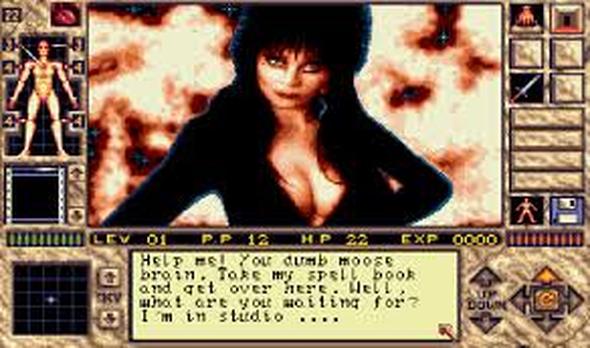 From a time long before the ability to save your progress was common, long, long, long before internet walkthroughs or video longplays, these games are exercises in the most obscure trial and error; it is so, so easy to walk into an “instant death” situation because you don't have a particular item or spell active, or to simply do something in such a manner that makes the games unbeatable, leaving you stumbling around like an idiot for hours on end not realising what you've done. This makes them more endurance trials than anything; not massively fun to play, save for the fact that, at the time, the video gaming public had never experienced anything quite like them; nothing so graphic or consistently frightening (certainly nothing as overtly gory). Every potential death in the games has its own particularly inventive image or animation, from your own severed head, still pulsing blood, to being cocooned in a giant spider's web and eaten alive, these games generated a degree of controversy at the time of their release, though nothing like what would come later with the infamous Mortal Kombat and Night Trap. In terms of horror, it is highly visual and extremely crude, by current standards: there is an atmosphere to these games, largely maintained by their music, but the majority of the “scares” come from encounters that you simply aren't expecting, from graphically mutilated corpses tumbling out of closets to the sudden emergence of a monster or mutated creature. Their intent is to shock rather than disturb or genuinely distress, which goes to the power of N for Horrorsoft's arguably more successful title, Waxworks: A game in the same vein as the earlier Elvira titles, Waxworks has a more defined story and back mythology, as well as a much denser air of dread about it. An anonymous member of a family suffering from a generational curse, it is your job to travel to various periods throughout history and do away with certain ancestors who have fallen afoul of the curse and become malevolent monstrosities, from necromancers raising armies of the dead to Satanic bio-chemists manipulating the genetics of plants to turn them into semi-demonic abominations. The game serves as a kind of tapestry; a homage to certain horror conventions in film and cinema, as well as being a fairly interesting title in and of itself. Again, like Elvira, the game is extremely crude by current standards; an early example of not only horror but of video games in general, but at the time, was entirely unique; still extremely fondly remembered, albeit with a degree of tooth-grinding frustration. Grimmer, more graphic and much, much bigger than its sister titles, Waxworks is arguably the pinnacle of Horrorsoft's Amiga titles; one that is much more worth checking out in video form than playing for oneself (even navigating the earliest screens is a chore), but one that stands as a significant historical artefact in the history of horror video gaming. Returning, for the moment, to the FMV era, we have the Phantasmagoria series; like Realms of the Haunting, an effort to create horror titles using “live action” actors in partially “real” sets, partially green screen, virtual environments; some of the more notable and successful of the era, in that they are quite fun to play, if somewhat limited: essentially point and click adventures, they involve wandering around environments, picking up items, interacting with characters, solving puzzles etc. 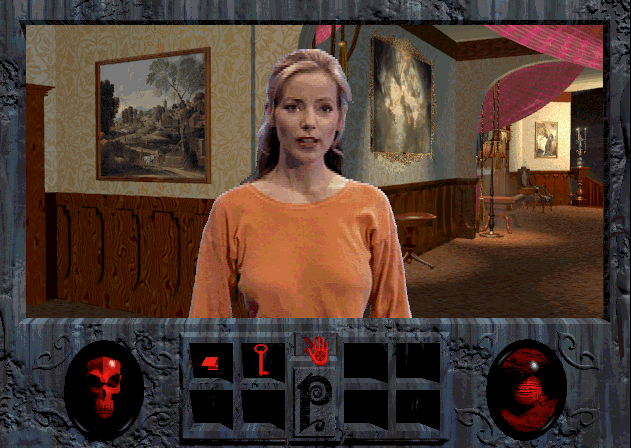 The first game in the series follows a newly married couple who move into an extremely ridiculous, over the top house; a vast and rambling manor that purportedly once belonged to a travelling magician, and which, somewhat bafflingly, is still filled with his personal effects. Forgiving, for the moment, the innate absurdities of the situation, the game puts you in the place of the wife as she wanders throughout the mansion and the nearby village, discovering its macabre history and the monstrous events that took place there. Meanwhile, her husband goes slowly, slowly insane as the house and its resident demons infect his mind, leading to one of the most hilariously over the top performances in any work of horror ever. The game draws inspiration from a variety of sources, from Stephen King (more than a whiff of The Shining about it) to H.P. Lovecraft (the entire setting and ethos is extremely Lovecraftian, as is the demon that manifests in the closing chapters), providing a kind of “ghost train ride” experience; creepy in the manner of a fun house or ghost stories on Halloween, though there are one or two legitimate shocks in the game (many of which derive from the slow degeneration of the husband, who becomes violent and aggressive towards the end of the game, resulting in several instances of domestic violence and even one of rape). It's a mixed bag: often extremely silly, endearing in its goofiness, occasionally shocking: diverting fun, if you have a spare day or so. Its sequel, on the other hand, is ludicrous. In attempting an entirely different tone, a far more psychological subject, the game takes itself far too seriously, whilst being equally or even more ridiculous, in its own way: Following the travails of player character Curtis Craig, the game explores an increasingly deranged mind as Curtis's fellow workers ae elaborately murdered one by one and Curtis himself experiences a number of bizarre hallucinations. The game fails on a number of levels, most notably the truly bizarre puzzles, which result in the player simply clicking everything on everything to see what works (even that doesn't work in some instances, requiring endless reloads, trial and error, extremely frustrating experimentation). Attempts to be avante garde and edgy come off as token and overdone, most notably the inclusion of extremely graphic violence, murder scenes; even unusual sexuality (there are scenes in the game which occur inside a BDSM club, which, like so much, is hammy, cartoonish and far removed from reality). Arguably most absurd is Curtis's friend and co-worker, Trevor, an early example of an openly gay character in video games, but far from progressive: a poorly written, atrociously acted stereotype that is more frustrating than endearing. Conflated, self important and the very definition of pretentious, Phantasmagoria 2: A Puzzle of Flesh is recommended only for the genuinely curious or (a ha) masochistic. That said, there are rare moments of invention: some of the murder scenes are inventive, the imagery can be creative and intriguing and one or two of the scares are clever (as the story progresses, you will notice subtle visual hallucinations that Curtis is having, which grow steadily more extreme, and can be quite creepy). A far wider church than most people realise, there are examples of horror in video gaming right back to its roots; some obscure rarities, some that are best left buried. All intriguing, in their own peculiar ways; all examples of how the genre and the medium have evolved over time. Do some digging, rake the muck; you never know what diamonds you might find. GEORGE DANIEL LEATHE HEART AND SOUL OF HORROR REVIEWSComments are closed.
|


Archives
April 2023

|
 RSS Feed

|

|