

the REAL HORRORSHOW: INFLUENCE OF SNUFF/SCHLOCK/HORROR ON THE MUSIC OF TRENT REZNOR BY ADAM STEINERWhen filming the video for Down In It a camera attached to a weather balloon suddenly slipped its moorings and drifted hundreds of miles away from Chicago to a cornfield in Michigan. A local farmer reported the find to the local police. After seeing the footage FBI investigators were called in to begin a manhunt for a murderer, and launched an appeal to find the body of the victim dressed all in black, from his leather jacket to the combat boots on his feet. This “lost scene” from the music video for the first single from 1989’s Pretty Hate Machine shows a young Trent Reznor lying face down in the dirt, like a corpse, playing dead for the camera. The subsequent media storm and poster campaign appealing for witnesses became a classic example of (accidental) guerilla marketing. This was Nine Inch Nails’ first brush with the world of ‘found’ footage, beginning a long strand of movie-world influences that runs through the DNA of Trent Reznor’s various musical projects. Running across visual and sonic aesthetics of Reznor’s multi-million-selling one-man band; to his career as renaissance soundtrack artist alongside close collaborator Atticus Ross. The duo has now won two OST Oscars, for The Social Network in 2011 and ten years later, almost inexplicably, for a Disney Pixar movie about life, loss and the afterlife, Soul. Since Pretty Hate Machine’s first use of samples Reznor has applied sound design techniques across his music. For The Downward Spiral Reznor referred to himself as a “director”, charging his collaborator Chris Vrenna to scour through hundreds of rented laserdisc movies. The band were recording in a home studio at 10050 Cielo Drive, the site of the notorious Manson murders of 1969, which included the death of Roman Polanski’s pregnant wife, actor Sharon Tate. Channeling the bleak spirit of the house where the dream of Californian sunshine got turned upside down, the stark and relentless atmosphere of The Downward Spiral album was built upon numerous sci-fi and horror films, Robot Jox, Leviathan, and most notably the savage dystopia of George Lucas’ first feature, THX1138. Reznor took the sound of a prisoner being mercilessly beaten from the film to establish the tone of album opener Mr Self-Destruct. Vrenna noted that removing sound from the prescriptive context of its image could sharpen its impact in new and unexpected ways: “You find great little ambiences. Movies are just trying to recreate some sort of space, whether it be outer-space or a creepy hallway, they’re recreating that falsely on film. You just listen to them; they don’t sound like anything.” The process turned into a full foley project; for Vrenna and Reznor a drum sound became a car door slamming, or a swarm of insects merging into a wild haze of densely-layered guitars. Elsewhere on The Downward Spiral we hear voices of blurring pain and ecstasy crying out in the background of “The Becoming”, halfway between an orgy and massacre it becomes the expression of overkill, of things having reached their limit and somehow slipping over the edge. We hear a looped and layered sample from a terrified crowd in the movie Robot Jox as a giant mecha-war robot falls onto a stand of spectators, cruchshing, killing and maiming as other scatter to escape. While the original film clip can seem slightly comical now Reznor conjures up a roiling pit of hell from vintage 80’s sci-fi, amplifying the explosion fear and suffering which feeds the toxic shock of shredded guitar and screaming in the chorus of The Becoming. Raised on many of the established horror films of his teenage years Reznor was in 1994 what kind of movies he might rent: “Normally, real depressing, sad, violent kind of movies, you know?” His list ran: “from The Exorcist and through all the Freddy and Jason shockers” long-running franchises which would come to define classic horror cinema with new sequels running beyond the decade. Reznor’s passion for horror films, and his taste for BDSM power relationships, particularly as the masochist ‘victim’ or submissive object, would feed into his musical expressions of aggression, violence and control, exploiting the dynamics of horror, schlock and snuff movie genres. Reznor’s self-awareness of his own aesthetic tastes, and their extremities, put him in the mindset of an audience hungry for darker material. On 1995’s MTV Superock show Reznor was asked what film he would like to re-score: “probably the first two Hellraiser films”. Some years earlier it was his friend/collaborator/inspirations, Peter “Sleazy” Christopherson and John Balance of the band Coil, who produced original music for Hellraiser, only for it to be rejected as too frightening – in spite of the film’s rich body horror content. Reznor also expressed an interest in soundtracking a David Cronenberg film, such as Scanners, Dead Ringers or Crash, all of which reflected Reznor’s use of body-horror; particularly a fixation on abject horror of fluids spilt or ejected from the body, along with psycho-sexual perversity and mutilation aesthetics, in both his music and videos. Reznor would later complete one aspect of this ambition by producing a cover version of the theme music from John Carpenter’s Halloween. The nod to Hellraiser is interesting, skipping its more obvious ‘goth’ overtones, the presence of black leather, chains, pleasure/pain S&M behaviours make the Hellraiser films fit hand-in-glove with Nine Inch Nails' early-90s imagery and musical themes. In the liner notes of Pretty Hate Machine Reznor credited author Clive Barker: “for sounds and ideas [with all due respect]” suggesting a deeper connection beyond surface sounds. Barker told S&M magazine Skin Two he used the film adaptation of Hellraiser to advance the idea of consensual S&M practices: “these are images of liberation, not of repression”. Speaking to the Guardian many years later, Barker explained his “emotional inspiration” came from his time as hustler in 1970s New York, delving into the straight-edge underworld of S&M club, Cellblock 28. With Hellraiser, he said: “I was validating a lifestyle. It was a celebration of the beauty of these strange secret rituals.” All of this would speak to Reznor’s continued interest in the power dynamics of control as consensual, sometimes grotesque, violence against the sanctity of the body, aligning with the idea of BDSM acts as the performance of freedom and choice, what Michel Foucault called “the eroticization of power”. Reznor’s film interests are present in a series of music videos as boundary-testing art-films that were combined into the ‘Broken Movie’. The film uses the framework of a kidnapped torture victim forced to watch a compilation of Nine Inch Nails music videos to create a looping meta-narrative, with one track “Help Me I Am In Hell” a nod to Hellraiser. The Broken Movie is extremely graphic, directed by Peter “Sleazy” Christopherson of Throbbing Gristle-fame, who based it upon the docu-film Henry: Portrait of a Serial Killer. The first-person hand-held camera perspective and rough-cut snuff intimacy of the film establishes the audience as equal parts voyeur, victim and spectator. It is perhaps not without some pride that Reznor described the film as: “The most horrific thing you’ll ever see. I said ‘Let’s just take it as far as we think is right. Forget that it’s a music video, forget standards and censorship. Fortunately, or unfortunately, depending how you look at it, it’s unplayable.” The music video for “Happiness In Slavery, stars masochist performance artist Bob Flanagan who suffered from cystic fibrosis, and put himself through extreme physical situations as if to project the unseen physical suffering of his condition to the audience. R In the film Flanagan’s body is vivisected by machines, literally taken apart, he sacrifices flesh and survival for pleasure as a kind of spiritual exorcism. In this video he acted as the figurehead of Reznor’s belief in making the pleasure principle an act of sacred self-expression. The Broken Movie was never properly screened on television and in the pre-internet age became an underground phenomenon with Reznor handing out tapes to a close circle of friends after which pirate copies were inevitably passed around. Speaking to Rolling Stone about the early-90s censorship of explicit imagery, Reznor said: ”I think the back room could represent anything that an individual might consider taboo yet intriguing, anything we're conditioned to abhor. Why do you watch horror films? Why do you look at an accident when you drive past, secretly hoping that you see some gore? I shamefully admit it – I do." Reznor has stated that his music cannibalized America’s obsession with its own culture of violence, and the hypocrisy within that, in part driven and hyped-up by the media: “If that didn’t exist, we [Nine Inch Nails] probably wouldn’t exist”. Reznor told Kerrang in 1994: “Natural Born Killers is an almost surreal kinda film that really starts to attack the American media for its glamorization of crime, and the way news is becoming entertainment.” Blurring the lines between snuff voyeurism: film as a record of genuine acts of murder, torture or suicide, sometimes framed within a documentary framework, begging the question of tension authenticity between reality; fake and creative interpretation, and the explitative self-awareness of the schlock film’s cheap and nasty production. Though the shock of “Henry…” is immediate, the murky truth of its reality, where many of the murderer’s confessions were never proven, sucks away at its hold on the viewer. The now iconic music video of Closer certainly aspires to the music promo as art, accomplished in edgy but painterly scenes. Rolling Stone observed: “Closer is a grainy meditation on the great fetish photography of Joel-Peter Witkin, shot partially on supersaturated 1920s film stock, overlaid with the scratchy patina of early surrealist shorts and shot through with indelible images: crucified monkeys; sneering industrialists straight out of a German expressionist print; siblings with their hair braided together.” The film’s aesthetic would be echoed in the presentation of Se7en, rough cut and jagged edges; the look of decay carried over into the vintage film stock used in shooting. This was horror with added nous and subtlety. Dusty gothic Victoriana, man-and-machine, compressed into an ageless self-contained space, existing outside of time. Reznor compared the relative slickness of Closer to his earlier ‘unwatchable’ videos: “I think it's more challenging to work with something that's more accessible yet is interesting, different, subversive.” From the planning stage, Romanek had been nervous of going too far and for MTV to reject the video outright, such was the network’s power, to re-shoot and make changes would take 3 weeks, and cost around $10,000 in production costs. Some shots of “naked pussy” and medical illustrations of genitalia were inevitably cut, Reznor perhaps overplaying his hand from the start so he could fall back to protect the rest of the video. He chose to self-censor swapping contentious graphic material for ironic ‘scene missing’ cards. Carol Siegel noted that Reznor is often the more passive, masochist ‘victim’ in his videos, less the sadistic dominator, in keeping with the lyrics of The Becoming, he is a being designed to absorb pain, this ‘defect’ becomes his hidden strength. In Closer Reznor is strapped to a chair wearing a ball-gag surrounded by S&M ‘tools’, then bound shirtless by the wrists wearing a blind visor, inspired by a Man Ray photograph, a Saint Sebastian flesh-cushion waiting to be stuck-full with arrows that never come, penetration threatened, but delayed. Although the lyrics would suggest that Reznor/the song’s narrator is the threatening partner, the video itself throws-off this paradigm of absolute control, instead embracing the power-play of role swapping he takes back control in choosing to be a submissive victim, although the song’s lyrics suggest otherwise. Reznor’s most extreme experiment of the Broken film pushed boundaries of graphic music video, and in his music both the lyrical content and the sound design merged body horror, the fear of the abject; spilling your guts, bleeding out, ejaculation, was brought directly to the listeners attention and brought transgressive themes to the heart of middle America. In testing the limitations of his musical audience Reznor inadvertently opened the door for more extreme forms of music that chased the fetishization of sex and violence; edging in and out of parody. Elsewhere the horror film industry shifted on its own axis, with the next generation of violent shockers focussing less on scares and screams than with forms of torture, from (self)mutilation and brutal psychological punishment. In Reznor’s earliest music videos we often see people in various forms of bondage, and within that, caged, trapped, or boxed-in a room, all these forms of enclosure kick-off the prisoner dynamic. The body horror of The Downward Spiral’s mental collapse and the physical transformations wrought between man-machine evolution and self-harm would spill over into what became pejoratively termed “torture porn”. The next generation of horror franchises, Hostel, Human Centipede, and the ongoing Saw series (all scored by ex-NIN keyboard player Charlie Clouser) would focus upon the disfigurement and abuse of victims, not just plain old murder. The more sadistic the action; the more entertaining for audiences, shocks were delivered in inevitable disgust not surprise. More recently this has evolved into the revenge-porn genre with a number of female-led films where a protagonist experiences the worst kinds of sexual abuse and after being left for dead returns to reclaim some of their lost control through taking revenge on whoever has wronged them. Again the genre is turned on its head, though the damage has already been done to the victim, they at least seem to redress the balance. Although in this process, muc like the vigilante justice of Marvel’s The Punisher, the act of revenge often causes the victim to become more like very people that they wish to destroy. On The Downward Spiral Reznor’s narrator is splintered by internal division, he dances with addiction, lost faith in God, extreme rough sex, abuse and self abuse, where the voices inside your head have become a deafening scream, his nightmare is the echo chamber of his greatest fears, as in fight Club, trying to overcome his inner nemesis he has become his own worst enemy. Adam Steiner Adam Steiner is the author of Into The Never: Nine Inch Nails and The Creation Of The Downward Spiral – the book explores the making-of the album and how Trent Reznor brought transgressive themes of mental health, suicide, and body horror to the mainstream. https://adamsteiner.uk/nine-inch-nails-into-the-never/ https://twitter.com/burndtoutward https://www.instagram.com/adamsteinerauthor/ Into The Never: Nine Inch Nails And The Creation Of The Downward Spiral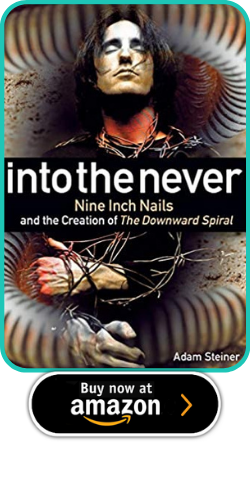 Ushering in a new era of confessional music that spoke openly about experiences of trauma, depression, and self-loathing, Nine Inch Nails' seminal album, The Downward Spiral, changed popular music forever bringing transgressive themes of heresy, S and M, and body horror to the masses and taking music technology to its limits. Released in 1994, the album resonated across a generation, combining elements of metal, industrial, synth-pop, and ambient electronica, and going on to sell over four million copies. Now, Into the Never explores the creation and cultural impact of The Downward Spiral, one of the most influential and artistically significant albums of the twentieth century, or ever. Inspired by David Bowie s Low and Pink Floyd's The Wall, the album recounts one man's disintegration as he descends into nihilism and nothingness. Blurring the lines between autobiography and concept album, creation and decay, it is also the story of Trent Reznor (the man who is Nine Inch Nails) as he pushed himself to the edge of the abyss, trapped in a cycle of addiction and self-destruction. The Downward Spiral also presents a reflection of America and a wider culture of violence, connecting the Columbine High School shooting, the infamous Manson family murders, and the aftermath of Vietnam and the Gulf War. TODAY ON THE GINGER NUTS OF HORROR WEBSITEENCYCLOPEDIA SHARKSPLOITANICA BY SUSAN SNYDER (BOOK REVIEW) the heart and soul of horror featuresComments are closed.
|


Archives
April 2023
|
 RSS Feed

|

|