

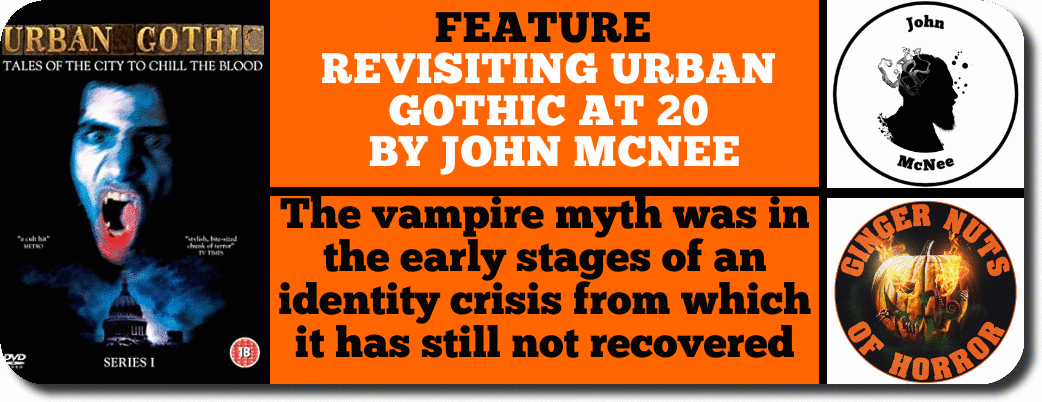
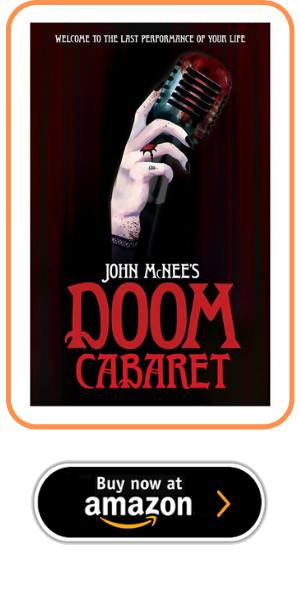
 BACK IN THE CITY: REVISITING URBAN GOTHIC AT 20, EPISODES 2 & 3: VAMPIROLOGY/THE ONE WHERES1.02 VAMPIROLOGY “Rex is a vampire. He has agreed to allow a small film crew to follow him for one night.” That's right. What We Do in the Shadows may get all the attention, but Urban Gothic did it first. A documentary crew exploring the world of a real-life vampire. What a juicy concept. In truth, while it deserves all the plaudits it gets for being one of the best episodes of Urban Gothic, the central idea behind 'Vampirology', directed by Colin Bucksey, isn't all that original. It's just Man Bites Dog with a vampire instead of a serial killer. Still. It works. Rex is a vampire. He lives in London, he has friends, he wanders the streets, hangs out in cafes and bars and every night has to find a new victim. And, while the cameras are on him, he waxes philosophic about the nature of his existence. “What does it mean to be a vampire?” he asks. For Rex, it means a lot of angst about his place in the world. People around him all have their own notions, but no-one really understands what a vampire is. Nor does he, really. Crosses and garlic don't kill him. Sunblock means he can walk around during the day. He's rejected a lot of the cliches of vampirism, but at the same time he relishes them, revealing himself to be highly knowledgable about their portrayals in the media. This is one of the more interesting aspects of Rex's character, his own passion for the filmed versions of the vampire myth. Analysing Dracula by way of Bond, he ranks Christopher Lee the best, the Sean Connery of bloodsuckers. Bela Lugosi? “Roger Moore. Relied on his eyebrows too much.” This is a rarely highlighted quality of the vampire monster itself. It is intelligent and self-aware enough to be able to recognise representations of itself in media and pass judgement on them, perhaps even learning from or attempting to embody them. It makes sense that a true vampire would be interested in how they are perceived by humanity, but it's not an idea that's been played with much. I remember Robert Quarry in The Return of Count Yorga (1976) watching cheap Spanish-language vampire flicks in his crypt (probably only put in as a gag), but 'Vampirology' expands on the idea. In a world awash with vampire stories, how does the real thing assert himself? Does he reject the myth or play up to it? And if he plays up to it, how long before he loses track of where the myth ends and he begins? Rex is a vampire playing at being a vampire. More than that, he's a vampire straining under the weight of a century of tropes, attempting to offer an 'authentic' portrayal of what a vampire is, when the truth is, he really doesn't know. He understands the tropes well enough to reject them, to file down his fangs because they're “a little kitsch”, but he doesn't have anything to replace them with. His number one rule is “know yourself”, but without the castle, the cape, the coffin, he's a little lost. And his frustration in attempting to present some notion of himself with which he's comfortable is readily apparent. “The 80s was a great decade to be a vampire. Insert Thatcher joke here,” he quips, before throwing his head back and groaning: “What a load of bollocks. Can we cut this, please?” Insecure is probably the best way to describe Rex. He's deeply concerned with image. He finds a lot of comfort in Hammer horror and other vampire portrayals, but that's not how he sees himself or how he wants to be seen. And how does he want to be seen? He's not sure. “I'm not sure anyone thinks I'm anyone special, these days,” he says. “Thanks to Sesame Street, if you tell a kid you're a vampire, he'll ask you to count to 10 with him. I'm a cartoon character.” One can only imagine what he would have made of Twilight. Thing is, when 'Vampirology' had its debut, Buffy the Vampire Slayer was still on TV. The first series of Angel had just aired. The romantic notion of the vampire with a soul was already part of the zeitgeist. The slippery slope towards the sexy, sparkling bloodsuckers of Twilight and True Blood was already being carved out. The vampire myth was in the early stages of an identity crisis from which it has still not recovered. Who knows if it ever will? I'm sure I'm not the only one who would love for vampires to become a frightening proposition again, and call me a pessimist, but I don't think another 17 remakes of Dracula (all with very, very clever new spins, I'm sure) will manage it. Rex, then, is the very personification of the vampire myth itself, struggling to find his place in our modern world, deeply embedded in our culture and trying to figure out how not to be seen as a joke. When a potential victim, on the verge of having her throat slit, helpfully explains her blood type is AB because “I thought you'd like to know what flavour you're getting,” Rex storms off in disgust. “What is it with this post-millennial death wish deal?” he rants. “No-one is scared of anything any more!” Amen, Rex. Amen. This meta-narrative reaches its apex when Rex encounters Hammer screen siren Ingrid Pitt in a restaurant and attempts to tell her how much her performances meant to him as a vampire, only for her to laugh him off. In the role of Rex, Keith-Lee Castle is a sardonic, seething ball of anger and resentment. I wouldn't call him charming, but he's certainly a commanding presence, swaggering about like a moody rock star, spitting out one quip after another, but emanating a perpetual fragility, like his bluster will at any moment give way to neurotic panic (which it frequently does). He's not really scary, but... that's part of his character's problem. It's a fantastic performance, but oddly enough not the definitive vampiric role of his career, which would probably have to be the Count in Young Dracula, which ran for eight years on CBBC. Excusing Ingrid Pitt, there are no other well-known faces among the cast, though some horror fans might just recognise Saskia Mulder (Rebecca in The Descent), who shows up to speak two lines and be brutally murdered in a very effective (and bloody) kill scene. When I interviewed writer Tom de Ville ahead of my rewatch of the series, he said 'Vampirology' was one of the episodes they had talked about expanding into a feature. It's not hard to see why. The hook is good, the character is compelling and it's all generally very clever. But I think it would have been a mistake. At 30 minutes it's a slick, arty little slice of entertainment and I doubt very much it could have been improved upon. 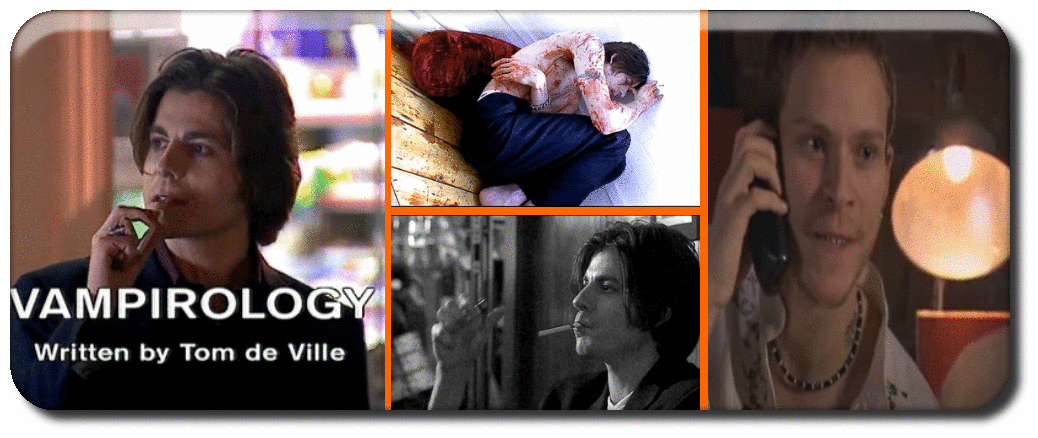 S1.03 THE ONE WHERE “I'm giving people what they want.” It's been a few years, so you'll have to forgive my memory being a bit hazy, but I was sure 'Old Nick' came after 'Vampirology'. Turns out I was wrong, at least as far as the running order on DVD goes. Third episode in the series is 'The One Where'. And if you can't guess by the title, this is the one about having 'friends'. Specifically, the one where an art critic invites a devilish TV executive into her circle of friends, and he begins torturing them for his own (or her own) entertainment. The one where Jude Cunningham off Hollyoaks has graphic sex in front of Tower Bridge (apparently, actress Davinia Taylor called it the most embarrassing acting job of her life, going at it all night on top of Primrose Hill in full view of a bunch of tramps and dog walkers). The one where Robert Webb (Peep Show, Mitchell and Webb, etc) shows up as an artist who paints with the blood of his ex-lovers, puts unborn fetuses in lava lamps and commits suicide when he's revealed to have lied about being molested by his father to make his autobiography more interesting. The one where a woman castrates a man to death in her bathtub for standing her up (“taking Girl Power a bit far” is the way one character puts it). The one where the villain feeds cocaine to a newborn baby before slitting his own throat and assuring the other characters “I'll be there for you”. I think he also kills the baby? Not sure. It all gets a bit vague at the end. I don't know how much more there is to say about 'The One Where'. It's a bit of a mess, frankly. There's the gem of a good idea – basically Brimstone and Treacle meets This Life – but there's way too much happening way too fast to keep track of. Any explanations about who the sinister executive is or his purpose are glossed over with clever-clever lines about our culture's relationship with TV and the like. But if there's a point to be made, it doesn't succeed at all in making it. Between the two, actually, I would have suggested 'The One Where' would have made a better candidate for expansion. A three-part drama told in hour-long episodes could have given the story and its themes room to breathe. As it stands, there's way too much going on to have the time to even learn anyone's name. There's more chance of the final scene – in which Jude Cunningham gives an exclusive interview to camera after poisoning her social circle at dinner – leaving you scratching your head than chilled to the bone. Still, it's got just enough violence, nudity, familiar faces and scenery chewing to make it a fun 30 minutes. They weren't all as much fun as this. Sadly. Join me next time for 'Sum of the Parts' and 'Deptford Voodoo'. John McNee's Doom Cabaret by John McNee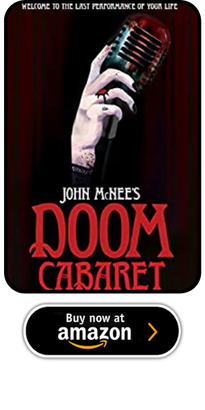 This is the stage. These are the players. A young woman’s sexual appetites prove too powerful to be undone by death. Hedonistic clubbers covet a drug that warps flesh rather than the mind. A wealthy cannibal encounters a meal too beautiful to be eaten. The Lullaby Man ushers another eager victim into his clockwork lair. Here is where such stories are told. Blood and beauty, defilement and deformity, musicians and monsters. Welcome to the Doom Cabaret. READ OUR 5 STAR REVIEW OF DOOM CABARET HERE   THE HEART AND SOUL OF HORROR PROMOTIONComments are closed.
|


Archives
April 2023
|
 RSS Feed

|

|