• HOME
  • CONTACT / FEATURE
  • FEATURES
  • FICTION REVIEWS
  • FILM REVIEWS
  • INTERVIEWS
  • YOUNG BLOOD
  • MY LIFE IN HORROR
  • FILM GUTTER
  • ARCHIVES
    • SPLASHES OF DARKNESS
    • THE MASTERS OF HORROR
    • THE DEVL'S MUSIC
    • HORROR BOOK REVIEWS
    • Challenge Kayleigh
    • ALICE IN SUMMERLAND
    • 13 FOR HALLOWEEN
    • FILMS THAT MATTER
    • BOOKS THAT MATTER
    • THE SCARLET GOSPELS
GINGER NUTS OF HORROR
  • HOME
  • CONTACT / FEATURE
  • FEATURES
  • FICTION REVIEWS
  • FILM REVIEWS
  • INTERVIEWS
  • YOUNG BLOOD
  • MY LIFE IN HORROR
  • FILM GUTTER
  • ARCHIVES
    • SPLASHES OF DARKNESS
    • THE MASTERS OF HORROR
    • THE DEVL'S MUSIC
    • HORROR BOOK REVIEWS
    • Challenge Kayleigh
    • ALICE IN SUMMERLAND
    • 13 FOR HALLOWEEN
    • FILMS THAT MATTER
    • BOOKS THAT MATTER
    • THE SCARLET GOSPELS
GINGER NUTS OF HORROR
horror review website ginger nuts of horror website

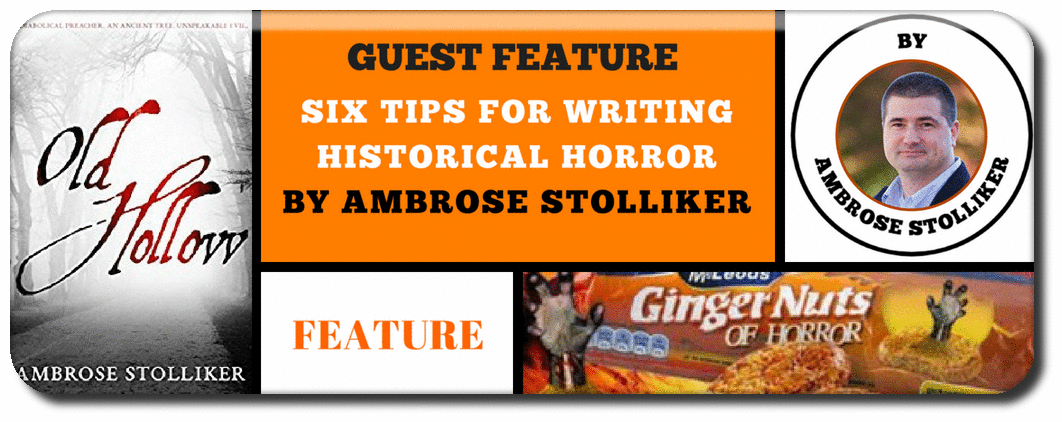
SIX TIPS FOR WRITING HISTORICAL HORROR BY AMBROSE STOLLIKER

31/5/2018

BY AMBROSE STOLLIKER
Picture

 
History has fascinated me since I was ten or twelve years old. Growing up, I couldn’t read enough books about the Titanic sinking, the Civil War, medieval Europe or World War II.
 
At the same time, I have always been a fan of horror fiction. So, writing stories that combine the two has always come naturally to me.
 
Many writers will tell you that the majority of their stories start with the characters, and, to a certain extent, that’s true for me as well. Still, as a student of history, I’ve always felt comfortable setting my characters in times and places in the distant past.
 
And while there’s probably no one good way to write “historical horror” fiction (if there even is such a genre), I’ve found sticking to a few principles over the years has served me well.
 
  1. Let your passion guide you in your travels to distant times. What I mean is this: If your book shelf is full of books about the Regency period in England or the Mongol era in China, maybe consider setting a story there. More than likely, you’ll already have a good feel for an era if you’ve read about it a lot. Years ago, I read an enthralling book by New York Times political columnist Timothy Egan about the Dust Bowl called The Worst Hard Time. Egan’s descriptions of the ecological disaster that was the Dust Bowl were haunting. I remember closing the book and thinking, “I HAVE to write a horror story set during this time.” The result, not long after, was The Dust Storm, which later appeared in Sanitarium Magazine.
 
  1. Do your research. If you’re going to set a story in a specific time and place, it’s critical that you know that time and place intimately. For one thing, it’ll keep you from introducing historical inaccuracies into your story. More importantly though, the more detail you can weave into a story to bring the setting alive for the reader, the better. A few years back, I wrote a WWII horror story entitled Six Miles to Bastogne, that was included in Muffled Scream I: Corner of the Eye. It’s the story of a group of American GI’s who slowly turn on each other after getting lost in the Ardennes Forest during the Battle of the Bulge. As I wrote the first draft, I ended up doing a fair amount of research on the fly. I soon discovered that the Germans had massacred a group of American POWs in nearby Malmedy, Belgium a month before the story takes place. This real-life massacre is one of the primary motivations for the bloodthirsty behavior in which the GIs engage in the story.
 
  1. But don’t do too much research. There’s a fine line between including enough detail to bring the story to life and overwhelming and weighing it down with extraneous tidbits that don’t move the story forward. Remember, you’re writing a work of fiction, not a dissertation. Also, don’t get so caught up in your research that you never start your story. Many a fine writer has used endless research as an excuse to never actually begin writing. Don’t be one of those writers!
 
  1. Language and voice are critical. One of my favorite characters in Old Hollow is Sergeant Jordy Lightfoot. I loved writing his dialogue and bringing his particular patois – peasant stock from Kentucky, as one character describes it – to life. It’s important that characters sound like they come from where and when they come from. In Six Miles to Bastogne, I actually had characters speaking in German. I used Bing Translator to get a rough English-to-German translation for the dialogue, and then had a language expert (my older sister, who speaks five languages) check it to make sure it was accurate.
 
  1. Names need to ring true. For Old Hollow, I wanted character names that sounded authentic – like they came from that era. So, I actually conducted an Internet search using the search terms “common names 1860s United States”. Guess what came up? A census taken in 1860 in St. Louis with a LONG list of names, including one that stuck out to me – Emil. As in Emil Boyd, the unfortunate young corporal who is grievously wounded when the story begins. Of course, not all the character names in Old Hollow were the result of research. I came up with Nan and Tessa myself. To my mind though, they sound like names from the period, and that’s the key.
 
  1. Don’t forget to make your story scary. After all, it’s horror, right? While many horror movies today overly rely on “jump scares”, that’s pretty hard, if not impossible, to pull off in a book. I always try to infuse my horror stories with a gradual sense of dread that becomes palpable when the story hits its climax. The best way to do that? Develop sympathetic (or at least interesting) characters and do terrible things to them so the suspense builds to the point that the reader has to keep turning the page until the protagonist meets his fate. And, again, it’s horror, so the fate is usually a terrible one.
 
Pick your era. Do your research. Get writing. Scare someone. Easy, right?
Ambrose Stolliker lives in the Pacific Northwest with his wife and son. His stories have been published in Ghostlight Magazine, Sex and Murder Magazine, Hungur Magazine, Sanitarium Magazine, Stupefying Stories, Tincture Journal and the State of Horror: Louisiana Volume IIanthology from Charon Coin Press. He is a former newspaper reporter and magazine journalist and currently works as a storyteller and digital marketing manager in the technology sector.

For more information, visit www.ambrosestolliker.com.

​Social Media
:
Twitter • Goodreads
Picture
"Come forth, o dark ones, and avail thee of our blood."
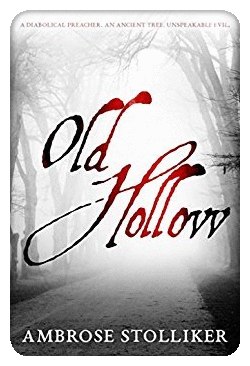
Spring, 1865. The Southern armies are close to defeat. Union Cavalry Commander Philip Sheridan has loosed his scouts into the Virginia countryside in search of an opportunity to intercept and destroy General Robert E. Lee's Rebel army and bring the war to an end.
One such scout is Captain Benjamin Lawson, a man haunted by the scenes of senseless slaughter he has endured from Antietam to Gettysburg. On a dark, rainy night, Lawson's party of scouts stumbles upon a large group of rebel cavalry. All hell breaks loose. Only Lawson, Sergeant Jordy Lightfoot and Corporal Emil Boyd manage to escape into a thick forest.
There, Lawson discovers the young corporal has been gravely wounded. Determined not to lose another man under his command, Lawson heads for a small town called Old Hollow in the hopes of finding a doctor who can help the dying boy. What he finds there is far more terrifying than anything he's witnessed on the battlefield. Soon, he and his men are in a fight for their lives against a twisted preacher who has struck a diabolical covenant with an ancient, unspeakable evil.

Picture
Picture


Become a Patron!

Comments are closed.
    Picture
    https://smarturl.it/PROFCHAR
    Picture

    Archives

    April 2023
    March 2023
    February 2023
    January 2023
    December 2022
    November 2022
    October 2022
    September 2022
    August 2022
    July 2022
    June 2022
    May 2022
    April 2022
    March 2022
    February 2022
    January 2022
    December 2021
    November 2021
    October 2021
    September 2021
    August 2021
    July 2021
    June 2021
    May 2021
    April 2021
    March 2021
    February 2021
    January 2021
    December 2020
    November 2020
    October 2020
    September 2020
    August 2020
    July 2020
    June 2020
    May 2020
    April 2020
    March 2020
    February 2020
    January 2020
    December 2019
    November 2019
    October 2019
    September 2019
    August 2019
    July 2019
    June 2019
    May 2019
    April 2019
    March 2019
    February 2019
    January 2019
    December 2018
    November 2018
    October 2018
    September 2018
    August 2018
    July 2018
    June 2018
    May 2018
    April 2018
    March 2018
    February 2018
    January 2018
    December 2017
    November 2017
    October 2017
    September 2017
    August 2017
    June 2017
    May 2017
    April 2017
    March 2017
    February 2017
    January 2017
    December 2016
    November 2016
    October 2016
    September 2016
    August 2016
    July 2016
    June 2016
    May 2016
    April 2016
    March 2016
    February 2016
    January 2016
    December 2015
    November 2015
    October 2015
    September 2015
    August 2015
    July 2015
    June 2015
    May 2015
    April 2015
    March 2015
    February 2015
    January 2015
    December 2014
    November 2014
    October 2014
    September 2014
    August 2014
    July 2014
    June 2014
    May 2014
    April 2014
    March 2014
    February 2014
    January 2014
    December 2013
    October 2013
    September 2013
    August 2013

    Picture

    RSS Feed

https://l.facebook.com/l.php?u=https%3A%2F%2Fmybook.to%2Fdarkandlonelywater%3Ffbclid%3DIwAR1f9y1sr9kcIJyMhYqcFxqB6Cli4rZgfK51zja2Jaj6t62LFlKq-KzWKM8&h=AT0xU_MRoj0eOPAHuX5qasqYqb7vOj4TCfqarfJ7LCaFMS2AhU5E4FVfbtBAIg_dd5L96daFa00eim8KbVHfZe9KXoh-Y7wUeoWNYAEyzzSQ7gY32KxxcOkQdfU2xtPirmNbE33ocPAvPSJJcKcTrQ7j-hg
Picture