

Something Nasty by Malcolm Devlin
12/4/2022
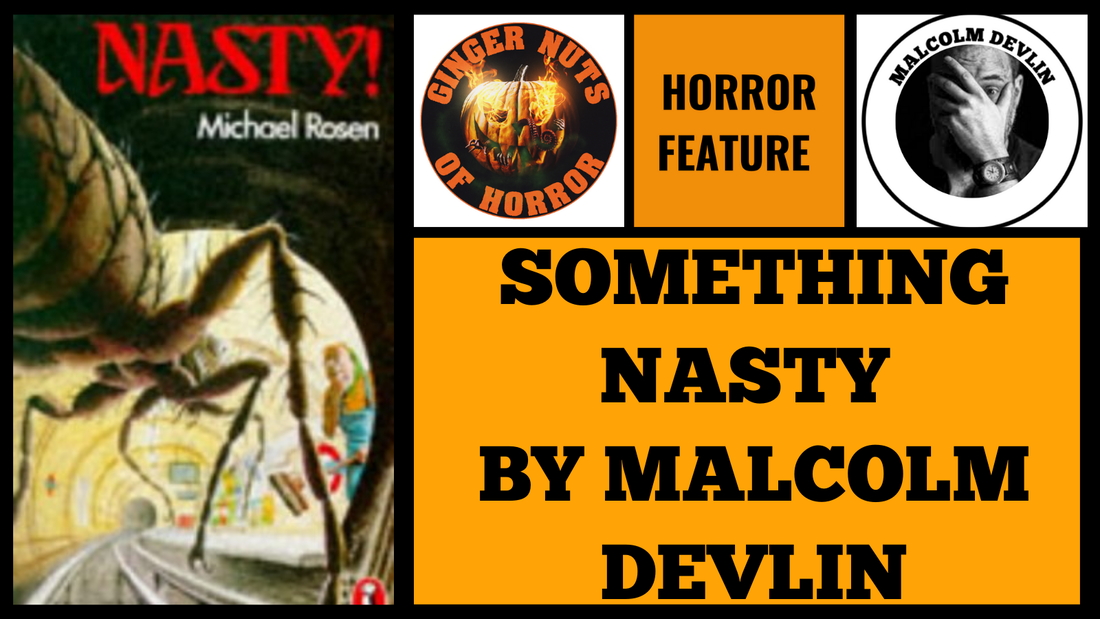 the stories in Nasty felt more Ken Loach than Stephen Spielberg. They were modest in scale, the stakes personal, not earthshaking or world-ending. These were horrors made on a BBC budget and all the more effective for what couldn’t afford to be shown I wasn't one for horror, when I was a child. Or that's what I used to tell myself. I think I always assumed it was something I'd be afraid of and assuming I wouldn't ever want to be that kind of afraid, I made sure it was something I skirted around. I have a distinct memory of standing in the library, reading and rereading the back cover copy of James Herbert's Fluke, trying to decide if it was horror or not. I knew that the book was about someone reincarnated as a dog, which didn't sound like horror, but I also knew that Herbert wrote horror novels and this book cover was the same black moody design all all his other books. The blurb on the inner flap used the word 'horror' but only once, and with such judicious care, that it didn't feel like it was a horror book. My parents didn't really read horror either. Of all the books in the lounge, the ones my sister and I would dare each other to peek at was Golding’s Lord of The Flies (with a rotting pig head on the cover), and Wyndham's Chocky -- the cover of which featured a weird negative image of a boy with concentric circles radiating from his head. It was his teeth I found most disturbing. There’s something about teeth in negative that makes them look like broken glass. But, I lived in the middle of the wood, so I have a suspicion that some sort of horror influence would have crept in somewhere through the cracks. Its hard not to think in ghost stories when the countryside is blotted out by acres of pitch black woodland; when eyes in the darkness met mine when it was my turn to fill the coal scuttle from the shed; when muntjac deer barked outside my window at night with a sound uncannily like someone expelling a long-held breath on the glass. The first horror book I bought for myself might not count for anyone but me. Nasty is a short collection by Michael Rosen, better known as the poet, Children's Laureate, Long Covid-surviving thorn in the Tory government’s side and author of We're All Going on A Bear Hunt. My copy is boxed up in my mother’s house in the UK with a whole lot of other books I need to sort out at some point. This means — pleasingly — there really is something nasty in her attic, but also it means this piece is entirely based on my memory of the book, which might not be quite the same as the one you can buy. My copy of Nasty is a slim little paperback with a red spine. On the cover, a flea the size of a double-decker bus emerges from a tube tunnel to terrify a group of cleaning staff working on the platform. Up close, the image is more cartoonish than frightening. The flea is all arse and legs, its teeth like torn paper. I must have been around eight or nine or so when I bought the book and perhaps something about the image felt manageable. Here was a horror book, but from the cover, the sharper edges had been sanded down. It looked safer than it pretended it was. It was one of a whole stack of books I blew a birthday book token on in Blackwell’s Children’s Bookshop. I don’t remember any of the others I got that day. I don’t even know if I still have them, but the flea stays with me — not the story so much as the image -- it took its place on my memory’s bookshelves with the rotting pig's head and the boy with negative teeth. More importantly, the recollection of it serves as a bookmark to the other stories in the collection which didn’t grace the cover. The Bakerloo Flea is the first story, and even these days, whenever I find myself in London, the title comes back when I look at a tube map. It was largely self-explanatory. A flea had grown fat in the labyrinth of tunnels underneath London, then got bigger still. Rosen recounts the story as an urban myth, related to him by a figure he comes to refer to as The Bakerloo Flea Woman. There’s a gossipy quality to the story of a monstrous (man-eating?) flea rampaging around the London Underground. The story is fun, but lived-in. It feels faintly gritty with dirt under its fingernails. It’s very British in that grey and slightly threadbare manner, and there’s something bittersweet about the final image of the monster being swallowed by a bin lorry. The Bakerloo Flea Woman appears in the other stories as well. From the illustrations, she’s one of the cleaners on the cover. A middle-aged figure in a housecoat and headscarf. In each story, she runs into Rosen’s narrator with a new job, a new story to tell, and by the end of the book — inevitably — she ends up being something of a spectre herself. What I remember most about the other stories in the book are their gentle bleakness, like an overcast British afternoon. I’d go on to read other horror stories by the usual big-name horror writers; countless classic ghost stories and weird tales, but they always felt a bit glossier by comparison. I suppose one analogue might be US readers' fondness for Alvin Schwartz’s Scary Stories to Tell in the Dark, but the stories in Nasty felt more Ken Loach than Stephen Spielberg. They were modest in scale, the stakes personal, not earthshaking or world-ending. These were horrors made on a BBC budget and all the more effective for what couldn’t afford to be shown. Even the titles of stories like ‘Lollipop Lady’ or ‘A Plague of Wasps in Winter’ promise a certain kind of texture. That second one isn’t The Swarm, it isn’t The Killer Bees, it’s just wasps — that bane of the British summer — lots of wasps, when there shouldn’t be any at all. ‘The Loaf and the Knife’ is the one that has stuck with me and that was by design. It’s a simple story about pest control. The Bakerloo Flea Woman hires the mysterious Mrs Kent to deal with her mouse problem once and for all. Kent will do something which will make the rest of the city’s mice avoid the house at all costs. She promises to do so for free on the condition she isn’t observed. “The image will live in your mind’s eye,” The Bakerloo Flea Woman is warned. But of course she does look, and she tells Rosen, who goes on to tell us. And yes, the image really is nasty, strong enough I can still remember it today. Perhaps it won’t shock seasoned horror readers, but as an eight-or-nine-year-old, it felt like something I shouldn’t have been allowed to read and Rosen ends by suggesting the story is viral. He’s cured himself of the image by passing it to the reader, so now we’re stuck with it. I was an impressionable kid. I lived in the middle of a wood. I didn’t need to be cursed by affable poets as well, thank you very much. What’s interesting, with hindsight, is the way the story hypes itself. Essentially, it’s the story of a single set-piece. The rest of the story — the lead up and aftermath — oversells it to the point it magnifies it. It’s a performer’s trick — I recently saw the same technique used in a Hannah Gadsby comedy special: “I will end the set with a joke about this,” she said, “and it will blow your mind.” I still find that completely fascinating. "This image will stick with you," Rosen promised and like a magic spell, it was true. But, even then, it didn't keep me awake at night. I don't even know if I considered the book a real horror one back then, still assuming in some compartmentalised way, that horror wasn't something I particularly enjoyed; still assuming that anything I found in Blackwell’s Children’s Bookshop was horror with training wheels at best. Years later, when I’d reached an age where I thought I liked fantasy novels more, I checked a copy of Clive Barker's ‘Weaveworld’ out of the library. It was a portal fantasy, but one set in Liverpool, which was where my mum was from and near where my grandmother lived. Part-way through, of course, I realised it was more of a horror book than the James Herbert novel ever had been, even though the copy promised magical things and didn’t use the word ‘horror’ once. I do wonder how things will be for our son as he grows up in a house of horror readers and writers. We have plenty of books for him to find when he gets older, some with our names on them; ghouls and ghosts and horrible things leering off the page. We have pictures on the wall I wonder if we should put in storage for a while. A girl followed home by a shark from Evie Wyld's Everything Is Teeth; a dead cat in a red velvet box from the cover of Helen's second collection; at least three or four green men sculptures gurning from the walls in the garden. If I grew up in a house like this, I wonder, would I have ever developed a fascination for something as rare and special as being frightened? Or would it be normal, common-place, already tame. I wonder what will frighten him and instinctively I want to protect him from it. But will that rob him of something more important? What will intrigue him? I wonder what images — glorious, fantastical, horrible, strange — will live on in his mind's eye? And Then I Woke Up Malcolm Devlin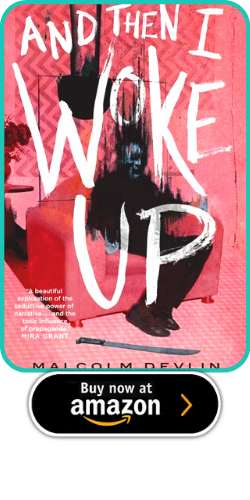 In the tradition of Mira Grant and Stephen Graham Jones, Malcolm Devlin’s And Then I Woke Up is a creepy, layered, literary story about false narratives and their ability to divide us. "A scathing portrait of the world we live in and a running commentary on what’s story, what’s truth, and what’s not."—Stephen Graham Jones In a world reeling from an unusual plague, monsters lurk in the streets while terrified survivors arm themselves and roam the countryside in packs. Or perhaps something very different is happening. When a disease affects how reality is perceived, it’s hard to be certain of anything… Spence is one of the “cured” living at the Ironside rehabilitation facility. Haunted by guilt, he refuses to face the changed world until a new inmate challenges him to help her find her old crew. But if he can’t tell the truth from the lies, how will he know if he has earned the redemption he dreams of? How will he know he hasn’t just made things worse? At the Publisher's request, this title is being sold without Digital Rights Management Software (DRM) applied. Malcolm Devlin Malcolm Devlin’s stories have appeared in Black Static, Interzone, The Shadow Booth and Shadows and Tall Trees. His first collection, You Will Grow Into Them, was published by Unsung Stories in 2017 and shortlisted for the British Fantasy and Saboteur Awards. He currently lives in Brisbane. CHECK OUT TODAY'S OTHER ARTICLES ON GINGER NUTS OF HORROR
THE HEART AND SOUL OF HORROR PROMOTION WEBSITES Comments are closed.
|


Archives
April 2023
|


 RSS Feed

|

|