

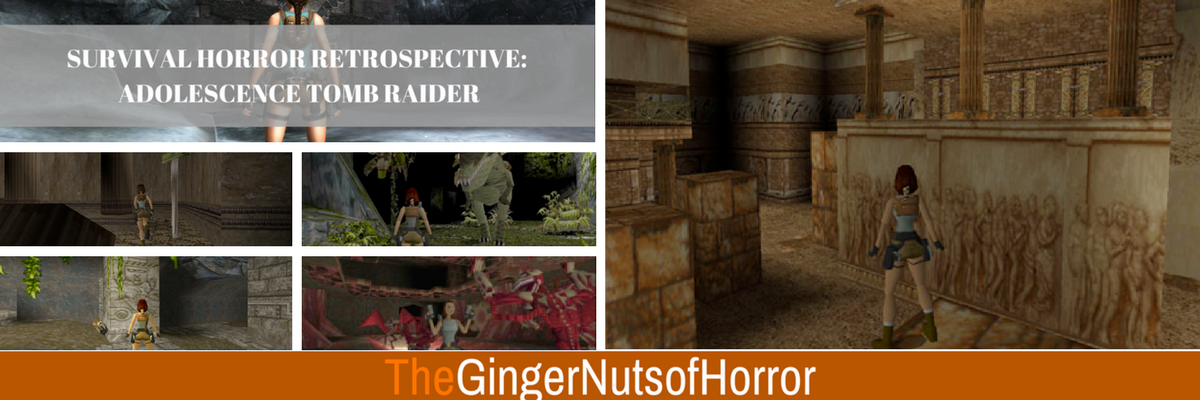
 A single chord of music, and suddenly, I'm fourteen again, stood at the highest point in an immense and unlikely temple, seeking out the vest vantage from which to swan-dive and have my polyganal avatar break her neck several floors down. There's very little that evokes the tumultuous period of adolescence quite as forcibly as video game soundtracks for me, and this one...well, it was one of the first PS1 games I ever owned and finished, the others being Final Fantasy VII and the Resident Evil (both of which will come up in this series). To have gone from two dimensional, side-scrolling Megadrive and SNES titles to this was a quantum leap: we'd never seen or played anything like it before. As for the soundtrack, Tomb Raider was amongst the very first video games to boast a fully orchestral score: sound often used to evoke atmosphere when the environments and the monsters that inhabited them might have otherwise looked ridiculous. And, hard as it may be for present day gamers to believe, this game had moments of genuine, genuine horror: arguably moreso than any we'd been exposed to in Western markets up to that point. Whilst games such as Super Metroid, Contra et al, not to mention certain UK works such as those produced by Horrorsoft, had attempted to present moments of horror within the technical and graphical limitations of the era, none of them quite succeeded to the same degree as those that exploded onto the market in the early days of the PS1. Much of that was due to the shifting culture of gaming itself: whereas video games had, up until that point, been the remit of children and adolescents exclusively, the markets tailored to cater to those demographics, the advent of more powerful and sophisticated systems pushed not only the content of video games, but also the cultures in which they operated into new and previously unexplored territories: 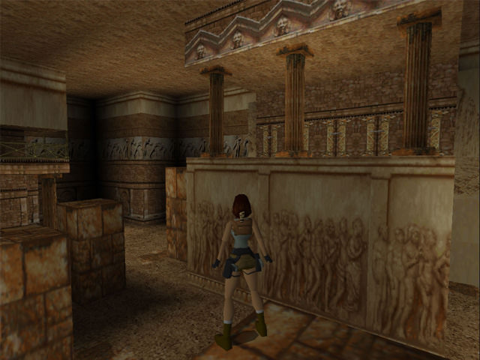 To have grown up through the eras of the Sinclair Spectrum, Commodore Amiga, SNES and Megadrive provided a unique perspective on the shift to “32-bit:” it allowed us to chart the evolution of video games in a way that, arguably, no other generation has been privy to: the format has grown up as we have; it has experienced its infancy and its childhood alongside us. As a result, most of us were adolescents when the likes of the PS1, Sega Saturn and N64 made their debuts: an era which can be legitimately regarded as the adolescence of video gaming itself: Whereas before, graphical limitations and cultural restrictions meant that any moments of horror within video games were often diluted, cushioned or massively censored (Super Metroid is an exception to the rule, especially on Nintendo systems), the efflorescence into 3 dimensions allowed developers to evoke a sense of place, scale, mood and atmosphere in ways they'd never before dreamed, not to mention present aesthetics and design, story and mythology, in a manner far closer to the medium of cinema, which is arguably one of video game's closest relatives (and certainly most significant influences). Tomb Raider was the gateway for many; the point at which video game systems no longer relied on cute, animal or cartoon mascotts to snare their audience: when the material presented to us became notably more “adult” (both in terms of the game's protagonist, Lara Croft, and the world in which she operated). Whilst the game made waves at the time owing to the peculiarly provocative design of its lead, it also stood as something of a technical marvel: a shift from classic, two dimensional “cinematic platformers” such as Prince of Persia (the game originally designed to be a 3D rendering of that very franchise), Another World and Flashback (all revolutionary titles in their day, not only owing to their graphics and design, but also the noticably more adult tone they evoked) into immense three dimensional arenas whose scale and scope often stole our breaths, whose ambition and architecture was genuinely unlike anything we'd ever seen before. Being a launch title for the then-fledgling PS1, the game still operated under certain graphical limitations, and therefore made cunning use of vast, empty spaces and shadows to evoke atmosphere, often utilising environment itself to awe the player in absence of anything else, alongside chords of revelatory music or isolated effects to suggest threat, intrigue or mystery. The minimalist nature of the score is utilised to fantastic degree to make what would otherwise be less impressive arenas threatening and atmospheric: Emerging from a series of underwater tunnels unto a vast, partially collapsed cavern, the player might pause at a sudden, hollow rustling, a sound like bones rattling or an isolated violin string. Wandering down an ostensibly inoccuous corridor, the player might draw to a halt as faint music begins to play, suggesting the traps and treasures that lie ahead. Whilst some more sophisticated examples of earlier titles and generations certainly made use of sound in their game design -as more than mere background noise-, technical limitations meant that there'd never been a time when environmental cues and soundtrack were so much a part of immersion; of how players engage with their gaming environments. And it was in the game's numerous moments of outright horror that it became most overt: Earlier “tombs” ease the player into the basic mechanics and ethos, with very little in the way of “instant death” traps or elaborate puzzles, the enemies primarily consisting of bats, wolves etc, which are all fairly frightening in and of themselves, owing to their framing and the music that often accompanies them. It arguably isn't until The Lost Valley that the game ramps up in terms of tension: emerging from a tunnel into an immense, subterranean realm that looks to have been preserved from the world above since prehistoric times, the player encounters some surprising lesser enemies in the form of velociraptors; the first creatures that suggest there might be fantasy and science fiction elements at work within the game, as opposed to the more conventional animals that have been encountered up until that point. There incongruity makes them more distressing than they have any right to be: the sprites themselves boxy, angular and unconvincing, phenomenally crude by the standards of tiday's fluid and realistic renderings, but unutterably terrifying to those of us who'd grown up with the likes of Super Mario World's koopa-troopers and Sonic the Hedgehog's cutesy “badnik” robots. Following those encounters, Lara descends into the valley proper, a deep, rhythmic rumbling in the distance, something approaching from the subterranean shadows that are a convenient camouflage for the game's limited draw-distance: The biggest sprite the game has thus far presented: an immense Tyrannosaurus Rex, the creature roaring, the orchestral score kicking in as it stampedes towards Lara across the valley. A genuinely heart-pounding moment, and one that few of my generation will forget: we'd rarely seen anything so vast in a video game before, certainly not in three dimensions, and certainly not as beautifully pitched and framed as the monster is: 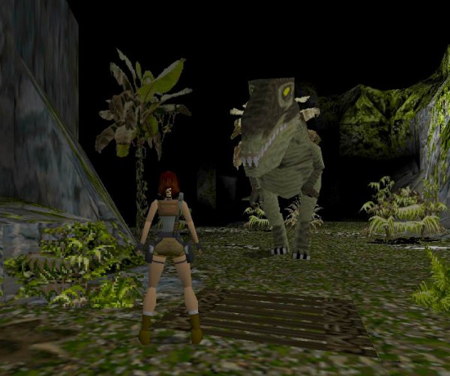 In an of itself, it may not have been terribly threatening: simply another gigantic “boss” style monster to deal with, but because the moments preceding it are so quiescent, because the valley itself is so lush and vast and beautiful, the player is lulled into a false sense of serenity, as well as a degree of awe at the environment itself. Until they hear the beast approaching, until it begins to emerge from the darkness. Then, everything becomes blind panic, not helped by the score, which escalates and escalates to terrifying, orchestral horror as the beast pursues the player through the valley, pausing to roar or to stamp its immense feet, causing the entire level to shudder. Whilst to present day eyes, the beast and its environment may seem incredibly crude (the dinosaur itself looks to be constructed from successive boxes woven together), at the time, we as players had never seen anything like it, nor had we experienced the sophisticated framing that makes it so much more than a ropey computer effect. One must also bear in mind that, in these earliest days of 3D gaming, developers were largely flying blind: certain templates and industry standards hadn't yet been established, meaning that experiment and invention were the orders of the day, any success therefore doubly noteworthy. Later, the game presents more subtle, sophisticated scares: in what is arguably my favourite level of the game, the aforementioned St. Francis's Folly, a number of rooms lead to puzzles and traps based on various myths of the ancient world: entering a particular chamber, a hollow sound rushes through, the camera slowly panning up to reveal the numerous swords suspended from the ceiling. Based on the legend of Damocles, any sound here will cause the swords to fall, requiring the player to tread with stealth and lightness to avoid being impaled. The tension as the player attempts to softly, gently navigate the chamber, without accidentally spuring Lara into a run, without treading on items or debris that might trigger the blades, is palpable, heart-pounding, the eventual release that comes with either success or failure part of the genuine pleasure of the game.  Later rooms contain traps based on Neptune, Thor and Atlas, all of them framed in such a manner as to suggest what might happen without having characters outright state it or the need for laborious, on-screen instruction. The experimental nature of the rooms and their solutions means that the player is in an almost constant state of tension, not quite knowing how to approach the situation without triggering this trap or releasing some caged enemy. The “trial by error” style that this enforces has long since fell out of fashion, but also elicits an incredible tension, as each step becomes a tightrope walk of nervous focus and concentration. Later, the game even plays with aesthetic and body horror; when the arena of play becomes far more alien with a descent into none other than Atlantis itself, the tone and aesthetic shifts from one of -albeit impressive- man made architecture to alien temples and palaces, many of which are partially formed from organic matter: walls and ceilings of flesh, pillars of twisted bone and muscle...the enemies likewise becoming bizarre, bio-mechanical creations, the entirety of the city some hideous, bio-mechanoid factory purportedly utilised by the game's antagonist, Natla, to cultivate an army of monstrosities.  At this point, the game takes a quantum leap in tone and subject, the more classic, mythological elements giving way to bizarre science fiction; a factor that, in context with the previous areas of the game, comes as a significant surprise to the player, and certainly did to us, given that we'd rarely seen this kind of horror imagery in video games before, and certainly not in titles that Tomb Raider is redolent of. In this manner, Tomb Raider prepared us for what would come shortly after: the efflorescence of a genre that would mark the shift of video gaming from a children's pastime to a truly adult medium of storytelling and subject matter: Survival Horror.   FICTION REVIEW: JIMBO YOJIMBO BY DAVID W. BARBEE
|


Archives
April 2023

|
 RSS Feed

|

|