

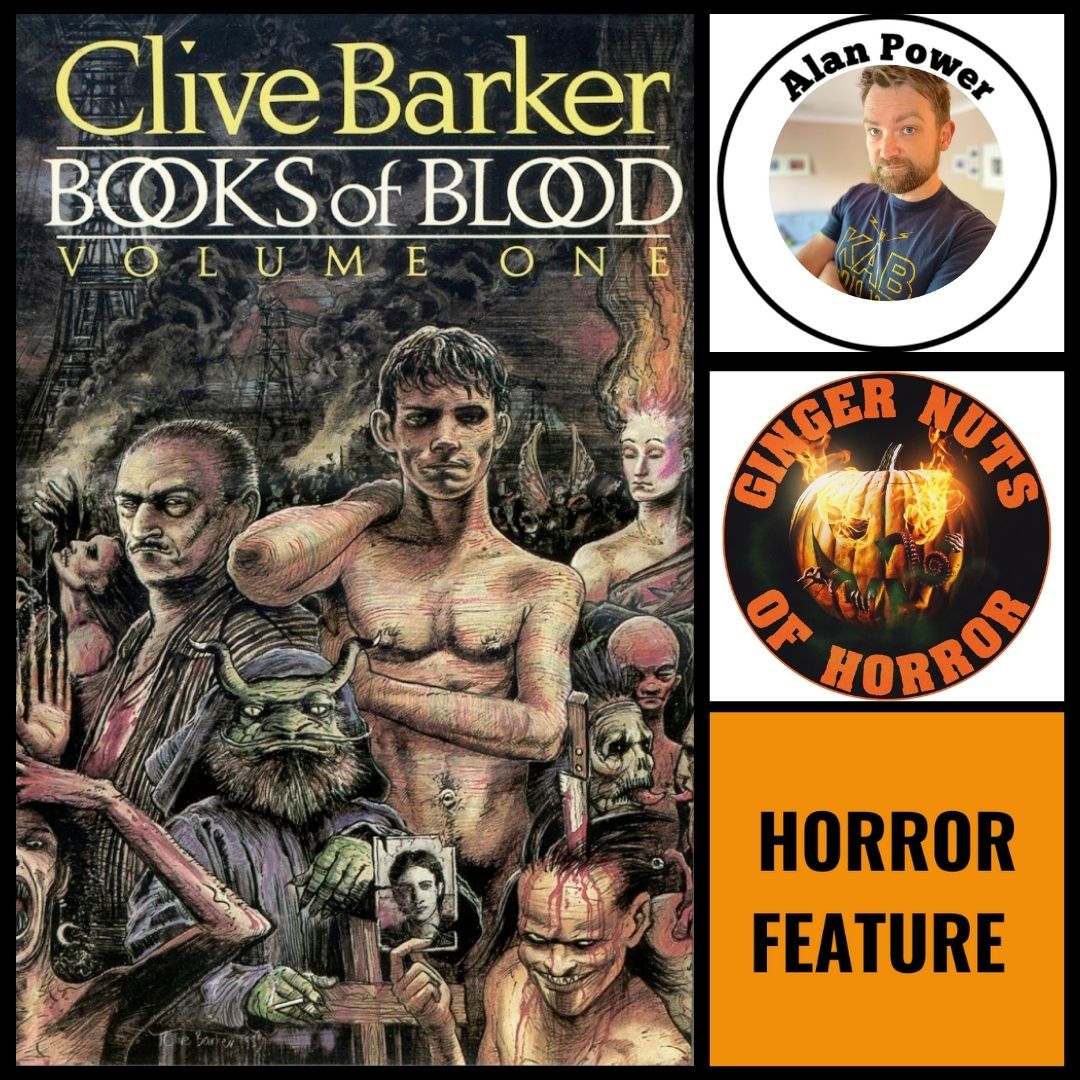
The Body of the State: Clive Barker, Politics and the Noble Tapeworm‘The dead have highways.’ Even now, thirty or so years on from the first time I read those words, they send a chill down my spine. The omnibus editions of Books of Blood were my initiation into the shocking, sinister yet often beautiful worlds of Clive Barker and as an opener, that line takes some beating. Now an elder statesman of the genre, Barker was at the time horror’s Young Turk and spearhead of the nascent ‘splatterpunk’ movement in horror fiction, which was seen as a rejection of the ‘traditional, meekly suggestive horror story’. At a time when the Video Nasties List seemed to me like the irresistible menu of a restaurant whose doors were forever locked, the Books of Blood were a revelation. To stretch the analogy far beyond breaking, Barker had set up another eatery next door, one whose décor and clientele were decidedly more upmarket, therefore deflecting the squint eye of pearl-clutching eighties censors. Barker’s cuisine – served rare - was available to all; the only requirements were an open mind and the imagination to keep up with some bizarre and transgressive concepts. It is impossible to speak in any meaningful way about the entirety of Books of Blood without expanding an article like this to towering, teetering proportions, so my focus will narrow to a single story from the first volume of that collection. In the Hills, The Cities features an unforgettable central image. Twin behemoths, each consisting of the lashed-together population of rival cities, meet in ceremonial combat in the isolated hills of a forgotten corner of Eastern Europe. When laid out in simple terms, it sounds faintly ridiculous, right? You see, Barker’s work often asks something of the reader, and this story in particular demands more than usual. Suspension of disbelief can be a tough hurdle for some readers to clear and with an obstacle this soaring, many might struggle to connect with the narrative, and so abandon it. But to do this would be to miss an incredible story, and the point. The story’s main characters, Mick and Judd, recognise the sheer absurdity of their situation. It is their struggle with disbelief that ultimately sends them into a mad spiral towards their divergent fates. The horror genre can be perversely conservative. Especially at the time these stories were written, horror more often than not hued to traditional roles and societal norms. Think of the teenagers in so many slasher movies, horny and heterosexual, happy to indulge in some carefully framed missionary-position antics or smoke a little puff – just enough bad behaviour to justify their imminent brutal slaughter. From the off, Barker signals that he has no interest in this squeamishness. We meet Mick and Judd on a road trip through Yugoslavia, and quickly find that they are lovers. Their gay relationship is not flagged as unusual or shocking; their dialogue, like their entire dynamic, is believable in that it is almost completely mundane. Like many couples who only really come to know each while on holiday, they find that cracks between them are widening. In the confined space of their Volkswagen, differences that were perhaps overlooked in the first flush of infatuation become glaringly obvious. An impromptu sexual liaison by the side of the road – naturalistically and explicitly portrayed by Barker - temporarily papers over those cracks, but each has a feeling that their time together is coming to an end. Judd is a journalist with fervent political opinions while Mick is a dance teacher with a love for the arts. All that holds them together now is their mutual physical attraction and a desire to get through this final excursion unscathed. In the Hills, The Cities is about communism. No, it’s not subtle. It is front and centre in that indelible image – the individuals of an Eastern Bloc city banding together for the greater good at the risk of their own lives. They are living and dying for the city, and are proud to do it. I’m ashamed to say I completely missed this when I first read it at age fifteen. Judd’s hyper-political remarks; the toiling of the locals as they are compelled to work harder and harder; the small lapses that lead to the downfall of the almighty whole – they all went over my head. What struck me – beyond the extraordinary concept of the rival giants – was the delicate way in which Mick and Judd’s relationship is handled. Unlike most horror fiction I had read up to that point, both were protagonist and antagonist. I could sympathise with both of them while also feeling like the other was a bit annoying, and all over the span of no more than twenty-seven pages. The rival cities of Popolac and Podujevo also eschew characteristics like good and evil. Both are simply carrying out a tradition that stretches far into the past, a friendly contest between neighbours, albeit one that has grown in stature and risk over the decades. We are never told why these cities clash every ten years. In fact, the why is unimportant. The only justification that is given is that it has always been done. This struggle between the traditional (giant combat) and the modern (communism and its tendency to chew up the proletariat) is mirrored in Mick and Judd’s relationship. One wants only to view the hoary, antiquated art of local monasteries while the other wants only to debate the heavyweight political issues of the day. Each has nothing but disdain for the other’s interests, a situation that is tearing them apart. To our modern sensibilities, the concept of the mysterious secret hidden in the obscurity of darkest Eastern Europe is perhaps a tough one to swallow. In some ways, it harkens back to much earlier horror fiction like that of Lovecraft, where the danger is foreign and unknowable. But Barker is the anti-Lovecraft; where one consistently fails to describe the horrors that assail his characters, the other does not flinch from the smallest detail, however outlandish or nauseating. This story bears all of Barker’s hallmarks, from sadomasochism and bondage to violence and gore, but also liberal springs of poetry. Consider Judd’s reply when Mick suggests a detour to view some more religious art: ‘”I told you, I don’t want to see another church; the smell of the places makes me sick. Stale incense, old sweat and lies…”’ The conclusion of the tale, with the countryside awash in blood and a mad behemoth rampaging through the hills, brings Barker’s surrealism and body horror to a fitting end. Judd, unable to comprehend the insanity that is striding towards him (or, to suspend his disbelief) is struck down. Mick, equally affected by this unimaginable spectacle, is caught up in it. The giants’ downfall is a mirror of that of the lovers, and like the giants, each goes to his end in his own particular way. I’ve read this story many times over the years. It’s probably the entry in Books of Blood that I’ve read most (although the near-journalism of Down, Satan! is a close second). The care and intricacy that Barker corralled into those twenty-seven pages was revealed gradually over those readings, like a mystery slowly giving up its secrets. I love the believable humanity of the characters, and the otherworldly and bizarre situation they find themselves in. As always, Barker paints his worlds with thoughtful and surprising strokes, and requires the reader to invest enough of themselves that they feel brought along for the ride, not left to passively observe like some gawping onlooker. Perhaps that’s why so many of his stories feel personal to us. But I’m not here to talk about why I love this strange amalgam of fantasy, horror and politics now; let’s get to the origin story. As a teenager, none of my friends were interested in reading. Cheap booze on the chilly slopes of the local golf course? Yes. Awkward and infrequent dalliances with the opposite sex? Definitely. As part of that group, I was just as enthusiastic and clumsy in my pursuit of these activities as the others. But as far as my contemporaries were concerned, reading belonged in school. Gav’s thing was that he liked to steal cars; Damo’s thing was the heroic intake of pills; Dave drank until he turned into a high street living statue. While I may have dabbled in their personal interests – some more than others – they never dipped so much as a toe into mine. That I was into nerdy stuff like books and all that, was just accepted and never discussed. It was my thing. Then I read Books of Blood, and suddenly I wanted it to become our thing. In my meandering, inadequate way, I described to them the stories I had read. They laughed and agreed that they did indeed sound cool, and then we went off to do something else, probably involving an off-licence and a blue plastic bag. The creation of my Barker reading circle was a bust, but the effort revealed to me something else. Here I had found stories that I felt connected to for reasons I could explain – Incredible ideas! Addictive prose! Fountains of gore! – and also for reasons I could not. In fact, these were more than stories; they were a transaction that demanded investment on the reader’s part and rewarded them with unthinkable revelations. That fiction could be a mutual back and forth exchange between author and reader was yet another concept that had failed to occur to fifteen-year old me, but I have no doubt that I felt something like it on a subterranean level. Good fiction grants the reader a measure of ownership. The characters, the plots and the style itself are absorbed so deeply that they can’t help but become a part of you. Like nature’s hero, the noble tapeworm. And like that most excellent of beasts, good stories – once embedded – are tough to get rid of, even though there are some we would happily live without. Like the one about the massive pig. What the hell was that all about, Clive? I mean, ugh. Kill The Queen! (Tales From The Grindhouse Book 1)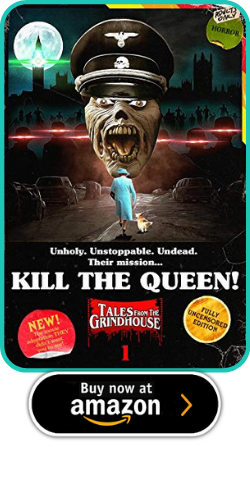 Unholy. Unstoppable. Undead. 1983 - From a forgotten World War II bunker beneath modern-day West Germany, an unspeakable evil arises to exact a madman's revenge. Leaving a trail of death and destruction in its wake, this infernal horde advances across Europe nearing London with every jackbooted step. The few who survive ask: can this bloodthirsty hellspawn be stopped? Or will they fulfil their satanic mission to... KILL THE QUEEN! WARNING - CONTAINS SCENES OF: Graphic sex Satanism Drug use Excessive gore Ghoul rampage NEW! The movie adaptation THEY didn't want you to see! For the first time ever, the FULLY UNCENSORED EDITION! KILL THE QUEEN! is #1 in the TALES FROM THE GRINDHOUSE series. Experience BRAND NEW adaptations of the most shocking movies NEVER made - NOT FOR THE NERVOUS! We open the vault and exhume the stories that were too violent, too horrific and too depraved for their time. Each entry in the series is a blood-soaked stand-alone narrative flung from a time when video stores supplied sick filth to minors, late night movies provided nightmares that would last a lifetime and a sleazy paperback was crammed under every pillow. Welcome to the Grindhouse. We hope you enjoy these tales, but beware - they are NOT FOR THE NERVOUS! Alan Power Alan Power was born in the past, screaming. He is the author of the Tales from the Grindhouse series, for which he also creates cover art and the occasional imaginary map. He now lives in Scotland with his wife, a host of children and a flyblown horde of mangy street cur dogs that are nevertheless affectionate and mostly tick-free. He screams slightly less these days. www.talesfromthegrindhouse.net TODAY ON THE GINGER NUTS OF HORROR WEBSITEWHERE ALL IS NIGHT, AND STARLESS BY JOHN LINWOOD GRANT (BOOK REVIEW) THE HEART AND SOUL OH HORROR FEATURESComments are closed.
|


Archives
April 2023
|
 RSS Feed

|

|