

 CHRIS KELSO CHRIS KELSO If you read my SF book The Black Dog Eats the City, you’ll find yourself superimposed into the lives of four demented male souls stuck in the midst of an introspective nightmare. Wire City is a world without women. The universe around these characters is unashamedly masculine, a place full of guns, grunting orgasms, perma-stubble, and female objectification. Even the bad guys are romanticised as memetic badasses! You name a masculine trope, I probably went there… Most of the characters are men too, and while I’d fervently argue that this fact is purely incidental, chances are most right-minded folk would come out the other end of my book thinking that it has a serious case of testosterone poisoning. But its genesis couldn’t have been more different. You see the main authorities behind The Black Dog Eats the City were all women. The truth is that this book has more in its bones to do with women and feminism than anything outwardly masculine; I’m talking about three women in particular - Anne Sexton, Sylvia Plath and Kathy Acker. Not exactly the typical influences you’d find in a contemporary SF novel. I stole Anne Sexton’s sense of futility. She and I share a certain preoccupation with death, or dying at least. A confessional poet whose morbid fascination with shuffling off this mortal coil can be found in the majority of her work, some resonate more profoundly than others – ‘Suicide Note’ and ‘Wanting to Die’ are two examples of Sexton at her most triumphant - the latter of which has a line in it that singlehandedly set The Black Dog Eats the City in motion. I did not think of my body as a needle Even the cornea and the leftover urine were gone Suicides have already betrayed the body This idea that the human body is in a state of constant decay was an interesting notion for me. It hadn’t really occurred to me that everyone was dying anyway and that this is what might be at the heart of every negative thought I’d ever had. People with mental illness can really identify with this kind of hopelessness. I really wanted to write a book that captured that concept, that pointlessness. It would be a direct representation of deep, dark depression. The characters wouldn’t have a happy ending and the entire world would have a temporary feel to it. Actually, reading up on Anne Sexton is one of the best things you can do to actually counter feelings of depression, trust me. If anything, it’s a relief to hear someone smart talk about emotions you can relate to. There’s also something to be said for her priest who famously told her “God is in your typewriter…” Sound advice. The only significant character in my book who is a woman is Blossom, who suffers at the hands of two oppressive male caricatures in the first chapter. This woman is based on Sylvia Plath. The various narratives in The Black Dog Eats the City have all been deliberately masculinised (in a way that is the antitheses of Joyce, who often feminised his narrative). The reason I did this was because masculinity, in the rotgut guzzling manifestation presented here at least, IS repulsive to me and, remember, these are men without women in a world of complete entropy. Blossom is articulate, feisty and beautiful - her eyes are always asking a mute question and her heart is in slow dive long before she disappears from the story entirely. What makes her such a target for The Black Dog virus is her own mind, her own irrational doubts, and to an extent men themselves. I thought it was important to imbue the text with the soul of Sylvia Plath, who was once described as “a time bomb that seemed always about to explode”. She was a woman who wrote with the freeform rhythm of jazz better than most beats and articulated her morbidity ten times more effectively. Plath, like me, was a slave to many things; her depression was just one of them. She had also been treated by electro-convulsive therapy. What makes her the perfect tragic character model for Blossom is that her oppression by men continued long after her death (when Plath’s ex-husband Ted Hughes seized control of her estate.) Like Blossom she burnt out earlier than a fair, just world would allow. When I thought about how to approach the prose itself it was Kathy Acker who brought the style – herself an existential pagan and materially didactic deconstructor of archaic systems, a proper artiste. Acker’s punk attitude saturated all of her work, but we discover that even this was a mask for hidden unrest. Blood and Guts in High School was a big influence on the execution of The Black Dog Eats the City in that it merely attempts to imitate a novel. Neither are linear novels, not in the traditional sense. They are both hybrid texts that comprise various mediums like poetry, prose and illustration to create something bigger than the sum of its parts. There is a big DIY aesthetic to Blood and Guts in High School that I found truly rousing. I wanted to replicate it. While women like Cosi-Fanni-Tutti inspired me to live life as art, Acker was one of the few successful probers of post-structural, post-modern modern theory who prompted me to make my book as multi-faceted as possible, to stop clutching at the fissures in the brick. The ugly side of masculinity is something to be explored when in a Kathy Acker style free-fall. You almost want pain to corkscrew through the reader in a book like this, before they’re revived by their own terror just in time to notice that bad taste in their mouth. THE BLACK DOG EATS THE CITY BY CHRIS KELSO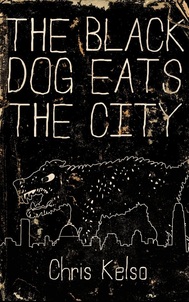 CHRIS KELSO CHRIS KELSO The Black Dog Eats the City. Unlike any other book about depression that you'll ever read. You just can’t win. You feel it before you see it, The Black Dog - the Cimmerian demon with baleful breath, diminishing the light wherever it tracks… …the size of a large calf, its footfalls are silent - the portents of death hidden behind caliginous evil. It squeezes into the soul. You know it because he scrunches your stomach into a tight paper-ball and forces it out through your anus. Then you’re a goner… You just can’t win. You can find The Black Dog Eats the City here: Omnium Gatherum Amazon.com Amazon.co.uk Amazon.ca Amazon.com.au B&N 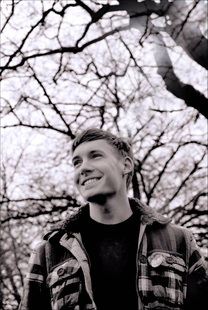 Photo by Colin Dunsmuir Photo by Colin Dunsmuir About the author Chris Kelso is a writer, illustrator and editor. His books in addition to The Black Dog Eats the City include: Schadenfreude (Dog Horn Publishing), Last Exit to Interzone (Black Dharma Press), A Message from the Slave State (Western Legends Books), Moosejaw Frontier (Bizarro Pulp Press),Transmatic(MorbidbookS) . He recently edited Caledonia Dreamin’ – Strange Fiction of Scottish Descent with Hal Duncan and is the co-creator of the anti-New Yorker,Imperial Youth Review. You can connect with Chris here: http://www.chris-kelso.com https://www.facebook.com/kelsowriter https://www.goodreads.com/author/show/5818945.Chris_Kelso https://twitter.com/ChrisKelso5 Author photograph used with permission from Colin DunsmuirGINGER NUTS OF HORROR THE HEART AND SOUL OF HORROR WEBSITES11/6/2014 09:26:21
Great piece Chris, I'm a big fan of Plath and Acker myself. With regards to writing that confronts depression I'm reading The Corrections by Jonathan Franzen at the moment. This novel concerns itself with the effects, causes and genetic disposition towards depression. In fact, to my mind, it's one of the major themes. Have you read it? Thanks very much Jasper. I haven't read The Corrections, although I have read Freedom, which had similar themes, I keep hearing great things about The Corrections - i hate the thought of finding all these amazing books that could've been perfect reference material AFTER the book is published, but I might give this one a go at your recommendation. Ham on Rye is probably still one of the best books about being an outsider and suffering depression that i've come across to date... Comments are closed.
|


Archives
April 2023

|
 RSS Feed

|

|