

 The uncanny is another hallmark of the genre that feels ever-more significant in today’s world where reality is increasingly blurred. We live vicariously through online avatars, play hyper-realistic video games, and continue to improve robots and artificial intelligence (we’re getting deeper into the Uncanny Valley). 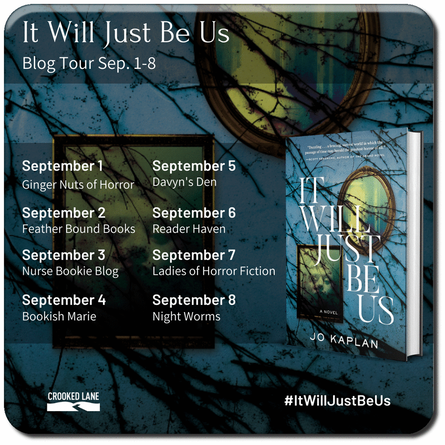 We are honoured to kick of the blog tour for the new novel from Jo Kaplan It Will Just Be Us, A terrifying new gothic horror novel about two sisters and a haunted house that never sleeps, perfect for fans of Shirley Jackson's We Have Always Lived in the Castle. Be sure to check out the other stops on the tour this week at these great review sites Feather Bound Books, Nurse Bookie Blog, Bookish Marie, Davyn's Den , Reader Haven, Ladies of Horror Fiction, and Night Wrms. Today Jo presents a fascinating essay on teaching Gothic studies. If you want to find out what genres are hot right now, just look at recent film and television trends: between Netflix’s Haunting of Hill House series, and film adaptations of The Little Stranger and We Have Always Lived in the Castle, the Gothic seems to be experiencing a renaissance, and is very much alive. Or, at least, undead. Perhaps the only disappointing thing about teaching a Gothic literature class is the general implication that the Gothic is dead, and we’re only examining it in its historical context. Students tend to think this way because the material usually focuses exclusively on the classics—which isn’t exactly surprising, considering there are so many more classics than I could possibly teach in a semester, so I’m already having to whittle my syllabus down to Dracula and a bunch of short fiction. Despite the glut of material, though, I think one of the great missed opportunities of many Gothic lit classes is the lack of attention to how the genre has evolved in modern times. The implication that the Gothic is dead does not bode well for student engagement, either: they tend to connect more with material that feels immediate and relevant. While the Gothic’s roots in the Victorian Era are an intrinsic part of the genre, focusing exclusively on the 18th and 19th centuries leaves out modern gems by Shirley Jackson, Angela Carter, and more recently, Laura Purcell, Elizabeth Kostova, Sarah Waters, Sylvia Moren-Garcia, and many more. Too often, students who read only the classics end up feeling as if the Gothic has become irrelevant, when this couldn’t be further from the truth. But in a genre steeped in crumbling castles and candlelight, deteriorating nobility and the clashing of science and superstition, what is it about the Gothic that remains relevant today? Some of the most resonant themes and motifs of the Gothic tradition actually seem incredibly, and perhaps surprisingly, timely in the 21st century. Its focus on transgression, for instance—whether that is religious, social, or sexual transgression—speaks to contemporary society’s enduring clash between traditional and progressive values. After all, isn’t Mina Harker described as having a “man’s brain”? And what about Matilda from The Monk, who seems to embody both the masculine and the feminine? Today we still have a society trying to come to terms with what had previously been considered “transgressive” as it contends with the bucking of traditional gender roles and movements for transgender rights. The uncanny is another hallmark of the genre that feels ever-more significant in today’s world where reality is increasingly blurred. We live vicariously through online avatars, play hyper-realistic video games, and continue to improve robots and artificial intelligence (we’re getting deeper into the Uncanny Valley). Nowadays, we spend a good chunk of our existence in those liminal spaces between reality and unreality. Our digital selves are just as much alive/not alive as the ghosts and supernatural beings of the Gothic tradition, and this uncomfortable blurring of binaries resonates with the ambivalence of modern society. The way the uncanny instills dread and apprehension mirrors the anxiety that plagues modern life. With all this in mind, over the last year or so I decided to bring my students a mix of classic and contemporary works: some which speak directly to one another, like Poe’s “The Masque of the Red Death” and John Langan’s “Technicolor,” in which a college professor teaching a class about Poe’s story explores the meaning of the colored rooms and offers unsettling revelations. We also read Dracula and used it to explore the evolution of vampire stories to contemporary times. It was really exciting to see my students then choose their own topics for research projects that furthered the examination of how the Gothic has evolved: there was one about the Gothic and folklore in Creepypastas, and another dissecting the way the movie The Lighthouse makes use of Gothic imagery, sexual transgression, the uncanny, and the sublime. Like the lurking specter, the Gothic may seem dead, but it continues to haunt us. When I wrote It Will Just Be Us, I wanted to write a Gothic work that nevertheless felt fresh; that, though it may explore the archaic and the arcane, is still situated in the present moment. Like the ghosts that roam my novel’s Wakefield manor, the Gothic will always be around in one form or another, because what makes it so particular is also what makes it universal: the uncanny, the transgressive, and those feelings of anxiety and dread surrounding the clash between past and future. And that is the very clash at the heart of Wakefield Manor in It Will Just Be Us, where time itself creates echoes and recursions in the halls of this rambling old mansion on the edge of a primordial swamp, and where holding up a mirror to the past may yet show us the future to come. 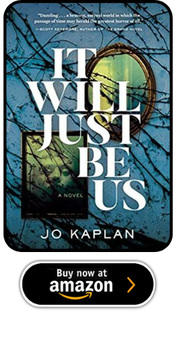 A terrifying new gothic horror novel about two sisters and a haunted house that never sleeps, perfect for fans of Shirley Jackson's We Have Always Lived in the Castle. They say there's a door in Wakefield that never opens... Sam Wakefield's ancestral home, a decaying mansion built on the edge of a swamp, isn't a place for children. Its labyrinthine halls, built by her mad ancestors, are filled with echoes of the past: ghosts and memories knotted together as one. In the presence of phantoms, it's all Sam can do to disentangle past from present in her daily life. But when her pregnant sister Elizabeth moves in after a fight with her husband, something in the house shifts. Already navigating her tumultuous relationship with Elizabeth, Sam is even more unsettled by the appearance of a new ghost: a faceless boy who commits disturbing acts--threatening animals, terrorizing other children, and following Sam into the depths of the house wielding a knife. When it becomes clear the boy is connected to a locked, forgotten room, one which is never entered, Sam realizes this ghost is not like the others. This boy brings doom... As Elizabeth's due date approaches, Sam must unravel the mysteries of Wakefield before her sister brings new life into a house marked by death. But as the faceless boy grows stronger, Sam will learn that some doors should stay closed--and some secrets are safer locked away forever.  Jo Kaplan writes and teaches in the Los Angeles area with much encouragement from her husband and two cats. Her fiction (sometimes as Joanna Parypinski) has appeared in Fireside Quarterly, Black Static, Nightmare Magazine, Vastarien, Haunted Nights edited by Ellen Datlow and Lisa Morton, Don’t Turn Out the Lights: A Tribute to Alvin Schwartz’s Scary Stories to Tell in the Dark edited by Jonathan Maberry, and the Nightscript series. Her novel, It Will Just Be Us, comes out September 8, 2020. She teaches English and creative writing at Glendale Community College.   the heart and soul of horror promotion websitesComments are closed.
|


Archives
April 2023
|
 RSS Feed

|

|