

 Everyone who loves the horror genre is familiar with the trope. A monster arrives/emerges/is born in the community. It picks off the townspeople/family/lighthouse keepers one by one, until the bravest and most wily of them finally defeat it by shooting it with a silver bullet/hacking off its head/throwing open some surprisingly heavy velvet curtains. With the monster gone, the community can go back to living happily ever after, albeit slightly more sparsely populated than before. The end. As formulae go, it’s not a bad one. There’s the sense of catharsis at the monster being overthrown, the restoring of a sense of order that follows his/her/its demise. We’ve endured the storm, and now there are blue skies ahead. We’ve enjoyed our vicarious thrills but can return to the safety of the real world, knowing that things are still the way they should be. I’ve suffered with depression on and off for over twenty-five years, and while there are many names for it – the black dog, a blue funk, the slough of despond – I’ve always thought of it as a monster, a beast. The monster would loom behind me when my mood was at its worst, blocking out the light, whispering negativity in my ear. It’s little surprise that I was a goth in my teenage years, or that I still tend towards horror fiction as my genre of choice. To paraphrase the Stones, when I saw a red door, I’d want to paint it black – such was the power of the monster at my back. For a long time, I thought of that monster as something to vanquish. After all, that’s what the stories have taught us, isn’t it? When a monster comes to town it needs someone to stand up to it and destroy it, to burn it to ashes and make sure it never darkens our doors again. So it was with my depression. Every time it reared its head I’d approach it as a creature to be defeated, a dark denizen to expel for once and for all. This time would be the time that I beat it. From here onwards it would be all sunshine and roses, once the monster was gone. Anyone who’s suffered with depression will tell you that this isn’t the way it works. There is no cure for depression, no silver bullet. Each time you vanquish it, it will come back. Like Jason Voorhees, the sequels keep on coming, and coming, and coming, and coming… In recent years, I’ve come to realise that my thinking was all wrong. Depression wasn’t a monster, a beast to be vanquished. Or at least, it was a monster, but my solution was getting me nowhere. This wasn’t a battle I could win, no matter how many times I threw open those heavy velvet curtains. Instead, it was a part of me – a negative part, but a part nonetheless – and my attention turned away from trying to defeat depression, and towards trying to live with it. Maybe it’s okay, after all, that I don’t always look on the bright side. Maybe weathering those storms fuels what I do, and informs it with a greater knowledge of the highs and lows of human experience. Maybe, just maybe, I could learn to live with my monster. It was as my outlook began to change that I started to see a different kind of narrative in modern horror. I won’t claim it’s anything new – there are very few new tools in our toolbox – but it seemed, to me at least, that horror writers were increasingly telling a different kind of story. In Guillermo del Toro’s Oscar-winning film The Shape of Water, Eliza Esposito falls in love with the monster and helps him escape captivity. In Paul Tremblay’s The Cabin at the End of the World, we’re left hanging without a resolution or an explanation, just the aftershocks of the bad things that have happened – not only is the monster not defeated, there isn’t really a monster at all. If you want to take it even further, the Twilight films and novels, while far from perfect, show us that maybe it’s okay to love the vampire. Maybe it’s okay to be like him, too. It would be wrong to draw any kind of conclusion from this. I suspect I’m simply looking in different places, finding different types of horror that conform more closely with my own experiences, that speak to me about my own life. There are still terrorised villagers, cursed families, and horned beasts galore to be put to the sword and burned. Even ambiguous horror isn’t always a blueprint for mental health – while Midsommar presents us with a monsterless horror, one that defies those traditional tropes, I certainly wouldn’t suggest that you follow Dani’s example. That way madness lies. But it does strike me that there’s a different type of narrative to tell than the old creature features, that horror could be teaching us a different lesson altogether. By being ambiguous, and avoiding the traditional monster tropes, these modern stories can teach us something about living with our monsters, rather than fighting a losing battle against them time after time after time. Now, when I feel the storm clouds of depression on the horizon, I no longer feel the need to fight what will always be a losing battle. Instead, I’ve learned to accept it and weather the storm, knowing that the looming darkness is as much a part of me as the good times. There’s nothing to vanquish, but there is something I can learn from, and maybe even love a little. It won’t last forever, and it will be back. But I can live with that. about Dan Coxon Dan Coxon is the Shirley Jackson Award and British Fantasy Award nominated editor of This Dreaming Isle (Unsung Stories, 2018), an anthology of British folk horror and weird fiction. He is currently compiling and editing an anthology of short fiction about depression to raise money and awareness for Mental Health UK – more details will be announced shortly. His writing has appeared in The Guardian, Salon, Black Static, The Ghastling, Wales Arts Review, Unsung Stories, The Portland Review, and the anthologies Nox Pareidolia, Humanagerie and Unthology 9, as well as many other magazines and anthologies. His mini-collection of horror stories, Green Fingers, will be published by Black Shuck Books as part of their Shadows series in April 2020. He runs an editing and proofreading business at www.momuseditorial.co.uk, publishes an occasional journal of weird and eerie fiction called The Shadow Booth (www.theshadowbooth.com), and can be found on Twitter at @dancoxonauthor. The Shadow Booth: Vol. 4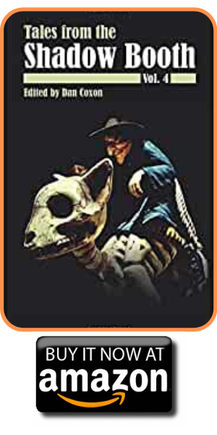 It's as Peter begins to wade into the tarn that he spies the strange canvas structure at the edge of the trees. It looks like an abandoned Punch & Judy booth, he thinks, but dirty and tired, stained black with mould. Ignoring the water licking cold about his ankles, he squints to read the crimson scrawl on the plank propped against it. Enter the Shadow Booth, it says, and you will never be the same again. The Shadow Booth is an international journal of weird and eerie fiction, publishing emerging and established writers of the strange. Drawing its inspiration from the likes of Thomas Ligotti and Robert Aickman, The Shadow Booth explores that dark, murky hinterland between mainstream horror and literary fiction. Volume 4 includes new weird and uncanny fiction by: Gary Budden, Jay Caselberg, Tim Cooke, James Everington, Lucie McKnight Hardy, Giselle Leeb, Polis Loizou, James Machin, Andrew McDonnell, Jane Roberts, Ashley Stokes, Anna Vaught, Charles Wilkinson and Marian Womack    Comments are closed.
|


Archives
April 2023
|
 RSS Feed

|

|