

 The old advice “write what you know” seems to apply here to some extent, but as well as writing about my childhood, a great deal of the High Moor books was me “writing to get to know myself”, although I didn’t realise this at the time. In many of the guides that I read before starting work on the first High Moor book, the idea of theme was more important than the actual plot of characterisation. The theme corresponded to the message that the book was trying to get across in many ways. I did not think of it that way when I started writing the books. Themes were, I thought, something for the more literary novel. It was not something that I consciously picked up on most of the time when I read a book for pleasure, and it certainly was not something I intended to put into my own work. However, I had a rough idea of what I wanted each novel to be about and the format of the work. The first High Moor novel was a coming-of-age tale for reasons I mentioned in the first author note. Moonstruck was written as a high-intensity chase thriller for the most part, and Bloodmoon was an epic scale action movie with political and humanitarian overtones. Mostly, though, I was interested in character first, then plot, and that was it. Despite that, some themes managed to sneak their way into the story. The idea that seemingly small actions can have enormous consequences years later is present throughout all three books. Another is that, despite the fangs and claws of the werewolves, people are often the real monsters (a theme present mainly in High Moor and Bloodmoon). And a large one was that things are rarely black and white – each character is the hero of their own story, and often they can justify their actions in terms of the greater good. There are no purely good or evil characters in this series. Everyone has their own motivations, and things really get interesting when those motivations clash. However, the central theme of these books and the element of werewolf lore that is the most original to this series is that of mental illness. There are three types of werewolves in my books. The first ones we encounter are the moonstruck, like Mirela and John. The moonstruck werewolf may not even realise what they are. They fight against the wolf inside of them, trying to suppress it until, under a full moon, the wolf side of their nature becomes too strong to contain. It breaks free – but only partially. The afflicted individuals are caught in a midway state between man and beast – the classic bi-pedal wolf-man. These creatures are all pain, rage, and instinct in a seven-foot frame. So it is hardly a surprise that they are as dangerous as they are, even to other werewolves. With Mirela, she became moonstruck because of her Alzheimer’s - as she lost the ability to remember or understand, the presence of that wolf within her became confusing and terrifying, so she fought against it. In John’s case, perhaps things may have been different if his parents didn’t keep telling him to fight it over and over again when he was a child. The second type of werewolf in the books are the wolves of The Pack. These werewolves accept that animal part of themselves and live in a symbiotic relationship with it. They are at one with their other half and can transform at will into a huge quadruped wolf. Yet, they retain their human intellect and utilise some of the wolf’s gifts in human form, such as enhanced senses, strength, and endurance. The last type of werewolf in my mythology is the person that loses themselves entirely to the wolf within. In the first High Moor book, we see this when Malcolm recoils from Lizzy Fletcher’s assault, and the wolf takes over because it sees him as weak. We also see something of this with Marie and Michael in Bloodmoon, where they remain in their Wolfen forms for so long that they begin to forget what it was to be human. Crucially, these three distinct types of werewolves are all products of the same curse. The only difference between them is the state of mind of the afflicted. I was pretty happy at this definition of my own particular brand of lycanthropy as it neatly tied together the three different cinematic versions of the werewolf. But my fiction was undoubtedly not the first to look at mental illness as part of the werewolf’s curse. Lycanthropy was referenced as being caused by “melancholia or an excess of black bile” as far back as the seventh century. It was referred to by James VI in his 1597 book Daemonologie “an excess of melancholy as the culprit which causes some men to believe that they are wolves and to ‘counterfeit’ the actions of these animals”. Modern science believes that lycanthropy, rather than being an illness in and of itself, is linked to other neurological conditions. These include schizophrenia, bipolar disorder, clinical depression, and body dysmorphia. Even in fiction and movies, works such as The Howling have explicit themes of the battle between civilised man and the animal within. When I was writing High Moor, I was not consciously aware that I was looking at mental health as an underlying theme of the book. But when I was diagnosed as suffering from borderline personality disorder in 2018, three years after I finished Bloodmoon, some of the pieces began to click into place. I want to make something clear at this stage. I do not and have never suffered from lycanthropy. I do not believe I turn into a wolf. Right? However, there are elements of my illness that have certain parallels to the behaviour of a moonstruck werewolf, and I think that may have been something I was trying to explore in the books. Let me walk you through a borderline episode so that you have a better understanding of what I mean. First, there is a triggering incident. Until that happens, I am going about my day like anyone else – flawed but normal and functional in most respects. Then something happens. My triggers are often focused on either mass disapproval or me doing something inadvertently that upsets someone that I care about. I will become a little withdrawn at this, smile, and continue to function, but inside, I will be in torment. Because part of the condition is a vastly enhanced emotional range, the trigger is generally anything that feeds into my fear of abandonment. This is what I refer to as Stage 1. If nothing else happens for a day or so, the Stage 1 attack will fade, and it will be as if nothing happened. But that is rarely the case because my behaviour will have changed to invite a further triggering stimulus. And when the following perceived incident occurs, I metaphorically sprout fangs. Welcome to Stage 2. This is the point where I will be overcome with the self-inflicted torment over what has happened. I cannot think clearly. I am in absolute emotional agony – close to what an average person would feel over, say, the death of a beloved cat or dog. I will try to distance myself from everyone and literally lock myself away in the same manner that John does at the start of the first book. I will literally do anything to make the pain stop. This includes drinking alcohol to excess to numb the emotions and begin fixating on confronting my biggest fear (abandonment) by willing it into existence – getting it over with, in other words. That is when Stage 3 happens. Once I hit Stage 3, then all bets are off. I have little or no control over my behaviour. I will have fixated on a course of action. Usually, the first “solution” that has presented itself to me, and I will go at it with a single-minded determination that is quite terrifying. At this stage, it is as if I am on rails and will continue along this track until I have achieved my objective. This usually brings about the worst-case scenario and blows my life up. In some instances, that has taken me to a very dark place indeed. As soon as I reach my objective or am prevented from achieving it for a prolonged period (about a day), I start coming out the other side. I am left to survey the carnage that I have created and deal with the consequences. Much like a moonstruck werewolf waking up in the morning, covered in the blood and entrails of his victims, only without the viscera. It is hardly surprising that before I was diagnosed and treated, I was left trying to make sense of these periodic losses of control and loss of self. And like John, once I had the proper treatment and guidance, I was able to some extent to come to terms with that side of my nature. Recognise the beginnings of a Stage 1 event, and take steps to contain it. These episodes are far less frequent, and generally, when they do occur, they tend not to be as severe. I still have some way to go, but I have made real progress on living with my own beast within. Counselling and therapy have given me the tools to understand the condition and deal with it. Antidepressants keep my emotional range within acceptable parameters. And I’m learning that my need to control things around me to keep myself safe, quite often, is counter-productive. The old advice “write what you know” seems to apply here to some extent, but as well as writing about my childhood, a great deal of the High Moor books was me “writing to get to know myself”, although I didn’t realise this at the time. Using fiction to explore, express and ultimately understand parts of my nature that terrify me. As a result, even if these books had not sold a single copy, I think they would have been worth the journey because I now understand my own beast that little bit better. High Moor 10th Anniversary Limited Edition Box Set – Slipcased, Signed and Numbered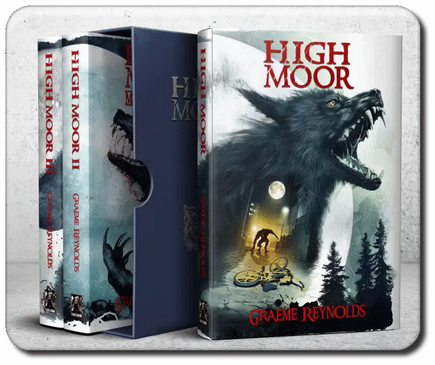 Horrific Tales Publishing are pleased to be able to offer a signed, numbered and slipcased limited edition boxed set of Graeme Reynolds High Moor Trilogy, to celebrate the 10th anniversary of the first novel’s publication. Each book will be an 8.5 x 5.5 dust jacketed, case laminate edition with new cover art by Ben Baldwin. In addition, each book will contain illustrations by Michelle Merlini, additional stories and novelettes set in the High Moor Universe (some of which have never before been published) and a series of short essays by the author that explore some of the influences for the novels, and some of the themes used in the series. High Moor 10th Anniversary Edition Bonus Material: Blood Relations (A High Moor Story) Moonstruck 10th Anniversary Edition Bonus Material: One of Those Things Beware The Moon Blood Moon 10th Anniversary Edition Bonus Material The Hunt Unnatural (Prologue) The production of this box set will be limited to One Hundred and Fifty units only. We now offer the ability to split payments with Klarna for UK based customers. Purchase a copy here High Moor When John Simpson hears of a bizarre animal attack in his old home town of High Moor, it stirs memories of a long forgotten horror. John knows the truth. A werewolf stalks the town once more, and on the night of the next full moon, the killing will begin again. He should know. He survived a werewolf attack in 1986, during the worst year of his life. It’s 1986 and the town is gripped in terror after the mutilated corpse of a young boy is found in the woods. When Sergeant Steven Wilkinson begins an investigation, with the help of a specialist hunter, he soon realises that this is no ordinary animal attack. Werewolves are real, and the trail of bodies is just beginning, with young John and his friends smack in the middle of it. Twenty years later, John returns to High Moor. The latest attack involved one of his childhood enemies, but there’s more going on than meets the eye. The consequences of his past actions, the reappearance of an old flame and a dying man who will either save or damn him are the least of his problems. The night of the full moon is approaching and time is running out. But how can he hope to stop a werewolf, when every full moon he transforms into a bloodthirsty monster himself? High Moor is the highest rated werewolf horror series on Amazon, and with good reason. Check out the reviews below. "Graeme Reynolds has written a real-deal werewolf story. In these dull days of nice, friendly lycanthropes, it is refreshing to see some brutality and animal instincts in what is a very fine British horror novel. Reynolds draws vivid pictures with words. His descriptions of High Moor the town is excellent, portraying an area in decay, one that suffered during the 1980s, and has yet to recover into the 21st century. The transformation scenes, where humans become wolves, are brilliantly done, and you can feel every crack of bone, every tear of flesh. High Moor is a worthy addition to the werewolf canon. - Thomas Emson, Author of Maneater, Prey, Skarlet, Krimson, Zombie Britannica" Ripe for a film or TV adaptation and left open for a sequel, High Moor is an excellent example of great British writing that deserves to be read. - Starburst Magazine. 9/10 If you’re craving some good werewolf action with well-developed characters and a fantastic plot, skip the Hollywood films and go straight for this electrifying novel, which is far more entertaining. - Hellnotes.com Graeme Reynolds has written a captivating, action packed, this-should-be-a-movie werewolf novel in High Moor and if this is going to be a series of some sort, count me in for the ride. It should be a fun one. - Horrortalk.com This is an action filled horror novel that also has fully realized characters; the fact that Reynolds brings the characters to life so well just adds to the terror you feel as a reader. - The Horrifically Horrifying Horror Blog It takes a writer of tremendous skill to imbue a an action packed novel with as much depth, as is displayed here. This book was a joy to read, not just for its ability to transport me back to a time gone by, but also because it is so well written. If this is the level of writing Graeme is capable of producing in a début novel, then I for one cannot wait for his next novel. - Gingernuts of Horror ABOUT GRAEME REYNOLDS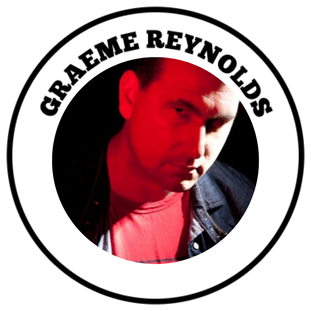 Graeme Reynolds was born in England in 1971. Over the years, he has been an electronic engineer in the Royal Airforce, worked with special needs children and been a teenage mutant ninja turtle (don't ask). He started writing in 2008, and has had over thirty short stories published in various ezines and anthologies before the publication of his first novel, High Moor, in 2011. When he is not breaking computers for money, he hides in a remote Welsh valley and dreams up new ways to offend people with delicate sensibilities. Check out today's other articles
the heart and soul of horror websitesComments are closed.
|


Archives
April 2023
|


 RSS Feed

|

|