

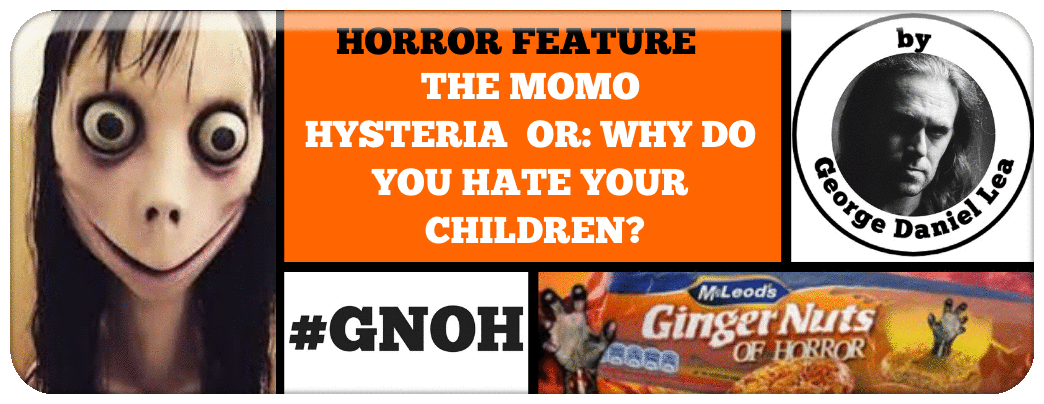
 Unless you happen to be some luddite hermit, living in an isolated, underground cavern, perhaps on Mars or in some corner of the multiverse where humanity never evolved, you can't help but have heard some whisper of the latest horror hysteria spreading not only across social media but mainstream outlets, too. The myth of “Momo,” the gaunt, faintly avian and/or reptilian female entity purported to haunt certain corners of the internet, to appear in random YouTube videos and drive viewers to states of hysteria or suicidal state of mind, is not necessarily new or old; like many urban myths accrued on the internet, it can trace its origins back to less than a decade ago, during the same fraught and fertile era that saw proliferations of such phenomena as CreepyPastas, SCP-Foundation entries, Sonic.EXE videos, Slenderman stories and more. Like many of them, Momo was and is nothing more than a post-modern manifestation of old tribal concerns; the kind of ghoul or goblin that would've once haunted dark woods or the unknown wilderness beyond tribal territories. Now, those old fears have found new manifestation and, indeed, new animus on the internet, which, being not only a medium but an environment, comes with its own host of concerns and issues. Perhaps the most distressing element of the Momo mythology is the so-called “Momo Challenge,” in which rumours and stories began to circulate concerning how the Momo entity had driven a number of young people to commit violent or self-harming acts, to the point that some accounts proclaim that children have been driven to suicide by the creature, that there are cabals of entirely amoral video makers that are inspiring children and young people to assault their parents, to murder pets or siblings, to take their own lives. Recently, accounts of this phenomena have spread like wildfire across social and popular media, resulting in a pearl-clutching, “won't someone please think of the children?” hysteria that more scurrilous outlets (my old enemy The Sun, for example) have only been too happy to capitalise on (well, of course: it's not like they can rely on actual news or facts, so anything that inspires contrived fear or outrage is essentially Manna from Heaven). And it's all bullshit. Contrived, exaggerated, hyperbolic bullshit. For my part, I'm perpetually fascinated by myths like Momo, particularly with regards to social media, the internet etc; the manner in which entirely new and yet extremely ancient archetypes are reborn and recycled for new generations, expressions both old and new concerns in old and new environments. Momo, like Slenderman, like The Rake, is an expression of the same. But, in Momo, there is something I would argue that is far, far darker: Not in the entity itself, which is, in many ways, a classic Japanese archetype, extremely similar to The Ring's Sadako and the entire bestiary of vengeful, female demons and spirits that pervade ancient Japanese mythology and oral tradition. No, the darkness of Momo and her “challenge” is in what their existence silently expresses: A profound and pervasive generational supremacy, a contempt for children and the young that masquerades as concern and affection. Read between the lines of any account, any article exploring the “Momo Challenge,” certainly in mainstream media, and you'll see it: beyond the superficial language of sentiment, of concern, a seething and foetid satisfaction, a bloated sense of self-superiority: “Oh my, look how foolish and impressionable the young are today, driven to violence and suicide by a creature that doesn't exist.” Beyond the superficial expressions of concern, the calls for “safety” (which are largely calls for stricture and censorship that are too cowardly to call themselves as such), lingers a perverse and prurient delight, a diseased, narcissistic contempt for all that is young and new and unfamiliar. Even though most, I have no doubt, are fully aware that the “Momo Challenge” and its various accounts and testimonies are nothing more than hyperbole and rumour-mongering, there's little doubting that they want it to be true, if only to reinforce their own narcisstic sense of generational superiority, to rain veiled spite and contempt down upon the children who are, purportedly, easy prey to such manipulations. It's grotesque and, like so many such phenomena, expresses far more about those that are willing to buy into it, to wallow in and foment it, than those who are ostensibly its subjects. Certainly here in the UK, there is currently an abyss between generations; a gulf that is gaping ever wider in the wake of current political events but also certain culturally pervasive assumptions and impositions. A powerfully poisonous form of nostalgia is currently informing almost every element of our media, our cultural systems and out political processes, one that is simultaneously alienating latter generations -who don't have the apparent benefit of such contexts- but also leading to a kind of hideous, self-involved isolationism from those of us that were born to them; a sense that we are somehow innately superior, despite all evidence to the contrary. People have very, very short memories, especially when it comes to their own hysterias and short-comings. Do me and every child alive today a favour: look into it. Go and seek out records of the decades you were children or teenagers or twenty-somethings and examine what previous generations were saying about you, what contrivances they were concocting to demonise you, what nonsense and baseless assumptions became so enshrined and pervasive, outlets like (fucking bastard pieces of shit rags) “newspapers” fed and sustained on their filth for years if not decades later. Go further; look back into history and see what Fathers were proclaiming about their sons, Mothers about their daughters, way, way back when: You will find expressions of exactly the same inter-generational conflicts, exactly the same paedophobic contempt, mythologised in very, very similar veins and forms. Where do you think cautionary fables and fairy tales come from? Where do you think tales of Changelings and Big Bad Wolves etc are born? The so-called “Momo Challenge” and the automatic assumptions of stupidity and malleability it requires to sustain any sense of legitimacy are nothing new: they are expressions as old as humanity itself, conflicts that are so much a part of our species, they arguably inform its most essential soul (for better or worse). The BIG difference now is their existence upon social media. There was a time, owing to the geographical distances that existed between us, the limtiatons of media itself, that such tales would have finite reach and influence: confined to particular cultures, between the pages of books or even carved into wood or stone (the most ancient, of course, lacking even that; being handed down by word of mouth from one generation to the next). Now, such limitations do not exist: Momo can reach out beyond wherever the myth originated and touch us all, fostering contemptuous hysteria in the credulous and egotistical not to mention eye-rolling impatience in those it proclaims to comment upon. Beyond that, owing to the nature of the internet, just like the Slenderman before her, Momo can and has already begun to take on a certain vitality an animus of her own: being a creature of abstraction, whose anatomy and mythology is bound up with the technology and media she occurs on, the fact of her is enough to give birth to her, to make the myth true, after a sense. Given the pervasiveness of technology, the ready access to the internet that is only spreading as history grinds on, of course entities like Momo will reach eyes and minds that are perhaps more susceptible to their influence, with natural -or cultivated- inclinations to paranoia, distorted perceptions of reality, mental illnesses of various stripe etc. So, of course, just as in the case of the Slenderman, it's entirely possible that some individuals somewhere will be inspired to commit unsavoury actions on the creature's say so (ironically, likely emulating the very stories that certain factors of culture and society have contrived and promulgated but publicly bemoan). This inevitable fact is no more an excuse for the rampant demonisation of the young the phenomena has inspired nor the calls from more conservative quarters for the censorship or restriction of technology than the murder of John Lennon was a legitimate reason to ban or censor Catcher in the Rye. The existence of stories or myths or images in in any medium runs the risk of reaching the wrong eyes, of influencing someone in the wrong state of mind to do terrible things. That is a sad but essential by-product of the existence of media and stories themselves. If anything, the fact of that phenomena is more a testament to the fact that we as individuals and as cultures need to be more educated, empathetic and robust in our understanding and treatment of mental illness, of the wider, far more complex factors that elicit or cultivate these states of mind. It's oh so easy for certain quarters to concoct handy-dandy scapegoats, easy-answers for the terminally tribal and lacking in imagination (what was it in the 1980s? Satanic toys like He-Man or games like Dungeons and Dragons. What was it in the 1990s? Rave culture and video games. And so on and so forth). But these spoon-fed, cartoon-caricature non-answers provide nothing in the way of genuine elucidation or solution: if anything, they are designed to feed the very neuroses and culturally enshrined insanities that allow for such phenomena to occur in the first place, that, in a very real sense, allow for the denigration of latter generations, of our own children. What I would sincerely ask those who are willing to take nonsense like the so-called “Momo Challenge” as read and to cluck and tut and shake their heads over the apparent stupidity and insanity of its subjects is this: Why do you hate your own children? Why is it so easy for you? I am, of course, being entirely facetious, as I know the answer (complex and irrational as it is): it's an expression of that very same narcissistic sense of fragile ego and identity that leads to bullying or abusive behaviour within a household or a schoolyard or a workplace: it is simultaneously the inspiration and by-product of lazy, toxic nostalgia and an inability to see through the romantic, hazy mythology we make of our own histories (“If you were born in such and such a decade, your childhood was great.” “If you watched these cartoons or played with these toys, your childhood was great.” “We were the last generation to play outside from dawn to dusk,” etc, etc, ad nauseum). It is the recapitulation of our children and our children's children as little more than fodder for our own egos, just as we ourselves became prey to similar unconscious efforts from our parents and their parent's parents and so on and so forth into the interminable, flesh and soul-pulping revolutions of human history itself. That's what the “Momo Challenge” manifests. Human sickness, but not in the way that certain outlets would have you believe. It's far darker, far more unpleasant, far more collectively sub-conscious and base and brute than that. And the fact of it should make us ashamed. 
Comments are closed.
|


Archives
April 2023

|

 RSS Feed

|

|