

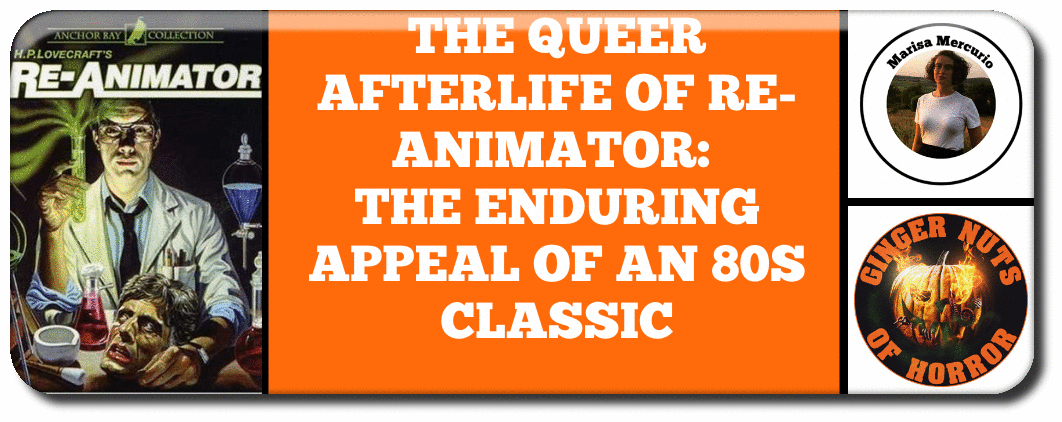
 Although queerness is fundamental to the horror genre, we are most often portrayed subtextually as monsters or written off as perverse. Although not free of such stereotyping, Herbert West offers a complex portrayal of this characterization that queer fans have since latched onto. Last October, Re-Animator celebrated its 35th anniversary. It’s been a cult classic for almost as long. Despite a modest $900,000 budget and producer Brian Yuzna’s refusal to accommodate the MPAA’s rating system, Re-Animator achieved unlikely critical acclaim upon its 1985 release. It has since garnered its status as one of the most beloved horror films whose stunningly gory practical effects and captivating performances continue to charm audiences. Directed by Stuart Gordon and starring Jeffrey Combs (Herbert West), Bruce Abbott (Dan Cain), and Barbara Crampton (Meg Halsey), Re-Animator follows medical student Herbert West’s disastrous attempt to bring the dead back to life. Admittedly, I came to the Re-Animator craze late, even by generational standards. Although my daily work and research explores horror’s literary ancestor, the Gothic, I didn’t immerse myself in horror film until my mid-twenties. By then, I had a lot of catching up to do. Swiftly, I realized the outlandish and colorful flicks of the 1980s appealed to my campy macabre sensibilities. Like Evil Dead II and The Lost Boys, when I finally saw Re-Animator I was thrilled by its gumption in all its transgressive glory. But more so, I couldn’t believe how queer it was. Then I saw the sequel. And then I went deep into the Internet’s annals. To my surprise, I didn’t have to do much digging. Discussion of the first two films was not only extant—it was thriving. (Beyond Re-Animator was released in 2003 and is, to put mildly, largely ignored.) These weren’t just folks reminiscing about seeing Re-Animator in theaters, but people my age and younger who came to the film recently. Another startling thing I noticed about these bloggers and creators was that they were, by massive margins, queer. Why, like myself, did queer horror fans flock to Herbert West? Reading queerness into Re-Animator demands a holistic approach. The most pronounced evidence is through Herbert West and his relationship to his roommate Dan Cain. From West’s appearance on Dan’s doorstep through his “death” (spoilers: he returns for the 1990 sequel Bride of Re-Animator), he demonstrates a singular interest in Dan among his disdain for every other character in the film. Particularly caustic toward Meg, Dan’s girlfriend, West personalizes his relationship with Dan by insisting he call him by his first name as opposed to Meg’s “Mr. West.” As West entices him into his experiments, he concurrently cultivates their relationship. In the bloody aftermath of their first human reanimation, West paws at him while he concocts an explanation for the police. He then drapes a blanket over a shocked Dan, patting his hand. Their relationship bookends the film: beginning with West’s refusal to shake Dan’s hand, their final interaction has them reaching out for one another before West, defeated, throws the sum of his work Dan’s way. Re-Animator’s queerness does not seem to be a secret among the film’s creators. Intent aside, Combs’s performance indubitably prescribes a jealous streak to West. Both Abbott and Crampton note West’s envy of Dan’s lovers in Re-Animator and Bride. In the latter film’s cast commentary, Abbott remarks, “I think it’s very interesting that Herbert is insanely jealous.” Along the same lines, Crampton states in Re-Animator’s bonus documentary feature, “I think there was definitely a triangle in the movie and it was [Meg] and Dan and Herbert West. Megan and Herbert West were foes fighting for the same man.” Nor was West’s queerness unrecognized in his contemporary moment, as evidenced by the novelization following Re-Animator’s success. The current market price for Jeff Rovin’s 1987 exceedingly rare novelization (over $100 on Abe Books) speaks to a renewed—and particular kind of—interest in the film. Rovin’s retelling has since made its rounds digitally, largely shared among online queer communities. Now infamous within these circles for its homophobia and disturbing forays into Dr. Hill’s perspective, the novelization’s popularity speaks to a reality for many queer fans of the genre: blatant acknowledgements of queerness in horror are worthwhile despite the despicable terms in which they are often written, the result of a “desperate for scraps” mentality. This is certainly the case with Rovin’s book. Thought of by Meg as “dirty” and “virulent,” inflammatory terms amid the AIDS crisis, and directly questioned about his sexuality (to which West notably does not answer), the novel emphasizes the film’s queer depiction of West. Although queerness is fundamental to the horror genre, we are most often portrayed subtextually as monsters or written off as perverse. Although not free of such stereotyping, Herbert West offers a complex portrayal of this characterization that queer fans have since latched onto. Re-Animator at first relays typical villain queer-coding: West’s queerness undeniably contributes to his threatening, disruptive force to the normative professional and emotional structure of Dan and Meg’s lives. Like Norman Bates before him, West exhibits the desire for control among chaos, whether that is the stifling force of a puritanical mother or, simply, the looming inevitability of death. Re-Animator and Bride both invite West’s comparison to Bates, initially through composer Richard Band’s overt homage to Psycho’s score but moreover through West’s characterization. His clean-cut presentation that unspools into an unhinged bloody mess and his nearly erotic interest in reanimation highlights the characters’ physical and psychological similarities; whereas Bates exercises power over lifeless objects through taxidermy, West favors cadavers. Abbott likewise points to West’s “unbelievably Anthony Perkins [Norman Bates]” moment after he witnesses Dan and Francesca, his love interest, in bed together. With a distraught expression, West turns forcefully away from the couple and walks slowly down the stairs. He glances upward again, clutching his heart and running a palm down his thigh. It is difficult to interpret this scene as anything other than heartbreak. “Why don’t I have that?” Combs speculates West thinking. Derisive of Francesca, the audience understands West does not wish to be in Dan’s place; rather, he would be in Francesca’s. Unlike Psycho, however, Re-Animator moves away from the queer lead’s status as villain. Halfway through the first film, Dr. Carl Hill emerges as the true antagonist. A plagiarist and sexual predator, Hill is responsible for Meg’s death and the ultimate devastation—the “Miskatonic Massacre”—at the hospital morgue. If our sympathies were not already with West, they realign when Hill declares his intention to steal West’s discovery. This narrative turn is crucial to the film’s—and thus the audience’s—relationship to queerness. With Hill as the unethical doctor and heterosexual violator, West becomes nearly heroic. The audience roots for Hill’s demise and for West’s monomaniacal quest to defeat death. We revel in West’s strangeness, adore his enthusiasm, and admire his defiance of Hill’s abuse of power. We, like Dan, are irrevocably along for the ride. But this wasn’t always the case. In 2017, Arrow Films released their Blu-Ray edition of Re-Animator. It included the film’s integral version for the first time in the United States and runs at 105 minutes, nearly 20 minutes longer than the theatrical cut. This version offers comparative insight into the narrative; it recontextualizes the film and illustrates just how wonderfully queer the final cut is. Although certain scenes amp up the love triangle as well as the homoeroticism between West and Cain—most significantly Herbert’s hypodermic fix of the diluted reagent in a literal and metaphorical penetration—the broader structure centers Dan and Meg’s relationship. It may be difficult to imagine a version in which Herbert West is relegated to a supporting character. But with the extended scenes, Re-Animator becomes a film about a couple tragically disrupted by a deviant man’s infiltration into their lives. In this version, West is more the manipulative mastermind, less the ambitious student. He is queer-coded more heavily, thoroughly conflating his sexuality with villainy. Dan’s characterization likewise alters, as he is uncomfortable with West throughout. Meg, too, shifts slightly enough to affect our perception of her character; her reaction to West reads like subdued homophobia (“I’m sorry, Danny, but he makes my skin crawl.”). Marriage too is Meg’s attempted blow against West. In this cut, Dan proposes and Meg only accepts after West becomes an obstacle, clarifying their potential to make life. Dan and Meg are the all-American couple, determined to excise West from their lives, and we, the audience, are meant to agree. The integral version amplifies what is already present to tiresome degrees. In Re-Animator’s case, less is more. By comparison, the original theatrical version renders the three primary characters with more depth. With less exposition to bolster their motivation, Dan’s interest in West and his work is more compelling, and Meg’s distrust of Dan reads less like a woman desperate to keep her man, but rather like the understandable frustration of being kept out of the loop. We can be thankful Yuzna let the film go unrated. Otherwise, Re-Animator may have been released as a 95-minute R-rated version, losing its goriest moments in favor of the extended scenes. Though delightful—West and Meg vying for Dan’s attention is absolutely delicious—these scenes belong on the periphery. Now that we have it, the integral version is a must-watch for any fan. But had it been the final original product, Re-Animator would not be a defining classic. It certainly wouldn’t persevere within the queer community today. Bride of Re-Animator harkens to another famously queer figure in the trajectory of horror: Mary Shelley’s Victor Frankenstein. The sequel’s reimagining of a modern Frankenstein and the 1935 classic Bride of Frankenstein (directed by James Whale, an openly gay man), similarly figures West’s desire to excise women from the creation of life. “Blasphemy?” demands West when confronted by Francesca, “Before what? God? A God repulsed by the miserable humanity He created in His own image? I will not be shackled by the failures of your God. The only blasphemy is to wallow in insignificance. I have taken refuse of your God’s failures and I have triumphed.” In addition to the novel’s homosociality, scholars—most notably Susan Stryker—have explored Frankenstein’s transgender impulses. Through such a speech, West’s disavowal of biological imperatives, restrictive embodiments, and religious doctrine resonates among transgender viewers as well. Although Re-Animator first proffers a queer Herbert West, Bride embellishes it as the film’s very premise. Set eight months after the Miskatonic Massacre, Doctors West and Cain return from volunteer work in Peru to Massachusetts where they live in a former mortuary. Their basement is a makeshift laboratory, littered with stolen body parts. When Dan expresses interest in moving out, West pulls out all the stops. He promises to build a woman—a new Meg—as long as he has Dan’s help. Dan cannot help himself; he agrees. “What is it about Meg that you loved?” West inquires. Desperate to keep Dan beside him, West presents Meg’s autopsied heart to Dan from outstretched arms. It reads like a proposal: cupping the organ in his palms like a gift, West begs, “Help me to continue the work.” It is Meg’s heart, but West’s heartfelt plea. This astoundingly queer moment sets in motion Bride’s driving tension between queerness and normativity. The question of why the two continue to live together in a new home after graduation, Bride never answers. Nor does Bride clarify why Dan specifically is so crucial to the work, raising further questions regarding West’s motivation. Although West has found a lackey at Miskatonic University Hospital, it is Dan who West trusts sees and a partner in. That Dan is so easily enticed furthermore suggests that West is not simply a manipulative genius, but that he finds something attractive about West and his work. If queer fans’ interpretations are anything to go by, there is ample room for a queer reading of Dan Cain as well. West’s unique affection for Dan in both films aside, Combs’s portrayal is ineffably queer. Wit, razor-edged intelligence, and cattiness define West’s character; for queer audiences, his “better than you” attitude is a familiar mechanism against prejudice. Beyond this, however, Re-Animator disrupts a status quo that is never restored. Among the troves of “bury your gays” horror films and queer-coded villains who get their comeuppance, West is seemingly unkillable even after intestines and collapsed mortuaries crush him. He returns and returns, to question traditional systems of knowledge and prove them inadequate. We cheer him on every time. Herbert West is a mad scientist. He’s a bit of a bastard too. But he’s right. In spite of his poor ethics and arrogance, Herbert West is likable. Even admirable. He’s content to be an outcast to all but the man with whom he shares his vision. He demands life in the face of death and refuses accommodate others’ morals. Is he mad? Is he perverse? Does he blaspheme? All the better. If he treads the line of villainy, queer audiences understand the status quo needs a little destruction anyway.  Marisa Mercurio (she/they) is a Michigan-based writer and scholar. As a PhD student, she studies intersections of gender, sexuality, and empire in nineteenth century British literature; female detective fiction; horror and the Gothic. Her writing has recently appeared in Sublime Horror and she is the author of the Queer Moon Rising series on werewolf media at Ancillary Review of Books. Marisa is also the co-creator and co-host of the However Improbable podcast, a Sherlock Holmes book club that narrates and discusses the great detective. You can find her on Twitter @marmercurio and at on Wordpress. Links: https://www.sublimehorror.com/author/marisamercurio/ https://ancillaryreviewofbooks.org/category/series/queer-moon-rising-the-werewolf-reread/ https://www.howeverimprobablepodcast.com/ https://marmercurio.wordpress.com/   Comments are closed.
|


Archives
April 2023

|
 RSS Feed

|

|