

 Another moment that you all most likely know, one that recurs again and again on “scary moments” lists, and with good reason: Amnesia: The Dark Descent was, in its day, part of a new wave of video game horror occurring in independent markets, largely as a response to the saturation (and fomentation) of Survival Horror, that had started to become extremely weary in its familiarity. Rather than placing the player in the position of an ex soldier or police-trained bad-ass, Amnesia takes an approach more redolent of Silent Hill, in that the player character, Daniel, is a lurching, schizophrenic mess of a man, insanely vulnerable to any danger he encounters, to the point whereby attempting to fight in this game is a fast-track to suicide. The game is one of escalating paranoia and psychological disturbance: when creatures and distressing phenomena are encountered, the best course of action is to run, find some shuttered room or sealable hiding place and wait for them to pass. Even the dark is enough to set Daniel wibbling, with escalating visual effects and slurred controls emulating his descent into insanity. This is a far cry from Survival Horror titles, in which, generally, player characters don't react outside of cut scenes to the horrific situations and phenomena they encounter. Here, even looking at something distressing is enough to affect Daniel's state of mind, and thereby make the game that much more difficult (if Daniel descends all the way into insanity, it is effectively a game over). The game also does what all good horror-on-a-budget does when it comes up against technical constraints and limitations: it errs on the side of subtlety. 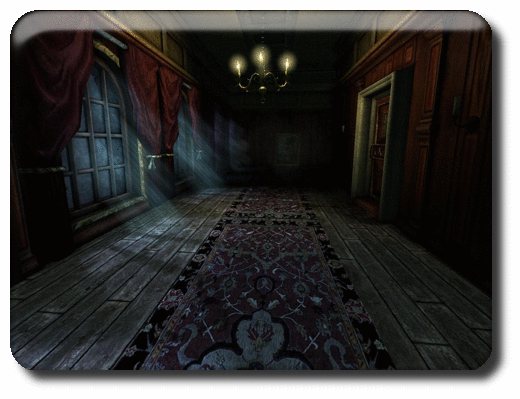 What few actual creatures and entities actually exist in the game are rare and sporadic, making encounters with them all the more fraught. Furthermore, they tend to occur randomly, and can seek Daniel out by sound, by scent, obliging the player to locate hiding places to which they can flee should they be spotted. Even then, if the creatures spy them slipping into a particular room, they can still wrench the door from its hinges and discover the cowering player, leaving the entire game an exercise in escalating paranoia. This is before we even consider Daniel's relative state of mind, which can produce visual and auditory hallucinations, conjure phantoms of smoke and shadow that linger at the edges of sight before dispersing, even cause cockroaches and beetles to swarm across the screen, as though Daniel is in the midst of a schizophrenic episode. It's therefore problematic for the player discerning what's real and what isn't; what constitutes an actual threat and what is symptomatic of Daniel mentally dissolving. It is a brilliant and beautiful example of how subtle horror can be in video games, and one of its most infamous moments is also one of its most conservative: There's an old cliché in independent horror films that: if you lack the budget or means to make the monster, just make it invisible. More often than not, this is a cheap and ineffective device, that comes off as wearisome and absurd rather than distressing. However, Amnesia utilises it to brilliant effect during one of its early stages: Deposited into a series of flooded hallways, Daniel is forced to traverse the stinking, debris-littered water in search of an escape. At first, the corridors seem ominous but empty, nothing but the flooding itself to cause the player concern. However, progressing deeper into the dark, we start to hear strange splashes, as of something lurching through the water. Daniel reacts with rapid breathing and panicked whimpers. Peering into the shadows, we see nothing; no sign of an approaching monstrosity, nothing to indicate what it might be. 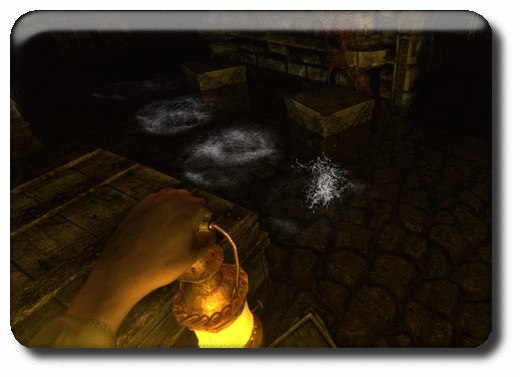 Then, the first splash. Seemingly nothing, just a disturbance in the water, as though some chunk of debris has fallen from the ceiling. Then another. And another. Like footsteps approaching. If the player has anything about them at this point, they might take the oportunity to leap out of the water onto a piece of floating debris. If they do so, the splashes (or “footsteps”) stop nearby, as though whatever unseen entity is responsible waits just beyond reach. Isolated on an island of rubble in an expanse of water that is now profoundly threatening, the player must guide Daniel in a manner redolent of children's games (“The floor is lava!”) from island to island, all the while avoiding the entity that follows wherever he goes. Should the entity catch up with him whilst he's in the water, the player doesn't see precisely what happens: all we hear is a tormented, inhuman growl as the creature starts ripping into us, though via what means we can't precisely say. The sophistication of the encounter in terms of its horror is manifold: first of all, the moment takes full advantage of the aforementioned independent, budgetary trope of the “invisible monster,” not only making it legitimate but insanely terrifying. Second, it has the effect of making a fairly innocuous environmental factor extremely threatening. Thirdly, like many of the creatures in this and other horror titles, it is designed to evoke raw panic, to make the player flail around in terrified confusion rather than acting rationally. The situation itself is not terribly difficult or dangerous, so long as the player keeps to the pathway of debris set out through the water, so long as they do not allow the darkness, the splashes and Daniel's hallucinations get the better of them. But this is incidental: the moment is obscenely powerful and uniquely threatening, especially since, up to this point, Daniel has encountered very little in the way of direct threats to his person. The unseen entity in the water relies upon the player's imagination, allowing them to conjure all manner of Lovecraftian obscenities from the pits of their own subconscious. Nor does the game make the mistake of allowing them to eventually see the entity: the invisible stalker remains so throughout the game, though it recurs again and again, in various different situations. Not only is this one of the most immediately terrifying moments in a profoundly terrifying game, but it also marks a significant departure from the tropes and mechanics familiar to Survival Horror. Were similar to occur in a Resident Evil title or maybe even the infinitely more sophisticated Silent Hill series, it's likely that the unseen stalker would become a combat encounter of sorts, perhaps some form of “boss fight” in which the player is obliged to find a means of combatting and slaying the creature before they are allowed to progress. Here, Daniel is utterly defenceless before the beast, which makes its refusal to touch him when he is not in the water confusing and terrifying: it's as though the entity is playing a game, like a cat with its prey or a psychotic child with an insect. Though it could easily, easily clamber up and dismember him at its leisure, when he is not in the water, the entity simply waits in absolute stillness and silence. Yet, as becomes evident if he tries to venture away from his sanctuary, the creature is still very much present, and will resume its pursuit the instant he steps back into the water. This “cat and mouse” quality renders the entity capricious and cruel, as well as mysterious: it isn't some mindless monster hungry for human flesh, but a conscious, considering and patient entity, that seems to thrive on the fear it causes and revel in the game it plays. One of the most terrifying entities in this entire series, all the more so because we are given no explanation by which it can be defined, and thereby known. (By the by, if you'd like to see firsthand just how terrifying this game is, come and check out my let's play of it at: https://www.youtube.com/watch?v=ayhtpoKbDgw, especially if you'd like to hear me scream like a little girl). 
Comments are closed.
|


Archives
April 2023

|
 RSS Feed

|

|