

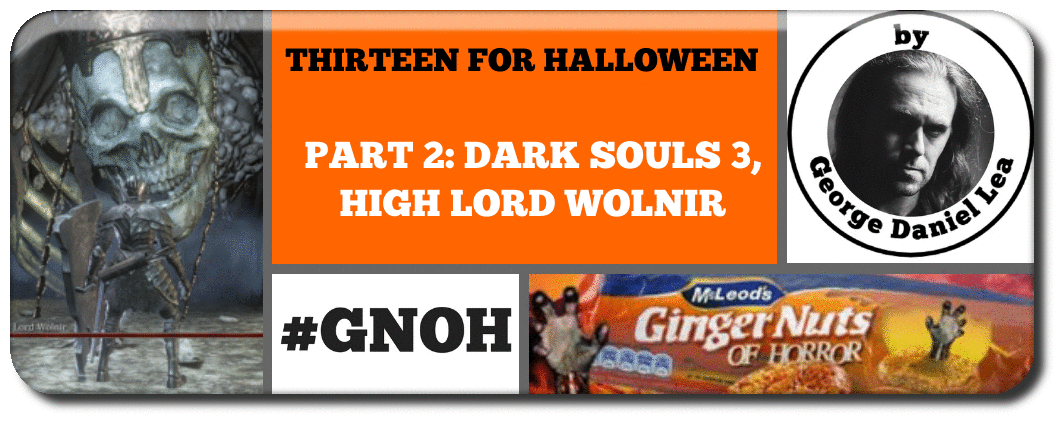
 The Dark Souls series (and its sibling, the incadesently brilliant Bloodborne, which will also be featuring in this series. Likely more than once) introduces us to a very different form of horror from the likes of Resident Evil, Silent Hill or Amnesia: The Dark Descent: Whereas those titles draw on immediately identifiable horror traditions, Dark Souls is of an entirely different breed and lineage: Its setting, its mythology, its aesthetics are those of bleak fantasy, as opposed to B-movie horror traditions (a la Resident Evil) or Lovecraftian metaphysics (Amnesia: The Dark Descent). At first glance, it might be difficult to tell why the game features so prominently on lists of horror titles or why it is so widely regarded by fans of more overt and evident horror. The fantastical settings, with their castles, dungeons, undead hordes, their dragons, their minotaurs and monsters, are, superficially, more redolent of The Lord of the Rings, the fantastical works of Ray Harryhausen or classical myth than, say, the works of Poe, Lovecraft or Shelley. It isn't until the horror fan sits and immerses themselves in the games that the source of their horror becomes clear: Whilst they do utilise some classic horror tropes and methods for their set pieces, the true horror of Dark Souls is far more epic and expansive: a species of mythological horror that evokes despair rather than dread, that suggests surrender to the inevitable rather than reactions of survivalist fright. The Dark Souls series is set not in a single world or plane of existence, but myriad states of being none of which are entirely “real” or abstract: it is a metaphysical state by its very nature, in which a state of mutual entropy exists between antithetical, elemental forces (symbolised in the game by The Void and The Fire respectively). However, this is not a clear cut moral situation in which Fire, redolent of light, life and creation, is unambigously positive or The Void, a power of death, entropy and darkness, is entirely negative: in this reality (and all the realities attached thereto), both forces are capricious, corrupting and potentially destructive, the gods and followers of both engaging in some truly horrendous, world-shattering acts that change the state of play long before the player character ever emerges into the world. As a result, the environments the player traverse are not in a state of mid-apocalypse or even post-apocalypse: this is a realm that is already dead a thousand times over, in which gods and elemental powers have all failed, died, become tainted or corrupted by encroaching madness. Nothing you encounter in this reality is truly alive, and even that which is has lost all sense of itself, from gods to great dragons, from primal powers to the antecedents of all humanity. Here, reality itself is breaking down and bleeding into itself, resulting in rents and warps in time, space and creation, a condition of sputtering entropy in which the dead rise, outnumbering the living, the denizens of both Heaven and Hell pour from their respective abodes (both of which are in mutual states of collapse) and there is nothing, nothing that can bring about the salvation of creation: only that which can hasten it, whether a new state will be born from the ashes or not. Even the player begins the original game as a wretch: undead, cast into an asylum at the edge of creation, with no hope of even death to release them from the turgid decay and madness escalating all around. In such a scenario, there are many and varied opportunities for turning the ostensibly fantastical images and settings to the purposes of evoking dread, horror or distress, and the games go out of their way to do so. But perhaps the most effective for me occurs in the latest (and perhaps last) game in the series: Dark Souls 3, which escalates the situation to the point that realities begin to literally dissolve around the player by game's end: Having navigated the ancient, buried city of Carthus, infested as it is by undead of numerous shape and size, the player comes across the burial chamber of what was clearly the kingdom's ruler: Recalling pagan barrows and necropolises of ancient Egypt and Sumeria, the hall is immense, elaborate, festooned with treasures and the most beautiful artefacts imaginable. But one in particular draws the player's eye: A goblet set prominently on an altar at the heart of the chamber, its shape sculpted to resemble bones and skulls, overflowing with what appears to be a misty darkness; the very stuff of the void. 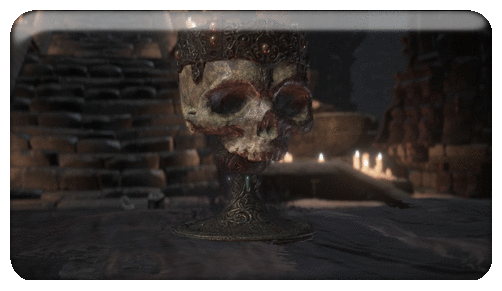 If the player approaches the goblet and interacts with it, a cut-scene occurs in which the goblet begins to overflow with the shadow-stuff, eclipsing the chamber, enveloping the player, snatching them away to some limbo state, in which all is darkness and silence, only the desolate ground beneath their feet visible. Being not only fans of this series but also aficinados of horror, we know what is coming, so we progress carefully, testing the outer boundaries of the arena, until the darkness won't let us progress any further, then retracing our steps back to the starting point. All that provides any clue as to a potential route is a distant light, flickering like a star in the darkness. We approach with all trepidation, waiting for the dark to peel away, for something to loom from it. And loom the inhabitant of this void most certainly does: From the darkness emerges an immensity so huge, it all but fills the screen: a skeletal titan, bedecked in jewels, bangles and a golden crown, its maw and eyes bleeding darkness, its limbs lashing out to pulverise us. This is High Lord Wolnir, one of the most terrifying entities in all of Dark Souls. Again, his design wouldn't necessarily suggest something genuinely frightening: he is, after all, simply a skeletal figure, for all of his immensity. But the nature of his framing, the mythos it suggests, makes him far more impressive than he would otherwise be: When he first emerges from the darkness, it is so close to the player he momentarily eclipses the entire screen, forcing the player to pan the camera up to take in the full scale of him. There's also something peculiar about his positioning and motions; the manner in which he scrabbles at the ground, crawling towards the player away from the abyss itself, suggesting that he is not merely some ancient evil, but is in a state of terror himself. 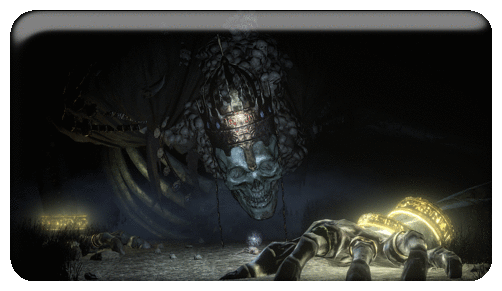 And that is exactly the case: whilst it isn't made overt in the encounter, delving into Wolnir's background suggests that he was originally terrified of dying and of the abyss that he knew awaited beyond death. Thus he utilised ancient sorceries to transform and suspend himself beyond the lip of the abyss. That's where we find him: suspended beyond death and living on the very edge of his own truest nightmare, clinging to light and life by the slimmest of margins. Whilst Wolnir himself is terrifying, the state surrounding him, the semi-sentient darkness attempting to drag him into the Void, is far worse. It also provides some clue as to how to beat the boss: normal attacks do nothing against Wolnir, barely even chipping away at his health. However, the eye is drawn to the sources of light that illuminate his form: two bracelettes decorating his wrists, that the player can attack whenever he strikes. These are the means by which he has shackled and suspended himself beyond death, magical artefacts that he uses to anchor himself not exactly in the land of the living, but beyond the full reach of the Void. In and of themselves, they suggest a species of mythological horror: that the Void is something so hideous, so terrifying, as to drive this Sorcerer-King to such extremes, to make a true abomination of himself. The player must therefore shatter each of the bracelettes, at which point Wolnir screams and is dragged away by the Void. By what means, the player can't precisely make out, but the manner of his disappearance into darkness is almost as terrifying as his emergence from it. Wolnir epitomises the various, subtle forms of horror that pervade the Dark Souls series, and is perhaps the most pertinent example of how metaphysically moribund its reality is.   Comments are closed.
|


Archives
April 2023
|
 RSS Feed

|

|