• HOME
  • CONTACT / FEATURE
  • FEATURES
  • FICTION REVIEWS
  • FILM REVIEWS
  • INTERVIEWS
  • YOUNG BLOOD
  • MY LIFE IN HORROR
  • FILM GUTTER
  • ARCHIVES
    • SPLASHES OF DARKNESS
    • THE MASTERS OF HORROR
    • THE DEVL'S MUSIC
    • HORROR BOOK REVIEWS
    • Challenge Kayleigh
    • ALICE IN SUMMERLAND
    • 13 FOR HALLOWEEN
    • FILMS THAT MATTER
    • BOOKS THAT MATTER
    • THE SCARLET GOSPELS
GINGER NUTS OF HORROR
  • HOME
  • CONTACT / FEATURE
  • FEATURES
  • FICTION REVIEWS
  • FILM REVIEWS
  • INTERVIEWS
  • YOUNG BLOOD
  • MY LIFE IN HORROR
  • FILM GUTTER
  • ARCHIVES
    • SPLASHES OF DARKNESS
    • THE MASTERS OF HORROR
    • THE DEVL'S MUSIC
    • HORROR BOOK REVIEWS
    • Challenge Kayleigh
    • ALICE IN SUMMERLAND
    • 13 FOR HALLOWEEN
    • FILMS THAT MATTER
    • BOOKS THAT MATTER
    • THE SCARLET GOSPELS
GINGER NUTS OF HORROR
horror review website ginger nuts of horror website

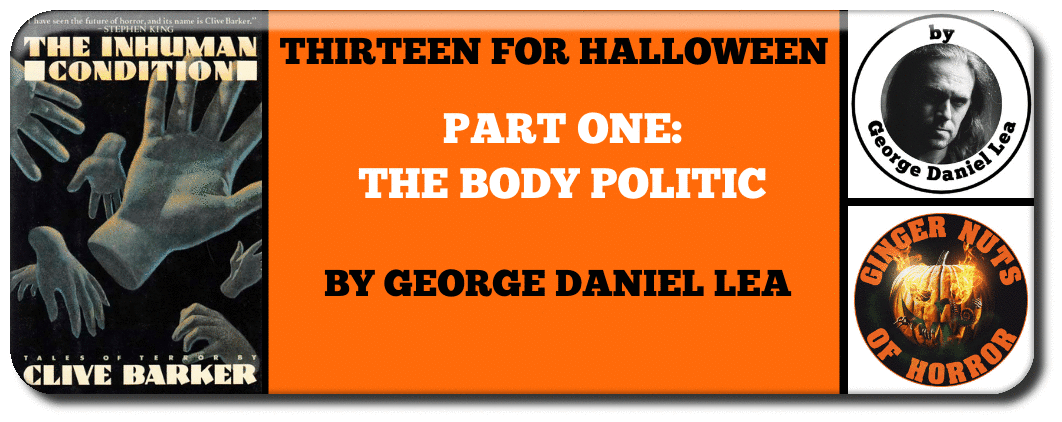
Thirteen For Halloween: The Body Politic

19/10/2020
the-best-website-for-horror-promotion-orig_orig

​Thirteen For Halloween (2020):
 
Part One: The Body Politic

The Body Politic is maybe one of Barker's strangest stories, and one that is the least classically “Barker-esque.”. Not only does it not feature any particularly abstruse monstrosities or elaborate metaphysics, it is one of a rare, rare stable in which Barker provides an implied political commentary, alongside its more direct statements on the nature of humanity itself.
Welcome, welcome and thrice-times welcome, my dearies, my darlings, to this semi-annual affair in which we celebrate in our oh-so-pagan manner the darker days of the year, when the subjects of horror are never far from our minds and we revel in the morbid, macabre and monstrous.
 
In previous years, we've taken a look at horror video games, toylines, video game monsters and all manner of esoteric morbidities. This year, given that it has provided plenty of waking life atrocities, we're going to be familiarising ourselves with the florid creations of an icon of the genre; a monster-maker unlike any other, whose nightmarish children are amongst the most inventive, abstruse and affecting of any who dare rake the darker realms and recesses of humanity's collective sub-consciousness:
 
Clive Barker.
 
Clive Barker, the man behind the iconic Cenobites of Hellraiser fame, the eponymous Candyman (soon to be resurrected on the cinema screen thanks to the stylings of Jordan Peele and Nia DaCosta) and the wildly malformed Nightbreed, to name but a few.
 
For the purposes of this first instalment, let's leave behind the waking horrors of 2020 and drift back, into the earliest days of the man's career, when his short story collections, The Books of Blood, made waves in burgeoning horror genre of the late 1980s, thanks to endorsements from Stephen King as well as their own unparalleled inventiveness.
 
Whilst the books themselves provide numerous subjects that might make this list (look out in later entries for some particularly strange and notable examples), one that sticks with me since my earliest reading isn't necessarily a monster at all; rather one of a significant number in which Barker looks for the monstrosity in us.
 
The Body Politic is maybe one of Barker's strangest stories, and one that is the least classically “Barker-esque.”. Not only does it not feature any particularly abstruse monstrosities or elaborate metaphysics, it is one of a rare, rare stable in which Barker provides an implied political commentary, alongside its more direct statements on the nature of humanity itself.
 
The story is a strangely simple concept, but one handled with incredible depth, wit and profundity:
 
The hands of humanity rebel against the anatomies that “imprison” and enslave them, sparked by a particularly unlikely man's appendages, who have been secretly plotting the rebellion for years. The hands have their own peculiar sentience, and talk in a coded language of gestures and motions, sewing conspiracies on his stomach whilst he sleeps, much to his wife's escalating disturbance.
 
The story is so drawn that, at this point, the reader might believe that the apparent sentience of the hands is nothing but a delusion, that their strange personalities (“Left” and “Right” embodying characteristics of those particular political and ideological wings, but here relying on one another as a means of mutual emancipation) are merely delusions of some diseased mind. Even when they set about murdering their enslaver's wife -choking her while the man sleeps-, the reader might easily believe that the sleeping homicide is an act of sub-conscious aggression.
 
However, following the event, the hands literally set about freeing themselves from the whole. Rather, “Right” aids in “Left's” emancipation by hacking it free with a meat cleaver, leaving the enslaver bleeding and wretched on his kitchen floor. This act of apparent self-mutilation reveals the metaphysics behind the story, in that “Left” does not end up a redundant piece of severed meat, but is now actively its own agent, scurrying along like a spider, silently urging the hands of first the murdered wife and then of anyone it encounters to similarly rise up. In a matter of hours, there is a full blown -and excessively murderous- rebellion in full swing, as Barker paints grimly comic and morbidly slapstick images of people strangling and mutilating themselves, crashing their cars, clawing their own eyes out and hacking at their wrists with scalpels, chainsaws and whatever comes to -a ha- hand.
 
In this respect, the story is far removed from almost anything that would become synonymous with Barker's peculiar brand of metaphysical disturbia thereafter; a wry and subtly political tale in which the metaphysics remains unexplained (the phenomena of the rebellious hands is explored no futher than through the hand's own ruminations on their own existence, which, fittingly enough, tends towards the utilitarian, when not consumed by the Utopian and vengeful visions of the pontificating “Right”). There are no grand movers or designers behind the scenes, no extra-dimensional or other-worldly monstrosities; the rebellion is of an exceedingly familiar sort, especially during the late 1980s, in which Thatcherite ideology had reduced much of the UK to such states of desperate privation, demonstrations and violent uprisings were commonplace.
 
The hands themselves are a peculiar form of “monster,” in that they are not monsters at all; they are, in many respects, examples of the familiar horror trope of taking the familiar and rendering it alien or hostile. In this instance, Barker has hit upon a masterstroke, encapsulating the very essence of “body horror;” i.e. an expression of the -generally unspoken- fear that our bodies will, one day, rebel against us. In that, the hands not only lead the reader to regard their own anatomies with suspicion, but also reflect certain escalating concerns of the era (developing medical technology and genetic understanding allowed human beings to comprehend more about their own bodies than they ever had before, not to mention the pervasiveness of news media providing more in the way of medical information -not to mention hyperbole and distortion- than any previous generations had enjoyed). Phenomena such as escalating public understanding of Cancer and its causes, the AIDs epidemic and numerous other examples are all metaphorically reflected here, lending the story a certain resonance with other forms and works of horror that were becoming vogue at the time (e.g. Cronenbergian body horror, gore and mutilation pieces such as The Evil Dead, Cannibal Holocaust etc).
 
Part of the point of the hands and their rebellion against humanity is that they are not monsters, no matter how we might perceive them or media might well have portrayed them in the aftermath; they are us: living, breathing and, it transpires, sentient entities that have grown weary of our casual neglects and abuses and have finally found the means and opportunity to rise up against their oppressors.
 
Whilst Barker himself has since gone on to largely abandon any conscious or concerted examination of politics in his work – regarding it as “. . .the arena of dead men,”-, The Body Politic is fairly overt in its implications, given the era of its publication and the social ills that it metaphorically reflects: hands are, by their very natures, “working class” organs; they are the slaves of the body entire but upon which the entire depends for its survival. They are organs that scrub and clean and feed and dress and wipe and wipe the arse of the rest, whilst the more privileged (e.g. eyes, tongues, nostrils) serve far more specific, specialised functions that we tend to romanticise far beyond their genuine conditions or the benefit they provide to the wider whole.
 
In that, the hands are far more than the mere slapstick and body horror images they might superficially present; there is a sincere depth of metaphor here that might not be immediately apparent from a surface or initial reading. A grounding in certain examples of philosophy and political ideology -Marxism not least amongst them, alongside a healthy dose of psychoanalytic theory- is essential to understanding Barker's uniqe form of commentary, especially given that the story contains enough grim irony in and of itself to satisfy the casual reader.
 
A rare example of a Marxist monster in Barker's work, The Body Politic's hands are one of numerous commentaries on the human condition that The Books of Blood contain, and one of the least remarked upon -but metaphorically intriguing- of Barker's menageries.
 
By George Daniel Lea 
the-best-website-for-horror-promotion-orig_orig
Picture

Comments are closed.
    Picture
    https://smarturl.it/PROFCHAR
    Picture

    Archives

    April 2023
    March 2023
    February 2023
    January 2023
    December 2022
    November 2022
    October 2022
    September 2022
    August 2022
    July 2022
    June 2022
    May 2022
    April 2022
    March 2022
    February 2022
    January 2022
    December 2021
    November 2021
    October 2021
    September 2021
    August 2021
    July 2021
    June 2021
    May 2021
    April 2021
    March 2021
    February 2021
    January 2021
    December 2020
    November 2020
    October 2020
    September 2020
    August 2020
    July 2020
    June 2020
    May 2020
    April 2020
    March 2020
    February 2020
    January 2020
    December 2019
    November 2019
    October 2019
    September 2019
    August 2019
    July 2019
    June 2019
    May 2019
    April 2019
    March 2019
    February 2019
    January 2019
    December 2018
    November 2018
    October 2018
    September 2018
    August 2018
    July 2018
    June 2018
    May 2018
    April 2018
    March 2018
    February 2018
    January 2018
    December 2017
    November 2017
    October 2017
    September 2017
    August 2017
    June 2017
    May 2017
    April 2017
    March 2017
    February 2017
    January 2017
    December 2016
    November 2016
    October 2016
    September 2016
    August 2016
    July 2016
    June 2016
    May 2016
    April 2016
    March 2016
    February 2016
    January 2016
    December 2015
    November 2015
    October 2015
    September 2015
    August 2015
    July 2015
    June 2015
    May 2015
    April 2015
    March 2015
    February 2015
    January 2015
    December 2014
    November 2014
    October 2014
    September 2014
    August 2014
    July 2014
    June 2014
    May 2014
    April 2014
    March 2014
    February 2014
    January 2014
    December 2013
    October 2013
    September 2013
    August 2013

    Picture

    RSS Feed

https://l.facebook.com/l.php?u=https%3A%2F%2Fmybook.to%2Fdarkandlonelywater%3Ffbclid%3DIwAR1f9y1sr9kcIJyMhYqcFxqB6Cli4rZgfK51zja2Jaj6t62LFlKq-KzWKM8&h=AT0xU_MRoj0eOPAHuX5qasqYqb7vOj4TCfqarfJ7LCaFMS2AhU5E4FVfbtBAIg_dd5L96daFa00eim8KbVHfZe9KXoh-Y7wUeoWNYAEyzzSQ7gY32KxxcOkQdfU2xtPirmNbE33ocPAvPSJJcKcTrQ7j-hg
Picture