

 Reflections on filmmaking, depression, and the benefits of embracing the darkness. 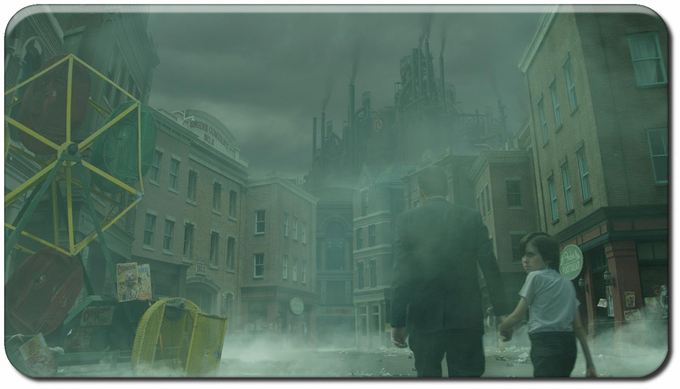 IN A FOREIGN TOWN is a short horror film based on the stories of Thomas Ligotti, who the Washington Post has called “the best kept secret in horror fiction.” In it, we tell the story of a man haunted by a terrifying apparition years after being abandoned by his father in a strange town. Among the film’s themes is the lasting effects of unresolved trauma and how traumatic experience can be passed down across generations. At first, I did not intend to make a film about these motifs. My original impulse was simply to bring to life the world of an author’s work I deeply admired. What I didn’t expect was that through the creative process, my relationship to depression, anxiety and so-called “negative” emotions would forever change. In my journey through Thomas Ligotti’s world, I discovered the psychological “darkness” which I’d so feared, so fought, and so resisted-- was the very thing that connected us all. The world of Thomas Ligotti “..Rampant oddity seemed to be the rule of the realm; imperfection became the source of the miraculous—wonders of deformity and marvels of miscreation. … It was a nightmare transformed in spirit by the utter absence of refuge: nightmare made normal.” Thomas Ligotti, VASTARIAN I discovered Thomas Ligotti’s fiction as a young literary agent and was captivated. His writing evoked the existential horror of Lovecraft, the eloquence of Poe and the biting absurdism of Kafka, and yet was wholly original. Ligotti’s characters are lost souls. Keenly aware, yet powerless, they are doomed to watch as an absurd and pitiless universe devours them. They are victims not of external monsters—but rather of a nightmarish experience of life itself. There was another reason why Ligotti’s stories resonated with me so profoundly: At that time in my life, I was struggling with depression. The recurring milieu of Ligotti’s stories--decaying labyrinthine cities, desolate “skeleton” towns--described my inner world: a place of emotional darkness, mental fog and distorted reality. A place where I felt alone, lost and unsafe. A place that foiled every effort to escape. Ligotti’s stories are rooted in philosophical pessimism, a worldview which (in Ligotti’s words) challenges the popular notion that “being alive is all right.” Surprisingly, his bleak perspective didn’t aggravate my pain. Instead, the stories gave form to my feelings of alienation. They validated the experience of not feeling at home, either in my own body—or in the world. Some part of me felt seen, acknowledged and comforted. Being not okay is not okay “…Those who suffer intolerably learn to hide their afflictions, both necessary and unnecessary, because the world does not run on pain time but on happy time, whether or not that happiness is honestly felt or a mask for the blackest despondency.” Thomas Ligotti, THE CONSPIRACY AGAINST THE HUMAN RACE Many of us are taught that not feeling okay… is NOT okay. To feel alone, afraid, or angry, to cry or show sadness, to admit helplessness – we learn that these things are not acceptable. Consequently, we bind them in shame, punishing ourselves before the world can punish us. We learn to keep these feelings hidden; from others— and sometimes even from ourselves. Whether these pressures originate from parents, teachers, social groups, or media; whether the directives were expressly stated or unspoken; they reinforce a uniform subtext: if you’re not “strong,” or “in control”, if you don’t “have it together” and feel “all right”… there is something wrong with you. Ligotti calls this cross-cultural chorus “The Conspiracy Against the Human Race.” Ligotti’s stories were an antidote, creating space and permission to feel “not all right.” And in the face of the pressures to feel “normal,” that alone was a huge relief.  Depression as a place Years later, having left representation for a directing career, I reached out to Mr. Ligotti with an idea for an anthology television series based on his IN A FOREIGN TOWN, IN A FOREIGN LAND collection. Set in a nameless town “near the northern border,” the surreal atmosphere of these stories suggested a dream-like underworld where our characters lose themselves. As the adaptation developed, I became fascinated with the idea of the Town as a stand-in for that familiar place I’d find myself when anxious or depressed. In THE DREAM AND THE UNDERWORLD, depth psychologist James Hillman proposes that there’s a benefit to taking the mythic idea of the underworld seriously, and to an extent, literally. In Hillman’s model, the Underworld is a place where our consciousness travels during the dream state. We find underworld territories described across cultures: whether it’s the Hades of Ancient Greece or the Shamanic “Lower World”, each describes a journey of the soul - in death, in dreams, or through psychedelic experiences. In these Underworlds, the rules of the “Dayworld” don’t apply. As we know from our shared dream experiences, this is a surreal, topsy-turvy place with its own “dream-logic” and strange physics. Pop culture echoes this—from the uncanny TWILIGHT ZONE to the “Upside-Down” shadow-realm of STRANGER THINGS (which itself suggests the Ancient Egyptian Underworld where “the dead walked upside-down, feet up, heads down.”) As I worked on the adaptation, I wondered: what if my descents into depression were an underworld journey? What if this was not an “illness” but a natural process? Considering depression as a place opened the possibility that the territory could be explored, perhaps even mapped. Suicide Crisis Hotline Shortly after completing the first draft, I signed up to volunteer at a Suicide Crisis Hotline. This experience showed me the power of simply listening and acknowledging another person’s emotional darkness without judgement. Counterintuitively, we were trained to invite sharing around subjects of death, suicidal thoughts, pain and trauma. As one of our instructors put it, our job was to “sit with our callers in their dark place.” I was continually moved by the power of connection and empathy to de-escalate and settle the nervous system. For those in crisis, in the upside-down underworld of depression or addiction, the experience of being alive—in that moment—is very much not all right. In that moment, we are psychically crying out in pain, asking to be seen, asking to be heard, desperate not to be rejected. And while the circumstances of individual suffering might be unique, denying, avoiding, resisting, and silencing its voice makes everything infinitely worse. By facing, naming, and connecting through our shared vulnerabilities there is a potential for a “better” to emerge. But to create space for “better,” we must first acknowledge where we’re not okay. Telling our stories “Soon my thoughts became fixed upon a town, picturing its various angles and aspects, a remote town near the northern border.” Thomas Ligotti, IN A FOREIGN TOWN, IN A FOREIGN LAND The series adaptation later gave rise to a short proof-of-concept film. Taking IN A FOREIGN TOWN on the festival circuit, I got to meet other Thomas Ligotti fans and sometimes hear personal stories of how his writing had helped them cope and persevere through dark times. Connecting to other people through my own and others’ work was the most rewarding of experiences. Ours was a kinship born of a shared love of nightmarish underworlds and seeing the world askance. After all, creating human connection is the abiding power of literature and cinema. Storytelling bonds us through shared experiences—and especially our vulnerabilities. Horror stories give us permission to be afraid, they show us we are not alone in our suffering, confusion and weakness. Perhaps ironically, it is through sharing what we most fear that we find connection, community and strength. And with the lifting of shame, stigma and isolation, comes the possibility of healing. Acknowledging the darkness was a gift I received from Thomas Ligotti. It is my hope that our film can pay it forward.  Michael Shlain is a writer-director working in Los Angeles. His short film, IN A FOREIGN TOWN, based on the works of Thomas Ligotti can be seen at www.inaforeigntown.com. A TV Anthology series of the same name is currently in active development. TODAY ON THE GINGER NUTS OF HORROR WEBSITE BEHIND THE SCENES OF SPAWN: WEIRD HORROR TALES ABOUT PREGNANCY, BIRTH AND BABIES, – PART THREE THE HEART AND SOUL OF HORROR WEBSITES Comments are closed.
|


Archives
April 2023

|
 RSS Feed

|

|