

 From the film franchises of the 1980s and 1990s that children probably shouldn't have watched (but which we did. Often over and over again.) to video games that children probably shouldn't have played (though we did. Over and over again.): It's somewhat difficult to talk about Resident Evil without descending into cliché; so much has been written and said concerning this franchise; it has been dissected down to the finest molecules, its atoms separated one by one and dispersed on the taciturn gales of media criticism.... 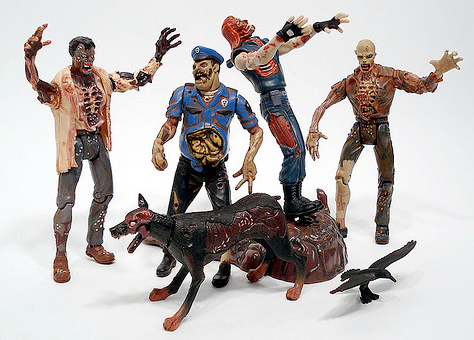 It was and remains a d phenomena; not the first example of video game horror by any means (if you search around these here haunted corridors, you might find a number of other articles exploring certain horror-based video games of yore), but Resident Evil was the title that brought horror video gaming kicking and screaming into the mainstream; that cemented the sub-genre of “Survival Horror” (essentially consisting of situations in which you play a hideously vulnerable character with limited resources in an extremely fraught and terrifying scenario) as a principle one in the video game market. For those of us who were in our adolescence when Resident Evil hit (closely followed by the seminal Silent Hill), the game represented soemthing very special, particularly considering we had grown up with video games almost since their inception; had seen the format evolve and transform in ways that often blew our not-quite-baked minds. Considering that we had also grown up in the midst of some of the best mainstream horror media to exist (a golden age that arguably stretches from the late 1960s right up to the mid 1980s), to be able to play a video game that evoked the feeling of those films and comics and novels was an experience I will always, always treasure: A cold, cold room (where our various computers were located), no lights; Christmas shennanigans at play downstairs. Me; a fairly isolated, highly imaginative child; always more at home in his own head than with other children, lost in the labyrinth of the Arklay Manor, waiting for the squelching, moaning monstrosity around the next corner to make itself known... There have always been video games that snared my imagination and drew me into their worlds, often to the detriment of the waking one, it has to be said. For all its B-movie hokum, Resident Evil and its sequel numbered amongst them. I found myself utterly obsessed with the setting, the background, the monsters and mythology; the atmosphere it evoked, as did any number of others: the game becoming the stuff of rumour and conversation throughout the corridors and play yards of my high school. That there would be toylines based on the franchise shouldn't come as any surprise, but it did: like Silent Hill, Final Fantasy VII, Metal Gear Solid and far too many franchises of the era to list, Resi transcended the parameters of video game culture and leaked out into general cultural consciousness, inspiring comics, numerous terrible films and, of course, a toy line. Unlike many in this series, Resident Evil was never explicitly marketed to children (though I do distinctly recall it flattering the shelves of children's toy stores in my home town): inspired by the absurdly detailed and grotesque output of Todd McFarlane toy lines, the range consisted of designes derived specifically from the video games; not interpretations or adaptations of the models, but three dimensional recreations of the models themselves, all of which are lovingly detailed (down to the most grotesque and un-child friendly minutiae), boasting a range of fairly disgusting gimmicks and accessories, not to mention a range of articulation that was exceedingly rare at the time. 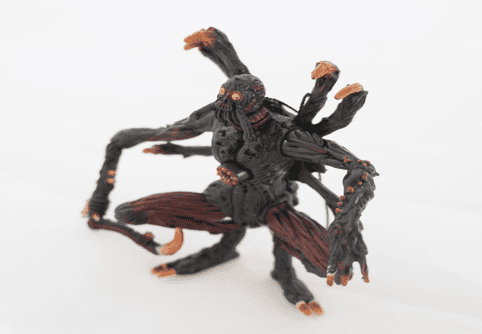 Whilst undeniably toys, the range was one of those that transcended traditional markets; being one that appealed as much to teenagers and adults as well as children in the forms of collectors pieces and fan-apparel. Being as detailed and exquisitley produced as they were, there's no denying that they were made to appeal to the adult eye (their subject matter notwithstanding); a market that would have certainly been detered by cheaper products or poorer quality. As for the figures themselves, the range is vast, deriving principally from the first two games in the series (though also boasting a number of key characters from Resident Evil 3 and Code Veronica). Alongside the ubiquitous zombies (of which there are a number of designs derived from the games, all boasting their own grotesque details and gimmicks), there are also figures of the “Cerberus;” T-Virus infected zombie-dogs, with their rotted, half-gnawed off faces, their exposed entrails and rib-cages, Hunters (bipedal, lizard-like monstrosities that replace the zombies a little later in the game) and even some of the larger nasties such as the final boss of the original game, the genetically-engineered bio-weapon, Tyrant. Set against them are the various human characters of the games; player characters Jill Valentine and Chris Redfield, Barry Burton and Albert Wesker...all fantastically accurate to their in-game models, with apparel and accessories redolent of how they function in-game. Arguably the strongest figures in the series (and certainly the most abitious) derive from the game's sequel, which boasted a far more surreal and inventive cast of monstrosities: a superb and exquisitely detailed plastic rendition of the game's plant monsters (complete with whipping tentacles and the ability to spit “venom”), the iconic “Lickers” (hideous entities that resemble flayed human beings with swollen, exposed brains, enormous talons and a whipping tongue) and, my personal favourite in the entire range, William Birkin; the scientist responsible for creating the various viruses that produce the game's monsters, now host to his own creation, and easily one of the most disturbing creatures in both the game and the toy range: 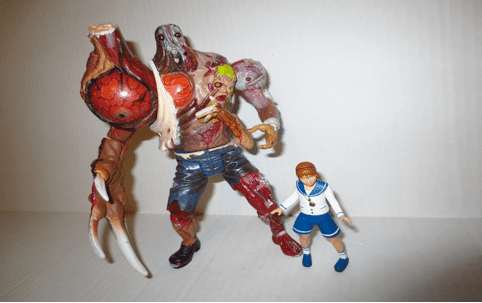 In the game, Birkin is a consistent enemy; arguably the prototype for later monsters who would stalk the player throughout the game's playtime. In each and every encounter, he mutates further, becoming less and less human until he finally devolves into a Lovecraftian, Shoggoth-like mass of eyes, maws and tendrils. This particular toy incarnation depicts Birkinduring one of his earliest stages; a significant amount of humanity still evident, but swollen and distorted; patches of skin pock-marked and decaying, one arm extended into an immense talon of bone. Perhaps the creature's most disturbing feature is that its head has sunken down towards its left shoulder, allowing for the protuberance of a new mass; a secondary, far more bestial head, its right shoulder swollen to absurd proportions, an immense, blood shot eye gaping within. The toy makes an action feature of this latter design (which is so detailed as to even boast a sclera of clear plastic), a switch on Birkin's back allowing it to be swivelled and rotated, as it does in the game when seeking out its prey. Always my favourite monster in the games, Birkin's toy incarnation is an absolute joy; a stunning rendition of the on-screen monster; weighty, detailed and exquisitely produced. There is also a rendition of Birkin in one of his latter forms, which is entirely inhuman; a loping, quadraped beast with a gaping maw at its front end that erupts with all manner of tusks, horns and teeth, numerous redundant limbs flailing on his back...a stunningly elaborate and disturbing monster, as the game series became infamous for, and one that is well worth owning. Perhaps the most surprising inclusion in the toy line is the relatively obscure “Mr X;” the precursor to the Nemesis monster that would stalk the player character throughout the third game, Mr. X is a creature that only occurs in the second scenario of each character in the Resident Evil 2 game; a mysterious hulk of a man, wrapped around in an ankle-long trench-coat, who is dropped into the setting of Raccoon City by the Umbrella Corporation to deal with any survivors (i.e. you). The creature turns up at various set locations throughout the game, often bursting through walls or dropping through ceilings, terrifying the life out of the player, and is very difficult to actually deal with; even when he falls, he is only wounded and will stand up to stalk you again. 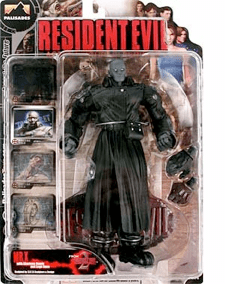 In game, he becomes one of the last bosses of the tertiary scenarios, dropping into a vat of molten stuff, presumably to his death, only to emerge sans trenchcoat and mutated into his final form: that of a new and much nastier form of Tyrant, with immense, scythe-like talons and a penchant for impaling victims or ripping their heads clean off. The toy incarnation of Mr.X/The Tyrant cleverly boasts the ability to switch between the two states, simply by removing the former's trenchcoat and applying a number of accessories. Later games also boast their own lines, through nowhere near as extensive as these original two: both Nemesis, the giant, highly intelligent bio-weapon creature that stalks the player character throughout Resident Evil 3 and Jill Valentine boast their own toys, as do numerous “Ganados;” the parasite-infested and controlled creatures from Resident Evil 4, that replace the series' iconic zombies. Though it has somewhat dwindled in recent years along with the relatice quality and popularity of its parent franchise, the Resident Evil toy line is one well worth looking into, certainly from a collector's perspective, as the toys are almost universally of exceptional quality and insane levels of detail. If you're a fan of body horror, surreal and disturbing monsters, distortions of human anatomy etc, then this is toy line is one that will endlessly delight. 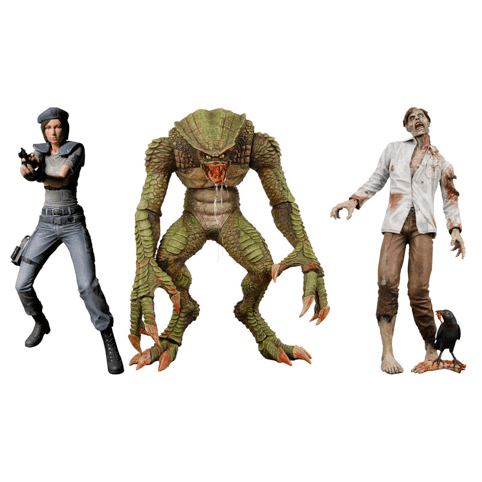 Comments are closed.
|


Archives
April 2023
|
 RSS Feed

|

|