

TWELVE TERRIFYING TOY FRANCHISES: SPAWN
21/12/2016
 A children's toy line based on a comic whose back mythology involves a Faustian pact with a demon from Hell, political corruption, questions on the morality of military service and the notion of moral violence, serial killers, a sub-plot involving a child abuser and murderer of children, a demonic clown that has more than a hint of John Wayne Gacey about him... 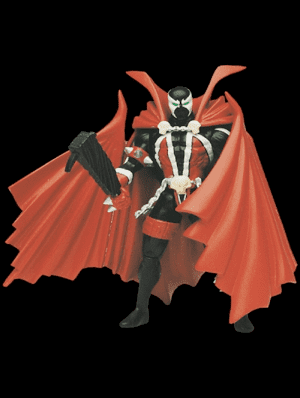 The 1990s were certainly an interesting time when it comes to children's media. During the mid-to-late 1990s, comic books as a whole were in a state of flux and (often agonising) renaissance; the prominence of franchises such as The Crow, V For Vendetta, The Sandman et al shaking up the fairly stagnant and saturated super hero market, certain significant revolutions happening within industry giants such as Marvel and DC...the days of the primary-coloured, morally absolute, often jingoistic or hideously conservative super hero were dying, leaving in their place an appetite for a somewhat darker, more ambiguous breed. Spawn is arguably the most enduring and iconic product of this era, creating its own sub-franchise to rival the likes of Batman or Spiderman, and catapulting creator Todd McFarlane to near super star status. Despite the characer's prominence in comic book cultures of the era, he wasn't terribly well known this side of the pond until much later; like most of my generation (I was only a child at the time), my first exposure came in the form of a toy line designed explicitly to market the comic book: 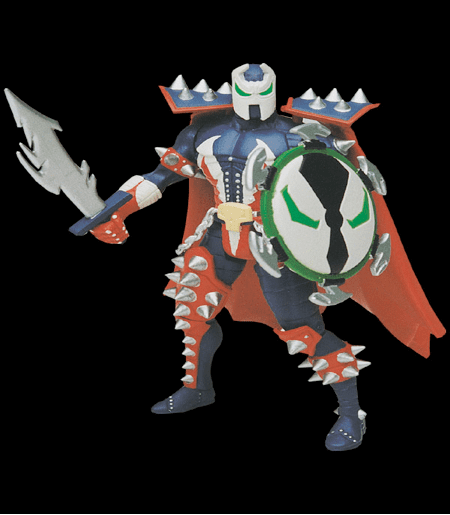 I distinctly recall the day I noticed the figures on the toy store shelves, my attention snared in particular by the rotund and disgustingly detailed Clown figure, as well as its alternative form, the wiry, distorted and demonic Violator. I and my brother left the store that day with two figures each; my own set consisting of the Violator and the Medieval Spawn, whilst my brother had the Clown and the iconic, central Spawn of the franchise (AKA Al Simmons). Whilst the figures themselves proved extremely entertaining (I recall many lost afternoons enacting various stories and scenarios with the Violator figure), it was the comics that demanded the vast majority of my attention: Barring the likes of 2000AD, I'd rarely come across comics that had such grim and disturbing subject matter; that consisted of such dirt, filth and psychological darkness. This led to an abiding fascination with the franchise that has endured, to a degree, to the present day. Whilst so iconically 1990s as to come off as somewhat camp these days, the central Spawn character and mythology has a great deal of potential to be significant, particularly in an era of such ideological extremism, political upheaval, wholesale corruption etc etc. Unlike so many super hero comics, which are, ultimately, about reinforcing certain cultural meta-narratives and insisting upon the absolutism of certain moralities, Spawn serves almost as a parody of that factor; its characters tormented, morally ambiguous, often deeply flawed and unpleasant (Al Simmons, the titular Hell Spawn, is not a nicr guy or a particularly good guy, though he believed himself to be, while he was alive. A soldier, an assassin; he justified his numerous acts of murder and violence with protests of patriotism and service, not realising that with every act, he was condemning himself to damnation. When he eventually emerges from Hell, having made a pact with the demon, Malbolgia, he's a self-loathing, bitter, angry and agonised creature, half forgotten to himself; a wretched thing that is as far from the likes of Spider Man or Super Man as it's possible to get, and deliberately so), its setting and mythology presenting numerous problematic and no-win scenarios: very often, it does not matter how a character acts or what decisions they make; they are condemned. This degree of ambiguity and moral nihilism has had a tremendous effect on comic books as a whole, but most notably on established super hero franchises, all of which took a cue from this and numerous other titles of the era, injecting their core characters with a degree of the same. 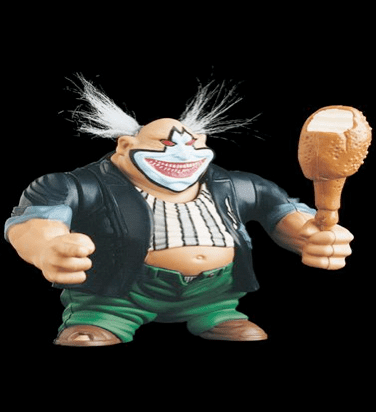 As for the toy line, it ranges in quality from the passable to the fairly bad: whilst the likes of the Violator is a splending piece of work; a wiry, rubbery and hunched creature with abundant sculpted detail and some fitting gimmicks, the central Spawn figure is extremely lacking; sparse on detail and articulation, the plastic of its iconic cape ridiculously thin and extremely brittle. Meanwhile, its Medieval Spawn counterpart is an excellent piece, with numerous painted and sculpted details, some fun (but unobtrusive) gimmicks and a certain atmosphere of mystery evoked by its skull-like helm and glowing green eyes. Other entries in the line are...perplexing. Whilst a prominent character in the comics, cyborg assassin Overkill doesn't really fit in with the rest of the range (too vast, too clunky; far too reminiscent of villains one might find in the likes of the super hero comics that Spawn is intended to parody). Similarly, the almost ubiquitous super hero car (even Spider Man had one of these) doesn't feel right, no matter how cool a toy it might be, whilst the Violator-possessed truck is a stunning piece of work, complete with grizzly organic details such as a bone rib-cage, a gaping open maw at its front and numerous other pleasingly gruesome touches. It's certainly arguable (almost certain, in fact) that the toy line itself was only ever intended as a kind of stepping stone (or gateway drug) to the comics, which perhaps explains why it is such a small toy line and why the figures are so various in quality and design. Even so, the line certainly succeeded in snaring my attention and those of numerous children of the era, and drawing them into a comic book culture they might not have otherwise known existed. 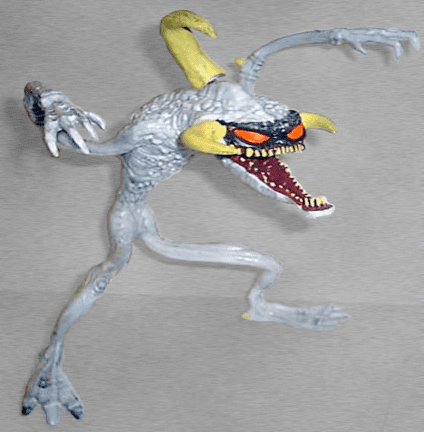 Nor was this the end of Spawn as a toyline; far from it: later series (many of which were produced by Todd McFarlane's own companies) would cater to somewhat older and more sophisticated markets; renditions of Spawn himself and his various enemies and allies derived from cerain scenes in the comics; hyper-detailed, hand-painted pieces with decorative and scenic bases, portraying everything from the titular Spawn himself in various states, guises and situations to Hellspawned dragons, the Violator and its kin, numerous angels, demons and mortal agents all derived from iconic scenes and stories within the comic book. 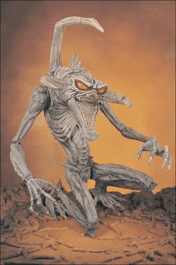 Along with numerous other lines (including a few we'll be looking at in detail later), the latter Spawn series (of which there are far, far too many to explore in any great detail) cemented McFarlane toys's particular reputation for figures of the most explicit and eye-watering detail, as well as of degrees of character and dynamism that are rarely seen in mass produced or child-focused toy lines. A cursory web search will turn up images that would not look out of place on an Iron Maiden album cover or that of a horror film book or DVD; the toys evolving in line with the imagery and art style of the comics themselves, which have become increasingly darker and more dementedly detailed since the 1990s, not to mention the developing tastes of its established fan base, many of which were first exposed to the material via the earliest (and certainly crudest) toy line. 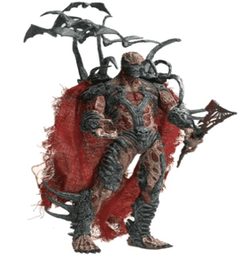 Comments are closed.
|


Archives
April 2023
|
 RSS Feed

|

|