

TWELVE TERRIFYING TOY FRANCHISES
3/1/2017
 The “interactive video board game” was a short lived phenomena in the mid to late 1990s. At a time when boardgames were struggling to compete with the burgeoning (but already pervasive) video game market, many turned to incorporating televisual technology as a means of making themselves more relevant to younger audiences. For the most part, such products consisted of fairly traditional boardgames leant added flare and flavour by a video “host,” who would provide instructions and tasks throughout the game. Arguably the most significant (and certaily most iconic) examples is the video boardgame, Atmosfear (known as Nightmare outside of Europe, where it was renamed so as not to be confused with the children's TV show, Knightmare). 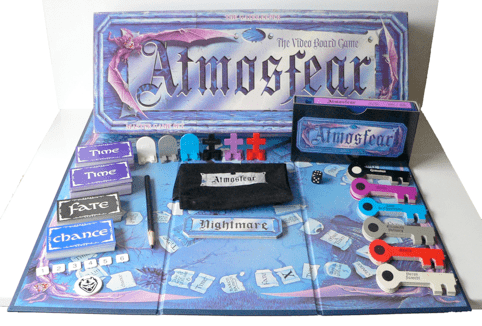 Not merely a boardgame with a televisual host, Atmosfear is also an exercise in inspiring dread and tension: the mythology of the game involves a collection of undead creatures, each of whom is based on “real life” myths, legends and historical figures (for example, players might find themselves in the role of Voodoo Loa, Baron Samedi or the vampiric murderess, Elizabeth Bathory). The game strikes a particular chord from the first instance, with its references to extremely dark and morbid subjects (ranging from voodoo and zombie lore to that of witch burnings, werewolves and Egyptian mummies). Each taking the role of one of these creatures, the players must make their way around the cemetery-styled playing board, collecting keys by performing various tasks or landing on particular squares. If they collect all of their keys, they can unlock the gates that lead to the centre of the playing board, where they must face and conquer their worst fears (written down before the game begins) in order to win. However, the players only have one hour to complete the task, throughout which they are harassed by the game's host, the self-proclaimed Gate Keeper. The Gate Keeper is the heart and soul of the original incarnation of the game; initially a cloaked and hooded figure, he demands absolute obeisence from the players, appearing with a burst of thunder and growling: “STOP!” at which point all players must cease play and attend to his every word. The Gate Keeper is not played for laughs; the actor responsible seems genuinely unhinged, snarling, shouting at and threatening the players, imposing penalties for disobedience or for not completing his tasks. When called by name, colour or number, players must answer: “Yes, my Gate Keeper!” or they will face consequences, which the Gate Keeper himself is quite explicit about. 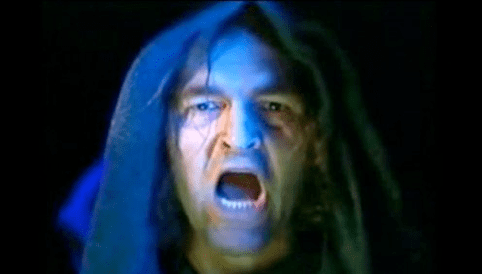 As for the tasks and games he imposes, they range from hideously difficult number puzzles to memory games and word play, many of them extremely complex, even for young adult players, let alone the children who were the game's main audience. As the game progresses and time runs out, strange noises begin to emit from the video tape; rustlings, whispers and scrapings, as well as chords of distressing music. As for the Gate Keeper himself, he periodically withers and transforms, seeming to rot on screen, becoming more decrepit and corpse like, until the last minutes of play, at which point he is almost wholly demonic, even his voice growling and screeching with strange after-echoes. As the name of the game suggests, it is dense with atmosphere; a brilliant activity for Halloween nights or after dark sleep overs; one that had many more timid or sheltered children fleeing from the game table in terror. Having played it a number of times as a child, I can attest that, even knowing the video tape inside out, it is monstrously difficult, incredibly tense and enormous fun; so much so, that it went on to spawn a variety of sequels and add ons: The second instalment in the series comes in the form of an add on pack that contains new playing cards and a new video tape, the host of which is one of the player creatures from the original game: the zombie, Baron Samedi. Whilst initially more comedic than the Gate Keeper (Samedi comports himself as a hip and jovial zombie with a penchant for quips, puns and party-lingo), he is also far, far more difficult to handle, and infinitely less fair to boot. The Baron's games are of another order ot magnitude to the Gate Keeper's, consisting of audio cues that the players must remember and repeat particular phrases when they occur, as well as number and memory games that the Baron baltantly cheats at. Worse, if you are particularly unfortunate, you will be assigned as “The Dirt Bag,” a player to whom the Baron takes a particular dislike, and will torment and harass throughout the run time. There's even a point at which he orders “Dirtbag” to leave the play table so that the other players can roll a particular number of the play dice, which Dirtbag must then guess within a set period of time or suffer penalties. Being the Dirtbag is a lot of fun, but it makes the game almost impossible. Like the Gate Keeper, the Baron changes and degenerates throughout the run time, becoming more dessicated and demonic, not to mention more malevolent, until his eyes become black, his voice growling and spine-tingling, the frequency and difficulty of the penalties he imposes towards the last ten minutes of his hour making the game practically unwinnable at that point. 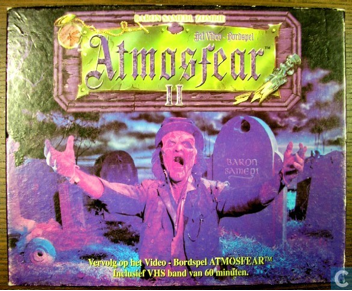 The second supplement to the original game was somewhat more expansive, containing not only new fate, time and chance cards, but also new special rules concerning the gathering together and casting of various “spells” that would have effects throughout the game. The host of this tape is Anne de Chantrain, a woman who genuinely was burned as a witch at the age of seventeen, and who here initially appears as a beautiful young woman with a sultry French accent. However, as the run time progresses, she begins to become more dishevelled, her hair and clothes rotting, scars and burn marks appearing on her face, her teeth becoming jagged and rotten. Perhaps the most disturbing feature; she begins to grunt and screech like a pig, writhing as though in flames. At her most hideous, a spike of black bone bursts through her nose, lending her the look of a classic witch. Easily, easily the most distressing and disturbing of the hosts, not to mention one of the most difficult to deal with: just as the Baron before her assigns one player as “The Dirtbag,” Anne transforms players into a variety of animals (Rat, Toad and Wart) whom she assigns various “tasks,” which become increasingly difficult as the game progresses. Rat, Toad and Wart might also be given the unpleasant task of undermining other players, which can lead to a great deal of fun at the playing table. 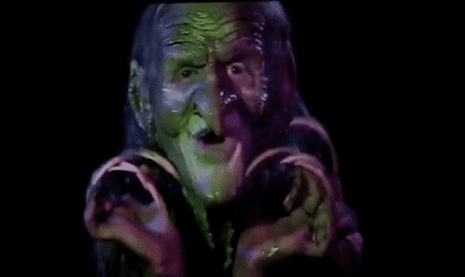 The final instalment for the original game is easily one of the most difficult to get a hold of, being produced at the end of the original game's shelf life and not being quite as well distributed as the rest. It was also the first instalment of the game that was explicitly marketed to adults, being somewhat more overt in subject and darker in tone, not to mention being erasily the most difficult of all of the versions of the game ever to be released. This time, play dives into the forests and castles of Transylvania, for a seductive game of blood and flesh in the court of Countess Elizabeth Bathory; a real life countess and murderess, generally regarded as one of the most prolific serial killers in all of history (estimates put her body count at around 600 victims), Bathory would murder the youths in her employ and bathe in their blood, believing that the practice kept her young and sustained her beauty. She was eventually bricked up in her own tower when her predations turned to her fellow nobles, by which point, she'd already amassed scores and scores of victims. Over time, Bathory and the mythology of vampires have become intertweined; there's even some speculation that she inspired certain aspects of Bram Stoker's iconic novel. In this incarnation, Bathory starts as an exquisitely beautiful and aristocratic woman, decked out in fine laces and jewellery, her manner subdued and seductive (no doubt part of the reason for the game's suggested adult age range). As play progresses, she undergoes the most ambitious metamorphosis of all the hosts, developing fangs and bat-like features, her arms becoming immense, bat-like wings that enshroud her, metallic spines sprouting from her head. By the end of the game, she is utterly inhuman; a silver-eyed, needle fanged monstrosity with a metal mask covering the lower half of her face. She is without a doubt one of the most distressing and vicious of the hosts, the games she plays the most complex and devious, the penalties she imposes the most severe. But perhaps the most problematic aspect of her game is her ability to “turn” players into vampires! At various points throughout the video, Bathory will declare to particlar players (usually those that lose her games): “You are now one of mine!” at which point they cannot win the game traditionally, but must instead chase down and feed on other players, turning them until ever player at the table has been infected, at which point the game ends. As a result of this particular rule, this instalment of Atmosfear/Nightmare is all but impossible to win; by the time the hour ends, there is a high probability that most if not all the players will be vampires, under Bathory's sway. 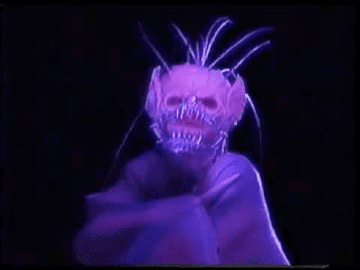 This supplement marked the end of the original game, but not the franchise itself: several years down the line, a much refined form of the game would be released entitled: Atmosfear: The Harbingers: much more coherent and fast paced game, this one involved a revised playing board, which could be assembled randomly to represent the various “provinces” of the eponymous Harbingers (the creatures from the previous game and its various supplements), not to mention flipped to represent the sewers and catacombs beneath. In this form of the game, players have to become the Harbinger of their choice by landing on their headstone within the first ten minutes of play. If they fail, they are instead condemned to become “Soul Rangers,” depicted in the game's artwork as motor-cycle riding, skeletal figures in wide brimmed hats and leather jackets. This dynamic adds a fresh air of tension to the game, as Soul Rangers have a particular function; they do not play the game as other players do, but mist hunt down the Harbingers and waylay them throughout at the Gate Keeper's behest. Similarly, each of the Harbingers have particular powers and capacities that allow them to play the game in different ways. Whilst the game itself is far more tense, coherent and fast paced than the previous incarnation, the Gate Keeper, alas, is far from as threatening, played instead for laughs, not to mention the tasks he provides largely being fairly uninspired dice rolls or games of luck. An excellent version of the game, but which could have certainly used a video experience more akin to the previous incarnations to live up to its own name. 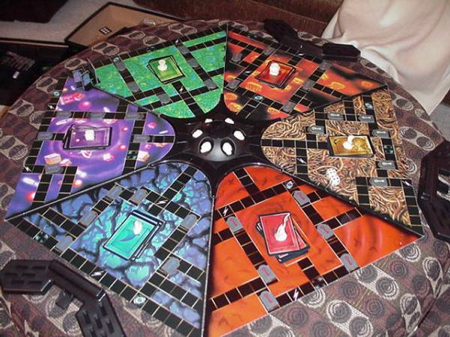 The latest version isn't even worth mentioning, not because it isn't fun (it's actually quite a well conceived piece of work), but because it lacks, well, atmosphere; all horror elements have been entirely abandoned in favour of yucks and ghost train giggles, the only element that maintains interest the fact the game is randomised thanks to its DVD format, meaning that no two games are ever entirely the same. Atmosfear/Nightmare maintains an especial place in many boardgamer's hearts, especially those of us that were children at the time of its original release and got to experience it at the right age for it to engage our imaginations. The game is recalled so fondly that many have attempted to make their own videos and instalments, which can be found on YouTube and various video sharing sites, and, in many instances, are as well produced and atmospheric as anything the original game and its supplements boasted. One franchise that is well overdue for a resurrection. 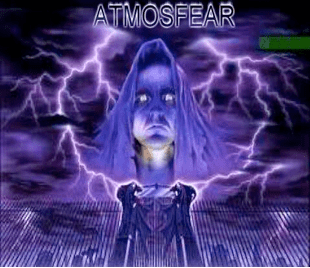  Comments are closed.
|


Archives
April 2023
|
 RSS Feed

|

|